
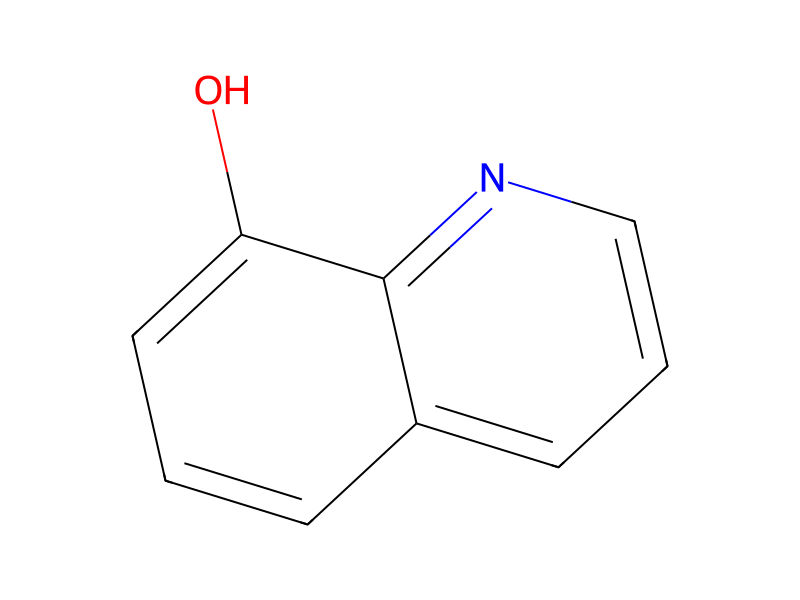
基本情報
- 標準SMILES
Oc1cccc2cccnc12- InChIKey
MCJGNVYPOGVAJF-UHFFFAOYSA-N- 分子式
- C9H7NO
- 平均分子量
- 145.16 g/mol
- 単同位体質量
- 145.05276384
概要
8-hydroxyquinoline appears as white to off-white or faintly yellow crystalline powder. Phenolic odor. (NTP, 1992)
名称と識別子
- 優先名称
- 8-Hydroxyquinoline
- IUPAC
- quinolin-8-ol
名称と別名
8-HYDROXYQUINOLINEquinolin-8-ol148-24-38-quinolinolOxyquinolineOxineQuinophenolOxychinolinPhenopyridine8-QuinolBioquinTumex
名称をさらに表示
OxinOxybenzopyridineHydroxybenzopyridine8-Oxyquinoline1-Azanaphthalene-8-ol8-Hydroxychinolin8-Chinolinol8-Hydroxy-chinolin
データベース識別子
- CAS
14495-13-7、148-24-3- PubChem CID
- 1923
- DTXSID
DTXSID5020730- ChEMBL
CHEMBL310555- ChEBI
CHEBI:48981- UNII
- 5UTX5635HP
- EC Number
- 205-711-1
- Nikkaji
- J2.960B
物性
構造計算による物性
- XLogP
- 2
- 極性表面積
- 33.1 Ų
- 水素結合供与体数
- 1
- 水素結合受容体数
- 2
- 回転可能結合数
- 0
- 重原子数
- 11
- 形式電荷
- 0
- 複雑度
- 138
実験および物理化学的性質
Chemical Classes
Nitrogen Compounds -> Quinolines
Industrial compound
Drugs
Pharmaceuticals
Pharmaceuticals -> Listed in ZINC15
Pharmaceuticals -> Antibiotics
Cosmetics
Cosmetic ingredients (Oxyquinoline) -> CIR (Cosmetic Ingredient Review)
Stabilizing
SpringerMaterials Properties15N nuclear magnetic resonance spectrum
PesticidesBactericides, Fungicides
LogPlog Kow = 2.02
OdorPhenolic odor
Density
1.034 at 408 °F (NTP, 1992) - Denser than water; will sink
1.034 @ 20 °C
Color/FormWhite crystals or white crystalline powder
Solubility
less than 1 mg/mL at 61 °F (NTP, 1992)
Insoluble
Soluble in alcohol, acetone, chloroform, benzene, and in formic, acetic, hydrochloric, and sulfuric acids and alkalies.
1 part in 1500 parts water
In water, 556 mg/l @ 20 °C
Boiling Point
513 °F at 760 mmHg (NTP, 1992)
Approx 267 °C
267 °C @760 [mm Hg]
DecompositionWHEN HEATED TO DECOMP EMITS HIGHLY TOXIC FUMES OF /NITROGEN OXIDES/.
安全と法規制
GHS分類
GHS Classification
Danger
H301: Toxic if swallowed [Danger Acute toxicity, oral]
P203, P261, P264, P264+P265, P270, P272, P273, P280, P301+P316, P302+P352, P305+P354+P338, P317, P318, P321, P330, P333+P317, P362+P364, P391, P405, and P501 (click each P-code to see the statement)
This chemical does not meet GHS hazard criteria for 0.6% (2 of 343) of reports.
Danger
H301 (49.3%): Toxic if swallowed [Danger Acute toxicity, oral]
危険有害性情報
Regulatory Information
Chemical: 8-Quinolinol
Hazard Traits - Reproductive Toxicity
Regulation (EC) No 396/2005 (amended)
Status: Active Update: 13-03-2019 https://echa.europa.eu/registration-dossier/-/registered-dossier/19356
8-Hydroquinoline: Does not have an individual approval but may be used under an appropriate group standard
Other Safety InformationIMAP assessments - Quinolinols: Human health tier II assessment
DOT LabelPoison
Fire HazardsFlash point data for this chemical are not available; however, it is probably combustible. (NTP, 1992)
Fire PotentialCombustible when exposed to heat or flame.
Health HazardsSYMPTOMS: Symptoms of exposure to this compound may include irritation of the skin, eyes, mucous membranes and respiratory tract. It also causes irritation of the gastrointestinal tract.
Hazards Summary
Oral LD50 (rat) = 1.2 g/kg; Causes convulsions when given intraperitoneally(ip) with an LD50 (rat) = 50 mg/kg; [HSDB] An irritant; Harmful if swallowed; Causes mutagenic effects and tumors in animals after high-dose feeding studies; [MSDSonline]
Reactive GroupAmines, Phosphines, and Pyridines
Special Reports
Toxicology Review; Internist 15 (1): 7 (1974)
Toxicology Review; Archives of Environmental Health 23: 6 (1971)
DHHS/NTP; Toxicology & Carcinogenesis Studies of 8-Hydroxyquinoline in F344/N Rats and B6C3F1 Mice (Feed Studies) Technical Report Series No. 276 (1985) NIH Publication No. 85-2532
FIFRA Requirements
As the federal pesticide law FIFRA directs, EPA is conducting a comprehensive review of older pesticides to consider their health and environmental effects and make decisions about their future use. Under this pesticide reregistration program, EPA examines health and safety data for pesticide active ingredients initially registered before November 1, 1984, and determines whether they are eligible for reregistration. In addition, all pesticides must meet the new safety standard of the Food Quality Protection Act of 1996. Pesticides for which EPA had not issued Registration Standards prior to the effective date of FIFRA '88 were divided into three lists based upon their potential for human exposure and other factors, with List B containing pesticides of greater concern and List D pesticides of less concern. Quinolinol is found on List D. Case No: 4047; Case Status: No products containing the pesticide are actively registered. Therefore, we are characterizing the case as "cancelled." Under FIFRA, pesticide producers may voluntarily cancel their registered products. EPA also may cancel pesticide registrations if registrants fail to pay required fees or make/meet certain reregistration commitments, or if EPA reaches findings of unreasonable adverse effects.; Active ingredient (AI): quinolinol; AI Status: The active ingredient is no longer contained in any registered products. Thus, we characterize it as "cancelled."
Reactivity Profile8-HYDROXYQUINOLINE darkens on exposure to light. This chemical readily forms stable metal chelates. It is incompatible with strong oxidizers. It is also incompatible with many metal ions. (NTP, 1992)
Air and Water ReactionsInsoluble in water.
安全と保護具
Fire FightingFires involving this material can be controlled with a dry chemical, carbon dioxide or Halon extinguisher. (NTP, 1992)
First Aid
EYES: First check the victim for contact lenses and remove if present. Flush victim's eyes with water or normal saline solution for 20 to 30 minutes while simultaneously calling a hospital or poison control center. Do not put any ointments, oils, or medication in the victim's eyes without specific instructions from a physician. IMMEDIATELY transport the victim after flushing eyes to a hospital even if no symptoms (such as redness or irritation) develop.
Nonfire Spill Response
SMALL SPILLS AND LEAKAGE: Should a spill occur while you are handling this chemical, FIRST REMOVE ALL SOURCES OF IGNITION, then you should dampen the solid spill material with 60-70% ethanol and transfer the dampened material to a suitable container. Use absorbent paper dampened with 60-70% ethanol to pick up any remaining material. Seal the absorbent paper, and any of your clothes, which may be contaminated, in a vapor-tight plastic bag for eventual disposal. Solvent wash all contaminated surfaces with 60-70% ethanol followed by washing with a soap and water solution. Do not reenter the contaminated area until the Safety Officer (or other responsible person) has verified that the area has been properly cleaned.
Disposal Methods
SRP: At the time of review, criteria for land treatment or burial (sanitary landfill) disposal practices are subject to significant revision. Prior to implementing land disposal of waste residue (including waste sludge), consult with environmental regulatory agencies for guidance on acceptable disposal practices.
Isolation and EvacuationExcerpt from ERG Guide 154 [Substances - Toxic and/or Corrosive (Non-Combustible)]:
Protective Action Criteria (PAC)
0.93 [mg/m3]
10 [mg/m3]
61 [mg/m3]
Personal Protective Equipment (PPE)
RECOMMENDED RESPIRATOR: Where the neat test chemical is weighed and diluted, wear a NIOSH-approved half face respirator equipped with an organic vapor/acid gas cartridge (specific for organic vapors, HCl, acid gas and SO2) with a dust/mist filter. (NTP, 1992)
毒性情報
Interactions
AFTER LETHAL IM DOSES IN MICE (30 MG/KG) INJECTED D-PENICILLAMINE (1 G/KG) PREVENTED /TOXIC/ SYMPTOMS & DEATH BUT NOT TRANSIENT HYPERGLYCEMIA.
THE INFLUENCE OF RADIOPROTECTORS, CYSTEAMINE & AMINOETHYLISOTHIOURONIUM AS WELL AS OF THE AMINO ACIDS L-ALANINE, L-CYSTEINE, L-ARGININE, L-ASPARAGINE, L-GLUTAMIC ACID, L-HISTIDINE, & L-METHIONINE, ON THE CYTOGENETIC ACTION OF 8-HYDROXYQUINOLINE SULFATE WAS TESTED IN HUMAN LYMPHOCYTE CULTURES IN VITRO. EXCESS L-CYSTEINE, CYSTEAMINE, & L-ASPARAGINE ADDED SIMULTANEOUSLY WITH 8-HYDROXYQUINOLINE SULFATE DISTINCTLY REDUCED THE CHROMOSOME. DAMAGING EFFECT OF 8-HYDROXYQUINOLINE. L-GLUTAMIC ACID & AMINOETHYLISOTHIOURONIUM EXERTED LESSER PROTECTIVE ACTIVITY. L-METHIONINE DISPLAYED SOME EFFECT ONLY IN REDUCING THE RELATIVELY RARE ISOCHROMATID ABERRATIONS INDUCED BY 8-HYDROXYQUINOLINE SULFATE. THE OTHER AMINO ACIDS HAD NO EFFECT.
The formation of DNA-strand breaks was studied in cultured human lung cells (A 549) subjected to iron, either in the form of iron(III) citrate or in combination with the metal chelators ethylene diamine tetra-acetic acid (EDTA), nitrilo triacetic acid (NTA), or 8-hydroxyquinoline (8HQ). After 15 min exposure to 5 uM iron(III) citrate or iron chelate, the cellular levels of iron were found to be three times higher in cells subjected to iron-8HQ than in cells subjected to iron(III) citrate, iron-EDTA or iron-NTA. Exposure to iron-8HQ caused extensive DNA-strand breakage, whereas no such breakage was found in cells exposed to iron-EDTA or iron-NTA. The DNA damage caused by iron-8HQ increased with time and dose, and DNA-strand breakage was clearly demonstrable in cells after 15 min exposure to as little as 0.1 uM iron-8HQ. Moreover, iron-8HQ was strongly toxic to the cells and inhibited their growth after exposure. Along with the formation of DNA-strand breaks, the concentration of cellular malondialdehyde increased four-fold after exposure to iron-8HQ and two-fold after exposure to iron-EDTA or iron-NTA, suggesting that reactive oxygen metabolites might be involved in the toxic action. Moreover, both iron-EDTA and iron-NTA caused a considerable hydroxylation of deoxyguanosine (dG) residues in DNA in vitro, whereas iron(III) citrate and iron-8HQ only caused a minor hydroxylation of dG. This points to the possibility that iron-8HQ-mediated DNA-strand breakage in cells might be due to the action of a metal-bound oxyl radical formed from the iron-8HQ complex rather than to the formation of hydroxyl radicals. Altogether, these findings indicate that iron bound to the lipophilic chelator, 8HQ, has strong toxic properties and that it may cause substantial DNA-strand breakage and lipid peroxidation in living cells.
Environmental Fate
TERRESTRIAL FATE: Based on a classification scheme(1), an estimated Koc value of 3,000(SRC), determined from a structure estimation method(2), indicates that 8-hydroxyquinoline is expected to have slight mobility in soil(SRC). Volatilization of 8-hydroxyquinoline from moist soil surfaces is not expected to be an important fate process(SRC) given an estimated Henry's Law constant of 5.7X10⁻⁷ atm-cu m/mole(SRC), based upon its vapor pressure, 1.66X10⁻³ mm Hg(3), and water solubility, 556 mg/l(4). 8-Hydroxyquinoline is not expected to volatilize from dry soil surfaces(SRC) based upon its vapor pressure(3). Biodegradation in soil is not an important environmental fate process based on a 0% theoretical BOD using sewage sludge(5).
AQUATIC FATE: Based on a classification scheme(1), an estimated Koc value of 3,000(SRC), determined from a structure estimation method(2), indicates that 8-hydroxyquinoline is expected to adsorb to suspended solids and sediment(SRC). Volatilization from water surfaces is not expected(3) based upon an estimated Henry's Law constant of 5.7X10⁻⁷ atm-cu m/mole(SRC) derived from its vapor pressure, 1.66X10⁻³ mm Hg(4) and water solubility, 556 mg/l(5). According to a classification scheme(6), an estimated BCF of 7(SRC), from its log Kow of 2.02(7) and a regression-derived equation(8), suggests the potential for bioconcentration in aquatic organisms is low(SRC). To test for photolytic degradation in aqueous solution, 8-hydroxyquinoline was illuminated with filtered light, simulating daylight(9). The half-life for the photolytic degradation of 8-hydroxyquinoline ranged from 40-64 hours. Biodegradation in water is not an important environmental fate process based on a 0% theoretical BOD using sewage sledge(10).
ATMOSPHERIC FATE: According to a model of gas/particle partitioning of semivolatile organic compounds in the atmosphere(1), 8-hydroxyquinoline, which has a vapor pressure of 1.66X10⁻³ mm Hg at 25 °C(2), is expected to exist solely as a vapor in the ambient atmosphere. Vapor-phase 8-hydroxyquinoline is degraded in the atmosphere by reaction with photochemically-produced hydroxyl radicals(SRC); the half-life for this reaction in air is estimated to be 2.0 hrs(SRC), calculated from its rate constant of 2.0X10⁻¹⁰ cu cm/molecule-sec at 25 °C(SRC) determined using a structure estimation method(3). 8-Hydroxyquinoline is expected to undergo photolysis in the atmosphere based upon aquatic photolytic experiments. The half-life for the photolytic degradation of 8-hydroxyquinoline in aqueous solution illuminated with filtered light, simulating daylight, ranged from 40-64 hours(4).
Adverse EffectsNeurotoxin - Other CNS neurotoxin
Toxicity Summary
Based on the available information, the CIR Expert Panel concludes that Oxyquinoline and Oxyquinoline Sulfate are safe as used as stabilizers for hydrogen peroxide in leave-on hair care cosmetic products. There are insufficient data to support the safety of Oxyquinoline and Oxyquinoline Sulfate in leave-on cosmetic products.
Safe for use in cosmetics, with qualifications
Ongoing Test Status
The following link will take the user to the National Toxicology Program (NTP) Test Agent Search Results page, which tabulates all of the "Standard Toxicology & Carcinogenesis Studies", "Developmental Studies", and "Genetic Toxicity Studies" performed with this chemical. Clicking on the "Testing Status" link will take the user to the status (i.e., in review, in progress, in preparation, on test, completed, etc.) and results of all the studies that the NTP has done on this chemical. [http://ntp-apps.niehs.nih.gov/ntp_tox/index.cfm?fuseaction=ntpsearch.searchresults&searchterm=148-24-3]
Soil Adsorption/Mobility
Using a structure estimation method based on molecular connectivity indices(1), the Koc for 8-hydroxyquinoline can be estimated to be 3,000(SRC). According to a classification scheme(2), this estimated Koc value suggests that 8-hydroxyquinoline is expected to have slight mobility in soil.
TSCA Test Submissions
The mutagenicity of 8-hydroxyquinoline was evaluated in Salmonella tester strains TA1535, TA1537, TA92, TA98 and TA100 (Ames Test), both in the presence and absence of added metabolic activation by either Aroclor or phenobarbital-induced rat liver S9 fraction. 8-Hydroxyquinoline, diluted in DMSO, was tested at concentrations up to 60ug/plate. 8-Hydroxyquinoline produced a positive response in Salmonella tester strain TA100 in the presence of added metabolic activation. The treatments failed to produce a positive response in any of the remaining tester strains with or without metabolic activation.
The mutagenicity of 8-hydroxyquinoline was evaluated in Salmonella tester strains TA1537, TA92, TA98 and TA100 (Ames Test), both in the presence and absence of metabolic activation by Aroclor or phenobarbital-induced rat liver preparation. 8-Hydroxyquinoline, diluted in DMSO, was tested at concentrations up to 100mcg/plate. 8-Hydroxyquinoline produced a positive response only in Salmonella tester strains TA92 with metabolic activation and TA100 with and without metabolic activation.
Natural Pollution Sources... IS NOT KNOWN TO OCCUR IN NATURE.
Human Toxicity ExcerptsVARIOUS HALOGENATED DERIVATIVES USED IN TREATING AMEBIASIS IN MAN ARE ... COMPARATIVELY BENIGN EXCEPT FOR FREQUENT ALLERGIC REACTIONS ... /8-HYDROXYQUINOLINE SULFATE/
Artificial Pollution Sources
8-Hydroxyquinoline's production and use as a chemical intermediate(1-3) and in steel electroplating(4) may result in its release to the environment through various waste streams(SRC). It's former use as a fungicide(5) may have resulted in its direct release to the environment(SRC).
Environmental BiodegradationAEROBIC: 8-Hydroxyquinoline, concentration not specified, reached 0% of its theoretical BOD in 5 days using a sewage sludge inoculum and standard dilution method(1).
Carcinogen Classification
8-Hydroxyquinoline
Group 3: Not classifiable as to its carcinogenicity to humans
Volume 13: (1977) Some Miscellaneous Pharmaceutical Substances
1987
1987
8-Hydroxyquinoline
法規制情報
FIFRA Requirements
As the federal pesticide law FIFRA directs, EPA is conducting a comprehensive review of older pesticides to consider their health and environmental effects and make decisions about their future use. Under this pesticide reregistration program, EPA examines health and safety data for pesticide active ingredients initially registered before November 1, 1984, and determines whether they are eligible for reregistration. In addition, all pesticides must meet the new safety standard of the Food Quality Protection Act of 1996. Pesticides for which EPA had not issued Registration Standards prior to the effective date of FIFRA '88 were divided into three lists based upon their potential for human exposure and other factors, with List B containing pesticides of greater concern and List D pesticides of less concern. Quinolinol is found on List D. Case No: 4047; Case Status: No products containing the pesticide are actively registered. Therefore, we are characterizing the case as "cancelled." Under FIFRA, pesticide producers may voluntarily cancel their registered products. EPA also may cancel pesticide registrations if registrants fail to pay required fees or make/meet certain reregistration commitments, or if EPA reaches findings of unreasonable adverse effects.; Active ingredient (AI): quinolinol; AI Status: The active ingredient is no longer contained in any registered products. Thus, we characterize it as "cancelled."
化学と産業
薬理情報
ATC Code
G - Genito urinary system and sex hormones
A - Alimentary tract and metabolism
D - Dermatologicals
R - Respiratory system
QA - Alimentary tract and metabolism
QR - Respiratory system
PharmacodynamicsOxyquinoline acts as a biocide to eliminate bacteria and fungi.
Mechanism of ActionThe mechanism by which oxyquinoline exerts its biocidal effect is unknown.
Metabolism/Metabolites
In the urine, 60% of the dose is excreted as glucuronide conjugates and 23% of the dose as sulfate conjugates. In the bile, 9% of the total dose is found as glucuronide conjugates.
IN RATS /MALE, DONRYU STRAIN, IV INJECTION/ 8-HYDROXYQUINOLINE WAS METABOLIZED TO GLUCURONIDE & SULFATE CONJUGATES.
8-HYDROXYQUINOLINE WAS METABOLIZED TO GLUCURONIDE & SULFATE CONJUGATES AFTER IV ADMIN IN RATS /MALE, DONRYU STRAIN/. UNMETABOLIZED FORMS WERE ONLY SLIGHTLY EXCRETED.
Absorption, Distribution and Excretion
Oxyquinoline is excreted in both the primarily in the urine with some in the bile.
IN RATS /MALE, DONRYU STRAIN, IV INJECTION/ 8-HYDROXYQUINOLINE WAS METABOLIZED TO GLUCURONIDE & SULFATE CONJUGATES. MORE 8-HYDROXYQUINOLINE GLUCURONIDE WAS EXCRETED IN URINE THAN 8-HYDROXYQUINOLINE SULFATE CONJUGATE. ONLY THE GLUCURONIDE CONJUGATE WAS EXCRETED IN BILE.
8-HYDROXYQUINOLINE WAS METABOLIZED TO GLUCURONIDE & SULFATE CONJUGATES AFTER IV ADMIN IN RATS /MALE, DONRYU STRAIN/. THE GLUCURONIDES WERE EXCRETED IN BILE & URINE, BUT THE SULFATES WERE EXCRETED EXCLUSIVELY IN THE URINE. UNMETABOLIZED FORMS WERE ONLY SLIGHTLY EXCRETED.
用途と製造
Uses
CIR ingredient: Oxyquinoline
Used as an antiseptic, hydrogen peroxide stabilizer, chemical reagent, corrosion inhibitor, stabilizer in nylon, chelating agent, fungicide, and brightener of steel sheets in electroplating baths; Also used to make dyes; [HSDB]
Steel Producing [Category: Industry]
For 8-Hydroxyquinoline (USEPA/OPP Pesticide Code: 059803) there are 0 labels match. /SRP: Not registered for current use in the U.S., but approved pesticide uses may change periodically and so federal, state and local authorities must be consulted for currently approved uses./
CHEMICAL INTERMEDIATE FOR THE ANTI-INFECTIVE AGENT, OXYQUINOLINE BENZOATE; FOR THE FUNGICIDE, COPPER 8-QUINOLINATE; FOR DIIODOHYDROXYQUIN; FOR FUNGICIDAL SALTS IN TEXTILE PRODUCTS; ANTISEPTIC IN NUMEROUS APPLICATIONS; STABILIZER FOR HYDROGEN PEROXIDE.
ANALYTICAL COLORIMETRIC REAGENT & FOR PRECIPITATION & SEPARATION OF METALS; PREPN OF NUMBER OF DERIVATIVES USED IN MEDICINE & INDUSTRIAL APPLICATIONS; USED TO MAKE ITS COPPER CHELATE, COPPER 8-HYDROXYQUINOLATE FOR FUNGICIDE IN AGRICULTURAL & INDUST APPLICATIONS; USED IN MFR OF DYES.
U.S. Imports
(1972) 2.51X10+7 G (PRINCPL CUSTMS DISTS)
(1975) 2.98X10+7 G (PRINCPL CUSTMS DISTS)
Methods of Manufacturing
REACTION OF O-AMINOPHENOL WITH O-NITROPHENOL, GLYCEROL & SULFURIC ACID; OR BY HYDROLYSIS OF QUINOLINE-8-SULFONIC ACID
By sulfonation fusion of quinoline, by hydrolysis of 8-chloroquinoline (93% (yield) or by a modified Skraup method with o-aminophenol (80% yield).
Acid hydrolysis of the appropriate aminoquinoline at temps 180-235 °C.
Formulations/Preparations
USEPA/OPP Pesticide Code 059803; Trade Names: Fennosan H 30, NCI-C55298, Tumex, USAF EK-794, Quinophenol.
... AVAILABLE IN USA IN TECHNICAL & REAGENT GRADES. IT IS ALSO AVAILABLE AS 0.5% SOLN (OR AEROSOL) SUITABLE FOR TOPICAL USE.
Household ProductsCosmetics product ingredient: quinolin-8-ol (8-hydroxyquinoline; Oxyquinoline)
Use Classification
Cosmetics -> Stabilizing
Bactericides, Fungicides
General Manufacturing Information
8-Quinolinol: ACTIVE
... /Has been/ discontinued by Ashland Chemical Co.
BACTERIOSTATIC & ANTIMYCOTIC ACTIVITY OF 8-HYDROXYQUINOLINE SULFATE IN DERMATOSES IS BLOCKED BY INCORPORATION OF 8-HYDROXYQUINOLINE SULFATE IN EXSICCANT PASTE SR71, ZINC OXIDE-OIL, & ZINC OXIDE LOTION. IT IS NOT RELEASED OR IS RELEASED IN ONLY SMALL AMOUNTS FROM LIPOPHILIC BASES (EXCEPT OLEOGELS), PREPARATIONS WITH EXTERNAL LIPID PHASE & ZINC OXIDE-CONTAINING VEHICLES. /8-HYDROXYQUINOLINE SULFATE/
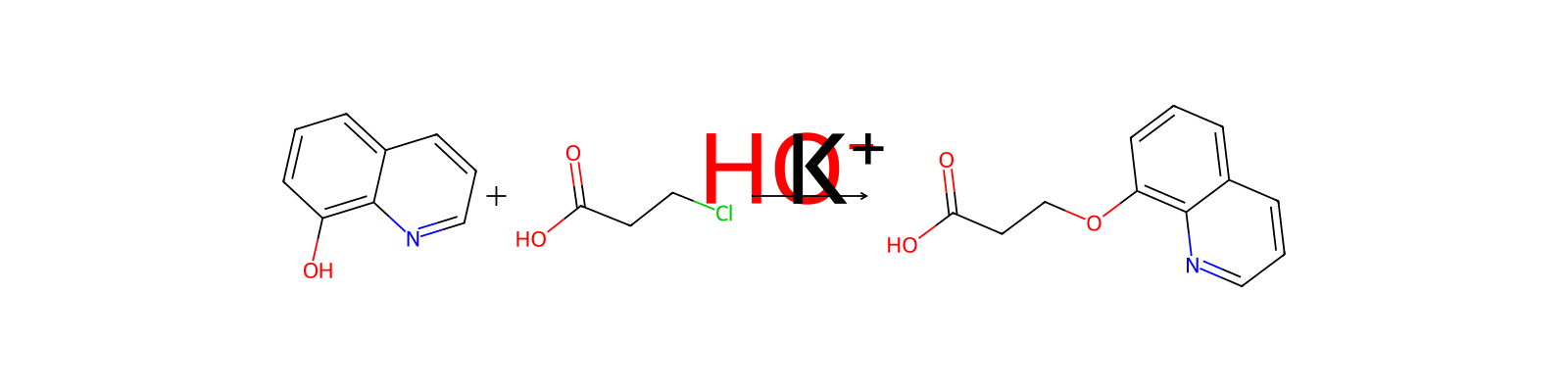
関連反応
635 件






関連ノート
読み込み中…