
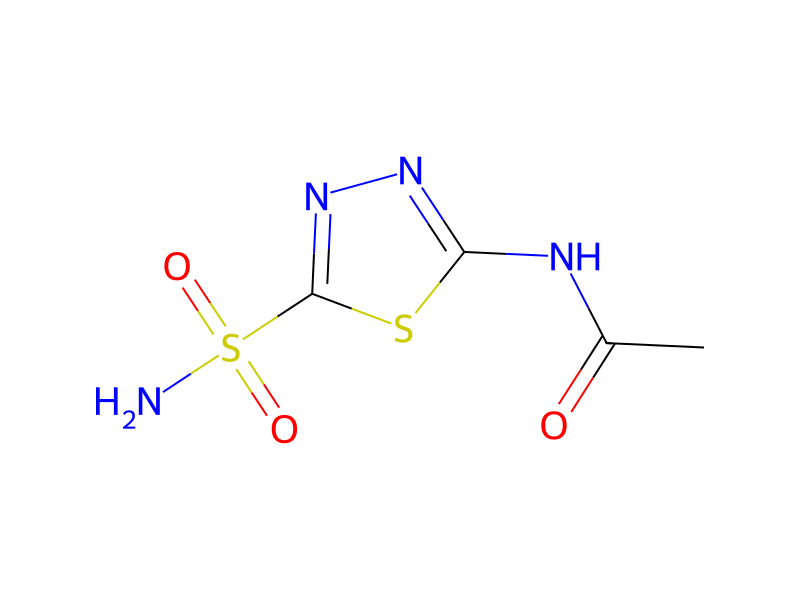
基本情報
- 標準SMILES
CC(=O)Nc1nnc(S(N)(=O)=O)s1- InChIKey
BZKPWHYZMXOIDC-UHFFFAOYSA-N- 分子式
- C4H6N4O3S2
- 平均分子量
- 222.3 g/mol
- 単同位体質量
- 221.98813205
概要
Acetazolamide can cause developmental toxicity according to state or federal government labeling requirements.
名称と識別子
- 優先名称
- Acetazolamide
- IUPAC
- N-(5-sulfamoyl-1,3,4-thiadiazol-2-yl)acetamide
- 現地名
- アセタゾラミド
- 英語名
- Acetazolamide
- 分子式
- C4H6N4O3S2
- 分子量
- 222.25
名称と別名
acetazolamide59-66-5AcetamoxGlaupaxN-(5-Sulfamoyl-1,3,4-thiadiazol-2-yl)acetamideEdemoxAcetazolamidDefiltranNephramideDiacarbDonmoxCidamex
名称をさらに表示
アセタゾラミドジアモックスアセトアゾールアミドグラウパックスジアカルブドンモックスアセタゾールアミドダイアモックスベタモックスアセタゾーラミドジウラミドジルランN-(2-スルファモイル-1,3,4-チアジアゾール-5-イル)アセトアミドジウタゾール2-(アセチルアミノ)-1,3,4-チアジアゾール-5-スルホンアミドN-(5-スルファモイル-1,3,4-チアジアゾール-2-イル)アセトアミドアセタモックス5-(アセチルアミノ)-1,3,4-チアジアゾール-2-スルホンアミドシダメックスネフラミド6063DiamoxAcetazolamide for system suitability CRSN-(5-[AMINOSULFONYL]-1,3,4-THIADIAZOL-2-YL)ACETAMIDEGlupax
DiluranPhonuritDidocDehydratinDiuramidDiuriwasDiutazolDiakarb
データベース識別子
- CAS
59-66-5- PubChem CID
- 1986
- DTXSID
DTXSID7022544- ChEMBL
CHEMBL20- ChEBI
CHEBI:27690- UNII
- O3FX965V0I
- EC Number
- 200-440-5
- Nikkaji
- J1.395A
物性
構造計算による物性
- XLogP
- -0.3
- 極性表面積
- 152 Ų
- 水素結合供与体数
- 2
- 水素結合受容体数
- 7
- 回転可能結合数
- 2
- 重原子数
- 13
- 形式電荷
- 0
- 複雑度
- 297
実験および物理化学的性質
Drugs
Pharmaceuticals -> Listed in ZINC15
Pharmaceuticals -> Antiepileptics
Pharmaceuticals -> Used in Switzerland
Pharmaceuticals
LogP
Log P= -0.45
-0.26
-0.25
OdorODORLESS
Color/Form
CRYSTALS FROM WATER
WHITE TO FAINTLY YELLOWISH WHITE, CRYSTALLINE, POWDER
Solubility
less than 1 mg/mL at 72 °F (NTP, 1992)
SPARINGLY SOL IN COLD WATER
SLIGHTLY SOL IN ALCOHOL
INSOL IN CHLOROFORM, DIETHYL ETHER, CARBON TETRACHLORIDE; SLIGHTLY SOL IN ACETONE
Readily soluble in 1 N sodium carbonate solution.
Human Drugs
Breast Feeding; Lactation; Milk, Human; Anticonvulsants; Antiglaucoma Agents; Carbonic Anhydrase Inhibitors; Diuretics
FDA approved drugs -> Active ingredient
FDA approved drugs -> Active ingredient
Pharmaceuticals
Ophthalmological preparations > Miotics and antiglaucoma medicines
Melting Point
496 to 498 °F (effervescence) (NTP, 1992)
258-259 °C (EFFERVESCENCE)
260.5 °C
Physical Description
Acetazolamide appears as white to yellowish-white fine crystalline powder. No odor or taste. (NTP, 1992)
Solid
Stability/Shelf LifeSENSITIVE TO LIGHT
Dissociation Constants
7.2
PKA: 7.2
Collision Cross Section
137.8 Ų [M-H]- [CCS Type: DT; Buffer gas: N2; Ionization: ESI-; Dataset: TOXCAST; Source Identifier: DTXSID7022544]
151.05 Ų [M+Na]+ [CCS Type: TW; Method: calibrated with polyalanine and drug standards]
140.7 Ų [M+H]+ [CCS Type: TW; Method: calibrated with polyalanine and drug standards]
Other Experimental PropertiesWEAK ACID
物理化学的性質
- 融点
- 258 · 258-259 °C
- 比重(密度)
- 1.61 · 1.610 (estimate)
- 屈折率
- 1.627 · 1.6270 (estimate)
- 貯蔵温度
- 2 · 2-8°C
- 溶解性
- 4 OH · NH4OH (50mg/mL)、DMSO、メタノールに可溶、エタノールに微溶。
- 酸解離定数(Pka)
- 7.2 · 7.2(at 25℃)
- 外見
- 個体
- 色
- ホワイトからオフホワイト
- 由来生物
- synthetic
- 水溶解度
- 0.1 g/100 · <0.1 g/100 mL で 22 ºC
- Merck
- 14 · 14,53
- BRN
- 212994 · 212994
- BCS Class
- 4 · 4
- 安定性
- 吸湿性
- InChI
- 1S/C4H6N4O3S2/c1-2(9)6-3-7-8-4(12-3)13(5,10)11/h1H3,(H2,5,10,11)(H,6,7,9)
- InChIKey
- BZKPWHYZMXOIDC-UHFFFAOYSA-N
- SMILES
- CC(=O)Nc1nnc(s1)S(N)(=O)=O
- CAS データベース
- 59 · 59-66-5(CAS DataBase Reference)
- NISTの化学物質情報
- 2 · 2-Acetylamino-1,3,4-thiadiazole-5-sulfonamide(59-66-5)
- EPAの化学物質情報
- Acetazolamide (59-66-5)
化学的性質
化学的特性White Solid
安全と法規制
GHS分類
GHS Classification
This chemical does not meet GHS hazard criteria for 0.7% (1 of 153) of reports.
Warning
H315 (90.2%): Causes skin irritation [Warning Skin corrosion/irritation]
P203, P264, P264+P265, P280, P302+P352, P305+P351+P338, P318, P321, P332+P317, P337+P317, P362+P364, P405, and P501 (click each P-code to see the statement)
Aggregated GHS information provided per 153 reports by companies from 13 notifications to the ECHA C&L Inventory. Each notification may be associated with multiple companies.
Danger
危険有害性情報
Regulatory Information
Hazard Traits - Developmental Toxicity
Acetamide, N-5-(aminosulfonyl)-1,3,4-thiadiazol-2-yl-: Does not have an individual approval but may be used as a component in a product covered by a group standard. It is not approved for use as a chemical in its own right.
Other Safety InformationIMAP assessments - Acetamide, N-[5-(aminosulfonyl)-1,3,4-thiadiazol-2-yl]-: Human health tier I assessment
Fire HazardsFlash point data for this chemical are not available; however, it is probably combustible. (NTP, 1992)
Health Hazards
SYMPTOMS: Symptoms of exposure to this compound may include paresthesias, "tingling" feeling in the extremities, some loss of appetite, polyuria, occasional drowsiness, confusion and photosensitivity. Other symptoms may include papular or erythematous skin eruptions, nausea, acidosis and blood dyscrasias. In addition it can cause acute transient myopia, malaise syndrome, which includes fatigue, anorexia, loss of weight, depression and loss of libido; gastrointestinal distress, elevated blood urate, acute gouty arthritis skin rashes and hair loss or excess growth of hair.
FDA Requirements
Manufacturers, packers, and distributors of drug and drug products for human use are responsible for complying with the labeling, certification, and usage requirements as prescribed by the Federal Food, Drug, and Cosmetic Act, as amended (secs 201-902, 52 Stat. 1040 et seq., as amended; 21 U.S.C. 321-392).
Reactive GroupAmides and Imides
Reactivity Profile
A weak acid and a diazo derivative. Azo, diazo, azido compounds can detonate. This applies in particular to organic azides that have been sensitized by the addition of metal salts or strong acids. Toxic gases are formed by mixing materials of this class with acids, aldehydes, amides, carbamates, cyanides, inorganic fluorides, halogenated organics, isocyanates, ketones, metals, nitrides, peroxides, phenols, epoxides, acyl halides, and strong oxidizing or reducing agents. Flammable gases are formed by mixing materials in this group with alkali metals. Explosive combination can occur with strong oxidizing agents, metal salts, peroxides, and sulfides.
Air and Water ReactionsInsoluble in water.
Hazard Classes and Categories
Skin Irrit. 2 (90.2%)
Reproductive toxicity - Category 1B
安全と保護具
Fire FightingFires involving this chemical can be controlled with a dry chemical, carbon dioxide, or Halon extinguisher. (NTP, 1992)
First Aid
EYES: First check the victim for contact lenses and remove if present. Flush victim's eyes with water or normal saline solution for 20 to 30 minutes while simultaneously calling a hospital or poison control center. Do not put any ointments, oils, or medication in the victim's eyes without specific instructions from a physician. IMMEDIATELY transport the victim after flushing eyes to a hospital even if no symptoms (such as redness or irritation) develop.
Storage ConditionsStore between 15 and 30 °C (59 and 86 °F), in a well-closed container, unless otherwise specified by manufacturer.
Nonfire Spill Response
SMALL SPILLS AND LEAKAGE: If you spill this chemical, dampen the solid spill material with 5% ammonium hydroxide, then transfer the dampened material to a suitable container. Use absorbent paper dampened with 5% ammonium hydroxide to pick up any remaining material. Your contaminated clothing and the absorbent paper should be sealed in a vapor-tight plastic bag for eventual disposal. Wash all contaminated surfaces with 5% ammonium hydroxide followed by washing with a soap and water solution. Do not reenter the contaminated area until the Safety Officer (or other responsible person) has verified that the area has been properly cleaned.
Disposal Methods
SRP: At the time of review, criteria for land treatment or burial (sanitary landfill) disposal practices are subject to significant revision. Prior to implementing land disposal of waste residue (including waste sludge), consult with environmental regulatory agencies for guidance on acceptable disposal practices.
Personal Protective Equipment (PPE)
RECOMMENDED RESPIRATOR: Where the neat test chemical is weighed and diluted, wear a NIOSH-approved half face respirator equipped with an organic vapor/acid gas cartridge (specific for organic vapors, HCl, acid gas and SO2) with a dust/mist filter. (NTP, 1992)
毒性情報
Interactions
/ACETAZOLAMIDE/ POTENTIATES MERCURIAL DIURETICS /IN ANIMALS/.
Concurrent use /of glucocorticoid corticosteroids, especially with significant mineralocorticoid activity; mineralocorticoid corticosteroids; parenteral amphotericin; corticotropin, especially prolonged therapeutic use/ with carbonic anhydrase inhibitors may result in severe hypokalemia and should be undertaken with caution; serum potassium concentrations and cardiac function should be monitored during concurrent use. /Carbonic anhydrase inhibitors/
Concurrent use of corticosteroids or corticotropin with acetazolamide sodium may increase the risk of hypernatremia and/or edema because these medications cause sodium and fluid retention; the risk with corticosteroids or corticotropin may depend on the patients's sodium requirement as determined by the condition being treated. /Acetazolamide sodium/
The possibility should be considered that concurrent chronic use of corticosteroids or corticotropin with carbonic anhydrase inhibitors may increase the risk of hypocalcemia and osteoporosis because these medications increase calcium excretion. /Carbonic anhydrase inhibitors/
For more Interactions (Complete) data for ACETAZOLAMIDE (16 total), please visit the HSDB record page.
Adverse Effects
There is a broad range of general and specific adverse effects that acetazolamide use can induce. Fatigue, nausea, vomiting, abdominal pain, and diarrhea are common in patients. Other patients will experience paresthesia, black stools, decreased libido, tinnitus, and taste alteration. There are also reports of patients developing depression while using acetazolamide or developing a bitter or metallic taste. Less commonly, there is a risk of developing metabolic acidosis, hyponatremia, and hypokalemia. Kidney stones can also be seen but are uncommon. Occasionally, patients develop Stevens-Johnson syndrome, aplastic anemia, agranulocytosis, toxic epidermal necrolysis, or fulminant hepatic necrosis.
Toxicity Summary
IDENTIFICATION: Acetazolamide is of synthetic origin. Acetazolamide exists as a white to faintly yellowish-white, odorless crystalline powder. Acetazolamide is very slightly soluble in water and only slightly soluble in ethanol (approx 750 g/l); it is practically insoluble in ether and chloroform. Uses: Preoperative management of closed-angle glaucoma, or as an adjunct in the treatment of open-angle glaucoma. Abnormal retention of fluid: drug-induced edema, obesity, and congestive cardiac failure. Epilepsy Metabolic alkalemia. Periodic paralysis HUMAN EXPOSURE: Patients with either acute or chronic overdosage with acetazolamide may show signs of dehydration with thirst, lethargy, confusion, poor skin turgor, and prolonged capillary refill time, but may have a paradoxical continued diuresis. Electrolyte abnormalities include hyponatremia, hypokalemia, and a non-anion gap hyperchloremic metabolic acidosis in the more than mild ingestion which may lead to further deterioration in mental status, production of seizures, electrocardiographic abnormalities, and arrhythmias. Prior renal insufficiency will lead to increased toxicity at a given dose. There are idiosyncratic reactions producing bone marrow suppression with hepatic and renal insufficiency. Acetazolamide may also precipitate in the renal tubules producing calculi with renal colic. Hypokalemia may lead to muscular weakness, hyporeflexia, and hypochloremic metabolic alkalosis. In geriatric patients, a chronic metabolic acidosis may lead to a chronic compensatory hyperventilation which increases pulmonary vascular resistance and decreases left ventricular function. This can be especially significant in patients on concurrent beta-blocker or calcium channel blocker therapy. The ventricular fibrillation threshold may then be reduced. Cardiac arrhythmias may occur due to potassium deficiency. Abuse or overdose may result in pancreatitis. Hyperglycemia, hyperuricemia, and hyperlipidemia may occur with acute overdose or in chronic use or abuse. Hypersensitivity reactions such as rash, photosensitivity, thrombocytopenia, and pancreatitis are rare. Contraindications: Renal hyperchloremic acidosis. Addison's disease and all types of suprarenal gland failure. Conditions where there is known depletion of sodium and potassium (at least until this is treated). Long-term administration is contraindicated in patients with chronic closed angle-closure glaucoma. Known sensitivity to sulfonamides. Acetazolamide should not be used to alkalinize urine following salicylate overdose since it may worsen metabolic acidosis. Acetazolamide is well absorbed from the gastrointestinal tract. Acetazolamide is distributed throughout body tissues; it concentrates principally in erythrocytes, plasma and kidneys and to a lesser extent in liver, muscles, eyes and the central nervous system. Acetazolamide does not accumulate in tissues. The drug crosses the placenta in unknown quantities. Acetazolamide is tightly bound to carbonic anhydrase and high concentrations are present in tissues containing this enzyme such as erythrocytes and the renal cortex. There is a small amount of irreversible binding to red cells. It is 70 to 90% bound to plasma protein. Acetazolamide is not metabolized. Acetazolamide is excreted unchanged by the kidneys via tubular secretion and passive reabsorption. There is no evidence of enterohepatic circulation although small amounts of unchanged drug are eliminated in the bile. Acetazolamide is a carbonic anhydrase inhibitor. Acetazolamide reduces the formation of hydrogen and bicarbonate ions from carbon dioxide and water by noncompetitive, reversible inhibition of the enzyme carbonic anhydrase, thereby reducing the availability of these ions for active transport into secretions. One patient died of cholestatic jaundice after taking 13 g of acetazolamide in 26 days. In one patient, fatal bone marrow depression with leukopenia, thrombocytopenia, and anemia occurred after therapy with 500 mg of acetazolamide twice daily for 14 weeks. One case of renal failure (anuria) occurred in a patient after taking 500 mg of acetazolamide twice daily for 2 weeks. There have been no reports of congenital defects despite past widespread use though one women on 750 mg per day for glaucoma during the 1st and 2nd trimester had a baby with a sacrococcygeal teratoma but no causal link could be made. Teratogenicity tests in rats and mice showed the absence of fourth and fifth digits from the right forelimb in the offspring of rats and mice. There were no apparent lessions in the newborn of rabbits and monkeys. The drug crosses the placenta in unknown quantities. Potentially hazardous interactions: The effects of folic acid antagonists, oral hypoglycaemic agents and oral anticoagulants may be increased by acetazolamide. The urinary antiseptic effect of methenamine may be prevented by acetazolamide by keeping the urine alkaline. The alkalinization of the urine by acetazolamide can reduce the urinary excretion of many weak bases (including amphetamine, quinine, quinidine, and diethylcarbamazine) and thus enhance their pharmacological effects. In one patient taking phenytoin and acetazolamide drug-induced osteomalacia was reported. The more serious effects include blood disorders, skin toxicity and renal stone formation. Stevens-Johnson syndrome has not been reported. Symptomatic adverse effects: Flushing, thirst, headache, drowsiness, dizziness, fatigue, irritability, excitement, paresthesias, ataxia, hyperpnoa and gastrointestinal disturbances have all been reported (Dollery). Oral ingestion is the usual means of exposure. There is no appreciable dermal absorption. There is no significant absorption or local irritation. ANIMAL/PLANT STUDIES: Numerous animal studies have demonstrated that the toxicity of acetazolamide was very low in the species studied (mouse, dog, rat, monkey).
There have been reports of central nervous system (CNS) toxicity with coma. In addition, hyperchloremic metabolic acidosis and electrolyte disturbances are usually seen in acetazolamide overdose. Therefore, clinicians should rapidly obtain serum electrolyte levels (especially serum potassium) and arterial blood gas analysis. According to product labeling, there is no specific antidote to acetazolamide; hence treatment is usually supportive. Bicarbonate administration can usually correct metabolic acidosis. Despite its plasma protein binding and high RBC distribution, acetazolamide may be dialyzable. Dialysis may be especially valuable in managing acetazolamide overdosage complicated with acute kidney injury.
Human Toxicity Excerpts
Serious toxic reactions to carbonic anhydrase inhibitors are infrequent; however, these drugs are sulfonamide derivatives and, like other sulfonamides, may cause bone marrow depression, skin toxicity, and sulfonamide-like renal lesions and may cause allergic reactions in patients hypersensitive to sulfonamides. /Carbonic Anhydrase Inhibitors/
Bone marrow depression manifested by aplastic anemia, thrombocytopenia or thrombocytopenic purpura, leukopenia, agranulocytosis, and hemolytic anemia has been reported with carbonic anhydrase inhibitors. Fatalities resulting from aplastic anemia have been reported following therapy with acetazolamide or methazolamide. In one patient, fatal bone marrow depression with leukopenia, thrombocytopenia, and anemia occurred after therapy with 500 mg of acetazolamide twice daily for 14 weeks.
Hypersensitivity reactions common to all sulfonamide derivatives occur rarely in patients receiving carbonic anhydrase inhibitors. One patient died of cholestatic jaundice after taking 13 g of acetazolamide in 26 days. The jaundice was attributed to drug-induced hypersensitivity and hepatitis. Other hypersensitivity reactions which may occur include fever, rash and skin eruptions including exfoliative dermatitis and urticaria, and pruritus.
One case of renal failure (anuria) occurred in a patient after taking 500 mg of acetazolamide twice daily for 2 weeks. The patient recovered after treatment of sodium bicarbonate (4 g orally initially, followed by 2 g every 6 hours) and forced fluids.
For more Human Toxicity Excerpts (Complete) data for ACETAZOLAMIDE (7 total), please visit the HSDB record page.
Drug Induced Liver Injury
Drug Induced Liver Injury Rank (DILIrank 2.0)
Acetazolamide
vMost-DILI-concern
8
Warnings & precautions
DOI:10.1016/j.drudis.2016.02.015
Non-Human Toxicity Excerpts
IV INFUSION OF ACETAZOLAMIDE INTO DOGS DECR GLOMERULAR FILTRATION RATE @ ALL DOSE LEVELS.
IV ADMIN OF ACETAZOLAMIDE 25 MG/KG INDUCED INCR OF CORTICAL OXYGEN TENSION IN RABBITS, ALSO ELEVATION OF LOCAL BLOOD FLOW IN CEREBRAL CORTEX. LENGTHENED SURVIVAL TIME OF MICE SUBMITTED TO ATMOSPHERIC DECOMPRESSION. NOT PROTECTIVE IN RATS UNDER ASPHYXIA.
IN RHESUS MONKEYS, ACETAZOLAMIDE PRODUCED AN IMMEDIATE & SIGNIFICANT INCR IN CEREBRAL BLOOD FLOW, INCR IN ARTERIAL CO2 TENSION, & A DECR IN CEREBRAL OXYGEN CONSUMPTION.
... Post-axial forelimb defects in mice and rats by feeding a diet containing 0.6% acetazolamide. The defect was specifically localized to the forelimb and the light side more often involved. Symmetric forelimb defects have been produced in the hamster. In monkeys, administration of 600 mg/kg for 3 to 6 embryonic days gave negative results.
For more Non-Human Toxicity Excerpts (Complete) data for ACETAZOLAMIDE (6 total), please visit the HSDB record page.
Environmental Fate/Exposure SummaryNo Data
Effects During Pregnancy and Lactation◉ Summary of Use during Lactation
法規制情報
FDA Requirements
Manufacturers, packers, and distributors of drug and drug products for human use are responsible for complying with the labeling, certification, and usage requirements as prescribed by the Federal Food, Drug, and Cosmetic Act, as amended (secs 201-902, 52 Stat. 1040 et seq., as amended; 21 U.S.C. 321-392).
安全データ
- wgk
- 2
- tsca
- TSCA listed
- rtecs
- AC8225000
- ridadr
- 2811
- 毒性
- LD50 oral in mouse: 4300mg/kg
- hs_code
- 29350090
- risk_code
- 36/38-36/37/38
- hazard_code
- Xi
- safety_code
- 26-36
- hazard_class
- 6.1
- packing_group
- III
- Hazard Classifications
- Eye Irrit. 2Skin Irrit. 2
- ストレージクラス
- 11 - Combustible Solids
- 有毒物質データの
- 59-66-5(Hazardous Substances Data)
毒性と防護
毒性LD50 3~6 g/kg(マウス,静注).
化学と産業
薬理情報
ATC Code
S01EC01
S - Sensory organs
QS - Sensory organs
S01EC01
Protein Binding98%
Pharmacodynamics
Acetazolamide is a potent carbonic anhydrase inhibitor, effective in the control of fluid secretion, in the treatment of certain convulsive disorders and in the promotion of diuresis in instances of abnormal fluid retention. Acetazolamide is not a mercurial diuretic. Rather, it is a nonbacteriostatic sulfonamide possessing a chemical structure and pharmacological activity distinctly different from the bacteriostatic sulfonamides.
Mechanism of Action
The anticonvulsant activity of Acetazolamide may depend on a direct inhibition of carbonic anhydrase in the CNS, which decreases carbon dioxide tension in the pulmonary alveoli, thus increasing arterial oxygen tension. The diuretic effect depends on the inhibition of carbonic anhydrase, causing a reduction in the availability of hydrogen ions for active transport in the renal tubule lumen. This leads to alkaline urine and an increase in the excretion of bicarbonate, sodium, potassium, and water.
Carbonic anhydrase inhibitors potently inhibit (IC50 for acetazolamide is 10 nM) both the membrane bound and cytoplasmic forms of carbonic anhydrase, resulting in nearly complete abolition of NaHCO3 reabsorption in the proximal tubule. /Carbonic Anhydrase Inhibitors/
Although the proximal tubule is the major site of action of carbonic anhydrase inhibitors, carbonic anhydrase also is involved in secretion of titratable acid in the collecting duct system (a process which involves a proton pump), and therefore the collecting duct system is a secondary site of action for this class of drugs. /Carbonic Anhydrase Inhibitors/
Acetazolamide frequently causes paresthesias and somnolence, suggesting an action of carbonic anhydrase inhibitors in the CNS. The efficacy of acetazolamide in epilepsy is in part due to the production of metabolic acidosis; however, direct actions of acetazolamide in the CNS also contribute to its anticonvulsant action.
... Inhibition of carbonic anhydrase decreases the rate of formation of aqueous humor and consequently reduce intraocular pressure. /Carbonic Anhydrase Inhibitors/
For more Mechanism of Action (Complete) data for ACETAZOLAMIDE (6 total), please visit the HSDB record page.
Biological Half-Life
3 to 9 hours
Plasma half-life: 6-9 hours /From table/
Metabolism/MetabolitesACETAZOLAMIDE DOSE NOT UNDERGO METABOLIC ALTERATION.
FDA Pharmacological Classification
O3FX965V0I
ACETAZOLAMIDE
Established Pharmacologic Class [EPC] - Carbonic Anhydrase Inhibitor
Mechanisms of Action [MoA] - Carbonic Anhydrase Inhibitors
Chemical Structure [CS] - Sulfonamides
Acetazolamide is a Carbonic Anhydrase Inhibitor. The mechanism of action of acetazolamide is as a Carbonic Anhydrase Inhibitor.
MeSH Pharmacological Classification
Drugs used to prevent SEIZURES or reduce their severity.
A class of compounds that reduces the secretion of H+ ions by the proximal kidney tubule through inhibition of CARBONIC ANHYDRASES.
Agents that promote the excretion of urine through their effects on kidney function.
Absorption, Distribution and Excretion
Carbonic anhydrase inhibitors are avidly bound by carbonic anhydrase and, accordingly, tissues rich in this enzyme will have higher concentrations of carbonic anhydrase inhibitors following systemic administration. /Carbonic Anhydrase Inhibitors/
Inhibitors of Carbonic Anhydrase. Drug: acetazolamide; Oral Absorption: nearly complete; Plasma Half-Life: 6-9 hours; and Route of Elimination: renal excretion of intact drug. /From table/
ACETAZOLAMIDE RELATED TO RESPONSE IN RABBIT; KIDNEY RESPONSE, MEASURED BY MONITORING URINE FLOW & NA ELIMINATION, URINE FLOW & NA ELIMINATION OCCUR IMMEDIATELY AFTER INJECTION CORRELATED WITH LOG DOSE.
IV BOLUS INJECTIONS OF (14)C-LABELED, ACETAZOLAMIDE WERE MADE IN RABBITS. PLASMA, URINE, & WASHED RED BLOOD CELL CONCN WERE MEASURED, THE LATTER INDICATING BOUND DRUG.
For more Absorption, Distribution and Excretion (Complete) data for ACETAZOLAMIDE (6 total), please visit the HSDB record page.
Cellular LocationsCytoplasm
用途と製造
Uses
MEDICATION (VET)
MEDICATION
Use (kg) in Switzerland (2009): >250
U.S. Production
(1977) PROBABLY GREATER THAN 4.54X10+5 GRAMS
(1979) PROBABLY GREATER THAN 4.54X10+5 GRAMS
Consumption PatternsESSENTIALLY 100% AS A DIURETIC
Methods of Manufacturing
REACTION OF HYDRAZINE HYDRATE WITH AMMONIUM THIOCYANATE, TO PRODUCE 5-AMINO-2-MERCAPTO-1,3,4-THIADIAZOLE, WHICH IS ACETYLATED AND OXIDIZED, THEN AMIDATED WITH AMMONIA
Hydrazine + ammonium thiocyanate + acetic anhydride + ammonia (thiocyanate addition/cyclization/acetylation/oxidation/sulfonamide formation)
Oxidative chlorination of 2-acetyl-amino-5-mercapto-1,3,4-thiadiazole or its S-benzyl or S-acyl derivatives to the corresponding sulfonyl chlorides followed by reaction with ammonia has proved to be an optimal method for the synthesis of acetazolamide.
Use ClassificationPharmaceuticals
General Manufacturing Information
Acetamide, N-[5-(aminosulfonyl)-1,3,4-thiadiazol-2-yl]-: ACTIVE
WARNING: DO NOT SLAUGHTER ANIMALS OR USE MILK FOR FOOD WITHIN 72 HR AFTER LAST TREATMENT.
応用分野
解説アセタゾラミド,白色の結晶性粉末.分解点255 ℃.pKa 7.2.エタノール,水,エーテルに難溶,アルカリに可溶.炭酸脱水酵素阻害剤,利尿薬,妊娠中毒症,および緑内障治療薬として使用される.森北出版「化学辞典(第2版)
用途炭酸脱水酵素阻害剤です。炭 酸脱水酵素阻害作用を示します。
用途炭酸脱水酵素阻害剤です。炭 酸脱水酵素阻害作用を示します。
用途医薬(炭酸脱水素酵素抑制剤)
説明Acetazolamide is a weak diuretic with limited use in edema associated with cardiac insufficiency, glaucoma, minor epileptic attacks, and altitude sickness.
使用Acetazolamide is used for epilepsy in the absence of attacks and also in conjunction with other antiepileptic drugs.
一般的な説明White to yellowish-white fine crystalline powder. No odor or taste.
調製方法
純化方法It is recrystallised from water. [Roblin & Clapp J Am Chem Soc 72 4890 1950, Beilstein 27 III/IV 8219.]
上流・下流製品情報
上流原料
サプライヤー50 社
国药集团化学试剂有限公司86-21-63210123 · [email protected]
北京华美互利生物化工010-56205725 · [email protected]
广州隽沐生物科技股份有限公司020-36607679; 13502246435 · [email protected]
INTATRADE GmbH+49 3493/605464 · [email protected]
陕西帕尼尔生物科技有限公司029-84385017-8007 17602929471
Baoji Guokang Healthchem co.,ltd+8615604608665 15604608665 · [email protected]
重庆康洲智通医药科技有限公司173-08362167 17308362167 · [email protected]
广州隽唐科技有限公司020-36607679 13502246435 · [email protected]
Hebei Yanxi Chemical Co., Ltd.+86-17531190177 · [email protected]
上海弘顺生物科技有限公司15901914505 · [email protected]
LGM Pharma1-(800)-881-8210 · [email protected]
Syntechem Co.,Ltd[email protected]
武汉易泰科技有限公司上海分公司18930552037 · [email protected]
上海晶抗生物工程有限公司021-54721350 13524668266 · [email protected]
阿法埃莎(中国)化学有限公司400-6106006 · [email protected]
安耐吉化学&3A(安徽泽升科技股份有限公司)400-0056266 · [email protected]
上海柯维化学技术有限公司021-64609169 18901607656 · [email protected]
河北茹麒科技有限公司176-03256889 17603256889 · [email protected]
孝感深远化工有限公司15527621225; 15527621225 · [email protected]
山东西亚化学有限公司13355009207 13355009207 · [email protected]
天津希恩思生化科技有限公司400 638 7771 · [email protected]
斯百全化学(上海)有限公司021-021-021-67601398-809-809-809 15221380277 · [email protected]
艾科试剂4008-755-333 18080918076 · [email protected]
上海明褀化学有限公司86-21-60936353
深圳菲斯生物科技有限公司0755-83725681-603
TCI AMERICA800-4238616 · [email protected]
TOKYO CHEMICAL INDUSTRY CO., LTD.03-36680489 · [email protected]
TCI Europe320-37350700 · [email protected]
深圳振强药物研发有限公司0755-66853366 13670046396 · [email protected]
广州爱纯医药科技有限公司020-39119399 18927568969 · [email protected]
上海敏寒医药科技有限公司17612188245 · [email protected]
武汉鹏胤药业有限公司13163333255 · [email protected]
苏州亚科科技股份有限公司0512-87182055 13451648594 · [email protected]
南京世洲生物科技有限公司13675144456 · [email protected]
上海湄水化工科技有限公司021-60549325 18616193163
深圳菲斯生物科技有限公司0755-83725350 13380397412 · [email protected]
安徽科迪达化工有限公司0554-2106669 · [email protected]
HBCChem, Inc.+1-510-219-6317 · [email protected]
成都零六生物科技有限公司400-1166-196 13458535857 · [email protected]
上海御略医药科技有限公司021-60345187 13671753212 · [email protected]
上海永叶生物科技有限公司86-021-61559134 15921386130 · [email protected]
江苏艾康生物医药研发有限公司025-66028182 17714375163 · [email protected]
凯试(上海)科技有限公司021-50135380 · [email protected]
池州凯隆进出口贸易有限公司[email protected]
Sigma-Aldrich西格玛奥德里奇(上海)贸易有限公司021-61415566 800-8193336 · [email protected]
武汉鑫儒化工有限公司15927387915 15337108568
济南沃尔德化工有限公司0531-88773586 13210588999 · [email protected]
药渡经纬信息科技(北京)有限公司+86-400-851-9921 · [email protected]
广州市齐云生物技术有限公司020-61288194 61288195 · [email protected]
上海前衍生物科技有限公司02781293128 · [email protected]
関連反応
12 件


関連ノート
読み込み中…