
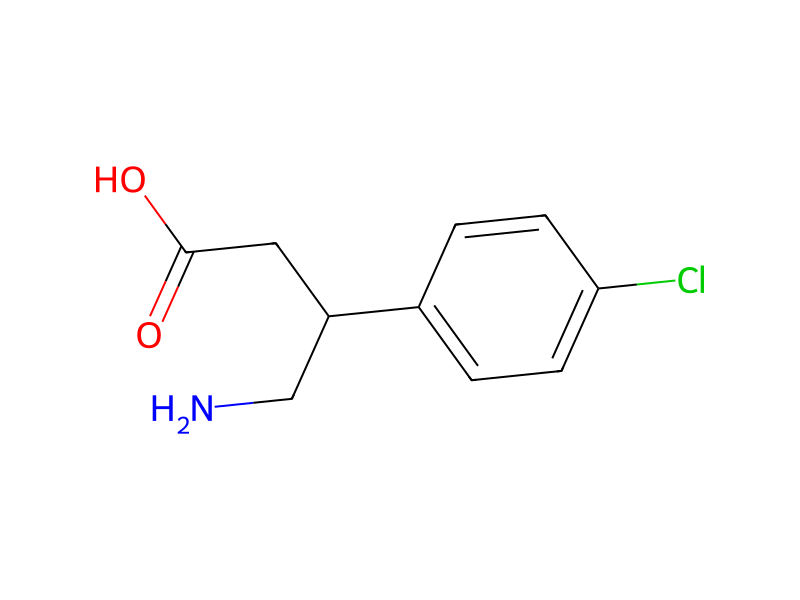
基本情報
- 標準SMILES
NCC(CC(=O)O)c1ccc(Cl)cc1- InChIKey
KPYSYYIEGFHWSV-UHFFFAOYSA-N- 分子式
- C10H12ClNO2
- 平均分子量
- 213.66 g/mol
- 単同位体質量
- 213.0556563
概要
Baclofen appears as odorless or practically odorless white to off-white crystalline powder. (NTP, 1992)
名称と識別子
- 優先名称
- Baclofen
- IUPAC
- 4-amino-3-(4-chlorophenyl)butanoic acid
- 現地名
- バクロフェン
- 英語名
- Baclofen
- 分子式
- C10H12ClNO2
- 分子量
- 213.66
名称と別名
baclofen1134-47-0Lioresal4-Amino-3-(4-chlorophenyl)butanoic acidKemstroBaclonDL-BaclofenBaclofeneBaclofeno4-Amino-3-(4-chlorophenyl)butyric acidBaclofenumBaclophen
名称をさらに表示
ギャバロン(±)-バクロフェンβ-(4-クロロフェニル)GABAdl-バクロフェンバクロフェンリオレサールガバロン4-アミノ-3-(4-クロロフェニル)酪酸3-(4-クロロフェニル)-4-アミノ酪酸rac-(R*)-4-アミノ-3-(4-クロロフェニル)酪酸3-(4-クロロフェニル)-4-アミノブタン酸β-(アミノメチル)-4-クロロベンゼンプロパン酸β-アミノメチル-4-クロロベンゼンプロパン酸β-(アミノメチル)-4-クロロヒドロけい皮酸(RS)-バクロフェン4-アミノ-3-(4-クロロフェニル)ブタン酸バクロフェン (JP17)(±)-BaclofenofenClofenSpinaxLioresaba34647Atrofenc34647ba
(+-)-Baclofenbeta-(4-Chlorophenyl)gabaLioresal Intrathecal(RS)-BACLOFENBa-34647GablofenCiba 34,647-Babeta-(Aminomethyl)-4-chlorobenzenepropanoic acid
データベース識別子
- CAS
1134-47-0- PubChem CID
- 2284
- DTXSID
DTXSID5022641- ChEMBL
CHEMBL701- ChEBI
CHEBI:2972- UNII
- H789N3FKE8
- EC Number
- 214-486-9
- Nikkaji
- J3.661G
物性
構造計算による物性
- XLogP
- -1
- 極性表面積
- 63.3 Ų
- 水素結合供与体数
- 2
- 水素結合受容体数
- 3
- 回転可能結合数
- 4
- 重原子数
- 14
- 形式電荷
- 0
- 複雑度
- 191
実験および物理化学的性質
DrugsPharmaceuticals
LogP1.3
Solubility
less than 1 mg/mL at 64 °F (NTP, 1992)
7.12e-01 g/L
Human Drugs
Breast Feeding; Lactation; Milk, Human; GABA Agonists; Muscle Relaxants, Central
FDA approved drugs -> Active ingredient
FDA approved drugs -> Active ingredient
Pharmaceuticals
Medicines for cerebral palsy
Melting Point
372 to 376 °F (NTP, 1992)
206 - 208 °C
Physical Description
Baclofen appears as odorless or practically odorless white to off-white crystalline powder. (NTP, 1992)
Solid
Dissociation Constants9.62 + 0.1 (amino group) and 3.87 + 0.1 (carboxyl group)
Collision Cross Section
143 Ų [M+H-H2O]+ [CCS Type: TW; Method: calibrated with polyalanine and drug standards]
149.2 Ų [M+H]+ [CCS Type: TW; Method: Major Mix IMS/Tof Calibration Kit (Waters)]
物理化学的性質
- 融点
- 208 · 208-210°C
- 沸点
- 364.3 · 364.3±32.0 °C(Predicted)
- 比重(密度)
- 1.2069 · 1.2069 (rough estimate)
- 屈折率
- 1.55 · 1.5500 (estimate)
- 貯蔵温度
- 2 · 2-8°C
- 溶解性
- 1 M · 1 M HCl: 50 mg/mL
- 外見
- 個体
- 酸解離定数(Pka)
- 3.87 · pKa 3.87±0.1(H2O) (Uncertain)
- 色
- 白色からわずかに黄色
- 水溶解度
- 7.6 · 希NaOHまたは希HClに可溶。 pH 7.6 で約 4mg/ml で水に可溶
- Merck
- 14 · 14,937
- 安定性
- Hygroscopic
- InChI
- InChI=1S/C10H12ClNO2/c11-9-3-1-7(2-4-9)8(6-12)5-10(13)14/h1-4,8H,5-6,12H2,(H,13,14)
- InChIKey
- KPYSYYIEGFHWSV-UHFFFAOYSA-N
- SMILES
- C1(C=CC(Cl)=CC=1)C(CN)CC(=O)O
- CAS データベース
- 1134 · 1134-47-0(CAS DataBase Reference)
- NISTの化学物質情報
- Baclofen(1134-47-0)
- EPAの化学物質情報
- -4 · .beta.-(Aminomethyl)-4-chlorobenzenepropanoic acid (1134-47-0)
化学的性質
化学的特性Off-White Solid
安全と法規制
GHS分類
GHS Classification
Danger
H301 (93.1%): Toxic if swallowed [Danger Acute toxicity, oral]
P203, P233, P260, P261, P264, P264+P265, P270, P271, P272, P280, P284, P301+P316, P302+P352, P304+P340, P305+P351+P338, P318, P319, P321, P330, P332+P317, P333+P317, P337+P317, P342+P316, P362+P364, P403, P403+P233, P405, and P501 (click each P-code to see the statement)
Aggregated GHS information provided per 58 reports by companies from 10 notifications to the ECHA C&L Inventory. Each notification may be associated with multiple companies.
危険有害性情報
Regulatory InformationBaclofen: Does not have an individual approval but may be used under an appropriate group standard
Other Safety InformationIMAP assessments - Benzenepropanoic acid, .beta.-(aminomethyl)-4-chloro-: Human health tier I assessment
DOT LabelPoison
Fire HazardsFlash point data for this chemical are not available. It is probably combustible. (NTP, 1992)
Health Hazards
SYMPTOMS: Symptoms of exposure to this compound via ingestion may include drowsiness, insomnia, dizziness, weakness, mental confusion, nausea, constipation, anorexia, urinary retention, impotence, nystagmus, diplopia and incoordination. Ingestion may lead to cholinergic effects and lassitude. It may also lead to ataxia. Other symptoms due to ingestion may include impaired renal function, fatigue, headache, hypotension, urinary frequency, rash, pruritis, ankle edema, excessive perspiration, weight gain, nasal congestion, and rarely, euphoria, excitement, depression, hallucinations, paresthesia, muscle pain, tinnitus, slurred speech, tremor, rigidity, dystonia, blurred vision, strabismus, miosis, mydriasis, dysarthia, epileptic seizure, dyspnea, palpitation, chest pain, syncope, dryness of the mouth, taste disorder, abdominal pain, vomiting, diarrhea, blood in the stools, enuresis, dysuria, inability to ejaculate, nocturia and hematuria. Overexposure through ingestion may result in seizures, and coma with respiratory depression. Aspiration pneumonia is a frequent complication of coma with respiratory depression. Other symptoms due to overdosage may include vomiting, muscular hypotonia, drowsiness, and accommodation disorders. Cyanosis has been reported. Chronic ingestion may result in drowsiness, depression, weakness, anxiety, ataxia, headaches, blurred vision, gastric upset and pruritic skin rashes characterized by urticaria or erythematous macular eruptions. Sudden withdrawal after chronic ingestion may cause auditory and visual hallucinations, anxiety and tachycardia. Seizures may also occur after sudden withdrawal. Abuse may lead to drug dependence. (NTP, 1992)
Reactive GroupAcids, Carboxylic
Reactivity Profile
BACLOFEN is an amine. Amines are chemical bases. They neutralize acids to form salts plus water. These acid-base reactions are exothermic. The amount of heat that is evolved per mole of amine in a neutralization is largely independent of the strength of the amine as a base. Amines may be incompatible with isocyanates, halogenated organics, peroxides, phenols (acidic), epoxides, anhydrides, and acid halides. Flammable gaseous hydrogen is generated by amines in combination with strong reducing agents, such as hydrides.
Air and Water ReactionsInsoluble in water.
Hazard Classes and CategoriesAcute Tox. 3 (93.1%)
安全と保護具
Fire FightingFires involving this material can be controlled with a dry chemical, carbon dioxide or Halon extinguisher. (NTP, 1992)
First Aid
EYES: First check the victim for contact lenses and remove if present. Flush victim's eyes with water or normal saline solution for 20 to 30 minutes while simultaneously calling a hospital or poison control center. Do not put any ointments, oils, or medication in the victim's eyes without specific instructions from a physician. IMMEDIATELY transport the victim after flushing eyes to a hospital even if no symptoms (such as redness or irritation) develop.
Nonfire Spill Response
SMALL SPILLS AND LEAKAGE: If you spill this chemical, you should dampen the solid spill material with water, then transfer the dampened material to a suitable container. Use absorbent paper dampened with water to pick up any remaining material. Seal your contaminated clothing and the absorbent paper in a vapor-tight plastic bag for eventual disposal. Wash all contaminated surfaces with a soap and water solution. Do not reenter the contaminated area until the Safety Officer (or other responsible person) has verified that the area has been properly cleaned.
Isolation and EvacuationExcerpt from ERG Guide 154 [Substances - Toxic and/or Corrosive (Non-Combustible)]:
Personal Protective Equipment (PPE)
RECOMMENDED RESPIRATOR: Where the neat test chemical is weighed and diluted, wear a NIOSH-approved half face respirator equipped with an organic vapor/acid gas cartridge (specific for organic vapors, HCl, acid gas and SO2) with a dust/mist filter. (NTP, 1992)
毒性情報
TreatmentTreatment may involve "pumping" the stomach, inducing vomiting, administering an antidote, and providing supportive care. (L1099)
Health Effects
Health effects include hypertonia, hyperthermia, formal thought disorder, psychosis, mania, mood disturbances, restlessness, and behavioral disturbances, tachycardia, seizures, tremors, autonomic dysfunction, hyperpyrexia, extreme muscle rigidity resembling neuroleptic malignant syndrome and rebound spasticity (L1098).
Hepatotoxicity
Limited data are available on the potential hepatotoxicity of baclofen. Among the many clinical trials evaluating the safety and efficacy of baclofen, none mentioned hepatic toxicity or rates of serum ALT elevations occurring during chronic therapy. The product insert starts that 5% of treated patients develop mild serum aminotransferase elevations, but little documentation is available on the significance, severity or duration of these abnormalities. A single case of mild and self-limited hepatitis attirbuted to baclofen has been published. The latency to onset was 3 months, the pattern of injury was hepatocellular, and recovery was rapid and complete, all laboratory tests being normal within a few weeks of stopping.
Adverse EffectsPotential adverse effects may involve several organ systems, such as the cardiovascular, gastrointestinal, genitourinary, respiratory, neuromuscular, cutaneous, and central nervous systems.
Exposure RoutesInhalation (L1104); ingestion (L1104); eye contact (L1104); dermal (L1104)
Rapidly and almost completely absorbed from the GI tract.
Toxicity Summary
Signs and Symptoms of Overdose
Baclofen is a direct agonist at GABAB receptors. The precise mechanism of action of Baclofen is not fully known. It is capable of inhibiting both monosynaptic and polysynaptic reflexes at the spinal level, possibly by hyperpolarization of afferent terminals, although actions at supraspinal sites may also occur and contribute to its clinical effect.
Signs and SymptomsLD<sub>50</sub>=45 mg/kg (male mice, IV); LD<sub>50</sub>=78 mg/kg (male rat, IV)
Carcinogen ClassificationNo indication of carcinogenicity to humans (not listed by IARC).
Drug Induced Liver Injury
Drug Induced Liver Injury Rank (DILIrank 2.0)
Baclofen
vLess-DILI-concern
3
Adverse reactions
DOI:10.1016/j.drudis.2016.02.015
Effects During Pregnancy and Lactation
◉ Summary of Use during Lactation
◈ What is baclofen?
Toxicity DataLD50: 45 mg/kg (Intravenous, Mouse) (A308)
LD50: 78 mg/kg (Intravenous, Rat) (A308)
EPA Human Health Benchmarks for Pharmaceuticals
Baclofen
0.9
3.9
Start therapy at a low dosage and increase gradually until optimum effect is achieved (usually between 40-80 mg daily).
Data used to generate the benchmarks include the following: Lowest Daily Dose (LDD): 40 mg/day, Lowest Therapeutic Dose (LTD): 0.5 mg/kg-day, and Screening Dose: 0.0002 mg/kg-day.
30-Mar-07
安全データ
- wgk
- 3
- rtecs
- MW5084200
- ridadr
- UN 2811 6.1/PG 3
- 毒性
- LD50 in male mice, rats (mg/kg): 45, 78 i.v.; 103, 115 s.c.; 200, 145 orally (Tadokoro)
- hs_code
- 2922492050
- risk_code
- 61-25-36/37/38-42/43-20/21/22
- hazard_code
- T,Xn
- safety_code
- 53-22-36/37/39-45-52-36-26
- hazard_class
- 6.1(b)
- packing_group
- III
- Hazard Classifications
- Acute Tox. 3 Oral
- ストレージクラス
- 6.1C - Combustible acute toxic Cat.3toxic compounds or compounds which causing chronic effects
化学と産業
薬理情報
ATC Code
M03BX01
M - Musculo-skeletal system
QM - Musculo-skeletal system
M03BX01
Protein BindingThe protein binding is approximately 30%.
Pharmacodynamics
Baclofen is an antispasmodic agent that induces muscle relaxation. It reduces the release of excitatory neurotransmitters in the pre-synaptic neurons and stimulates inhibitory neuronal signals in the post-synaptic neurons. Oral formulations of baclofen are the most commonly used form of the drug. In one cross-section study, intrathecal baclofen was more effective than oral baclofen in relieving spasticity directly at the level of the spinal cord. Baclofen has CNS depression properties and can cause sedation with tolerance, somnolence, ataxia, and respiratory and cardiovascular depression. Baclofen also mediates some antinociceptive effects and stimulates gastric acid secretion. Baclofen exhibits anti-inflammatory and neuroprotective activities: it inhibits the release of pro-inflammatory cytokines from microglia and astrocytes, and decreases oxidative stress in rats.
Mechanism of Action
The exact mechanism of action of baclofen is unclear. Baclofen is an agonist at the beta subunit of gamma-aminobutyric acid (GABA) receptors expressed on pre- and post-synaptic neurons. Upon binding to GABA<sub>B</sub> receptors, baclofen causes an influx of potassium into the neuron, leading to hyperpolarization of the neuronal membrane and decreased calcium influx at presynaptic nerve terminals. This results in a decreased rate of action potential threshold being reached by presynaptic neurons and reduced action potential of postsynaptic motor neurons that innervate the muscle spindles. Baclofen thereby inhibits the transmission of both mono- and polysynaptic reflexes at the spinal cord, relaxing spasticity. Baclofen may act on some voltage-gated calcium channels; however, the clinical significance of this is unclear.
Biological Half-LifeThe half-life is 2-6 hours after oral administration and 1-5 hours following intrathecal administration. The apparent elimination half-life of baclofen oral suspension or granules is about 5.6 hours.
Metabolism/Metabolites
Approximately 15% of the oral dose is metabolized in the liver, mainly by deamination. Deamination yields the main metabolite, β-(p-chlorophenyl)-4-hydroxybutyric acid, which is pharmacologically inactive.
~ 15% of the dose is metabolized in the liver, primarily by deamination. 70-80% of the dose is excreted unchanged or as metabolites in urine and the remainder is excreted in feces. Oral Baclofen is readily absorbed from the gastrointestinal tract. After oral administration, baclofen appears in the blodd within half an our. It is fairly distributed in most organs and body tissues. After oral administration of baclofen, about 85% is excreted unchanged in the urine and feces and the remainder is oxidatively dearninated in the liver to produce beta-(p-chlorophenyl)-gamma-hydroxybutyric acid as a major metabolite. (L1322). Route of Elimination: In a study using radiolabeled baclofen, approximately 85% of the dose was excreted unchanged in the urine and feces. Baclofen is excreted primarily by the kidney as unchanged drug; 70 - 80% of a dose appears in the urine as unchanged drug. The remainder is excreted as unchanged drug in the feces or as metabolites in the urine and feces. Half Life: 2.5-4 hours
FDA Pharmacological Classification
H789N3FKE8
BACLOFEN
Mechanisms of Action [MoA] - GABA A Agonists
Mechanisms of Action [MoA] - GABA B Agonists
Established Pharmacologic Class [EPC] - gamma-Aminobutyric Acid-ergic Agonist
Baclofen is a gamma-Aminobutyric Acid-ergic Agonist. The mechanism of action of baclofen is as a GABA A Agonist and GABA B Agonist.
MeSH Pharmacological Classification
A heterogeneous group of drugs used to produce muscle relaxation, excepting the neuromuscular blocking agents. They have their primary clinical and therapeutic uses in the treatment of muscle spasm and immobility associated with strains, sprains, and injuries of the back and, to a lesser degree, injuries to the neck. They have been used also for the treatment of a variety of clinical conditions that have in common only the presence of skeletal muscle hyperactivity, for example, the muscle spasms that can occur in MULTIPLE SCLEROSIS. (From Smith and Reynard, Textbook of Pharmacology, 1991, p358)
Endogenous compounds and drugs that bind to and activate GABA-B RECEPTORS.
Absorption, Distribution and Excretion
Baclofen has an oral bioavailability of 70% to 85%. Following oral administration, it is rapidly absorbed through the gastrointestinal tract with peak plasma concentrations being reached two to three hours after ingestion. Peak effect is observed about four hours after intrathecal administration. The absorption is dose-dependent and increases with higher doses. There is intersubject variation in absorption. Administration of oral baclofen suspension with a high-fat meal resulted in 9% decrease in AUC and 33% decrease in Cmax compared to the fasted state.
About 70-80% of baclofen is eliminated in an unchanged form by renal excretion within 72 hours of administration. About 5% of the dose is excreted via the kidneys as metabolites. There is intersubject variation in elimination.
The volume of distribution of baclofen is 0.7 L/kg. As baclofen is mainly water-soluble, it does not readily cross the blood-brain barrier. Drug concentrations of baclofen in the cerebrospinal fluid are approximately 8.5 times lower than in the plasma.
The systemic clearance (CL/F) was 180 mL/min and the renal clearance was 103 mL/min following oral administration.
Cellular LocationsExtracellular
用途と製造
Uses
Use (kg; approx.) in Germany (2009): ?1000
For the alleviation of signs and symptoms of spasticity resulting from multiple sclerosis, particularly for the relief of flexor spasms and concomitant pain, clonus, and muscular rigidity.
Use ClassificationPharmaceuticals
応用分野
用途GABA の誘導体で、脊髄の単 シナプス及び多シナプス反射の抑制作用を示 します。
用途GABAの誘導体で、脊髄の単 シナプス及び多シナプス反射の抑制作用を示 します。
用途シグナル伝達研究用。
使用Baclofen may be used as a pharmaceutical secondary reference standard for the determination of the analyte in plasma samples by liquid chromatography tandem mass spectrometry and tablet formulations by UV spectroscopy, respectively.
一般的な説明Odorless or practically odorless white to off-white crystalline powder.
上流・下流製品情報
上流原料
下流製品
サプライヤー50 社
北京华美互利生物化工010-56205725 · [email protected]
梯希爱(上海)化成工业发展有限公司021-67121386 · [email protected]
上海阿拉丁生化科技股份有限公司400-6206333 13167063860 · [email protected]
河北创海生物科技有限公司+86-86-13131129325 · [email protected]
Hebei Yanxi Chemical Co., Ltd.+86-17531190177 · [email protected]
韶远科技(上海)有限公司021-50795510 4000665055 · [email protected]
LGM Pharma1-(800)-881-8210 · [email protected]
Syntechem Co.,Ltd[email protected]
上海迈瑞尔生化科技有限公司4006356688 18621169109 · [email protected]
武汉易泰科技有限公司上海分公司18930552037 · [email protected]
大连美仑生物技术有限公司0411-62910999 13889544652 · [email protected]
太原市瑞和丰科贸有限公司+86 351 7031519 · [email protected]
安耐吉化学&3A(安徽泽升科技股份有限公司)400-0056266 · [email protected]
上海瀚鸿科技股份有限公司021-54306202 13764082696 · [email protected]
上海诗丹德标准技术服务有限公司021-021-57127007-6622-6622 17621252073 · [email protected]
上海相辉医药科技有限公司13761987713 · [email protected]
Ascent Scientific4401179829988 · [email protected]
嘉兴市艾森化工有限公司0573-85285100 18627885956 · [email protected]
MedChemexpress LLC021-58955995 · [email protected]
武汉丰泰威远科技有限公司+86-27-8746-5837 +86-18627785180 · [email protected]
Zhejiang J&C Biological Technology Co.,Limited+1-2135480471 · [email protected]
上海瀚香生物科技有限公司177-54423994 17754423994 · [email protected]
合肥天健化工有限公司551-65418679 15856988503;15837135945 · [email protected]
武汉丰泰威远科技有限公司027-87465837 19945049750 · [email protected]
孝感深远化工有限公司15527621225; 15527621225 · [email protected]
云南西力生物技术股份有限公司0871-65217109 · [email protected]
天津希恩思生化科技有限公司400 638 7771 · [email protected]
斯百全化学(上海)有限公司021-021-021-67601398-809-809-809 15221380277 · [email protected]
上海遐瑞医药科技有限公司+86 21 61551611
TCI AMERICA800-4238616 · [email protected]
TOKYO CHEMICAL INDUSTRY CO., LTD.03-36680489 · [email protected]
TCI Europe320-37350700 · [email protected]
深圳振强药物研发有限公司0755-66853366 13670046396 · [email protected]
上海诺宝化工有限公司+86(0)21 60484900
广州爱纯医药科技有限公司020-39119399 18927568969 · [email protected]
南京生利德生物科技有限公司025-57798810 18652991625 · [email protected]
湖北鑫源顺医药化工有限公司13971561712, 13995564702, 027-50664929 · [email protected]
成都零六生物科技有限公司400-1166-196 13458535857 · [email protected]
江苏艾康生物医药研发有限公司025-66028182 17714375163 · [email protected]
上海孚一生物科技有限公司+86 (21) 61124340
凯试(上海)科技有限公司021-50135380 · [email protected]
池州凯隆进出口贸易有限公司[email protected]
Sigma-Aldrich西格玛奥德里奇(上海)贸易有限公司021-61415566 800-8193336 · [email protected]
桦特昇生物科技(武汉)有限公司027-59207879 1972026995 18140587686 · [email protected]
TargetMol中国(陶术生物)021-021-33632979 15002134094 · [email protected]
上海陶术生物科技股份有限公司+1-781-999-5354; +1-00000000000 · [email protected]
九鼎化学(上海)科技有限公司4009209199 · [email protected]
杭州鼎燕化工有限公司0571-87157530-8003 18267553885 · [email protected]
济南沃尔德化工有限公司0531-88773586 13210588999 · [email protected]
EMMX Biotechnology LLC888-539-0666 · [email protected]
補足説明
定義ChEBI: A monocarboxylic acid that is butanoic acid substituted by an amino group at position 4 and a 4-chlorophenyl group at position 3. It acts as a central nervous system depressant, GABA agonist and muscle relaxant.
関連反応
2 件

関連ノート
読み込み中…