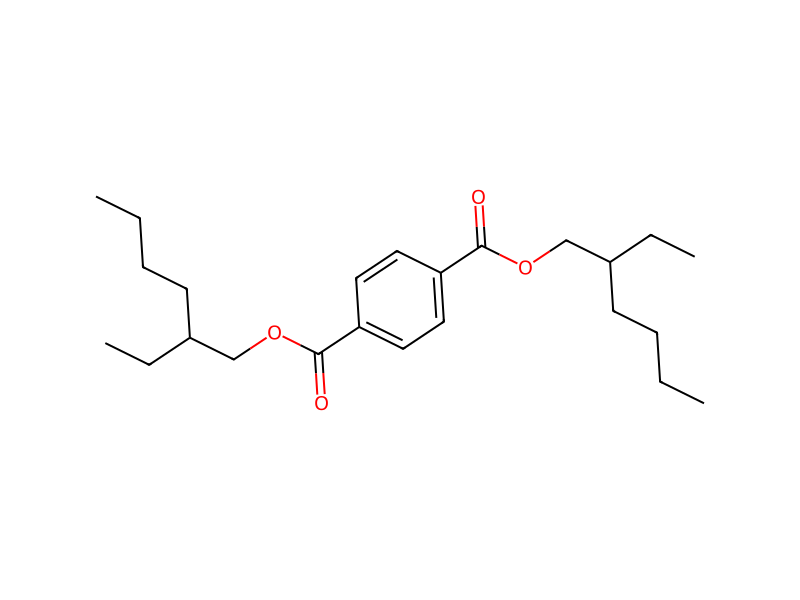
基本情報
- 標準SMILES
CCCCC(CC)COC(=O)c1ccc(C(=O)OCC(CC)CCCC)cc1- InChIKey
RWPICVVBGZBXNA-UHFFFAOYSA-N- 分子式
- C24H38O4
- 平均分子量
- 390.6 g/mol
- 単同位体質量
- 390.2770097
名称と識別子
- 優先名称
- Di-(2-ethylhexyl) terephthalate
- IUPAC
- bis(2-ethylhexyl) benzene-1,4-dicarboxylate
- 現地名
- ベンゼン-1,4-ジカルボン酸ビス(2-エチルヘキシル)
- 英語名
- Dioctyl terephthalate
- 分子式
- C24H38O4
- 分子量
- 390.56
名称と別名
名称をさらに表示
データベース識別子
- CAS
6422-86-2- PubChem CID
- 22932
- DTXSID
DTXSID7027625- ChEMBL
CHEMBL1871770- UNII
- 4VS908W98L
- EC Number
- 229-176-9
- Nikkaji
- J138.316G
物性
構造計算による物性
- XLogP
- 7.4
- 極性表面積
- 52.6 Ų
- 水素結合供与体数
- 0
- 水素結合受容体数
- 4
- 回転可能結合数
- 16
- 重原子数
- 28
- 形式電荷
- 0
- 複雑度
- 386
実験および物理化学的性質
Polymers
Plastics -> N.a.
Plastics -> Plasticisers
Plasticizers
Plastics & Rubber -> Other Plasticizers
Plasticizer
Plasticizers
Plasticizer
Food Contact Substances
FCS -> FDA Inventory of Food Contact Substances Listed in 21 CFR
FCS -> FDA Inventory of Effective Food Contact Substance (FCS) Notifications
FCS -> FDA Inventory of Effective Food Contact Substance (FCS) Notifications
FCS -> FDA Inventory of Effective Food Contact Substance (FCS) Notifications
FCS -> FDA Inventory of Effective Food Contact Substance (FCS) Notifications
FCS -> FDA Inventory of Effective Food Contact Substance (FCS) Notifications
物理化学的性質
- 融点
- -48 °C · -48 °C
- 沸点
- 400 °C · 400 °C (lit.)
- 比重(密度)
- 0.986 g/mL · 0.986 g/mL at 25 °C (lit.)
- 蒸気圧
- 1 mm · 1 mm Hg ( 217 °C)
- 屈折率
- 20 · n20/D 1.49(lit.)
- 闪点
- 230 °F · 230 °F
- 貯蔵温度
- 2 · 2-8°C
- 溶解性
- 水性ベース(わずかに)
- 外見
- 液体
- 色
- 無色透明
- 水溶解度
- 不溶性
- Henry's Law Constant
- 9.9 · 9.9×10-1 mol/(m3Pa) at 25℃, HSDB (2015)
- 安定性
- 吸湿性
- 主な用途
- 洗浄剤化粧品環境食品および飲料パーソナルケア
- 化粧品成分の機能
- 可塑剤
- InChI
- 1S/C24H38O4/c1-5-9-11-19(7-3)17-27-23(25)21-13-15-22(16-14-21)24(26)28-18-20(8-4)12-10-6-2/h13-16,19-20H,5-12,17-18H2,1-4H3
- InChIKey
- RWPICVVBGZBXNA-UHFFFAOYSA-N
- SMILES
- CCCCC(CC)COC(=O)c1ccc(cc1)C(=O)OCC(CC)CCCC
- LogP
- 8.34 at · 8.34 at 20℃
- CAS データベース
- 6422 · 6422-86-2(CAS DataBase Reference)
- EPAの化学物質情報
- Bis(2-ethylhexyl) terephthalate (6422-86-2)
化学的性質
化学的特性Clear colorless liquid
安全と法規制
GHS分類
GHS Classification
This chemical does not meet GHS hazard criteria for 99.7% (375 of 376) of all reports.
Not Classified
Aggregated GHS information provided per 376 reports by companies from 2 notifications to the ECHA C&L Inventory.
危険有害性情報
Regulatory Information
Chemical: 1,4-Benzenedicarboxylic acid, bis(2-ethylhexyl) ester
Regulation (EC) No 1935/2004 (amended)
1,4-Benzenedicarboxylic acid, 1,4-bis(2-ethylhexyl) ester is listed on the EPA's Chemical Data Reporting (CDR) system. Manufacturers and importers of 1,4-Benzenedicarboxylic acid, 1,4-bis(2-ethylhexyl) ester are required to report information about their production and use of this chemical to the EPA under the Toxic Substances Control Act (TSCA). (40 eCFR Part 711)
REACH registered substance: Bis(2-ethylhexyl) terephthalate (EC: 229-176-9)
Bis(2-ethylhexyl) terephthalate: Does not have an individual approval but may be used under an appropriate group standard
TSCA Requirements
Pursuant to section 8(d) of TSCA, EPA promulgated a model Health and Safety Data Reporting Rule. The section 8(d) model rule requires manufacturers, importers, and processors of listed chemical substances and mixtures to submit to EPA copies and lists of unpublished health and safety studies. Bis(2-ethylhexyl) terephthalate is included on this list. Effective date: 1/3/83; Sunset date: 1/3/93.
安全と保護具
Disposal Methods
SRP: The most favorable course of action is to use an alternative chemical product with less inherent propensity for occupational exposure or environmental contamination. Recycle any unused portion of the material for its approved use or return it to the manufacturer or supplier. Ultimate disposal of the chemical must consider: the material's impact on air quality; potential migration in soil or water; effects on animal, aquatic, and plant life; and conformance with environmental and public health regulations.
毒性情報
Environmental Fate
TERRESTRIAL FATE: Based on a classification scheme(1), an estimated Koc value of 2,000(SRC), determined from a water solubility of 4.0 mg/L(2) and a regression-derived equation(3), indicates that bis(2-ethylhexyl) terephthalate is expected to have slight mobility in soil(SRC). Volatilization of bis(2-ethylhexyl) terephthalate from moist soil surfaces is expected to be an important fate process(SRC) given an estimated Henry's Law constant of 1.0X10⁻⁵ atm-cu m/mole(SRC), using a fragment constant estimation method(4). Bis(2-ethylhexyl) terephthalate is not expected to volatilize from dry soil surfaces(SRC) based upon an estimated vapor pressure of 2.1X10⁻⁵ mm Hg(SRC), determined from a fragment constant method(5). Biodegradation data on bis(2-ethylhexyl) terephthalate were not available(SRC, 2008). However, biodegradation studies on structurally similar bis(2-ethylhexyl) phthalate was demonstrated to undergo aerobic(6) and possibly anaerobic biodegradation(7); therefore, biodegradation is likely to be an important fate process for bis(2-ethylhexyl) terephthalate(SRC).
AQUATIC FATE: Based on a classification scheme(1), an estimated Koc value of 2,000(SRC), determined from a water solubility of 4.0 mg/L(2) and a regression-derived equation(3), indicates that bis(2-ethylhexyl) terephthalate is expected to adsorb to suspended solids and sediment(SRC). Volatilization from water surfaces is expected(3) based upon an estimated Henry's Law constant of 1.0X10⁻⁵ atm-cu m/mole(SRC), developed using a fragment constant estimation method(4). Using this Henry's Law constant and an estimation method(3), volatilization half-lives for a model river and model lake are 7.3 and 59 days, respectively(SRC). According to a classification scheme(5), an estimated BCF of 25(SRC), from an estimated log Kow of 8.39(6) and a regression-derived equation(7), suggests the potential for bioconcentration in aquatic organisms is low(SRC). Hydrolysis is not expected to be an important process(SRC) based on estimated hydrolysis half-lives of 1.4 years and 51 days at pHs 7 and 8, respectively(8). Biodegradation data on bis(2-ethylhexyl) terephthalate were not available(SRC, 2008). However, biodegradation studies on structurally similar bis(2-ethylhexyl) phthalate was demonstrated to undergo aerobic(9) and possibly anaerobic biodegradation(10); therefore, biodegradation is likely to be an important fate process for bis(2-ethylhexyl) terephthalate(SRC)
ATMOSPHERIC FATE: According to a model of gas/particle partitioning of semivolatile organic compounds in the atmosphere(1), bis(2-ethylhexyl) terephthalate, which has an estimated vapor pressure of 2.1X10⁻⁵ mm Hg at 25 °C(SRC), determined from a fragment constant method(2), will exist in both the vapor and particulate phases in the ambient atmosphere. Vapor-phase bis(2-ethylhexyl) terephthalate is degraded in the atmosphere by reaction with photochemically-produced hydroxyl radicals(SRC); the half-life for this reaction in air is estimated to be 18 hours(SRC), calculated from its rate constant of 2.2X10⁻¹¹ cu cm/molecule-sec at 25 °C(SRC) that was derived using a structure estimation method(3). Particulate-phase bis(2-ethylhexyl) terephthalate may be removed from the air by wet or dry deposition(SRC). Bis(2-ethylhexyl) terephthalate does contain chromophores that absorb at wavelengths >290 nm(4) and therefore may be susceptible to direct photolysis by sunlight(SRC).
Effluent Concentrations
Bis(2-ethylhexyl) terephthalate's possible use in the formulation of PVC waterstops, the sealing materials used in concrete construction joints at dams, water and wastewater treatment facilities(1), may have resulted in its direct contact with water resulting in release to the environment via effluent(SRC).
Soil Adsorption/Mobility
The Koc of bis(2-ethylhexyl) terephthalate is estimated as 2,000(SRC), using a water solubility of 4 mg/L(1) and a regression-derived equation(2). According to a classification scheme(3), this estimated Koc value suggests that bis(2-ethylhexyl)terephthalate is expected to have slight mobility in soil.
TSCA Test Submissions
The absorption and metabolism of (hexyl-2-14C)di-(2-ethylhexyl)terephthalate (DEHT) mixed with corn oil and administered by gavage at 100 mg/kg of body weight in 10 male Sprague Dawley rats (2 animals fasted for 4 hrs after dosing, remaining animals were allowed access to food immediately following dosing). Test material was rapidly hydrolyzed to 2-ethylhexanol (2-EH), mono-(2-ethylhexyl) terephthalate (MEHT) and unlabeled terephthalic acid (TPA). Radioactivity was excreted in the feces (95.6 +/- 12.2% of the dose) as DEHT (36.6%), MEHT (2.5%), and polar metabolites. Radioactivity was excreted in the urine (31.9% +/- 10.9%) as metabolic products of MEHT and 2-EH, and was expired as 14CO2 (3.6 +/- 0.9%). All tissues examined contained 14C with the highest concentrations in the liver and fat. Excretion of 95 and 99% of the total urinary and fecal radioactivity occurred by 24 and 48 hrs, respectively. Major metabolites in the urine included TPA (51% of the dose), oxidized metabolites of 2-EH and MEHT, and glucuronic and sulfuric acid conjugates.
In a reproduction study to evaluate differences between different strains of rats, male and female Wistar and CD strain rats were orally exposed to bis(2-ethylhexyl) terephthalate in the diet at concentrations of 0, 0.03, 0.125, 0.5, 2.0 or 5.0% for 90 days. The number of rats/group and the days during which mating took place were not reported. The surviving rats were sacrificed on day 90 of exposure. There were significant differences between treated and control animals in the following: decreased weight gain (highest 3 dose groups, both strains), dose-dependent lethal effects on newborn and young rats (2 and 5% groups, both strains), decreased day 1 newborn body weight and day 21 newborn survival and increased incidence of parental renal and bladder calculi at day 51 (high-dose group, both strains), increased incidence of chronic inflammatory lesions of the urinary bladder and urethra (high-dose group, more frequent in females of both strains), and strain difference with respect to urinary terephthalic acid concentrations at sacrifice (dose level not reported). There were no significant differences between treated and control animals in the following: reproduction or fertility parameters, and microscopic examination of kidney or ureter.
The mutagenicity of urine from Sprague-Dawley rats dosed daily by gavage for 15 days with 2,000 mg/kg of bis(2-ethylhexyl) terephthalate was evaluated in Salmonella tester strains TA 98, TA100, TA1535, TA1537 and TA1538 (Modified Ames Test), both in the presence and absence of Aroclor-induced rat liver S9 metabolic activation and beta-glucuronidase/aryl sulfatase. Cultures were dosed with up to 2 ml of urine using direct plating procedures. The urine of rats treated with di-(2-ethylhexyl) terephthalate did not cause a positive response under any of the test conditions.
The mutagenic effect of bis(2-ethylhexyl) terephthalate was evaluated in Salmonella typhimurium strains TA 1535, TA 1537, TA 1538, TA 98 and TA 100 with and without metabolic activation provided by rat liver S9 fraction. The test article was administered at levels from 0.001 to 10.0 mg/plate and was not found to be mutagenic in the presence or absence of activation. In a preliminary range finding study, bis(2-ethylhexyl) terephthalate levels up to 10 mg/plate were non-toxic to cells.
For more TSCA Test Submissions (Complete) data for BIS(2-ETHYLHEXYL) TEREPHTHALATE (9 total), please visit the HSDB record page.
Environmental Biodegradation
Biodegradation data on bis(2-ethylhexyl) terephthalate were not available(SRC, 2008); however, bis(2-ethylhexyl) phthalate, a structurally similar compound, is reported to undergo aerobic(1,2) and possibly anaerobic biodegradation(3,4). Therefore, biodegradation is likely to be an important fate process for bis(2-ethylhexyl) terephthalate.
Environmental Bioconcentration
An estimated BCF of 25 was calculated in fish for bis(2-ethylhexyl) terephthalate(SRC), using an estimated log Kow of 8.39(1) and a regression-derived equation(2). According to a classification scheme(3), this BCF suggests the potential for bioconcentration in aquatic organisms is low(SRC).
Volatilization from Water/Soil
The Henry's Law constant for bis(2-ethylhexyl) terephthalate is estimated as 1.0X10⁻⁵ atm-cu m/mole(SRC) using a fragment constant estimation method(1). This Henry's Law constant indicates that bis(2-ethylhexyl) terephthalate is expected to volatilize from water surfaces(2). Based on this Henry's Law constant, the volatilization half-life from a model river (1 m deep, flowing 1 m/sec, wind velocity of 3 m/sec)(2) is estimated as 7.3 days(SRC). The volatilization half-life from a model lake (1 m deep, flowing 0.05 m/sec, wind velocity of 0.5 m/sec)(2) is estimated as 59 days(SRC). Bis(2-ethylhexyl) terephthalate's Henry's Law constant indicates that volatilization from moist soil surfaces may occur(SRC). Bis(2-ethylhexyl) terephthalate is not expected to volatilize from dry soil surfaces(SRC) based upon an estimated vapor pressure of 2.1X10⁻⁵ mm Hg(SRC), determined from a fragment constant method(3).
Environmental Abiotic Degradation
The rate constant for the vapor-phase reaction of bis(2-ethylhexyl) terephthalate with photochemically-produced hydroxyl radicals has been estimated as 2.2X10⁻¹¹ cu cm/molecule-sec at 25 °C(SRC) using a structure estimation method(1). This corresponds to an atmospheric half-life of about 18 hours at an atmospheric concentration of 5X10+5 hydroxyl radicals per cu cm(1). A base-catalyzed second-order hydrolysis rate constant of 0.16 L/mole-sec(SRC) was estimated using a structure estimation method(2); this corresponds to half-lives of 1.4 years and 51 days at pH values of 7 and 8, respectively(2). Bis(2-ethylhexyl) terephthalate does contain chromophores that absorb at wavelengths >290 nm(3) and therefore may be susceptible to direct photolysis by sunlight(SRC).
Probable Routes of Human Exposure
Occupational exposure to bis(2-ethylhexyl) terephthalate may occur through inhalation of aerosols and dermal contact with this compound at workplaces where bis(2-ethylhexyl) terephthalate is produced or used. Use data indicate that the general population may be exposed to bis(2-ethylhexyl) terephthalate via dermal contact from products containing this compound. (SRC)
Environmental Fate/Exposure Summary
Bis(2-ethylhexyl) terephthalate's production and subsequent use as a plasticizer may result in its release to the environment through various waste streams. If released to air, an estimated vapor pressure of 2.1X10⁻⁵ mm Hg at 25 °C indicates bis(2-ethylhexyl) terephthalate will exist in both the vapor and particulate phases in the atmosphere. Vapor-phase bis(2-ethylhexyl) terephthalate will be degraded in the atmosphere by reaction with photochemically-produced hydroxyl radicals; the half-life for this reaction in air is estimated to be 18 hours. Particulate-phase bis(2-ethylhexyl) terephthalate will be removed from the atmosphere by wet or dry deposition. Bis(2-ethylhexyl) terephthalate does contain chromophores that absorb at wavelengths >290 nm and therefore may be susceptible to direct photolysis by sunlight. If released to soil, bis(2-ethylhexyl) terephthalate is expected to have slight mobility based upon an estimated Koc of 2,000. Volatilization from moist soil surfaces is expected to be an important fate process based upon an estimated Henry's Law constant of 1.0X10⁻⁵ atm-cu m/mole. Biodegradation data on bis(2-ethylhexyl) terephthalate were not available. However, biodegradation studies on structurally similar bis(2-ethylhexyl) phthalate was demonstrated to undergo aerobic and possibly anaerobic biodegradation; therefore, biodegradation is likely to be an important fate process for bis(2-ethylhexyl) terephthalate. If released into water, bis(2-ethylhexyl) terephthalate is expected to adsorb to suspended solids and sediment based upon the estimated Koc. Volatilization from water surfaces is expected to be an important fate process based upon this compound's estimated Henry's Law constant. Estimated volatilization half-lives for a model river and model lake are 7.3 and 59 days, respectively. An estimated BCF of 25 suggests the potential for bioconcentration in aquatic organisms is low. Hydrolysis is not expected to be an important process based on estimated hydrolysis half-lives of 1.4 years and 51 days at pHs 7 and 8, respectively. Occupational exposure to bis(2-ethylhexyl) terephthalate may occur through inhalation of aerosols and dermal contact with this compound at workplaces where bis(2-ethylhexyl) terephthalate is produced or used. Use data indicate that the general population may be exposed to bis(2-ethylhexyl) terephthalate via dermal contact from products containing this compound. (SRC)
法規制情報
TSCA Requirements
Pursuant to section 8(d) of TSCA, EPA promulgated a model Health and Safety Data Reporting Rule. The section 8(d) model rule requires manufacturers, importers, and processors of listed chemical substances and mixtures to submit to EPA copies and lists of unpublished health and safety studies. Bis(2-ethylhexyl) terephthalate is included on this list. Effective date: 1/3/83; Sunset date: 1/3/93.
安全データ
- wgk
- 1
- tsca
- TSCA listed
- rtecs
- WZ0883500
- hs_code
- 29173990
- 化審法
- 3-4053
- safety_code
- 24/25
- ストレージクラス
- 10 - Combustible liquids
- 有毒物質データの
- 6422-86-2(Hazardous Substances Data)
化学と産業
薬理情報
Absorption, Distribution and Excretion
Rats readily excreted (14)C EHT given in a single dose at 100 mg/kg. 57.9%, 28.6%, and 3.6% of the (14)C was recovered in the feces, urine an expired air, respectively, within 144 hr after admin. Only 2.1% remained in the carcass.
The hydrolysis of di(2-ethylhexyl) terephthalate and di(2-ethylhexyl) phthalate were studied using rat gut homogenate fractions in vitro. Both isomers were hydrolysed by the intestinal fraction; however di(2-ethylhexyl) phthalate was hydrolysed to 2-ethylhexanol and mono(2-ethylhexyl) phthalate in about equal proportions whereas di(2-ethylhexyl) terephthalate was hydrolysed to 2-ethylhexanol and terephthalic acid. The half-lives for disappearance of the diesters were determined to be 12.6 min for di(2-ethylhexyl) phthalate and 53.3 min for di(2-ethylhexyl) terephthalate. 2. The absorption and metabolism of di(2-ethylhexyl) terephthalate were studied by administering (hexyl-(14)C)di(2-ethylhexyl) terephthalate (in corn oil) by oral gavage at a dose level of 100 mg/kg to 10 adult male Sprague Dawley rats. Urine feces and expired air were collected for 144 hr and analysed for the presence of radioactivity and feces and urine were analysed for unlabelled metabolites. 3. Radioactivity was eliminated in feces (56.5 +/- 12.1% of dose) primarily as unchanged di(2-ethylhexyl) terephthalate, small amounts of mono(2-ethylhexyl) phthalate and polar metabolites; excreted in urine (31.9 +/- 10.9% of dose) principally as mono(2-ethylhexyl) phthalate and metabolic products of 2-ethylhexanol; and expired as (14)C02 (3.6 +/-0.9% of dose). Less than 2% of the administered radioactivity was found in the carcass. Small amounts of (14)C were found in the tissues with the highest amounts found in liver and fat. 4. Metabolites identified in urine included terephthalic acid (equivalent to 51% of dose), oxidized metabolites of 2-ethylhexanol and mono(2-ethylhexyl) phthalate, and glucuronic and sulfuric acid conjugates (equivalent to about 10% of dose). 5. These findings indicate that di(2-ethylhexyl) terephthalate was hydrolysed more extensively than di(2-ethylhexyl) phthalate and consequently the urinary metabolite profiles for these two isomeric plasticizers were very different. The hydrolysis and metabolism of di(2-ethylhexyl) terephthalate were found to be similar to those of di(2-ethylhexyl) adipate in that hydrolysis of both ester bonds occurs.
用途と製造
Uses
Used as plasticizer and as a softener for nitrile-butadiene rubber, chloroprene rubber, and isobutylene-isoprene rubber; [HSDB]
SOFTENER FOR NITRILE-BUTADIENE & CHLOROPRENE RUBBER
SOFTENER FOR ISOBUTYLENE-ISOPRENE RUBBER
Plasticizer which is compatible with cellulose acetate-butyrate, cellulose nitrate, poly(methyl methacrylate), polystyrene, poly(vinyl butyral), and poly(vinyl chloride) resins.
U.S. Production
2023: 400,000,000 - <550,000,000 lb
(1979) PROBABLY GREATER THAN 2.27X10+6 GRAMS
(1981) PROBABLY GREATER THAN 2.27X10+6 GRAMS
1,4-Benzenedicarboxylic acid, bis(2-ethylhexyl) ester is listed as a High Production Volume (HPV) chemical (65FR81686). Chemicals listed as HPV were produced in or imported into the U.S. in >1 million pounds in 1990 and/or 1994. The HPV list is based on the 1990 Inventory Update Rule. (IUR) (40 CFR part 710 subpart B; 51FR21438).
Production volumes for non-confidential chemicals reported under the Inventory Update Rule. [Table#5728]
Use Classification
Fragrance Ingredients
Plastics -> Polymer Type -> N.a.
Plastics -> Plasticisers
General Manufacturing Information
All Other Basic Organic Chemical Manufacturing
1,4-Benzenedicarboxylic acid, 1,4-bis(2-ethylhexyl) ester: ACTIVE
応用分野
用途テレフタル酸ビス(2-エチルヘキシル)は、DOPよりも耐熱老化性、電気絶縁性が優れた軟質塩ビ全般に対応できる可塑剤です。 テレフタル酸ビス(2-エチルヘキシル)は、軟質塩ビ全般に対応できる可塑剤です。
使用It is used primarily as a plasticizer for polyvinyl chloride and other polymers.
一般的な説明Dioctyl terephthalate (DOTP) is a plasticizer that can be prepared by alcoholysis of polyethylene terephthalate (PET) with isooctyl alcohol.
調製方法
DEHT is manufactured by the esterification of terephthalic acid and 2-ethylhexanol.
上流・下流製品情報
上流原料
サプライヤー50 社
関連反応
現在のフィルター条件では反応記録がありません。
関連ノート
読み込み中…