
ベタヒスチン
Betahistine
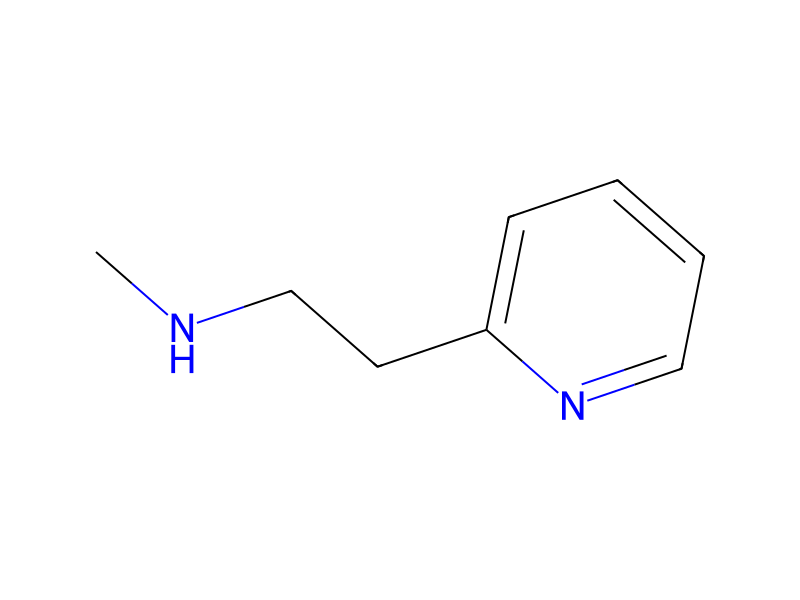
基本情報
- CAS
5638-76-6- 標準SMILES
CNCCc1ccccn1- InChIKey
UUQMNUMQCIQDMZ-UHFFFAOYSA-N- 分子式
- C8H12N2
- 平均分子量
- 136.19 g/mol
- 単同位体質量
- 136.10004839
概要
Betahistine is an aminoalkylpyridine that is pyridine substituted by a 2-(methylamino)ethyl group at position 2. It acts as a histamine agonist and a vasodilator, and is thought to improve the microcirculation of the labyrinth, resulting in reduced endolymphatic pressure. It is used (generally as the hydrochloride or mesylate salt) to reduce the symptoms of vertigo, tinnitus, and hearing loss associated with Mnire's disease. It has a role as a vasodilator agent and a H1-receptor agonist. It is an aminoalkylpyridine and a secondary amino compound.
名称と識別子
- 優先名称
- Betahistine
- IUPAC
- N-methyl-2-pyridin-2-ylethanamine
- 現地名
- ベタヒスチン
- 英語名
- Betahistine
- 分子式
- C8H12N2
- 分子量
- 136.19
名称と別名
betahistine5638-76-6N-Methyl-2-pyridineethanamineVasomotal2-Pyridineethanamine, N-methyl-Betahistina2-[2-(Methylamino)ethyl]pyridineN-methyl-2-pyridin-2-ylethanamineBetahistinummethyl[2-(pyridin-2-yl)ethyl]amineBetaistina2-(2-(Methylamino)ethyl)pyridine
名称をさらに表示
N-メチルピリジン-2-エタンアミンN-メチル-2-ピリジンエタンアミンN-メチル-2-(2-ピリジル)エチルアミンベータヒスチンβ-ヒスチンN-メチルピリジン-2-(エタンアミン)2-(2-メチルアミノエチル)ピリジン2-[2-(メチルアミノ)エチル]ピリジン2-(メチルアミノエチル)ピリジンベタヒスチンN-メチル-2-ピリジンエタン-1-アミンメチル[2-(ピリジン-2-イル)エチル]アミンn-methyl-2-(pyridin-2-yl)ethan-1-amineY-G 14-d3PT 9 baseSerc baseβ-HistineNSC 42617-d3AKOS BBS-00002883Sinmenier (free base)
Vestibo(2-(2-Pyridyl)ethyl)methylamine[2-(2-Pyridyl)ethyl]methylamine2-(beta-Methylaminoethyl)pyridineHISTALEANX32KK4201DN-Methyl-2-(2-pyridinyl)ethanamineNSC-42617
物性
構造計算による物性
- XLogP
- 0.4
- 極性表面積
- 24.9 Ų
- 水素結合供与体数
- 1
- 水素結合受容体数
- 2
- 回転可能結合数
- 3
- 重原子数
- 10
- 形式電荷
- 0
- 複雑度
- 83.3
実験および物理化学的性質
Drugs
Pharmaceuticals -> Listed in ZINC15
Pharmaceuticals
Pharmaceuticals -> Used in Switzerland
LogP0.68
Boiling Point210.9±15.0 °C
Melting Point150-144
Physical DescriptionSolid
Dissociation Constants3.5, 9.7
Collision Cross Section132.35 Ų [M+K]+ [CCS Type: TW; Method: calibrated with polyalanine and drug standards]
物理化学的性質
- 沸点
- 113 · 113-114 °C30 mm Hg(lit.)
- 比重(密度)
- 0.984 g/mL · 0.984 g/mL at 25 °C(lit.)
- 蒸気圧
- 17.7 Pa · 17.7Pa at 25℃
- 屈折率
- 20 · n20/D 1.518(lit.)
- 闪点
- 206 °F · 206 °F
- 貯蔵温度
- Keep in dark place,Inert atmosphere,Room temperature
安全と法規制
安全情報は参考情報です。供給元の安全データシート(SDS)、適用法令、専門家による評価に代わるものではありません。
GHS分類
GHS Classification
Warning
H315 (100%): Causes skin irritation [Warning Skin corrosion/irritation]
P261, P264, P264+P265, P271, P280, P302+P352, P304+P340, P305+P351+P338, P319, P321, P332+P317, P337+P317, P362+P364, P403+P233, P405, and P501 (click each P-code to see the statement)
Aggregated GHS information provided per 47 reports by companies from 5 notifications to the ECHA C&L Inventory. Each notification may be associated with multiple companies.
危険有害性情報
Regulatory InformationREACH registered substance: Betahistine (EC: 227-086-4)
Hazard Classes and CategoriesSkin Irrit. 2 (100%)
毒性情報
Drug Induced Liver Injury
Drug-Induced Liver Injury Severity and Toxicity (DILIst)
betahistine
DILI Positive
Oral
DOI:10.1016/j.drudis.2019.09.022
安全データ
- wgk
- 2
- tsca
- TSCA listed
- rtecs
- UT5552000
- hs_code
- 2933399990
- risk_code
- 36/37/38
- hazard_code
- Xi,C
- hazard_note
- Corrosive
- safety_code
- 26-37/39
- Hazard Classifications
- Eye Irrit. 2Skin Irrit. 2STOT SE 3
化学と産業
薬理情報
ATC Code
N07CA01
N - Nervous system
QN - Nervous system
Protein BindingThe plasma protein binding of betahistine is reported to be less than 5%.
PharmacodynamicsThrough its actions on the histamine receptors, betahistine provides relief from vertigo associated with Ménière's disease.
Mechanism of Action
OBE101 is a H1 receptor agonist and partial H3 receptor antagonist. Because inhibition of H1 receptors increases feeding, agonism of H1 receptors by OBE101 should reduce feeding. By also partially antagonizing H3, OBE101 impedes a negative feedback loop that essentially prolongs stimulation of the H1 receptors.
Vertigo is a disturbing sensation of movement caused by dysfunction of the labyrinth (inner ear), vestibular nerve, cerebellum, brainstem, or Central Nervous System (CNS). Vestibular forms of vertigo are often accompanied by auditory dysfunctions such as hyperacusis, hearing loss, and tinnitus. In most cases, adaptive mechanisms of the CNS lead to functional recovery after episodes of vertigo, however, syndromes such as Ménière's disease tend to cause the recurrence of vertigo symptoms. This significantly impacts the quality of life and the ability to carry out daily activities. **H1-receptor activity** The mechanism of action of betahistine is multifactorial. Ménière's disease is thought to result from a disruption of endolymphatic fluid homeostasis in the ear. Betahistine mainly acts as a histamine H1-receptor agonist. The stimulation of H1-receptors in the inner ear causes a vasodilatory effect leading to increased permeability of blood vessels and a reduction in endolymphatic pressure; this action prevents the rupture of the labyrinth, which can contribute to the hearing loss associated with Ménière's disease. Betahistine is also purported to act by reducing the asymmetrical functioning of sensory vestibular organs and increasing vestibulocochlear blood flow, relieving symptoms of vertigo. **H3-receptor activity** In addition to the above mechanisms, betahistine also acts as a histamine H3-receptor antagonist, increasing the turnover of histamine from postsynaptic histaminergic nerve receptors, subsequently leading to an increase in H1-agonist activity. H3-receptor antagonism elevates levels of neurotransmitters including serotonin in the brainstem, inhibiting the activity of vestibular nuclei, thus restoring proper balance and decreasing vertigo symptoms.
関連反応
64 件




化合物ノート
読み込み中…