
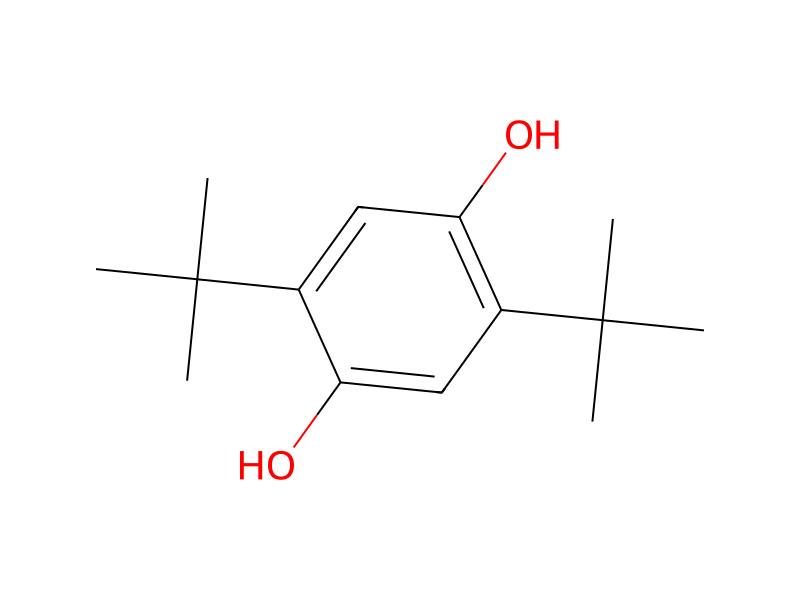
基本情報
- 標準SMILES
CC(C)(C)c1cc(O)c(C(C)(C)C)cc1O- InChIKey
JZODKRWQWUWGCD-UHFFFAOYSA-N- 分子式
- C14H22O2
- 平均分子量
- 222.32 g/mol
- 単同位体質量
- 222.16197994
概要
2,5-di-tert-butylbenzene-1,4-diol is a member of the class of hydroquinones that is benzene-1,4-diol substituted by tert-butyl groups at position 2 and 5.
名称と識別子
- 優先名称
- 2,5-Di-tert-butylhydroquinone
- IUPAC
- 2,5-ditert-butylbenzene-1,4-diol
- 現地名
- 2,5-ジ-tert-ブチルヒドロキノン
- 英語名
- 2,5-Di-tert-butylhydroquinone
- 分子式
- C14H22O2
- 分子量
- 222.32
名称と別名
2,5-Di-tert-butylhydroquinone88-58-42,5-Di-tert-butylbenzene-1,4-diolDTBHQDibugDi-t-butylhydroquinoneDybugSantovar O2,5-Di-tert-butylquinolNonflex AlbaNaugard 451Antage DBH
名称をさらに表示
2,5-ジ-tert-ブチルヒドロキノン2,5-ビス(1,1-ジメチルエチル)ヒドロキノン2,5-ビス(1,1-ジメチルエチル)-1,4-ベンゼンジオール2,5-ジ-tert-ブチルハイドロキノン2,5-ジtert-ブチルヒドロキノン2,5-ジ-tert-ブチル-1,4-ベンゾハイドロキノン2,5-ジ(tert-ブチル)ヒドロキノン2,5-ジ-tert-ブチル-1,4-ベンゼンジオール2,5-ジ-tert-ブチル-1,4-ベンゾヒドロキノン2,5-ビス(tert-ブチル)-1,4-ベンゼンジオール2,5-ビス(tert-ブチル)ヒドロキノン2,5-ジ-tert-ブチルベンゼン-1,4-ジオール2,5-ジ-t-ブチルハイドロキノン2,5ジtブチルヒドロキノンBHQ2,5ジtertブチルヒドロキノン2,5‐ジ‐TERT‐ブチルヒドロキノン2,5-ジ(TERT-ブチル)-1,4-ベンゼンジオール2,5-ジ-T-ブチルヒドロキノンBHQDBHQBlack Hole QuencherProbesANTIOXIDANT DTBHQDibutylhydroquinone2,5-ditertiary butyl hydroquinone2-carbamoyl-2-propylpentanoic acid
Nocrac NS 71,4-Benzenediol, 2,5-bis(1,1-dimethylethyl)-2,5-Di-tert-butyl-1,4-benzenediol2,5-Di-tert-butyl-1,4-hydroquinonedi-tert-butylhydroquinone1,4-Dihydroxy-2,5-di-tert-butylbenzene2,5-Di-tert-butyl-1,4-benzohydroquinoneDTXSID8041248
データベース識別子
- CAS
1322-72-1、88-58-4- PubChem CID
- 2374
- DTXSID
DTXSID8041248- ChEMBL
CHEMBL480626- ChEBI
CHEBI:41094- UNII
- 26XK13B61B
- EC Number
- 201-841-8
- Nikkaji
- J3.545I
物性
構造計算による物性
- XLogP
- 4.6
- 極性表面積
- 40.5 Ų
- 水素結合供与体数
- 2
- 水素結合受容体数
- 2
- 回転可能結合数
- 2
- 重原子数
- 16
- 形式電荷
- 0
- 複雑度
- 208
実験および物理化学的性質
Chemical ClassesOther Classes -> Phenols
DrugsPharmaceuticals -> Listed in ZINC15
Cosmetics
Cosmetic ingredients (Di-t-Butylhydroquinone) -> CIR (Cosmetic Ingredient Review)
Antioxidant
Food Contact SubstancesFCS -> FDA Inventory of Food Contact Substances Listed in 21 CFR
Physical Description
CBI
Off-white crystalline powder; [Alfa Aesar MSDS]
Collision Cross Section155.1 Ų [M]+ [CCS Type: DT; Buffer gas: N2; Ionization: APCI+; Dataset: TOXCAST; Source Identifier: DTXSID8041248]
物理化学的性質
- 融点
- 216 · 216-218 °C(lit.)
- 沸点
- 321 °C · 321°C
- 比重(密度)
- 1 · 1,07 g/cm3
- 屈折率
- 1.4576 · 1.4576 (estimate)
- 闪点
- 216 °C · 216 °C
- 貯蔵温度
- 30 °C · Store below +30°C.
- 溶解性
- almost transparency in Methanol
- 酸解離定数(Pka)
- 11.89 · 11.89±0.23(Predicted)
- 外見
- 結晶性粉末
- 色
- ライトベージュ~ピンクベージュ
- 水溶解度
- 3.8 mg/L · 3.8mg/L at 20℃
- BRN
- 2049542 · 2049542
- 安定性
- 安定。酸化剤と相容れない。
- 化粧品成分の機能
- 抗酸化物質
- InChI
- 1S/C14H22O2/c1-13(2,3)9-7-12(16)10(8-11(9)15)14(4,5)6/h7-8,15-16H,1-6H3
- InChIKey
- JZODKRWQWUWGCD-UHFFFAOYSA-N
- SMILES
- CC(C)(C)c1cc(O)c(cc1O)C(C)(C)C
- LogP
- 274 at · 274 at 30℃
- CAS データベース
- 88 · 88-58-4(CAS DataBase Reference)
- NISTの化学物質情報
- 1 · 1,4-Benzenediol, 2,5-bis(1,1-dimethylethyl)-(88-58-4)
- EPAの化学物質情報
- 1 · 1,4-Benzenediol, 2,5-bis(1,1-dimethylethyl)- (88-58-4)
化学的性質
化学的特性cream or pale brown solid
安全と法規制
GHS分類
GHS Classification
This chemical does not meet GHS hazard criteria for 0.7% (2 of 279) of reports.
Danger
H301 (46.6%): Toxic if swallowed [Danger Acute toxicity, oral]
P260, P261, P264, P264+P265, P270, P271, P272, P273, P280, P301+P316, P301+P317, P302+P352, P304+P340, P305+P351+P338, P319, P321, P330, P332+P317, P333+P317, P337+P317, P362+P364, P391, P403+P233, P405, and P501 (click each P-code to see the statement)
Aggregated GHS information provided per 279 reports by companies from 19 notifications to the ECHA C&L Inventory. Each notification may be associated with multiple companies.
危険有害性情報
Regulatory Information
Chemical: 1,4-Benzenediol, 2,5-bis(1,1-dimethylethyl)-
1,4-Benzenediol, 2,5-bis(1,1-dimethylethyl)- is listed on the EPA's Chemical Data Reporting (CDR) system. Manufacturers and importers of 1,4-Benzenediol, 2,5-bis(1,1-dimethylethyl)- are required to report information about their production and use of this chemical to the EPA under the Toxic Substances Control Act (TSCA). (40 eCFR Part 711)
Status: Active Update: 10-10-2022 https://echa.europa.eu/registration-dossier/-/registered-dossier/24124
2,5-Di-tert-butylhydroquinone: Does not have an individual approval but may be used under an appropriate group standard
Hazards Summary
Causes lung and liver changes in 2-day intermittent oral studies of mice; Causes changes in clotting factors in 3-week constant oral studies rats; [RTECS] A skin and strong eye irritant; Harmful by ingestion; [Alfa Aesar MSDS] See t-Butylhydroquinone. See 2,5-Di-t-pentylhydroquinone.
Hazard Classes and CategoriesAcute Tox. 3 (46.6%)
安全と保護具
Protective Action Criteria (PAC)
3.0 [mg/m3]
32 [mg/m3]
190 [mg/m3]
毒性情報
Adverse EffectsOccupational hepatotoxin - Secondary hepatotoxins: the potential for toxic effect in the occupational setting is based on cases of poisoning by human ingestion or animal experimentation.
Toxicity Summary
The Expert Panel concludes that the available data are insufficient to support the safety of Di-t-Butylhydroquinone for use in cosmetic products.
The available data are insufficient to support safety, but the ingredient is not used
安全データ
- wgk
- 3
- tsca
- TSCA listed
- rtecs
- MX5160000
- hs_code
- 29072900
- risk_code
- 36/37/38-22
- 化審法
- (3)-553
- hazard_code
- Xi,Xn
- hazard_note
- Irritant
- safety_code
- 26-24/25
- 自然発火温度
- 790 °F
- Hazard Classifications
- Acute Tox. 3 OralAquatic Acute 1Aquatic Chronic 1Skin Sens. 1STOT SE 3
- ストレージクラス
- 6.1D - Non-combustible acute toxic Cat.3toxic hazardous materials or hazardous materials causing chronic effects
化学と産業
薬理情報
MeSH Pharmacological Classification
Naturally occurring or synthetic substances that inhibit or retard oxidation reactions. They counteract the damaging effects of oxidation in animal tissues.
Compounds or agents that combine with an enzyme in such a manner as to prevent the normal substrate-enzyme combination and the catalytic reaction.
用途と製造
Uses
CIR ingredient: Di-t-Butylhydroquinone
Ca2+-ATPase antagonist. [ChemIDplus]
U.S. Production2023: 75,000 - <500,000 lb
Consumer UsesNot Known or Reasonably Ascertainable
Industry UsesNot Known or Reasonably Ascertainable
Use ClassificationCosmetics -> Antioxidant
General Manufacturing Information
All Other Basic Organic Chemical Manufacturing
1,4-Benzenediol, 2,5-bis(1,1-dimethylethyl)-: ACTIVE
応用分野
用途酸化防止剤。有機ゴム薬品(老化防止剤)。
説明2,5-Di-tert-butylhydroquinone, also known as 2,5-TBHQ or DTBHQ, belongs to the class of organic compounds known as phenylpropanes. These are organic compounds containing a phenylpropane moiety. It is a phenol derivative containing 2 phenol groups and 2 alkyl groups, each consisting of three methyl groups.
使用2,5-Di-tert-butylhydroquinone is the oxidation substrate used to measure the catalytic activity of the copper(II) enzyme-like catalysts.
一般的な説明Mobilizes Ca2+ specifically from the Ins(1,4,5)P3-sensitive Ca2+ stores by inhibiting microsomal and sarcoplasmic reticulum Ca2+-ATPase activity. Does not affect mitochondrial Ca2+ fluxes or plasma membrane Ca2+/Mg2+ ATPase activity. Useful for the study of endomembrane Ca2+ stores and plasma membrane Ca2+ permeability pathways.
調製方法
純化方法Crystallise the hydroquinone from *C6H6 or AcOH. [Beilstein 6 III 4741.]
上流・下流製品情報
上流原料
下流製品
サプライヤー50 社
国药集团化学试剂有限公司86-21-63210123 · [email protected]
梯希爱(上海)化成工业发展有限公司021-67121386 · [email protected]
湖北永阔科技有限公司027-59223108 15972152991 · [email protected]
上海阿拉丁生化科技股份有限公司400-6206333 13167063860 · [email protected]
爱斯特(成都)生物制药股份有限公司+86-28-85122536 85324413 · [email protected]
上海将来实业股份有限公司400-0066400 13621662912 · [email protected]
Syntechem Co.,Ltd[email protected]
武汉易泰科技有限公司上海分公司18930552037 · [email protected]
天津中信凯泰化工有限公司022-66880623 · [email protected]
阿法埃莎(中国)化学有限公司400-6106006 · [email protected]
安耐吉化学&3A(安徽泽升科技股份有限公司)400-0056266 · [email protected]
上海瀚鸿科技股份有限公司021-54306202 13764082696 · [email protected]
Ascent Scientific4401179829988 · [email protected]
嘉兴市艾森化工有限公司0573-85285100 18627885956 · [email protected]
上海隆盛化工有限公司58099637 13585536065 · [email protected]
合肥天健化工有限公司551-65418679 15856988503;15837135945 · [email protected]
山东西亚化学有限公司13355009207 13355009207 · [email protected]
玛雅试剂+86 (573) 82222445 (0)18006601000 452520369 · [email protected]
四川库利南科技有限公司400-1166-196 18981987031 · [email protected]
天津希恩思生化科技有限公司400 638 7771 · [email protected]
南京维奥化工有限公司Please Send Email 18652950785 · [email protected]
艾科试剂4008-755-333 18080918076 · [email protected]
烟台恒诺新材料有限公司0535-6397790 18653519533 · [email protected]
上海思域化工科技有限公司86-21-34053660 · [email protected]
赛默飞世尔科技(中国)有限公司800-810-5118 · [email protected]
北京伊诺凯科技有限公司400-810-7969 010-59572699 · [email protected]
上海特伯化学科技有限公司+86-21-60341587 · [email protected]
南京诺利斯医药科技有限公司13901585132 · [email protected]
江苏艾康生物医药研发有限公司025-66113011 13913916777 · [email protected]
TCI AMERICA800-4238616 · [email protected]
TOKYO CHEMICAL INDUSTRY CO., LTD.03-36680489 · [email protected]
TCI Europe320-37350700 · [email protected]
越林试剂021-62960152 · [email protected]
无锡市乾丰化工科技有限公司0510-82860650 · [email protected]
上海汇凯化学科技有限公司021-61995394 18916691159 · [email protected]
烟台东方化学有限公司+86 532 68629711 137 8060 5697 · [email protected]
上海将来实业股份有限公司400-0066400 13621662912 · [email protected]
上海将来实业股份有限公司021-61552785 · [email protected]
安徽科迪达化工有限公司0554-2106669 · [email protected]
HBCChem, Inc.+1-510-219-6317 · [email protected]
日照力德士化工有限公司010-51268198 · [email protected]
美岚实业(上海)有限公司021-58958189 · [email protected]
上海石洋化工有限公司021-56795766 · [email protected]
上海爱蝶实业有限公司021-58957966 18930537195 · [email protected]
成都零六生物科技有限公司400-1166-196 13458535857 · [email protected]
广拓化学(上海)有限公司021-60899189-8001 18918189673 · [email protected]
上海麦克林生化科技股份有限公司15221275939 15221275939 · [email protected]
杭州杰恒化工有限公司0571-87396432 · [email protected]
上海洽凡生化科技有限公司+86-021-61654350 · [email protected]
湖北巨胜科技有限公司027-59599241 18871490274 · [email protected]
補足説明
定義ChEBI: A member of the class of hydroquinones that is benzene-1,4-diol substituted by tert-butyl groups at position 2 and 5.
関連反応
22 件





関連ノート
読み込み中…