
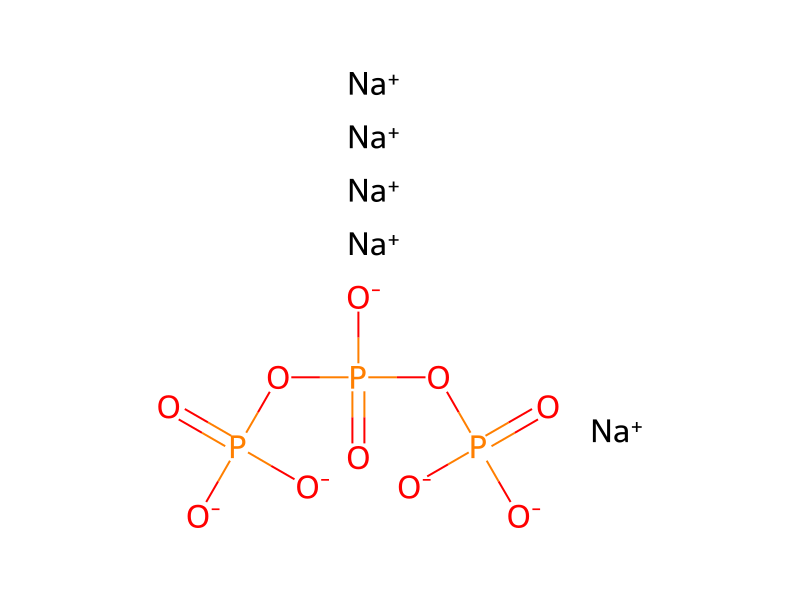
基本情報
- 標準SMILES
O=P([O-])([O-])OP(=O)([O-])OP(=O)([O-])[O-].[Na+].[Na+].[Na+].[Na+].[Na+]- InChIKey
HWGNBUXHKFFFIH-UHFFFAOYSA-I- 分子式
- Na5P3O10
- 平均分子量
- 367.86 g/mol
- 単同位体質量
- 367.81927749
概要
The CIR Expert Panel concluded that the following 31 ingredients are safe in the present practices of use and concentration in cosmetics as described in this safety assessment, when formulated to be non-irritating...Pentasodium Triphosphate...
名称と識別子
- 優先名称
- Sodium Tripolyphosphate
- IUPAC
- pentasodium;[oxido(phosphonatooxy)phosphoryl] phosphate
- 現地名
- 三りん酸ペンタナトリウム
- 英語名
- Sodium tripolyphosphate
- 分子式
- Na5O10P3
- 分子量
- 367.86
名称と別名
7758-29-4Pentasodium triphosphateSTPPArmofosThermphosRhodiaphos LVThermphos NTriphosphoric acid, pentasodium saltThermphos SPRThermphos L 50Sodium phosphate (Na5P3O10)Sodium triphosphate (Na5P3O10)
名称をさらに表示
三りん酸五ナトリウムアルモホストリポリりん酸ナトリウムフリーズ-ガードFP-19ロジアホスLV三りん酸ペンタナトリウムトリポリりん酸ソーダエンピホスSTP-DテルムホスSPRポリゴンテルムホスNテルムホスL-50テルムホストリポリリン酸ソダトリポリリン酸ソ-ダペンタナトリウム=トリホスファト三リン酸5Naトリポリリン酸ナトリウム TECHNICAL GRADE,85%トリポリりん酸ナトリウム,無水三リン酸ナトリウム 五塩基性polySTPtripolyphosphateSODIUM TRIPHOSPHATEPENTASODIUM TRIPOLYPHOSPHATEFood Grade Sodium Tripolyphosphates400PDpTSM
9SW4PFD2FZS 400DTXSID9036307RefChem:1714745HK03SA80JDTXCID7016307SODIUM TRIPOLYPHOSPHATE, UNSPECIFIED231-838-7
データベース識別子
- CAS
7758-29-4、9010-08-6- PubChem CID
- 24455
- DTXSID
DTXSID9036307- UNII
- 9SW4PFD2FZ
- EC Number
- 231-838-7、618-452-8
- Nikkaji
- J44.053A
物性
構造計算による物性
- 極性表面積
- 185 Ų
- 水素結合供与体数
- 0
- 水素結合受容体数
- 10
- 回転可能結合数
- 2
- 重原子数
- 18
- 形式電荷
- 0
- 複雑度
- 241
実験および物理化学的性質
Chemical ClassesMetals -> Phosphates, Metallic Salts
Cosmetics
Cosmetic ingredients (Pentasodium Triphosphate) -> CIR (Cosmetic Ingredient Review)
Chelating; Buffering
pH
Between 9,1 and 10,2 (1 % solution)
1% soln @ 25 °C = 9.7-9.8
Food AdditivesANTICAKING AGENT OR FREE-FLOW AGENT, ANTIOXIDANT, DRYING AGENT, EMULSIFIER OR EMULSIFIER SALT, HUMECTANT, PH CONTROL AGENT, SEQUESTRANT, STABILIZER OR THICKENER, TEXTURIZER -> FDA Substance added to food
Density2.52 g/cm³
Color/Form
White powder
Two crystalline forms of anhydrous salt (transition point 417 °C)
Solubility
Freely soluble in water. Insoluble in ethanol
Sol in water (g/100 ml) at 25 °C: 20; at 100 °C: 86.5
Solubility in water, g/100ml at 25 °C: 14.5
Melting Point
622 °C
622 °C
622 °C
Physical Description
Large Crystals; CBI; Dry Powder; Other Solid; Dry Powder; Liquid; Liquid; Liquid; Other Solid
White, slightly hygroscopic granules or powder
Slightly hygroscopic solid; [Merck Index] White granules; [MSDSonline]
WHITE CRYSTALS OR POWDER.
Stability/Shelf LifeMORE STABLE THAN THE HIGHER (IE, META-) PHOSPHATES, BUT LESS STABLE THAN TETRASODIUM PYROPHOSPHATE
Other Experimental Properties
With prolonged heating of sodium tripolyphosphate soln, it tends to revert to the orthophosphate.
Hygroscopic
Its properties are between those of tetrasodium pyrophosphate & sodium metaphosphate.
TRIPOLYPHOSPHATE @ 20 MG/L DOES NOT AFFECT SMELL, TASTE & ACTIVE REACTION (PH) OF WATER. LIMITING PROPERTY IS TURBIDITY AT 5 MG/L ON HEATING.
Forms stable hydrates.
物理化学的性質
- 融点
- 622 °C · 622 °C
- 比重(密度)
- 2.52 g/cm3 · 2.52 g/cm3 (20℃)
- 蒸気圧
- 0.1 hPa · <0.1 hPa (20 °C)
- 屈折率
- 1.658 · 1.658
- 貯蔵温度
- Storage temperature: no restrictions.
- 溶解性
- 2 O: · H2O: 透明からわずかにかすんでいる場合があります
- 外見
- 粉体・固形
- 色
- 白い
- 臭い (Odor)
- 無臭
- PH
- 9 · 9.0-10.0 (25℃, 1% in H2O)
- 水溶解度
- 20 g/100mL · 20g/100mL(20℃)
- Merck
- 14 · 14,8697
- 安定性
- 安定。強酸化剤、強酸とは相容れない。吸湿性。
- 化粧品成分の機能
- キレート化バッファリング
- InChI
- 1S/5Na.H5O10P3/c;;;;;1-11(2,3)9-13(7,8)10-12(4,5)6/h;;;;;(H,7,8)(H2,1,2,3)(H2,4,5,6)/q5*+1;/p-5
- InChIKey
- HWGNBUXHKFFFIH-UHFFFAOYSA-I
- SMILES
- [Na+].[Na+].[Na+].[Na+].[Na+].[O-]P([O-])(=O)OP([O-])(=O)OP([O-])([O-])=O
- LogP
- -4.691 · -4.691 (est)
- CAS データベース
- 7758 · 7758-29-4(CAS DataBase Reference)
- EPAの化学物質情報
- Sodium tripolyphosphate (7758-29-4)
化学的性質
化学的特性white or colourless crystals, granules or powder
安全と法規制
GHS分類
GHS Classification
This chemical does not meet GHS hazard criteria for 36% (1266 of 3517) of reports.
Warning
H315 (62.2%): Causes skin irritation [Warning Skin corrosion/irritation]
P261, P264, P264+P265, P271, P280, P302+P352, P304+P340, P305+P351+P338, P319, P321, P332+P317, P337+P317, P362+P364, P403+P233, P405, and P501 (click each P-code to see the statement)
Aggregated GHS information provided per 3517 reports by companies from 19 notifications to the ECHA C&L Inventory. Each notification may be associated with multiple companies.
危険有害性情報
Regulatory Information
Chemical: Triphosphoric acid, pentasodium salt
Triphosphoric acid, sodium salt (1:5) is listed on the EPA's Chemical Data Reporting (CDR) system. Manufacturers and importers of Triphosphoric acid, sodium salt (1:5) are required to report information about their production and use of this chemical to the EPA under the Toxic Substances Control Act (TSCA). (40 eCFR Part 711)
Status: Active Update: 01-12-2021 https://echa.europa.eu/registration-dossier/-/registered-dossier/15386
Pentasodium tripolyphosphate: Does not have an individual approval but may be used under an appropriate group standard
Other Safety InformationIMAP assessments - Triphosphoric acid, pentasodium salt: Human health tier I assessment
Fire HazardsNot combustible. Gives off irritating or toxic fumes (or gases) in a fire.
Hazards Summary
A moderate skin and mucous membrane irritant; [Merck Index] Emergency treatment: Irritants; [HSDB] Aerosol is a mild skin, eye, and respiratory tract irritant; [ICSC] A skin, eye, and respiratory tract irritant; [CAMEO] May cause eye, nose, and throat irritation; Effects in high-dose ingestion animal studies include kidney damage; [CHEMINFO] An irritant; [MSDSonline]
FDA Requirements
Sodium tripolyphosphate used as a multiple purpose food substance in food for human consumption is generally recognized as safe when used in accordance with good manufacturing practice.
Sodium tripolyphosphate used as a sequestrant in food for human consumption is generally recognized as safe when used in accordance with good manufacturing practice.
Sodium tripolyphosphate used as a general purpose food additive in animal drugs, feeds, and related products is generally recognized as safe when used in accordance with good manufacturing or feeding practice.
Sodium tripolyphosphate used as a sequestrant in animal drugs, feeds, and related products is generally recognized as safe when used in accordance with good manufacturing or feeding practice.
Sodium tripolyphosphate is a food additive permitted for direct addition to food for human consumption, as long as 1) the quantity of the substance added to food does not exceed the amount reasonably required to accomplish its intended physical, nutritive, or other technical effect in food, and 2) any substance intended for use in or on food is of appropriate food grade and is prepared and handled as a food ingredient.
EPA Safer ChemicalChemical: Sodium tripolyphosphate
FIFRA Requirements
Residues of sodium tripolyphosphate are exempted from the requirement of a tolerance when used as a buffer, surfactant, suspending agent, dispersing agent, anticaking agent or conditioning agent in accordance with good agricultural practices as inert (or occasionally active) ingredients in pesticide formulations applied to growing crops or to raw agricultural commodities after harvest.
As the federal pesticide law FIFRA directs, EPA is conducting a comprehensive review of older pesticides to consider their health and environmental effects and make decisions about their future use. Under this pesticide reregistration program, EPA examines health and safety data for pesticide active ingredients initially registered before November 1, 1984, and determines whether they are eligible for reregistration. In addition, all pesticides must meet the new safety standard of the Food Quality Protection Act of 1996. Pesticides for which EPA had not issued Registration Standards prior to the effective date of FIFRA, as amended in 1988, were divided into three lists based upon their potential for human exposure and other factors, with List B containing pesticides of greater concern and List D pesticides of less concern. Sodium tripolyphosphate is found on List D. Case No: 4053; Pesticide type: fungicide, herbicide, and antimicrobial; Case Status: None of the active ingredients in the case are being supported for reregistration by their registrants. All are unsupported, or some are unsupported and some are cancelled. Cases described as "unsupported" generally are being processed for cancellation.; Active ingredient (AI): sodium tripolyphosphate; AI Status: The active ingredient is no longer contained in any registered pesticide products ... "cancelled."
Chemical DangersDecomposes on heating. This produces toxic fumes including phosphorus oxides.
Toxic Combustion ProductsWHEN HEATED TO DECOMP, CAN EMIT HIGHLY TOXIC FUMES OF PO(X). /PHOSPHATES/
CERCLA Reportable Quantities
Persons in charge of vessels or facilities are required to notify the National Response Center (NRC) immediately, when there is a release of this designated hazardous substance, in an amount equal to or greater than its reportable quantity of 5000 lb or 2270 kg. The toll free number of the NRC is (800) 424-8802; In the Washington D.C. metropolitan area (202) 426-2675. The rule for determining when notification is required is stated in 40 CFR 302.4 (section IV. D.3.b).
Hazard Classes and CategoriesSkin Irrit. 2 (62.2%)
Skin, Eye, and Respiratory Irritations
EYE CONTACT WITH CONCENTRATED ALKALI CAUSES CONJUNCTIVAL EDEMA & CORNEAL DESTRUCTION. A. ALKALIES PENETRATE SKIN SLOWLY. EXTENT OF DAMAGE THEREFORE DEPENDS ON DURATION OF CONTACT. B. CHRONIC POISONING (FROM SKIN CONTACT). CHRONIC DERMATITIS MAY FOLLOW REPEATED CONTACT ... . /ALKALIES/
安全と保護具
Fire FightingIn case of fire in the surroundings, use appropriate extinguishing media.
First Aid Measures
Fresh air, rest. Refer for medical attention.
Rinse skin with plenty of water or shower.
First rinse with plenty of water for several minutes (remove contact lenses if easily possible), then refer for medical attention.
Rinse mouth. Give one or two glasses of water to drink.
Safe StorageDry. Well closed.
Firefighting HazardsBehavior in fire: May melt with loss of steam. /Sodium Phosphates/
Disposal Methods
SRP: At the time of review, criteria for land treatment or burial (sanitary landfill) disposal practices are subject to significant revision. Prior to implementing land disposal of waste residue (including waste sludge), consult with environmental regulatory agencies for guidance on acceptable disposal practices.
Spillage Disposal
Personal protection: particulate filter respirator adapted to the airborne concentration of the substance. Sweep spilled substance into covered containers. Carefully collect remainder. Then store and dispose of according to local regulations.
Eye PreventionWear safety spectacles or eye protection in combination with breathing protection if powder.
Inhalation RiskA nuisance-causing concentration of airborne particles can be reached quickly, especially if powdered.
Skin PreventionProtective gloves.
Allowable Tolerances
Residues of sodium tripolyphosphate are exempted from the requirement of a tolerance when used as a buffer, surfactant, suspending agent, dispersing agent, anticaking agent or conditioning agent in accordance with good agricultural practices as inert (or occasionally active) ingredients in pesticide formulations applied to growing crops or to raw agricultural commodities after harvest.
Ingestion PreventionDo not eat, drink, or smoke during work.
Inhalation PreventionUse ventilation (not if powder).
毒性情報
Interactions
The mechanism by which sodium tripolyphosphate increases cadmium toxicity after sc administration was investigated in mice after a dose of cadmium (30 umol/kg), alone or with sodium tripolyphosphate (90 umol/kg). ... Histological ... changes in the liver were not observed during the first 12 hr after injection of cadmium, but already 6-8 hr after injection of cadmium plus sodium tripolyphosphate early centrilobular necroses and blood stasis appeared. At 12 hr more advanced necroses were present. Sodium tripolyphosphate administered alone was nontoxic and did not change the liver morphology, when compared to animals killed immediately after injection. During the first 12 hr after cadmium administration with sodium tripolyphosphate, there was a much faster transport of cadmium, giving rise to higher liver and kidney concn of cadmium and partial inhibition of cadmium-metallothionein binding, as compared with animals receiving the same dose of cadmium without sodium tripolyphosphate.
The adjuvant effect of di-sodium DL-alpha-glycerophosphate on the rectal absorption of cefoxitin (as the sodium salt) was greatly augmented by the presence of ... sodium tripolyphosphate. ... Coadjuvants only slightly enhanced cefoxitin rectal absorption when administered alone.
Exposure RoutesThe substance can be absorbed into the body by inhalation of its aerosol.
Toxicity Summary
The CIR Expert Panel concluded that the following 31 ingredients are safe in the present practices of use and concentration in cosmetics as described in this safety assessment, when formulated to be non-irritating...Pentasodium Triphosphate...
Safe for use in cosmetics, with qualifications
IDENTIFICATION AND USE: Pentasodium tripolyphosphate is a white powder which is soluble in water.r It is used as a hydrogen peroxide stabilizer. This chemical is one of the most widely used and most effective builder in heavy duty fabric washing compositions. Because of its high sequestration power, it also finds extensive application in automatic dish washing detergents. It forms stable hydrates and aids in the manufacture of crisp spray dried laundry powders. It is used in dairy substitute products: milk based pudding, whipped topping, sour cream, and cheese. It is used in water softening and as a peptizing agent; emulsifier and dispersing agent, it is an ingredient of cleansers in drilling fluids to control mud viscosity in oil fields; as preservative, sequestrant, and as a texturizer in foods. The active ingredient is no longer contained in any registered pesticide products used in the United States. HUMAN EXPOSURE AND TOXICITY: If ingested in large amounts this chemical can cause nausea, vomiting, and diarrhea. It has produced vesiculation when applied to intact and abraded skin of humans. Sodium and potassium hexametaphosphates, polyphosphates, tripolyphosphates, pyrophosphates, and other phosphates used as water softeners form complexes with calcium and, after ingestion, are capable of seriously reducing the serum level of ionic calcium. They have less corrosive effect on mucous membranes than sodium or potassium hydroxide. Eye contact with concentrated material can cause conjunctival edema and corneal destruction. Chronic dermatitis may follow repeated contact of the chemical that migrates to food from packaging materials. Occupational exposure involves acetyl cellulose makers, bronze alloy makers, munitions workers, smoke bomb and incendiary makers, pesticide rat poison worker, fertilizer makers, electroluminescent-coating makers, and semiconductor workers. ANIMAL STUDIES: This chemical induced emesis in dogs. Dietary administration in animals has caused decrease iron content in bone, liver, and spleen, and bone depletion of calcium.
Signs and Symptoms
Cough. Sore throat.
Redness. Pain.
Redness. Pain.
Human Toxicity Excerpts
IF INGESTED IN LARGE AMT NAUSEA, VOMITING, & DIARRHEA ARE PROBABLE. ... IF APPRECIABLE AMT OF INTACT POLYMER ARE ABSORBED FROM ALIMENTARY TRACT, HYPOCALCEMIC TETANY MAY BE A DANGER DUE TO BINDING (CHELATION) OF IONIZED CALCIUM. HYPOCALCEMIC TETANY ALSO OCCURRED IN ONE INGESTION EPISODE. /TRIPOLYPHOSPHATE/
CMPD APPLIED TO INTACT & ABRADED SKIN OF HUMANS FOR 4 HR: SKIN RESPONSES GRADED 4, 24 & 48 HR AFTER. SODIUM TRIPOLYPHOSPHATE PRODUCED VESICULATION @ ABRADED SITES OF 1 OF 6 HUMANS.
A 1% AQ SOLN HAS A PH OF 9.8, & PH OF CONCENTRATED SOLN (SLURRIES) IS ABOUT 10.5, SO THAT THERE IS NO SIGNIFICANT DANGER OF CORROSIVE INJURIES TO THE EYES OR ESOPHAGUS AS IN LYE POISONING ... WITH PH'S ABOVE 11 OR EVEN 12. /TRIPOLYPHOSPHATE/
ACUTE POISONING BY INJESTION: ... EVEN THOUGH PATIENTS RECOVER FROM IMMEDIATE DAMAGE, ESOPHAGEAL STRICTURE CAN OCCUR WK, MO, OR YR LATER TO MAKE SWALLOWING DIFFICULT. INGESTION OF TRIPOLYPHOSPHATE ... IN ... DETERGENTS OR LAXATIVES CAUSE SHOCK-LIKE STATE, FALL OF BLOOD PRESSURE, SLOW PULSE, CYANOSIS COMA & SOMETIMES TETANY AS RESULT OF REDN IN IONIC CALCIUM. /ALKALIES/
For more Human Toxicity Excerpts (Complete) data for PENTASODIUM TRIPOLYPHOSPHATE (7 total), please visit the HSDB record page.
Non-Human Toxicity Excerpts
IN BEAGLE DOGS, SODIUM TRIPOLYPHOSPHATE INDUCED EMESIS. EMESIS PROBABLY RESULTS FROM A DIRECT ACTION UPON THE GI MUCOSA.
DIETARY ADMIN OF TRIPOLYPHOSPHATE DECR BONE, LIVER & SPLEEN CONTENTS OF IRON & INCR THE BONE DEPOSITION OF CALCIUM.
Gastrointestinal absorption, transport, tissue deposition, and excretion of cadmium were investigated in mice after single or repeated exposure with or without chelating agents. Male CBA-mice received a single oral 69 mg/kg dose of cadmium-109 in combination with a single 600 mg/kg dose of nitrilotriacetic acid, sodium tripolyphosphate, or 60 or 600 mg/kg ethylenediaminetetraacetic acid. Animals were observed, and blood cadmium concentrations followed, from 5 minutes to 21 days before dissection and tissue analysis. Female CBA-mice received a single oral 15 ug/kg dose of radioactive cadmium in combination with cadmium and 50 or 500 ppm of these chelating agents in their drinking water and were observed for 18 months. Acute cadmium toxicity was reduced in mice given cadmium in combination with ethylenediaminetetraacetic acid. At all times from 5 minutes to 5 hours after dosing blood cadmium concentrations were lowest in mice exposed to cadmium plus sodium tripolyphosphate. Almost all cadmium in kidneys of mice exposed to cadmium and ethylenediaminetetraacetic acid at the higher doses was bound in the cadmium ethylenediaminetetraacetic acid complex, while at the lower dose of ethylenediaminetetraacetic acid part of the cadmium was bound to high molecular weight proteins. Cadmium 24 hour elimination was increased from 20% with cadmium alone to 45% with the higher and 35% with the lower dose of ethylenediaminetetraacetic acid. Whole body retention at 21 days was 4.4% with cadmium alone, 2% with nitrilotriacetic acid and 5.5% with sodium tripolyphosphate. With repeated exposure no substantial differences in whole body or organ retention of cadmium were seen after treatment with different chelating agents. Chelating agents did not affect mortality over 18 months. /It was concluded/ that the effects of different chelating agents on acute cadmium toxicity and metabolism are produced by change in the stability of the chelate complexes and the availability of metal binding ligands in-vivo.
Probable Routes of Human Exposure
MIGRATES TO FOOD FROM PACKAGING MATERIALS ... .
Occupational exposure involves acetyl cellulose makers, bronze alloy makers, munitions workers, smoke bomb and incendiary makers, pesticide rat poison worker, fertilizer makers, electroluminescent-coating makers, and semiconductor workers. /Phosphorus/
RAIS Toxicity Values
1
PPRTV Current
4
PPRTV Current
Non-Human Toxicity Values
LD50 Mouse stomach, sc and ip 3.02, 1.26, and 0.94 g/kg, respectively.
LD50 Rat stomach, sc and ip 5.19, 2.06, and 1.78 g/kg, respectively.
LD50 Guinea pig sc 0.75 g/kg.
Hazard Quotient Level 0.1 or Cancer Risk Level 1E-06
7.80e+04
1.20e+06
2.00e+04
1.5E+01(G)
1.00e+00
Volatile
Hazard Quotient Level 3 or Cancer Risk Level 1E-04
2.30e+05
3.50e+06
6.00e+04
1.5E+01 (G)
1.00e+00
Volatile
法規制情報
FDA Requirements
Sodium tripolyphosphate used as a multiple purpose food substance in food for human consumption is generally recognized as safe when used in accordance with good manufacturing practice.
Sodium tripolyphosphate used as a sequestrant in food for human consumption is generally recognized as safe when used in accordance with good manufacturing practice.
Sodium tripolyphosphate used as a general purpose food additive in animal drugs, feeds, and related products is generally recognized as safe when used in accordance with good manufacturing or feeding practice.
Sodium tripolyphosphate used as a sequestrant in animal drugs, feeds, and related products is generally recognized as safe when used in accordance with good manufacturing or feeding practice.
Sodium tripolyphosphate is a food additive permitted for direct addition to food for human consumption, as long as 1) the quantity of the substance added to food does not exceed the amount reasonably required to accomplish its intended physical, nutritive, or other technical effect in food, and 2) any substance intended for use in or on food is of appropriate food grade and is prepared and handled as a food ingredient.
FIFRA Requirements
Residues of sodium tripolyphosphate are exempted from the requirement of a tolerance when used as a buffer, surfactant, suspending agent, dispersing agent, anticaking agent or conditioning agent in accordance with good agricultural practices as inert (or occasionally active) ingredients in pesticide formulations applied to growing crops or to raw agricultural commodities after harvest.
As the federal pesticide law FIFRA directs, EPA is conducting a comprehensive review of older pesticides to consider their health and environmental effects and make decisions about their future use. Under this pesticide reregistration program, EPA examines health and safety data for pesticide active ingredients initially registered before November 1, 1984, and determines whether they are eligible for reregistration. In addition, all pesticides must meet the new safety standard of the Food Quality Protection Act of 1996. Pesticides for which EPA had not issued Registration Standards prior to the effective date of FIFRA, as amended in 1988, were divided into three lists based upon their potential for human exposure and other factors, with List B containing pesticides of greater concern and List D pesticides of less concern. Sodium tripolyphosphate is found on List D. Case No: 4053; Pesticide type: fungicide, herbicide, and antimicrobial; Case Status: None of the active ingredients in the case are being supported for reregistration by their registrants. All are unsupported, or some are unsupported and some are cancelled. Cases described as "unsupported" generally are being processed for cancellation.; Active ingredient (AI): sodium tripolyphosphate; AI Status: The active ingredient is no longer contained in any registered pesticide products ... "cancelled."
CERCLA Reportable Quantities
Persons in charge of vessels or facilities are required to notify the National Response Center (NRC) immediately, when there is a release of this designated hazardous substance, in an amount equal to or greater than its reportable quantity of 5000 lb or 2270 kg. The toll free number of the NRC is (800) 424-8802; In the Washington D.C. metropolitan area (202) 426-2675. The rule for determining when notification is required is stated in 40 CFR 302.4 (section IV. D.3.b).
安全データ
- F
- 3
- wgk
- 1
- tsca
- TSCA listed
- rtecs
- YK4570000
- 毒性
- LD50 orally in rats: 6.50 g/kg (Smyth)
- hs_code
- 28353110
- risk_code
- 36/37/38
- hazard_code
- Xi
- safety_code
- 26-36-24/25
- ストレージクラス
- 11 - Combustible Solids
- 有毒物質データの
- 7758-29-4(Hazardous Substances Data)
化学と産業
薬理情報
Mechanism of Action
The effects of condensed phosphate ( ... sodium tripolyphosphate ... ) on the growth of Streptococcus mutans, sugar metabolism in vitro, and S mutans-induced caries of hamsters were studied. All condensed phosphates depressed the growth of S mutans. This growth inhibition was reversed by divalent metal ions. Thus, the chelating capacity of condensed phosphate is responsible for their antibacterial actions. Condensed phosphates depressed lactate production from glucose and sucrose by the S mutans.
Metabolism/Metabolites
THOUGHT TO BE HYDROLYZED TO (ORTHO)PHOSPHATES BEFORE ABSORPTION. /TRIPOLYPHOSPHATE/
In the body, phosphorus is converted to phosphates. /Phosphorus/
Absorption, Distribution and Excretion
If ingested in large amounts nausea, vomiting and diarrhea are probable. Thought to be hydrolyzed to (ortho)phosphates before absorption. If appreciable amounts of the intact polymer are absorbed from the alimentary tract, hypocalcemic tetany may be a danger due to the binding (chelation) of ionized calcium. Hypocalcemic tetany apparently occurred in one ingestion episode. /Tripolyphosphate/
用途と製造
Uses
CIR ingredient: Pentasodium Triphosphate
Used in water softening, heavy-duty fabric washing, automatic dish washing, drilling fluid cleaning, and liquid cattle feed supplements; Also used as a peptizing, emulsifying, and dispersing agent; a preservative, sequestrant, and texture-modifier in foods; a sealant for leaking farm ponds; and a calcium and magnesium chelating agent; [HSDB] Used in paper pulping, paper coatings, clay and textile processing, and ore flotation; Also used as a hydrogen peroxide solution stabilizer and to make rubber and paint; [CHEMINFO]
Petroleum Production and Refining [Category: Industry]
The active ingredient is no longer contained in any registered pesticide products ... "cancelled."
TO SEAL LEAKING FARM PONDS BY MIXING WITH SOIL FLOOR
Used as a hydrogen peroxide stabilizer. /phosphates/
ImpuritiesMay contain up to 10% pyrophosphate & up to 5% trimetaphosphate.
U.S. Exports
(1972) 4.96X10+10 GRAMS
(1975) 8.46X10+10 GRAMS
(1984) 3.28X10+10 G.
U.S. Imports
(1972) NEGLIGIBLE
(1975) 5.44X10+9 GRAMS
U.S. Production
2023: 55,000,000 - <70,000,000 lb
(1972) 9.38X10+11 GRAMS
(1975) 6.99X10+11 GRAMS
(1979) 688 thousand metric tons
(1984) 6.12X10+11 G.
Production Capacity: 555 thousand tons/year /Sodium tripolyphosphate (STPP)/
Consumption Patterns
85% AS A PHOSPHATE BUILDER (CONDITIONER) FOR HOME LAUNDRY DETERGENTS; 8% AS A PHOSPHATE BUILDER (CONDITIONER) FOR AUTOMATIC DISHWASHING DETERGENTS; 2% AS AN ADDITIVE FOR PROCESSED MEAT, TUNA, & POULTRY; 1% AS A PHOSPHATE BUILDER (CONDITIONER) FOR SCOURING CLEANSERS; 1% AS A PHOSPHATE BUILDER (CONDITIONER) FOR LAUNDRY PRESOAKS; & 3% FOR MISC APPLICATIONS (1973).
Home laundry detergent builder, 45%; Industrial and institutional detergents, 24%; Dish washing detergents, 16%; Food uses, 3.5%; Misc, 6%; Exports, 5.5% (1984).
Industrial and institutional detergents, 45%; autodish detergents, 40%; food uses, 10%; home laundry detergent builder, 5%. /Sodium tripolyphosphate (STPP)/
Consumer UsesWetting agent (non-aqueous)
Industry UsesBinder
Methods of Manufacturing
Prepared by molecular dehydration of mono- & disodium phosphates.
Controlled calcination of sodium orthophosphate mixture from sodium carbonate & phosphoric acid.
Formulations/Preparations
Grades: Powdered & Granular, FCC /Food Chemicals Codex/.
A bath salt: ... triethanolamine salt of ethoxylated lauryl alcohol 9.0%, lauryl ammonium sulfate 2.0%, diethanolamides of coconut or rape oil fatty acids 1.0%, ethoxylated lanolin 0.500%, ethyl alcohol 2.0%, pentasodium tripolyphosphate 10.0%, sodium chloride 42.8%, tartaric acid 13.0%, anhydrous sodium sulfate 19.299%, fragrance 0.4%, and dye 0.001%.
Household ProductsInformation on 53 consumer products that contain Pentasodium tripolyphosphate in the following categories is provided:
Use Classification
EPA Safer Chemical Functional Use Classes -> Oxidants and Oxidant Stabilizers
Safer Chemical Classes -> Yellow triangle - The chemical has met Safer Choice Criteria for its functional ingredient-class, but has some hazard profile issues
Food additives
Food Additives -> SEQUESTRANT; TEXTURIZER; THICKENER -> JECFA Functional Classes
Food Additives -> SEQUESTRANT; TEXTURIZER; THICKENER -> JECFA Functional Classes
Food Additives -> SEQUESTRANT; TEXTURIZER; THICKENER -> JECFA Functional Classes
応用分野
解説水溶性の無色結晶,Na5P3O10.トリポリリン酸ナトリウムは俗称.六水和物および無水和物Ⅰ型(高温安定型)とII型(低温安定型)の三つの結晶型が知られている.金属イオン錯化能,アルカリ緩衝能などに優れ,合成洗剤のビルダーとして用いられているが,廃水による環境問題から需要は減少している.硬水軟化剤,染色助剤,食品添加物などとしても用いられる.
用途合成洗剤、清缶剤
使用Sodium tripolyphosphate is a binder, stabilizer, and sequestrant that is mildly alkaline, with a pH of 10, and moderately soluble in water, with a solubility of 15g in 100ml of water at 25°C. It is used to improve the whipping properties of egg-containing angel food cake mix and meringues. It reduces gelling of juices and canned ham and tenderizes canned peas and lima beans. It is a moisture binder in cured pork and protects against discoloration and reduces shrinkage in sausage products. In algin desserts, it functions as a calcium sequestrant. Sodium tripolyphosphate is also termed pentasodium tripolyphosphate and sodium triphosphate.
調製方法
合成方法NaHPO4とNaHPO4の2:1(モル比)混合物を540?580℃で焼成
純化方法Purify it by repeated precipitation from aqueous solution by slow addition of MeOH and dried in air. Also a solution of anhydrous sodium tripolyphosphate (840g) in water (3.8L) is filtered, MeOH (1.4L) is added with vigorous stirring to precipitate Na5P3O10.6H2O. The precipitate is collected on a filter, air dried by suction, then left to dry in air overnight. It is crystallised twice more in this way, using a 13% aqueous solution (w/w), and leaching the crystals with 200mL portions of water [Watters et al. J Am Chem Soc 78 4855 1956]. Similarly, EtOH can be added to precipitate the salt from a filtered 12-15% aqueous solution, the final solution containing ca 25% EtOH (v/v). Air drying should be at a relative humidity of 40-60%. Heat and vacuum drying should be avoided. [Quimby J Phys Chem 58 603 1954, Klement in Handbook of Preparative Inorganic Chemistry (Ed. Brauer) Academic Press Vol I p 547 1963.]
上流・下流製品情報
上流原料
下流製品
サプライヤー50 社
国药集团化学试剂有限公司86-21-63210123 · [email protected]
北京华美互利生物化工010-56205725 · [email protected]
郑州阿尔法化工有限公司+86-18530059196 · [email protected]
衢州润东化工有限公司0570-8789886 18892685668 · [email protected]
济南聚美汇化工有限公司1876152800 15098881566 · [email protected]
上海阿拉丁生化科技股份有限公司400-6206333 13167063860 · [email protected]
武汉麦可欣科技有限公司027-85785063 13476159580 · [email protected]
河北创海生物科技有限公司+86-86-13131129325 · [email protected]
上海迈瑞尔生化科技有限公司4006356688 18621169109 · [email protected]
大连美仑生物技术有限公司0411-62910999 13889544652 · [email protected]
阿法埃莎(中国)化学有限公司400-6106006 · [email protected]
安耐吉化学&3A(安徽泽升科技股份有限公司)400-0056266 · [email protected]
北京绿百草科技发展有限公司010-61136123 · [email protected]
上海瀚鸿科技股份有限公司021-54306202 13764082696 · [email protected]
山东洛克化工有限公司17653113209 13065062079 · [email protected]
南通合润生物科技有限公司18362409333 · [email protected]
上海景颜化工科技有限公司13817811078 · [email protected]
上海泰坦科技股份有限公司400-6009262 15618770481 · [email protected]
济南圣丰工贸有限公司186-15597515 17615809616
天津金汇太亚化学试剂有限公司022-59582624 18622766592 · [email protected]
山东西亚化学有限公司13355009207 13355009207 · [email protected]
玛雅试剂+86 (573) 82222445 (0)18006601000 452520369 · [email protected]
四川库利南科技有限公司400-1166-196 18981987031 · [email protected]
天津希恩思生化科技有限公司400 638 7771 · [email protected]
斯百全化学(上海)有限公司021-021-021-67601398-809-809-809 15221380277 · [email protected]
上海源叶生物科技有限公司13636370518 · [email protected]
赛默飞世尔科技(中国)有限公司800-810-5118 · [email protected]
北京伊诺凯科技有限公司400-810-7969 010-59572699 · [email protected]
深圳振强药物研发有限公司0755-66853366 13670046396 · [email protected]
潍坊沃腾进出口有限公司0536-2456718
南京杜莱生物技术有限公司025-84699383-8003;025-846993838003-8003 18013301590 · [email protected]
陕西帕尼尔生物科技有限公司13720616393;029-84385017-8003 13720616393 · [email protected]
北京环宇世纪化学科技有限公司hysj_bj.com
上海将来实业股份有限公司400-0066400 13621662912 · [email protected]
安徽科迪达化工有限公司0554-2106669 · [email protected]
HBCChem, Inc.+1-510-219-6317 · [email protected]
日照力德士化工有限公司010-51268198 · [email protected]
成都零六生物科技有限公司400-1166-196 13458535857 · [email protected]
上海御略医药科技有限公司021-60345187 13671753212 · [email protected]
上海麦克林生化科技股份有限公司15221275939 15221275939 · [email protected]
杭州杰恒化工有限公司0571-87396432 · [email protected]
成都润泽本土化工有限公司13096311329 028-88469284 616445927 · [email protected]
湖北巨胜科技有限公司027-59599241 18871490274 · [email protected]
池州凯隆进出口贸易有限公司[email protected]
Sigma-Aldrich西格玛奥德里奇(上海)贸易有限公司021-61415566 800-8193336 · [email protected]
西安康诺化工有限公司029-86107037 15829389671 · [email protected]
九鼎化学(上海)科技有限公司4009209199 · [email protected]
尤尼威尔化学品(上海)有限公司021-61932772 13012862996 · [email protected]
杭州鼎燕化工有限公司0571-87157530-8003 18267553885 · [email protected]
山东智尚新材料有限公司+8617653113209 · [email protected]
補足説明
定義本品は、次の化学式で表される無機塩である。
関連反応
25 件


関連ノート
読み込み中…