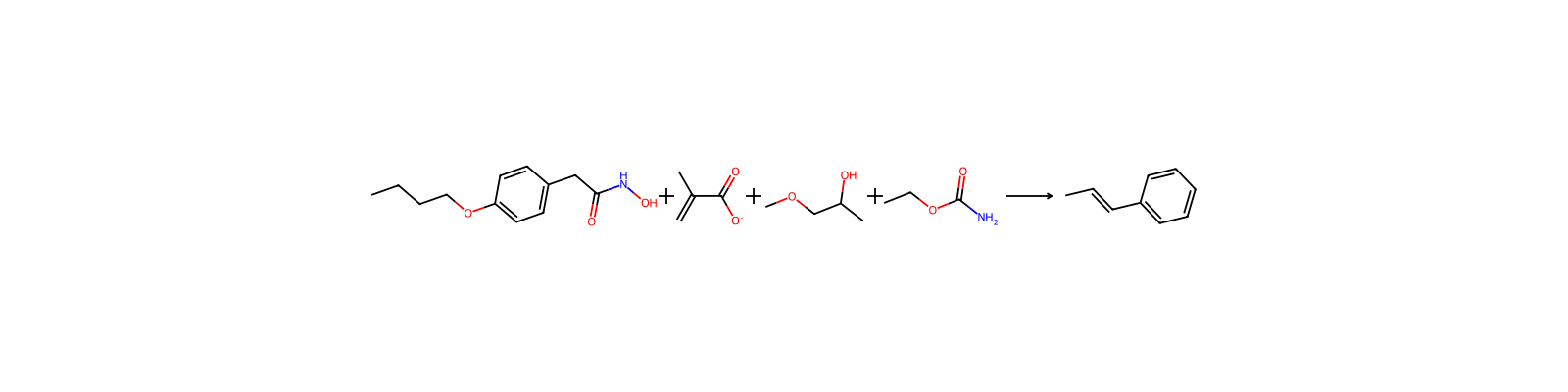
HRID 73474反応物として
Bufexamac

2438-72-4CCCCOc1ccc(CC(=O)NO)cc1MXJWRABVEGLYDG-UHFFFAOYSA-NBufexamac is a hydroxamic acid derived from phenylacetamide in which the benzene moiety is substituted at C-4 by a butoxy group. It has anti-inflammatory, analgesic, and antipyretic properties. It has a role as a non-steroidal anti-inflammatory drug, a non-narcotic analgesic and an antipyretic. It is a hydroxamic acid and an aromatic ether.
Pharmaceuticals
Pharmaceuticals -> Listed in ZINC15
Immiscible
>33.5 [ug/mL] (The mean of the results at pH 7.4)
161.48 Ų [M+Na]+ [CCS Type: TW; Method: calibrated with polyalanine and drug standards]
161 Ų [M+H]+ [CCS Type: TW; Method: calibrated with polyalanine and drug standards]
安全情報は参考情報です。供給元の安全データシート(SDS)、適用法令、専門家による評価に代わるものではありません。
This chemical does not meet GHS hazard criteria for 33.3% (1 of 3) of reports.
Warning
H302 (33.3%): Harmful if swallowed [Warning Acute toxicity, oral]
P261, P264, P270, P272, P280, P301+P317, P302+P352, P321, P330, P333+P317, P362+P364, and P501 (click each P-code to see the statement)
Aggregated GHS information provided per 3 reports by companies from 3 notifications to the ECHA C&L Inventory. Each notification may be associated with multiple companies.
M - Musculo-skeletal system
M - Musculo-skeletal system
QM - Musculo-skeletal system
QM - Musculo-skeletal system
Bufexamac is a topically-active anti-inflammatory agent that inhibits the cyclooxygenase enzyme. In cutaneous and deep experimental inflammation, topical administration of bufexamac exerted a dose-related anti-inflammatory effect. In guinea pigs, bufexamax was shown to be more active than topical acetylsalicylic acid 5% or phenylbutazone 5% in delaying the local increase in temperature resulting from UV exposure. Bufexamac is unlikely to have any effect on wound healing.
The full mechanism of action is unclear. It is proposed that bufexamac acts similarly to other non-steroidal anti-inflammatory drugs to inhibit prostaglandin biosynthesis _in vitro_, via inhibiting cyclo-oxygenase (COX) enzymes. Systematically administered bufexamac may accumulate preferentially in the adrenal cortex of rats and may play a role in adrenal stimulation; however its topical anti-inflammatory action is likely to be independent of this effect.
Anti-inflammatory agents that are non-steroidal in nature. In addition to anti-inflammatory actions, they have analgesic, antipyretic, and platelet-inhibitory actions. They act by blocking the synthesis of prostaglandins by inhibiting cyclooxygenase, which converts arachidonic acid to cyclic endoperoxides, precursors of prostaglandins. Inhibition of prostaglandin synthesis accounts for their analgesic, antipyretic, and platelet-inhibitory actions; other mechanisms may contribute to their anti-inflammatory effects.
2438-72-4DTXSID7045368CHEMBL94394CHEBI:31317化学的特性White Solid
Method of application affects the extent of cutaneous absorption. Following rectal administration as suppositories, the systemic absorption was reported to be low.
Following topical administration of 5% bufexamac, the recovery in the urine was 3.5% of the applied dose within 144 hours. Studies in healthy volunteers receiving an oral dose of 125 to 500 mg indicate that an average of 80% of the total dose is excreted in the urine within 48 hours.
No data available.
No data available.
使用Bufexamac is a specific inhibitor of class IIB histone deacetylases (HDAC6 and HDAC10). Bufexamac is a non-steroidal anti-inflammatory drug used topically as well as rectally. Formulations containing Bufexamac is used by many patients with eczematous disorders as an alternative to topical corticosteroids.
定義ChEBI: A hydroxamic acid derived from phenylacetamide in which the benzene moiety is substituted at C-4 by a butoxy group. It has anti-inflammatory, analgesic, and antipyretic properties.