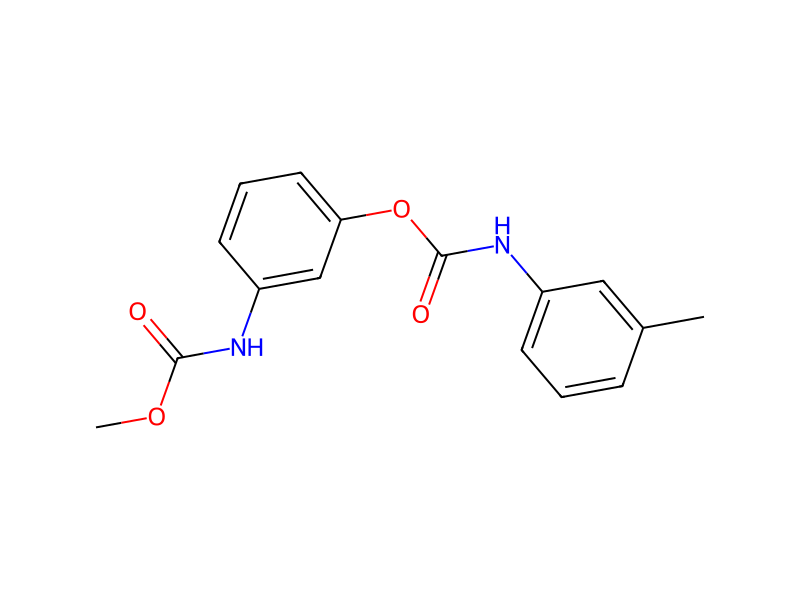
基本情報
- 標準SMILES
COC(=O)Nc1cccc(OC(=O)Nc2cccc(C)c2)c1- InChIKey
IDOWTHOLJBTAFI-UHFFFAOYSA-N- 分子式
- C16H16N2O4
- 平均分子量
- 300.31 g/mol
- 単同位体質量
- 300.11100699
概要
Phenmedipham appears as colorless crystals or white powder. (NTP, 1992)
名称と識別子
- 優先名称
- Phenmedipham
- IUPAC
- [3-(methoxycarbonylamino)phenyl] N-(3-methylphenyl)carbamate
- 現地名
- (3-メチルフェニル)カルバミド酸3-[(メトキシカルボニル)アミノ]フェニル
- 英語名
- Phenmedipham
- 分子式
- C16H16N2O4
- 分子量
- 300.31
名称と別名
名称をさらに表示
データベース識別子
- CAS
13684-63-4- PubChem CID
- 24744
- DTXSID
DTXSID1024255- ChEMBL
CHEMBL1079421- ChEBI
CHEBI:81734- UNII
- UJE31KXP78
- EC Number
- 237-199-0
- Nikkaji
- J1.862G
物性
構造計算による物性
- XLogP
- 3.6
- 極性表面積
- 76.7 Ų
- 水素結合供与体数
- 2
- 水素結合受容体数
- 4
- 回転可能結合数
- 5
- 重原子数
- 22
- 形式電荷
- 0
- 複雑度
- 388
実験および物理化学的性質
Pesticides
Pesticide -> EPA IRIS
Herbicides
Active substance -> EU Pesticides database: Approved
Pesticides -> Herbicides, Other
Environmental transformation -> Pesticides (parent, predecessor)
Herbicides
Density
0.25 to 0.3 at 68 °F (NTP, 1992)
0.25-0.30 g/cu c at 20 °C
Solubility
less than 1 mg/mL at 70 °F (NTP, 1992)
COLORLESS, ODORLESS, CRYSTALLINE SOLID; MP 143-144 °C; SOLUBILITY: 1 MG/L WATER AT 20 °C, ACETONE 20%, CYCLOHEXANONE 20%, METHANOL 5% /TECHNICAL MATERIAL 97% PURE/
4.7 MG/L WATER; ABOUT 200 G/KG IN ACETONE, CYCLOHEXANONE; ABOUT 50 G/KG IN METHANOL; 20 G/KG IN CHLOROFORM; 2.5 G/KG IN BENZENE; ABOUT 500 MG/KG IN HEXENE AT ROOM TEMP
Melting Point
289 to 291 °F (NTP, 1992)
139-142 (143-144 °C)
物理化学的性質
- 融点
- 140 · 140-144°C
- 沸点
- 441.54 °C · 441.54°C (rough estimate)
- 比重(密度)
- 1.1782 · 1.1782 (rough estimate)
- 屈折率
- 1.624 · 1.6240 (estimate)
- 闪点
- 100 °C · 100 °C
- 貯蔵温度
- Sealed in dry,Room Temperature
- 溶解性
- DMSO (Slightly), Methanol (Slightly)
- 酸解離定数(Pka)
- 13.03 · 13.03±0.70(Predicted)
- 外見
- Solid
- 色
- White to off-white
- 水溶解度
- 0.1 g/100 · <0.1 g/100 mL で 21 ºC
- BRN
- 2395027 · 2395027
- Henry's Law Constant
- 1.2 · 1.2×107 mol/(m3Pa) at 25℃, Duchowicz et al. (2020)
- 主な用途
- 農業環境
- InChI
- 1S/C16H16N2O4/c1-11-5-3-6-12(9-11)18-16(20)22-14-8-4-7-13(10-14)17-15(19)21-2/h3-10H,1-2H3,(H,17,19)(H,18,20)
- InChIKey
- IDOWTHOLJBTAFI-UHFFFAOYSA-N
- SMILES
- COC(=O)Nc1cccc(OC(=O)Nc2cccc(C)c2)c1
- LogP
- 3.59 · 3.590
- CAS データベース
- 13684 · 13684-63-4(CAS DataBase Reference)
- NISTの化学物質情報
- 3 · Methyl 3-m-tolylcarbamoyloxyphenylcarbamate(13684-63-4)
- EPAの化学物質情報
- Phenmedipham (13684-63-4)
化学的性質
化学的特性Colorless crystalline solid, or needles; white powder. Odorless. Commercial product is available as an emulsifiable concentrate
安全と法規制
GHS分類
GHS Classification
Warning
H400: Very toxic to aquatic life [Warning Hazardous to the aquatic environment, acute hazard]
P273, P391, and P501 (click each P-code to see the statement)
Warning
H400 (99.7%): Very toxic to aquatic life [Warning Hazardous to the aquatic environment, acute hazard]
P273, P391, and P501 (click each P-code to see the statement)
危険有害性情報
Regulatory Information
Regulation (EC) No 396/2005 (amended)
Phenmedipham is listed in the dataset of EPA Human Health Benchmarks for Pesticides under the Safe Drinking Water Act (40 eCFR 141)
04/58/EC, Reg. (EU) 2017/841, Reg. (EU) 2018/917, Reg. (EU) 2019/707, Reg. (EU) 2020/869, Reg. (EU) 2021/745, Reg. (EU) 2022/708, Reg. (EU) 2023/918, Reg. (EU) 2025/99, Reg. (EU) 2026/1826, Reg. (EU) No 540/2011
Phenmedipham: Does not have an individual approval but may be used under an appropriate group standard
Hazards Summary
Allergic and photoallergic contact dermatitis reported in farmers; [Kanerva, p. 783] Emergency treatment: Carbamate herbicides and fungicides; [HSDB] The erythrocyte is the primary target of toxicity with hemolytic anemia observed in sub-chronic (rat, mouse, and dog) and chronic (rat) feeding studies; Methemoglobinemia and other hematological changes also seen in some studies; The severity of hematological effects noted in sub-chronic studies did not progress with time as evidenced in chronic studies; No developmental toxicity observed at the highest tested dose in rats (1,350 mg/kg/day) or rabbits (1,000 mg/kg/day) by gavage during gestation; [EPA REDs] May cause irritation; Toxic by skin absorption; [Aldrich MSDS]
FIFRA Requirements
As the federal pesticide law FIFRA directs, EPA is conducting a comprehensive review of older pesticides to consider their health and environmental effects and make decisions about their future use. Under this pesticide reregistration program, EPA examines health and safety data for pesticide active ingredients initially registered before November 1, 1984, and determines whether they are eligible for reregistration. In addition, all pesticides must meet the new safety standard of the Food Quality Protection Act of 1996. Phenmedipham is found on List A, which contains most food use pesticides and consists of the 194 chemical cases (or 350 individual active ingredients) for which EPA issued registration standards prior to FIFRA, as amended in 1988. Case No: 0277; Pesticide type: Herbicide; Registration Standard Date: 03/30/87; Case Status: OPP is reviewing data from the pesticide's producers regarding its human health and/or environmental effects, or OPP is determining the pesticide's eligibility for reregistration and developing the Reregistration Eligibility Decision (RED) document.; Active ingredient (AI): Phenmedipham; Data Call-in (DCI) Date(s): 10/13/95; AI Status: The producers of the pesticide has made commitments to conduct the studies and pay the fees required for reregistration, and are meeting those commitments in a timely manner.
Tolerances are established for residues of the herbicide phenmedipham, methyl m-hydroxycarbanilate m-methylcarbanilate in or on the following raw agricultural commodities: beets, beets (sugar, roots and tops), and spinach.
Reactivity Profile
PHENMEDIPHAM is a carbamate ester. Carbamates are chemically similar to, but more reactive than amides. Like amides they form polymers such as polyurethane resins. Carbamates are incompatible with strong acids and bases, and especially incompatible with strong reducing agents such as hydrides. Flammable gaseous hydrogen is produced by the combination of active metals or nitrides with carbamates. Strongly oxidizing acids, peroxides, and hydroperoxides are incompatible with carbamates. This compound is incompatible with alkaline preparations. (NTP, 1992)
Hazard Classes and Categories
Aquatic Acute 1 (99.7%)
Hazardous to the aquatic environment (acute) - category 1
Specific target organ toxicity - Repeated exposure - Category 2 (blood system)
Specific target organ toxicity - Repeated exposure - Category 2 (blood system)
Aquatic Acute 1
安全と保護具
First Aid
EYES: First check the victim for contact lenses and remove if present. Flush victim's eyes with water or normal saline solution for 20 to 30 minutes while simultaneously calling a hospital or poison control center. Do not put any ointments, oils, or medication in the victim's eyes without specific instructions from a physician. IMMEDIATELY transport the victim after flushing eyes to a hospital even if no symptoms (such as redness or irritation) develop.
Nonfire Spill Response
SMALL SPILLS AND LEAKAGE: If a spill of this chemical occurs, FIRST REMOVE ALL SOURCES OF IGNITION, then you should dampen the solid spill material with acetone and transfer the dampened material to a suitable container. Use absorbent paper dampened with acetone to pick up any remaining material. Seal your contaminated clothing and the absorbent paper in a vapor-tight plastic bag for eventual disposal. Solvent wash all contaminated surfaces with acetone followed by washing with a soap and water solution. Do not reenter the contaminated area until the Safety Officer (or other responsible person) has verified that the area has been properly cleaned.
Allowable Tolerances
Tolerances are established for residues of the herbicide phenmedipham, methyl m-hydroxycarbanilate m-methylcarbanilate in or on the following raw agricultural commodities: beets, 0.2 ppm (negligible residue (N)); beets (sugar, roots and tops), 0.1 ppm (N); and spinach, 0.5 ppm.
Personal Protective Equipment (PPE)
RECOMMENDED RESPIRATOR: Where the neat test chemical is weighed and diluted, wear a NIOSH-approved half face respirator equipped with an organic vapor/acid gas cartridge (specific for organic vapors, HCl, acid gas and SO2) with a dust/mist filter. (NTP, 1992)
Wear goggles to prevent splashing into eyes.
毒性情報
Treatment
If the compound has been ingested, rapid gastric lavage should be performed using 5% sodium bicarbonate. For skin contact, the skin should be washed with soap and water. If the compound has entered the eyes, they should be washed with large quantities of isotonic saline or water. In serious cases, atropine and/or pralidoxime should be administered. Anti-cholinergic drugs work to counteract the effects of excess acetylcholine and reactivate AChE. Atropine can be used as an antidote in conjunction with pralidoxime or other pyridinium oximes (such as trimedoxime or obidoxime), though the use of '-oximes' has been found to be of no benefit, or possibly harmful, in at least two meta-analyses. Atropine is a muscarinic antagonist, and thus blocks the action of acetylcholine peripherally.
Health Effects
Acute exposure to cholinesterase inhibitors can cause a cholinergic crisis characterized by severe nausea/vomiting, salivation, sweating, bradycardia, hypotension, collapse, and convulsions. Increasing muscle weakness is a possibility and may result in death if respiratory muscles are involved. Accumulation of ACh at motor nerves causes overstimulation of nicotinic expression at the neuromuscular junction. When this occurs symptoms such as muscle weakness, fatigue, muscle cramps, fasciculation, and paralysis can be seen. When there is an accumulation of ACh at autonomic ganglia this causes overstimulation of nicotinic expression in the sympathetic system. Symptoms associated with this are hypertension, and hypoglycemia. Overstimulation of nicotinic acetylcholine receptors in the central nervous system, due to accumulation of ACh, results in anxiety, headache, convulsions, ataxia, depression of respiration and circulation, tremor, general weakness, and potentially coma. When there is expression of muscarinic overstimulation due to excess acetylcholine at muscarinic acetylcholine receptors symptoms of visual disturbances, tightness in chest, wheezing due to bronchoconstriction, increased bronchial secretions, increased salivation, lacrimation, sweating, peristalsis, and urination can occur. Chronically high (>10 years) exposure leads to neuropsychological consequences including disturbances in perception and visuo-motor processing. (A15321)
Environmental Fate
In soils, 71-86% of amount determined 1 day after treatment was degraded in 90 days.
TERRESTRIAL FATE: Betanal can degrade in soil through microbial degradation and chemical hydrolysis. Biological screening studies have demonstrated that betanal will biodegrade(1-2); in one study, chemical degradation was faster than microbial degradation(2). Betanal is susceptible to alkaline hydrolysis. The following aqueous hydrolysis half-lives have been reported for buffered betanal solutions at 22 °C(3): 70 days at pH 5, 24 hr at pH 7 and 10 min at pH 9(3). The second-order hydrolysis rate constant was experimentally determined to be 106 L/mol-sec at 25 °C(4) which corresponds to half-lives of 7.5 days at pH 6, 18 hr at pH 7 and 1.8 hr at pH 8(4,SRC). Therefore, degradation rates can be expected to increase with increasing pH; microbial degradation will become more important as the acidity increases(SRC).
TERRESTRIAL FATE: The US Dept of Agric's Pesticide Properties Database lists a soil half-life of 30 days for betanal(1). At recommended application rates, the resultant avg persistence is reported to be 25 days(4). In slightly acidic soils of low humus content, half-lives of 28-55 days were observed(2). Using an alkaline soil (pH 8) and C14-labelled betanal, the concn of betanal dropped from 89.6% at time zero to approximately 11% in 32 days(3); methyl hydroxyphenylcarbamate was the major metabolite with small amounts of m-aminophenol(3). Betanal is reported to remain in the top layers of soil (0 to 2 inches) after herbicidal applications(4) and its Koc value of 2400(1) would suggest a low potential to leach(SRC).
AQUATIC FATE: Betanal can degrade in water through microbial degradation and chemical hydrolysis. Biological screening studies have demonstrated that betanal will biodegrade(1-2). Betanal is susceptible to alkaline hydrolysis. The following aqueous hydrolysis half-lives have been reported for buffered betanal solutions at 22 °C(3): 70 days at pH 5, 24 hr at pH 7 and 10 min at pH 9(3). The second-order alkaline hydrolysis rate constant was experimentally determined to be 106 L/mol-sec at 25 °C(4) which corresponds to half-lives of 7.5 days at pH 6, 18 hr at pH 7 and 1.8 hr at pH 8(4,SRC). Therefore, degradation rates in water may increase with increasing pH; microbial degradation may become more important as the acidity increases(SRC). Based upon a Koc value of 2400(5), some partitioning from the water column to sediment and suspended material may occur(SRC). Aquatic volatilization is not expected to be important fate process(SRC).
For more Environmental Fate (Complete) data for BETANAL (9 total), please visit the HSDB record page.
Toxicity Summary
Phenmedipham is a cholinesterase or acetylcholinesterase (AChE) inhibitor. Carbamates form unstable complexes with chlolinesterases by carbamoylation of the active sites of the enzymes. This inhibition is reversible. A cholinesterase inhibitor suppresses the action of acetylcholine esterase. Because of its essential function, chemicals that interfere with the action of acetylcholine esterase are potent neurotoxins, causing excessive salivation and eye-watering in low doses. Headache, salivation, nausea, vomiting, abdominal pain and diarrhea are often prominent at higher levels of exposure. Acetylcholine esterase breaks down the neurotransmitter acetylcholine, which is released at nerve and muscle junctions, in order to allow the muscle or organ to relax. The result of acetylcholine esterase inhibition is that acetylcholine builds up and continues to act so that any nerve impulses are continually transmitted and muscle contractions do not stop.
Signs and Symptoms
As with organophosphates, the signs and symptoms are based on excessive cholinergic stimulation. Unlike organophosphate poisoning, carbamate poisonings tend to be of shorter duration because the inhibition of nervous tissue acetylcholinesterase is reversible, and carbamates are more rapidly metabolized. Muscle weakness, dizziness, sweating and slight body discomfort are commonly reported early symptoms. Headache, salivation, nausea, vomiting, abdominal pain and diarrhea are often prominent at higher levels of exposure. Contraction of the pupils with blurred vision, incoordination, muscle twitching and slurred speech have been reported. (L795)
EPA IRIS Information
Phenmedipham
2.5 x 10 ^-1 mg/kg-day
Soil Adsorption/Mobility
Molecular modelling techniques used to estimate the mobility of organic chemicals in soils were evaluated. The effect of molecular structure & water solubility on mobility is discussed.
Using several different soils, an Rf value of 0.17 was measured via soil thin-layer chromatography which is indicative of low soil mobility(1). Based upon a water solubility of 4.7 mg/L at 25 °C(2), the Koc of betanal can be estimated to be about 1860 from a regression derived equation(3,SRC). The US Dept Agric's Pesticide Properties Database lists a Koc value of 2400 for betanal(2). According to a suggested classification scheme(4), these Koc values suggest that betanal has low mobility in soil(SRC). Betanal is reported to remain in the top layers of soil (0 to 2 inches) after herbicidal application(5). In a field study in sugar beet soil, applications of betanal remained in the upper 10 cm of soil 2 months after application(6).
Human Toxicity Excerpts
Two farmers came separately to the same department of dermatology for diagnosis. One had used phenmedipham for 8 or 9 yr without recognized difficulty in spite of a long history of photodermatitis. However, what was considered an exacerbation of photodermatitis began only a few days after he used phenmedipham in 1978, and a patch test required 14 days to subside. The second farmer presented with a severe, spreading, bullous dermatitis of both hands a few days after he used the compound. He too had used it for 8 or 9 yr without difficulty, but a patch test was positive.
法規制情報
FIFRA Requirements
As the federal pesticide law FIFRA directs, EPA is conducting a comprehensive review of older pesticides to consider their health and environmental effects and make decisions about their future use. Under this pesticide reregistration program, EPA examines health and safety data for pesticide active ingredients initially registered before November 1, 1984, and determines whether they are eligible for reregistration. In addition, all pesticides must meet the new safety standard of the Food Quality Protection Act of 1996. Phenmedipham is found on List A, which contains most food use pesticides and consists of the 194 chemical cases (or 350 individual active ingredients) for which EPA issued registration standards prior to FIFRA, as amended in 1988. Case No: 0277; Pesticide type: Herbicide; Registration Standard Date: 03/30/87; Case Status: OPP is reviewing data from the pesticide's producers regarding its human health and/or environmental effects, or OPP is determining the pesticide's eligibility for reregistration and developing the Reregistration Eligibility Decision (RED) document.; Active ingredient (AI): Phenmedipham; Data Call-in (DCI) Date(s): 10/13/95; AI Status: The producers of the pesticide has made commitments to conduct the studies and pay the fees required for reregistration, and are meeting those commitments in a timely manner.
Tolerances are established for residues of the herbicide phenmedipham, methyl m-hydroxycarbanilate m-methylcarbanilate in or on the following raw agricultural commodities: beets, beets (sugar, roots and tops), and spinach.
安全データ
- wgk
- 2
- rtecs
- FD9050000
- ridadr
- UN 3077
- 毒性
- (96-hour) for bluegill sunfish 3.98 mg/L, rainbow trout 1.4–3.0 mg/L, Daphnia magna 3.2 mg/L (Worthing and Hance, 1991), harlequin fish 16.5 mg/L (Hartley and Kidd, 1987); acute oral LD50 of pure phenmedipham and the formulated product for rats 3,700 and 10,300 mg/kg, respectively (Ashton and Monaco, 1991).
- PRTR法
- 第1種指定化学物質
- risk_code
- 50/53
- 化審法
- 一般化学物質
- hazard_code
- N
- safety_code
- 60-61
- Hazard Classifications
- Aquatic Acute 1Aquatic Chronic 1
- ストレージクラス
- 11 - Combustible Solids
- 有毒物質データの
- 13684-63-4(Hazardous Substances Data)
化学と産業
薬理情報
Mechanism of Action
BETANAL EXERTS ITS HERBICIDAL ACTION BY DISRUPTING PHOTOCHEMICAL REACTIONS. MAJOR CHANGES INVOLVED PHOSPHORYLATION & ITS RELATED NONCYCLIC ELECTRON TRANSPORT.
PHENMEDIPHAM IS STRONG INHIBITOR OF HILL REACTION /IN PLANTS/.
At concn near 2X10⁻⁴ M, phenmedipham inhibited electron transfer in potato and mung bean mitochondria. The inhibition seemed to be localized in the flavoprotein region. It affected preferentially the exogenous nicotinamide-adenine dinucleotide (NADH) dehydrogenase, in potato mitochondria. Succinate dehydrogenase was less inhibited. Photosynthesis was completely inhibited by 2X10⁻⁷ M phenmedipham.
Metabolism/Metabolites
WHEN ADMIN TO WHITE RATS, PHENMEDIPHAM ... RAPIDLY METABOLIZED ... HYDROLYSIS YIELDED METHYL N-(3-HYDROXYPHENOL) CARBAMATE (MHPC) ... HYDROXYPHENYLCARBAMATES FORMED ... DEGRADED TO M-AMINOPHENOL WHICH WAS ACETYLATED TO ... 3-HYDROXYACETANILIDE. THESE METABOLITES WERE THEN CONJUGATED AS GLUCURONIDES & SULFATES.
BETANAL ... WAS RAPIDLY METABOLIZED BY RATS TO CORRESPONDING PHENOL ... (60-70%)(WHICH WAS PARTLY CONJUGATED) & M-HYDROXYANILINE, WHICH WAS EXCRETED AS M-HYDROXYACETANILIDE ... (2%).
The carbamates are hydrolyzed enzymatically by the liver; degradation products are excreted by the kidneys and the liver. (L793)
Absorption, Distribution and Excretion
In rats, dogs & humans ... phenmedipham ... /is/ readily absorbed ... .
RECOVERY OF /ORALLY/ ADMIN DOSE /TO RATS/ IN URINE & FECES, AT 72 HR AFTER TREATMENT, WAS ... 99% ... URINE ... PRIMARY ROUTE OF ELIMINATION, WITH 80% ... EXCRETED VIA URINE IN INITIAL 24 HR ... TRACE AMT OF RADIOLABEL ... IN KIDNEY ... 0.039 PPM ... ALL OTHER TISSUES FELL BELOW THIS LEVEL.
It is absorbed through leaves & has little action by way of soil & roots.
用途と製造
Uses
Used as a post-emergent herbicide; [Kanerva, p. 783] Used as a broadleaf herbicide for sugar and table beets, spinach, and Swiss chard grown for seed (over 98% used on sugar beets); [EPA REDs]
Farming (Pesticides) [Category: Industry]
POST EMERGENT HERBICIDE FOR CONTROL OF CERTAIN BROADLEAF & GRASS WEEDS; RECOMMENDED FOR USE IN SUGAR BEETS, STRAWBERRIES & SUNFLOWERS
Phenmedipham is a selective herbicide commonly used in beet, spinach, and strawberry crops to protect against weeds, often in comination with Desmedipham.
Formulations/Preparations
'BETANAL' (157 G AI/L); IN UNITED KINGDOM 'BETANAL E' (120 G/L). TECHNICAL PRODUCT IS MORE THAN 95% PURE.
EMULSIFIABLE CONCENTRATES 16.7% (WT/VOL) TECHNICAL MATERIAL, 15.9% (WT/VOL) TECHNICAL MATERIAL.
Use Classification
Herbicides
Environmental transformation -> Pesticides (parent, predecessor)
Pharmaceuticals
General Manufacturing Information
US PATENT/S/ 3,404,075 & 3,692,820.
IT IS APPLIED EITHER BROADCAST OR AS BAND TREATMENT. RATES: BROADCAST--1 TO 1.25 LB/ACRE AT COTYLEDON TO TWO TRUE LEAF STAGE WEEDS. 1.25 TO 1.5 LB/ACRE AT 2 TO 4 TRUE LEAF STAGE OF WEEDS. USUAL CARRIER: PHENMEDIPHAM IS APPLIED DILUTED WITH WATER AT BROADCAST RATE OF 20 GALLONS/ACRE.
応用分野
用途農薬(除草剤(テンサイに選択性を有する。茎葉処理でシロザ、ナズナ、ノハラガラシ等の一年生雑草に有効))
使用Phenmedipham is an carbanilate selective herbicide used post-emergence in beet crops after the emergence of most broad-leaved weeds and before they develop.
一般的な説明Colorless crystals or white powder.
上流・下流製品情報
上流原料
下流製品
サプライヤー50 社
補足説明
定義ChEBI: A carbamate ester that is (3-methylphenyl)carbamic acid in which the hydrogen of the hydroxy group has been replaced by a 3-[(methoxycarbonyl)amino]phenyl group.
関連反応
現在のフィルター条件では反応記録がありません。
関連ノート
読み込み中…