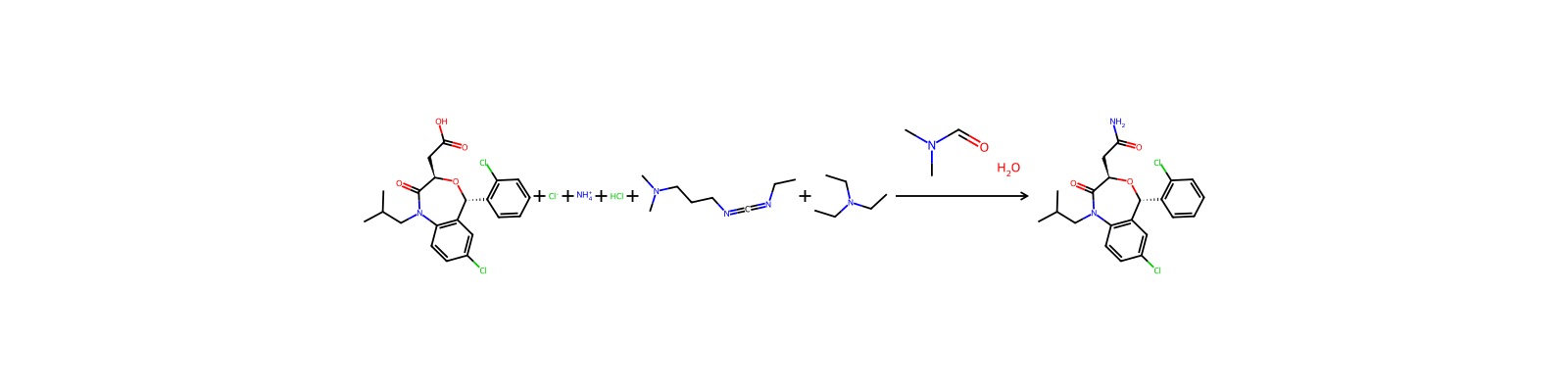
HRID 936反応物として
1,3-Propanediamine, N'-(ethylcarbonimidoyl)-N,N-dimethyl-, monohydrochloride

25952-53-8CCN=C=NCCCN(C)C.ClFPQQSJJWHUJYPU-UHFFFAOYSA-Nstructure in first source
安全情報は参考情報です。供給元の安全データシート(SDS)、適用法令、専門家による評価に代わるものではありません。
Danger
H302 (73.7%): Harmful if swallowed [Warning Acute toxicity, oral]
P260, P261, P262, P264, P264+P265, P270, P271, P272, P273, P280, P301+P317, P302+P352, P304+P340, P305+P351+P338, P305+P354+P338, P316, P317, P319, P321, P330, P332+P317, P333+P317, P337+P317, P361+P364, P362+P364, P391, P403+P233, P405, and P501 (click each P-code to see the statement)
Aggregated GHS information provided per 315 reports by companies from 35 notifications to the ECHA C&L Inventory. Each notification may be associated with multiple companies.
Chemical: 1,3-Propanediamine, N'-(ethylcarbonimidoyl)-N,N-dimethyl-, monohydrochloride
REACH registered substance: N'-(ethylcarbonimidoyl)-N,N-dimethylpropane-1,3-diamine monohydrochloride (EC: 247-361-2)
N-(3-Dimethylaminopropyl)-N'-ethylcarbodiimide hydro chloride: Does not have an individual approval but may be used under an appropriate group standard
用途有機合成化学において、カルボジイミド基を含む化合物は脱水縮合剤として用いられる。良く使われる例としてはカルボン酸に対するアミド結合、もしくはエステル結合形成の促進である。脱水縮合を促進させ、かつ副反応を抑制するための添加剤として 1-ヒドロキシベンゾトリアゾール (HOBt) や N-ヒドロキシコハク酸イミド (HOSu) などが良く用いられる。
用途ペプチド合成用。
一般的な説明EDC hydrochloride is a water-soluble derivative of carbodiimide useful for conjugating haptens to proteins and polypeptides. Used to modify NMDA receptors and as a condensing agent in peptide synthesis. The major advantage of EDAC coupling is the easy removal of excess reagent and the corresponding urea by washing with dilute acid or water. Carbodiimides catalyze the formation of amide bonds, carboxylic acids, and amines by activating the carboxylate to form an O-acylurea. This intermediate can be attacked by an amine directly to form an amide. EDAC is released as a soluble urea derivative.
純化方法It is an excellent H2O-soluble peptide coupling reagent. It is purified by dissolving (ca 1g) in CH2Cl2 (10mL) at room temperature and then add dry Et2O (~110mL) dropwise and the crystals that separate are collected, washed with dry Et2O, recrystallised from CH2Cl2/Et2O and dried in a vacuum over P2O5. It is important to work in a dry atmosphere or work rapidly and then dry the solid as soon as possible. The material is moderately hygroscopic, but once it becomes wet it reacts slowly with H2O. Store it away from moisture at -20o to slow down the hydrolysis process. The free base has b 47-48o/0.27mm, 53-54o/0.6mm, n 1.4582. The methiodide is recrystallised from CHCl3/EtOAc, the crystals are filtered off, washed with dry Et2O, recrystallised from CHCl3/Et2O, and dried in vacuo over P2O5, m 93-95o, 94-95o. [Sheehan et al. J Am Chem Soc 87 2492 1965, Sheehan & Cruickshank Org Synth Coll Vol V 555 1973.] § A polymer bound version is commercially available.
25952-53-8、7084-11-9DTXSID50880076CHEMBL1968770化学的特性EDC-HCl, or 1-(3-Dimethylaminopropyl)-3-ethylcarbodiimide hydrochloride, is a white crystalline powder that easily deliquescent and can dissolve in both water and ethanol. It is commonly used as an activating reagent in amide synthesis to activate carboxyl groups. It can also activate phosphate groups, cross-link proteins and nucleic acids, and produce immunocouplers. EDC-HCl is commonly applied in the pH range of 4.0-6.0 and is often used in conjunction with N-Hydroxysuccinimide (NHS) or N-Hydroxysulfosuccinimide sodium salt to improve coupling efficiency.