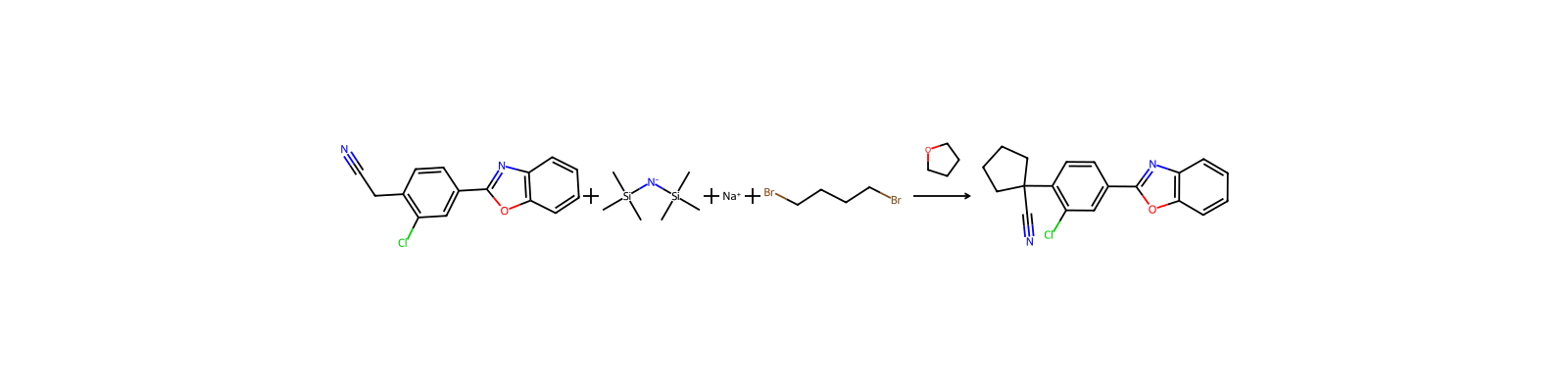
HRID 5562反応物として
Sodium bis(trimethylsilyl)amide
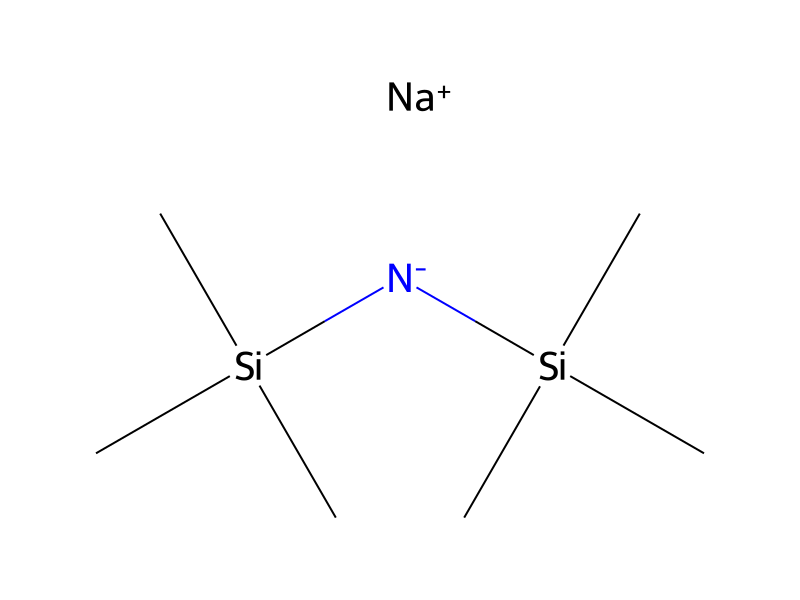
1070-89-9C[Si](C)(C)[N-][Si](C)(C)C.[Na+]WRIKHQLVHPKCJU-UHFFFAOYSA-N1070-89-9DTXSID5061451化学的特性Slightly yellow to light beige crystalline powder
安全情報は参考情報です。供給元の安全データシート(SDS)、適用法令、専門家による評価に代わるものではありません。
Danger
H302 (63.4%): Harmful if swallowed [Warning Acute toxicity, oral]
P260, P261, P264, P264+P265, P270, P271, P273, P280, P301+P317, P301+P330+P331, P302+P352, P302+P361+P354, P304+P340, P305+P354+P338, P316, P317, P321, P330, P362+P364, P363, P405, and P501 (click each P-code to see the statement)
Aggregated GHS information provided per 235 reports by companies from 11 notifications to the ECHA C&L Inventory. Each notification may be associated with multiple companies.
REACH registered substance: N-sodiohexamethyldisilazane (EC: 213-983-8)
Silanamine, 1,1,1-trimethyl-N-(trimethylsilyl)-, sodium salt: Does not have an individual approval but may be used under an appropriate group standard
260 [mg/m3]
430 [mg/m3]
520 [mg/m3]
使用Sodium bis(trimethylsilyl)amide is a synthetically useful reagent in that it combines both high basicity and nucleophilicity, each of which may be exploited for useful organic transformations such as selective formation of enolates, preparation of Wittig reagents, formation of acyl anion equivalents, and the generation of carbenoid species. As a nucleophile, it has been used as a nitrogen source for the preparation of primary amines.It is useful as a sterically hindered base and as a nucleophile.
一般的な説明Sodium bis(trimethylsilyl)amide solution (NaHMDS) is widely used as a strong base in organic synthesis for deprotonation reactions and base-catalyzed reactions. It is also involved in the generation of enolates, Wittig reagents and carbenes.
純化方法It can be sublimed at 170o/2mm (bath temperature 220-250o) onto a cold finger, and can be recrystallised from *C6H6 (its solubility is: 10g in 100mL at 60o). It is slightly soluble in Et2O and is decomposed by H2O. [Wannagat & Niederprüm Chem Ber 94 1540 1961.]It is available commercially under N2 in Sure/Seal bottles in tetrahydrofuran (various concentrations) and at ~0.6M in toluene. [Beilstein 4 IV 4014.]