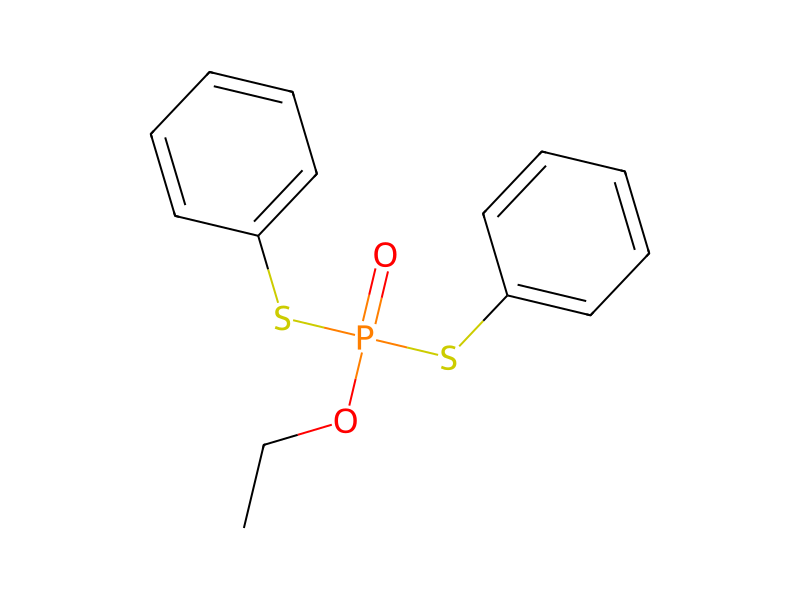
基本情報
- 標準SMILES
CCOP(=O)(Sc1ccccc1)Sc1ccccc1- InChIKey
AWZOLILCOUMRDG-UHFFFAOYSA-N- 分子式
- C14H15O2PS2
- 平均分子量
- 310.4 g/mol
- 単同位体質量
- 310.02510835
概要
Edifenphos is an organic thiophosphate that is the O-ethyl-S,S-diphenyl ester of phosphorodithioic acid. Used to control a variety of fungal diseases on rice including blast, ear blight and stem rot. Edifenphos is moderately toxic to mammals and fish but poses more of a risk to aquatic invertebrates. It has a role as an EC 3.1.1.7 (acetylcholinesterase) inhibitor, a neurotoxin, a phospholipid biosynthesis inhibitor and an antifungal agrochemical.
名称と識別子
- 優先名称
- Edifenphos
- IUPAC
- [ethoxy(phenylsulfanyl)phosphoryl]sulfanylbenzene
- 現地名
- ジチオりん酸=O-エチル=S,S-ジフェニル
- 英語名
- Edifenphos
- 分子式
- C14H15O2PS2
- 分子量
- 310.37
名称と別名
名称をさらに表示
データベース識別子
- CAS
17109-49-8- PubChem CID
- 28292
- DTXSID
DTXSID7041910- ChEMBL
CHEMBL1671900- ChEBI
CHEBI:34735- UNII
- 770M9U0F8Q
- EC Number
- 241-178-1
- Nikkaji
- J3.449E
物性
構造計算による物性
- XLogP
- 3.8
- 極性表面積
- 76.9 Ų
- 水素結合供与体数
- 0
- 水素結合受容体数
- 4
- 回転可能結合数
- 6
- 重原子数
- 19
- 形式電荷
- 0
- 複雑度
- 276
実験および物理化学的性質
Pesticides
Agrochemicals -> Pesticide active substances
Active substance -> EU Pesticides database: Not approved
Pesticides -> Fungicides
Pesticide (Edifenphos) -> USDA PDB
LogP
log Kow = 3.48
3.48
3.68
Color/Form
Yellow to light brown liquid... .
Clear yellow to light-brown liquid
Solubility
In n-hexane 20-50, dichloromethane, isopropanol, toluene 200 (all in g/l, 20 °C). Readily soluble in methanol, acetone, benzene, xylene, carbon tetrachloride and dioxane. Sparingly soluble in heptane.
In water, 56 mg/l @ 20 °C
0.056 mg/mL at 20 °C
Decomposition
At 25 °C decomposition occurs in 49 hr at pH 9 and in 1,135 hr at pH 7.
When heated to decomposition it emits toxic fumes of /phosphorous and sulfur oxides/.
Melting Point
-25 °C
< 25 °C
Vapor Pressure
0.00000027 [mmHg]
2.70X10⁻⁷ mm Hg @ 25 °C
Physical Description
Clear yellow to light brown liquid; [Merck Index]
Solid
物理化学的性質
- 融点
- 25 °C · 25°C
- 沸点
- 0.01 · bp0.01 154°
- 比重(密度)
- 420 · d420 1.23
- 蒸気圧
- 1.3 x · 1.3 x 10-2Pa (20 °C)
- 屈折率
- 22 · nD22 1.61
- 貯蔵温度
- 0 · 0-6°C
- 水溶解度
- 56 mg · 56 mg l-1 (20 °C)
- 外見
- 液体
- Merck
- 13 · 13,3547
- BRN
- 1988797 · 1988797
- Henry's Law Constant
- 5 · 5.0×103 mol/(m3Pa) at 25℃, Watanabe (1993)
- 主な用途
- 農業環境
- InChI
- 1S/C14H15O2PS2/c1-2-16-17(15,18-13-9-5-3-6-10-13)19-14-11-7-4-8-12-14/h3-12H,2H2,1H3
- InChIKey
- AWZOLILCOUMRDG-UHFFFAOYSA-N
- SMILES
- CCOP(=O)(Sc1ccccc1)Sc2ccccc2
- CAS データベース
- 17109 · 17109-49-8(CAS DataBase Reference)
- NISTの化学物質情報
- Phosphorodithioic acid, o-ethyl s,s-diphenyl ester(17109-49-8)
- EPAの化学物質情報
- Edifenphos (17109-49-8)
安全と法規制
GHS分類
GHS Classification
Danger
H301: Toxic if swallowed [Danger Acute toxicity, oral]
P261, P264, P270, P271, P272, P273, P280, P301+P316, P302+P352, P304+P340, P316, P317, P321, P330, P333+P317, P362+P364, P391, P403+P233, P405, and P501 (click each P-code to see the statement)
Danger
H301 (100%): Toxic if swallowed [Danger Acute toxicity, oral]
P261, P264, P270, P271, P272, P273, P280, P301+P316, P302+P352, P304+P340, P316, P317, P321, P330, P333+P317, P362+P364, P391, P403+P233, P405, and P501 (click each P-code to see the statement)
危険有害性情報
DOT Emergency Guidelines
/GUIDE 131: FLAMMABLE LIQUIDS-TOXIC/ Health: TOXIC; may be fatal if inhaled, ingested or absorbed through skin. Inhalation or contact with some of these materials will irritate or burn skin and eyes. Fire will produce irritating, corrosive and/or toxic gases. Vapors may cause dizziness or suffocation. Runoff from fire control or dilution water may cause pollution. /Organophosphorus pesticide, liquid, flammable, poisonous; Organophosphorus pesticide, liquid, flammable, toxic; Organophosphorus pesticide, liquid, poisonous, flammable; Organophosphorus pesticide, liquid, toxic, flammable/
/GUIDE 131: FLAMMABLE LIQUIDS-TOXIC/ Fire or Explosion: HIGHLY FLAMMABLE: Will be easily ignited by heat, sparks or flames. Vapors may form explosive mixtures with air. Vapors may travel to source of ignition and flash back. Most vapors are heavier than air. They will spread along ground and collect in low or confined areas (sewers, basements, tanks). Vapor explosion and poison hazard indoors, outdoors or in sewers. Those substances designated with a "P" may polymerize explosively when heated or involved in a fire. Runoff to sewer may create fire or explosion hazard. Containers may explode when heated. Many liquids are lighter than water. /Organophosphorus pesticide, liquid, flammable, poisonous; Organophosphorus pesticide, liquid, flammable, toxic; Organophosphorus pesticide, liquid, poisonous, flammable; Organophosphorus pesticide, liquid, toxic, flammable/
/GUIDE 131: FLAMMABLE LIQUIDS-TOXIC/ Public Safety: CALL Emergency Response Telephone Number ... . As an immediate precautionary measure, isolate spill or leak area for at least 50 meters (150 feet) in all directions. Keep unauthorized personnel away. Stay upwind. Keep out of low areas. Ventilate closed spaces before entering. /Organophosphorus pesticide, liquid, flammable, poisonous; Organophosphorus pesticide, liquid, flammable, toxic; Organophosphorus pesticide, liquid, poisonous, flammable; Organophosphorus pesticide, liquid, toxic, flammable/
/GUIDE 131: FLAMMABLE LIQUIDS-TOXIC/ Protective Clothing: Wear positive pressure self-contained breathing apparatus (SCBA). Wear chemical protective clothing that is specifically recommended by the manufacturer. It may provide little or no thermal protection. Structural firefighters' protective clothing provides limited protection in fire situations ONLY; it is not effective in spill situations where direct contact with the substance is possible. /Organophosphorus pesticide, liquid, flammable, poisonous; Organophosphorus pesticide, liquid, flammable, toxic; Organophosphorus pesticide, liquid, poisonous, flammable; Organophosphorus pesticide, liquid, toxic, flammable/
For more DOT Emergency Guidelines (Complete) data for EDIFENPHOS (16 total), please visit the HSDB record page.
DOT Hazard Classification
Edifenphos
Marine pollutant
Hazard Classes and Categories
Acute Tox. 3 (100%)
Skin sensitisation - category 1
Acute toxicity (Oral) - Category 3
Acute Tox. 3 *
Standard Transportation Number
49 216 74; Organophosphorus pesticide, liquid, not otherwise specified (compounds and preparations) (insecticides, other than agricultural, NEC)
49 216 75; Organophosphorus pesticide, liquid, not otherwise specified (compounds and preparations) (agricultural insecticides, NEC, liquid)
49 105 44; Organophosphorus pesticide, liquid, not otherwise specified (compounds and preparations) (insecticides, other than agricultural, NEC)
49 105 45; Organophosphorus pesticide, liquid, not otherwise specified (compounds and preparations) (agricultural insecticides, NEC, liquid)
49 216 76; Organophosphorus pesticide, solid, not otherwise specified (compounds and preparations) (insecticides, other than agricultural, NEC)
49 216 77; Organophosphorus pesticide, solid, not otherwise specified (compounds and preparations) (agricultural insecticides, NEC, other than liquid)
Shipment Methods and Regulations
No person may /transport,/ offer or accept a hazardous material for transportation in commerce unless that person is registered in conformance ... and the hazardous material is properly classed, described, packaged, marked, labeled, and in condition for shipment as required or authorized by ... /the hazardous materials regulations (49 CFR 171-177)./
The International Air Transport Association (IATA) Dangerous Goods Regulations are published by the IATA Dangerous Goods Board pursuant to IATA Resolutions 618 and 619 and constitute a manual of industry carrier regulations to be followed by all IATA Member airlines when transporting hazardous materials.
The International Maritime Dangerous Goods Code lays down basic principles for transporting hazardous chemicals. Detailed recommendations for individual substances and a number of recommendations for good practice are included in the classes dealing with such substances. A general index of technical names has also been compiled. This index should always be consulted when attempting to locate the appropriate procedures to be used when shipping any substance or article.
Marine Pollutant
Shipping Name/ Number DOT/UN/NA/IMO
UN 3018; Organophosphorus pesticides, liquid, toxic, not otherwise specified
UN 3017; Organophosphorus pesticides, liquid, toxic, flammable, not otherwise specified, flashpoint between 23 °C and 61 °C
UN 2783; Organophosphorus pesticides, solid, toxic, not otherwise specified
UN 2784; Organophosphorus pesticides, liquid, flammable, toxic, not otherwise specified, flashpoint less than 23 °C
For more Shipping Name/ Number DOT/UN/NA/IMO (Complete) data for EDIFENPHOS (6 total), please visit the HSDB record page.
安全と保護具
Fire Fighting Procedures
If material on fire or involved in fire: Do not extinguish fire unless flow can be stopped. Use water in flooding quantities as fog. Solid streams of water may be ineffective. Cool all affected containers with flooding quantities of water. Apply water from as far a distance as possible. Use "alcohol" foam, dry chemical or carbon dioxide. /Organophosphorus pesticides, liquid, flammable, toxic; Organophosphorus pesticides, liquid, toxic/
If material on fire or involved in fire: Use water in flooding quantities as fog. Extinguish fire using agent suitable for type of surrounding fire. (Material itself does not burn or burns with difficulty.) /Organophosphorus pesticides, solid, toxic/
Cleanup Methods
Environmental considerations: Air spill: Apply water spray or mist to knock down vapors. /Organophosphorus pesticides, liquid, flammable, toxic; Organophosphorus pesticides, liquid, toxic; Organophosphorus pesticides, solid, toxic/
Environmental considerations: Water spill: Use natural barriers or oil spill control booms to limit spill travel. Remove trapped material with suction hoses. /Organophosphorus pesticides, liquid, flammable, toxic; Organophosphorus pesticides, liquid, toxic; Organophosphorus pesticides, solid, toxic/
Environmental considerations: Land spill: Dig a pit, pond, lagoon, holding area to contain liquid or solid material. /SRP: If time permits, pits, ponds, lagoons, soak holes, or holding areas should be sealed with an impermeable flexible membrane liner./ Dike surface flow using soil, sand bags, foamed polyurethane, or foamed concrete. Absorb bulk liquid with fly ash, cement powder, or commercial sorbents. /Organophosphorus pesticides, liquid, flammable, toxic; Organophosphorus pesticides, liquid, toxic; Organophosphorus pesticides, solid, toxic/
Disposal Methods
SRP: The most favorable course of action is to use an alternative chemical product with less inherent propensity for occupational exposure or environmental contamination. Recycle any unused portion of the material for its approved use or return it to the manufacturer or supplier. Ultimate disposal of the chemical must consider: the material's impact on air quality; potential migration in soil or water; effects on animal, aquatic, and plant life; and conformance with environmental and public health regulations.
Preventive Measures
If material not on fire and not involved in fire: Keep sparks, flames, and other sources of ignition away. Keep material out of water sources and sewers. /Organophosphorus pesticides, solid, toxic/
If material not on fire and not involved in fire: Keep sparks, flames, and other sources of ignition away. Keep material out of water sources and sewers. Build dikes to contain flow as necessary. Attempt to stop leak if without undue personnel hazard. Use water spray to knock-down vapors. /Organophosphorus pesticides, liquid, toxic/
If material not on fire and not involved in fire: Keep sparks, flames, and other sources of ignition away. Keep material out of water sources and sewers. Build dikes to contain flow as necessary. Use water spray to knock-down vapors. /Organophosphorus pesticides, liquid, flammable, toxic/
Personnel protection: Avoid breathing dusts, and fumes from burning material. Keep upwind. Avoid bodily contact with the material. Do not handle broken packages unless wearing appropriate personal protective equipment. Wash away any material which may have contacted the body with copious amounts of water or soap and water. /Organophosphorus pesticides, solid, toxic/
For more Preventive Measures (Complete) data for EDIFENPHOS (8 total), please visit the HSDB record page.
毒性情報
Interactions
Because different classes of enzymes may be inhibited, the effects of organophosphorus pesticide poisoning may be complex and potentially at least could involve interactions with drugs as well as with other pesticides or chemicals. Potentiation may also involve solvents or other components of formulated pesticides. Certain drugs such a phenothiazines, antihistamines, CNS depressants, barbiturates, xanthines (theophylline), aminoglycosides and parasympathomimetic agents are to be avoided because of increased toxicity. /Organophosphorus pesticides/
Ecotoxicity Values
LD50 Bobwhite quail oral 290 mg/kg
LD50 Mallard duck oral 2,700 mg/kg
LC50 Cyprinus carpio 1.3 mg/l/48 hr
LC50 Rainbow trout 0.43 mg ai/L/96 hr /Conditions of bioassay not specified/
For more Ecotoxicity Values (Complete) data for EDIFENPHOS (6 total), please visit the HSDB record page.
Environmental Fate
TERRESTRIAL FATE: Based on a classification scheme(1), an estimated Koc value of 1,900(SRC), determined from a log Kow of 3.48(2) and a regression-derived equation(3), indicates that edifenphos is expected to have low mobility in soil(SRC). Volatilization of edifenphos from moist soil surfaces is not expected to be an important fate process(SRC) given an estimated Henry's Law constant of 7.6X10⁻¹⁰ atm-cu m/mole(SRC), derived from its vapor pressure, 2.7X10⁻⁷ mm Hg(4), and water solubility, 56 mg/l(5). Edifenphos is not expected to volatilize from dry soil surfaces(SRC) based upon its vapor pressure(4). During a field-study, edifenphos, applied at a rate of 5.0 mg on a paddy field soil in Japan, disappeared in 39 days with a half-life of 5-6 days(6). The percent degradation of edifenphos on a silica gel plate was greater than that observed for distilled water(7). Results suggest that edifenphos on the surface of solids such as agricultural leaves and clay particles are readily degraded as compared to natural water(7).
AQUATIC FATE: Based on a classification scheme(1), an estimated Koc value of 1,900(SRC), determined from a log Kow of 3.48(2) and a regression-derived equation(3), indicates that edifenphos is expected to adsorb to suspended solids and sediment(SRC). Volatilization from water surfaces is not expected(3) based upon an estimated Henry's Law constant of 7.6X10⁻¹⁰ atm-cu m/mole(SRC), derived from its vapor pressure, 2.7X10⁻⁷ mm Hg(4), and water solubility, 56 mg/l(5). According to a classification scheme(6), BCFs values ranging from 28.8 to 40.6 for fish(7) suggest bioconcentration in aquatic organisms is moderate(SRC). Edifenphos is hydrolyzed by strong acids and alkalis(5). Hydrolysis half-lives at pH 7 and 9 are 19 and 2 days, respectively(5). Based on a field study in soil(8), edifenphos is also expected to degrade in aqueous systems(SRC).
ATMOSPHERIC FATE: According to a model of gas/particle partitioning of semivolatile organic compounds in the atmosphere(1), edifenphos, which has a vapor pressure of 2.7X10⁻⁷ mm Hg at 25 °C(2), will exist in both the vapor and particulate phases in the ambient atmosphere(SRC). Vapor-phase edifenphos is degraded in the atmosphere by reaction with photochemically-produced hydroxyl radicals(SRC); the half-life for this reaction in air is estimated to be 8.7 hrs(SRC), calculated from its rate constant of 4.4X10⁻¹¹ cu cm/molecule-sec at 25 °C(SRC) that was derived using a structure estimation method(3). Particulate-phase edifenphos may be removed from the air by wet and dry deposition(SRC).
Medical Surveillance
Measurement of whole blood-AChE is the most widely adopted method for monitoring the effects of occupational exposure to organophosphorus insecticides. Physiological variations in blood ChE levels occur in a healthy person and are seen among a population. It has been estimated that the coefficient of variation for AChE activity in samples from an individual is 8-11%, and that a decrease of 23% below pre-exposure level may, therefore, be considered significant. If the average of several pre-exposure values were available, then a decrease of 17% would be significant. It has been recommended that, if measured activity is reduced by 30% or more of the pre-exposure value, AChE measurements should be repeated at appropriate intervals to confirm the results. Depressions of AChE or ChE in excess of 20-25% are considered diagnostic of exposure but not, necessarily, indicative of hazard. Depressions of 30-50% or more are considered indicators for removal of an exposed individual from further contact with pesticides until levels return to normal. /Organophosphorus Pesticides/
...Organophosphorus pesticides may undergo hydrolysis in vivo to yield substituted phosphoric acids that are subsequently excreted in urine. Advances in gas chromatography and combined gas chromatography/mass spectrometry (GC/MS) have made it possible to analyse the urine of exposed persons for the presence of appropriate metabolites. It is usually necessary to preserve the sample by the addition of chloroform, to concentrate or extract the metabolite(s), and to convert them to suitably-volatile derivatives that can be detected by GC. Obviously, access to a well-equipped analytical laboratory, capable of the quick processing of samples, is a necessary factor if monitoring by urine analysis is proposed. However, in some cases, simpler and sensitive colorimetric tests are available for screening the urine of exposed persons. Thus, 4-nitrophenol can be measured directly in the urine of workers exposed to parathion. Consideration of the concentration of metabolite(s) in the urine can be helpful in determining patterns of exposure, and these concentrations can be calibrated against the effects on AChE for a particular pesticide. However, the time-course and peak of excretion of metabolites appears to vary according to dose, so that serial sampling and analyses of urine are desirable. Levels of metabolite alone cannot be considered a guide to hazard. This is obvious when it is realized that pesticides that have very different toxicities may yield identical acidic metabolites. Thus, the level of metabolites in urine, after exposure to sufficient amounts of the very toxic parathion-methyl to depress blood-AChE to 50%, will be much lower than that of the identical metabolites, following exposure to the related fenitrothion, which is about 40 times less toxic. /Organophosphorus Pesticides/
Soil Adsorption/Mobility
The Koc of edifenphos is estimated as 1,900(SRC), using a log Kow of 3.48(1) and a regression-derived equation(2). According to a classification scheme(3), this estimated Koc value suggests that edifenphos is expected to have low mobility in soil(SRC).
Human Toxicity Excerpts
/HUMAN EXPOSURE STUDIES/ ...In human subjects sufficiently exposed to organophosphates to depress plasma- or erythrocyte-ChEs, some or all of the following behavioral variables might be impaired. In cognition: vigilance, information processing and psychomotor speed, and memory; in speech: both performance and perception; in psychic state: increased tendencies to depression, anxiety, and irritability; and in EEG records: a tendency to faster frequencies and higher voltages. /Organophosphorus Pesticides/
/HUMAN EXPOSURE STUDIES/ Respiratory and ocular symptoms are expected to appear first after exposure to airborne organophosphorus pesticides. /Organophosphorus pesticides/
/SIGNS AND SYMPTOMS/ Signs and symptoms of acute intoxication by organophosphorus insecticides include muscarinic, nicotinic, and central nervous system (CNS) manifestations. Symptoms may develop rapidly, or there may be a delay of several hours after exposure before they become evident. The delay tends to be longer in the case of more lipophilic compounds, which also require metabolic activation. Symptoms may increase in severity for more than one day and may last for several days. In severe cases, respiratory failure is a dominant effect. /Organophosphorus Pesticides/
/SIGNS AND SYMPTOMS/ The clinical picture of organophosphorus intoxication results from accumulation of ACh at nerve endings. ...The symptoms can be summarized in three groups as follows: (a) Muscarinic manifestations- increased bronchial secretion, excessive sweating, salivation, and lachrymation; pinpoint pupils, bronchoconstriction, abdominal cramps (vomiting and diarrhea); and bradycardia. (b) Nicotinic manifestations- fasciculation of fine muscles and, in more severe cases, of diaphragm and respiratory muscles; and tachycardia. (c) Central nervous system manifestations- headache, dizziness, restlessness, and anxiety; mental confusion, convulsions, and coma; and depression of the respiratory centre. All these symptoms can occur in different combinations and can vary in time of onset, sequence, and duration, depending on the chemical, dose, and route of exposure. Mild poisoning might include muscarinic and nicotinic signs only. Severe cases always show central nervous system involvement; the clinical picture is dominated by respiratory failure, sometimes leading to pulmonary edema, due to the combination of the above-mentioned symptoms. /Organophosphorus Pesticides/
For more Human Toxicity Excerpts (Complete) data for EDIFENPHOS (8 total), please visit the HSDB record page.
Environmental Biodegradation
ANAEROBIC: Using adapted bacteria, edifenphos was found to degrade faster under flooded conditions compared to non-flooded conditions(1). Edifenphos was recovered at 42% from autoclaved soils compared to 10% recovery from non-autoclaved soils(1). During a field-study, edifenphos, applied at a rate of 5.0 mg on a paddy field soil in Japan, disappeared in 39 days with a half-life of 5-6 days(2).
Environmental Bioconcentration
Whole fish BCFs for female guppy, male guppy, killifish, gold fish, and white cloud mountain fish are measured as 40.6, 29.3, 28.8, 38.9, and 29.3, respectively(1). According to a classification scheme(2), BCF values ranging from 28.8 to 40.6 for fish(1) suggest bioconcentration in aquatic organisms is moderate(SRC).
Volatilization from Water/Soil
The Henry's Law constant for edifenphos is estimated as 7.6X10⁻¹⁰ atm-cu m/mole(SRC) derived from its vapor pressure, 2.7X10⁻⁷ mm Hg(1), and water solubility, 56 mg/l(2). This Henry's Law constant indicates that edifenphos is expected to be essentially nonvolatile from water and moist soil surfaces(3). The volatilization rate of edifenphos from the surface of aqueous solution was found to be 8.8X10⁻⁹ m/hr(4). Edifenphos is not expected to volatilize from dry soil surfaces(SRC) based upon its vapor pressure(1).
安全データ
- wgk
- 3
- rtecs
- TE3850000
- ridadr
- UN 2810
- 毒性
- LD50 in female, male rats (mg/kg): 25.5, 66.5 i.p. (Chen)
- PRTR法
- 第1種指定化学物質
- risk_code
- 21-23/25-43-50/53-24/25-23
- 消防法
- 危-4-3-III
- hazard_code
- T,N
- safety_code
- 36/37-45-60-61
- hazard_class
- 6.1(b)
- packing_group
- III
- 毒劇物取締法
- III
- Hazard Classifications
- Acute Tox. 3 DermalAcute Tox. 3 InhalationAcute Tox. 3 OralAquatic Acute 1Aquatic Chronic 1Skin Sens. 1
- ストレージクラス
- 6.1C - Combustible acute toxic Cat.3toxic compounds or compounds which causing chronic effects
- 有毒物質データの
- 17109-49-8(Hazardous Substances Data)
化学と産業
薬理情報
Mechanism of Action
Organophosphorus insecticides exert their acute effects in both insects and mammals by inhibiting acetylcholinesterase (AChE) in the nervous system with subsequent accumulation of toxic levels of acetylcholine (ACh), which is a neurotransmitter. In many cases, the organophosphorylated enzyme is fairly stable, so that recovery from intoxication may be slow. /Organophosphorus Pesticides/
Metabolism/Metabolites
The major metabolite in /the urine of/ rats was the des-S-phenyl hydrolysis product while in mice the mono-S-phenyl phosphorothioate was prevalent (further dealkylation of the major rat metabolite). In feces, small (< 2%) quantities of edifenphos were noted as well as diphenyl disulfide
...Edifenphos was degraded primarily by loss of the phenyl, thiophenyl and ethyl groups to give organophosphorus acids. The ultimate metabolites were phosphoric and sulfuric acids. Furthermore, oxidation and methylation were apparent in the later stage of metabolism, and conjugated metabolites were formed.
14C-Edifenphos was degraded in rice primarily by loss of phenyl, thiophenyl, and/or ethyl groups to give organophosphorus acids, the ultimate products being benzenesulfonic acid and presumably phosphoric acid.
Metabolism occurs principally by oxidation, hydrolysis by esterases, and by transfer of portions of the molecule to glutathione. Oxidation of organophosphorus insecticides may result in more or less toxic products. The glutathione transferase reactions produce products, that are, in most cases, of low toxicity. Hydrolytic and transferase reactions affect both thioates and their oxons. /Organophosphorus Pesticides/
For more Metabolism/Metabolites (Complete) data for EDIFENPHOS (7 total), please visit the HSDB record page.
Absorption, Distribution and Excretion
Edifenphos is rapidly absorbed following acute oral administration to rats. Within 8 hours of dosing the major part of an 35S-dose was absorbed. Within 72 hours of the administered dose, 96% in rats and > 97% in mice was excreted in the urine and feces. There were no significant sex differences noted in rats, while in mice females excreted somewhat more in the feces than corresponding males. Apart from this no sex differences in absorption and excretion were noted. Tissue residues (35S-labelled) in both rats and mice were extremely low at 72 hours. Residues in tissues following acute or sub-acute (10-daily) doses were generally low and associated with tissues concerned with distribution and excretion. Of the 6 tissues examined at various intervals after dosing (from 1 to 72 hours) the following sequence reflects tissue distribution: liver > kidney > lung > heart >> blood = brain. This same qualitative relationship of tissue distribution was reflected over the time for maximum tissue clearance.
Comparative studies on the metabolic fate of 35(S)-labeled edifenphos in rats and mice are described. Dose levels were 10 mg/kg in female rats and 20 mg/kg in mice and male rats. Only 15 to 30% of the administered radioactivity was detected in digestive organs 6 hr after administration. At 72 hr, only a trace amount of radioactivity was found over the whole body of the animals. The major part of the radioactivity was excreted via urine (75-90%) and feces (5-20%). The main metabolite of the rat is ethyl hydrogen S-phenyl phosphorothiolate (54-57%) and that of mice is dihydrogen S-phenyl phosphorothiolate (3 1-42%). Diphenyl disulfide was found in feces in both animals, but metabolites such as methyl phenyl sulfide and its derivatives were absent. Thus edifenphos is rapidly absorbed, metabolized and eliminated from mice and rats following oral administration.
用途と製造
Uses
Used as fungicide to protect rice; Not currently registered with the EPA for use in the US; [HSDB]
Farming (Pesticides) [Category: Industry]
For edifenphos (USEPA/OPP Pesticide Code: 434300) there are 0 labels match. /SRP: Not registered for current use in the U.S., but approved pesticide uses may change periodically and so federal, state and local authorities must be consulted for currently approved uses./
Fungicide for blast disease, ear blight, and stemrot in rice.
Formulations/Preparations
Emulsifiable concentrate, dustable powder.
Selected tradenames: 'Hinosan' (Nihon Bayer), 'Vihino' (Vipesco) ; mixtures: 'Hinorabcide' (+ phthalide) (Nihon Bayer); 'Hinosuncide' (+ propoxur) (Nihon Bayer).
応用分野
用途リン脂質メチル基転移阻害剤病の防除に用いられる
使用Edifenphos is a foliar applied contact fungicide that provides both protective and curative control of rice blast diseases caused by Pyricularia oryzae. It also controls ear blight and stem rot in rice.
上流・下流製品情報
上流原料
サプライヤー39 社
補足説明
定義ChEBI: An organic thiophosphate that is the O-ethyl-S,S-diphenyl ester of phosphorodithioic acid. Used to control a variety of fungal diseases on rice including blast, ear blight and stem rot. Edifenphos i moderately toxic to mammals and fish but poses more of a risk to aquatic invertebrates.
関連反応
現在のフィルター条件では反応記録がありません。
関連ノート
読み込み中…