
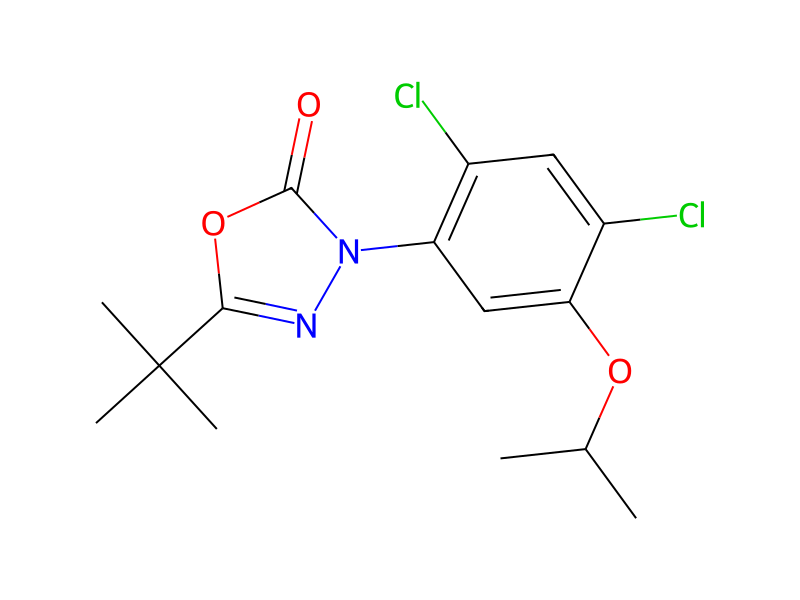
基本情報
- 標準SMILES
CC(C)Oc1cc(-n2nc(C(C)(C)C)oc2=O)c(Cl)cc1Cl- InChIKey
CHNUNORXWHYHNE-UHFFFAOYSA-N- 分子式
- C15H18Cl2N2O3
- 平均分子量
- 345.2 g/mol
- 単同位体質量
- 344.0694478
概要
Oxadiazon can cause cancer according to an independent committee of scientific and health experts. It can cause developmental toxicity according to The Environmental Protection Agency (EPA).
名称と識別子
- 優先名称
- Oxadiazon
- IUPAC
- 5-tert-butyl-3-(2,4-dichloro-5-propan-2-yloxyphenyl)-1,3,4-oxadiazol-2-one
- 現地名
- オキサジアゾン
- 英語名
- Oxadiazon
- 分子式
- C15H18Cl2N2O3
- 分子量
- 345.22
名称と別名
OXADIAZON19666-30-9RonstarOxadiazoneRP 17623DTXSID3024239G 315C6U0E0YTP65-tert-Butyl-3-(2,4-dichloro-5-isopropoxyphenyl)-1,3,4-oxadiazol-2(3H)-one2-tert-Butyl-4-(2,4-dichloro-5-isopropyloxyphenyl)-1,3,4-oxadiazolin-5-oneDTXCID3042393-(2,4-Dichloro-5-(1-methylethoxy)phenyl)-5-(1,1-dimethylethyl)-1,3,4-oxadiazol-2(3H)-one
名称をさらに表示
5-ターシャリ-ブチル-3-(2,4-ジクロロ-5-イソプロポキシフェニル)-1,3,4-オキサジアゾール-2(3H)-オン5-(1,1-ジメチルエチル)-3-(2,4-ジクロロ-5-イソプロピルオキシフェニル)-1,3,4-オキサジアゾール-2(3H)-オン2-tert-ブチル-4-(2,4-ジクロロ-5-イソプロポキシフェニル)-1,3,4-オキサジアゾール-5(4H)-オンロンスターオキサジアゾン標準品2tブチル4(2,4ジクロル5イソプロポキシフェニル)1,3,4オキサジアゾリン5オン5-ターシャリ-ブチル-3-(2,4-ジクロロ-5-イソプロポキシフェニル)-1,3,4-オキサジアゾール-2(3H)-オン (別名 オキサジアゾン)5-tert-ブチル-3-(2,4-ジクロロ-5-イソプロポキシフェニル)-1,3,4-オキサジアゾール-2(3H)-オンオキサジアゾン STANDARDオキサジアゾン Standard, 100 µg/mL in MeOHオキサジアゾン Standard, 1000 µg/mL in MeOHオキサジアゾン5-tert-ブチル-3-[2,4-ジクロロ-5-(プロパン-2-イルオキシ)フェニル]-2,3-ジヒドロ-1,3,4-オキサジアゾール-2-オンDOXARLonster17623 RPForesiteHERBSTAR0xadiazon
RP-176233-[2,4-Dichloro-5-(1-methylethoxy)phenyl]-5-(1,1-dimethylethyl)-1,3,4-oxadiazol-2(3H)-oneRefChem:8570192-(tert-butyl)-4-(2,4-dichloro-5-isopropyloxy-phenyl) delta(2)-1,3,4-oxadiazoline-5-one5-tert-butyl-3-(2,4-dichloro-5-(propan-2-yloxy)phenyl)-2,3-dihydro-1,3,4-oxadiazol-2-one243-215-7Oxydiazon5-tert-butyl-3-(2,4-dichloro-5-propan-2-yloxyphenyl)-1,3,4-oxadiazol-2-one
データベース識別子
- CAS
19666-30-9- PubChem CID
- 29732
- DTXSID
DTXSID3024239- ChEMBL
CHEMBL1080648- ChEBI
CHEBI:81786- UNII
- C6U0E0YTP6
- EC Number
- 243-215-7
- Nikkaji
- J1.867H
物性
構造計算による物性
- XLogP
- 4.8
- 極性表面積
- 51.1 Ų
- 水素結合供与体数
- 0
- 水素結合受容体数
- 4
- 回転可能結合数
- 4
- 重原子数
- 22
- 形式電荷
- 0
- 複雑度
- 462
実験および物理化学的性質
Chemical ClassesTeratogens
SpringerMaterials PropertiesFusion temperature
Pesticides
Pesticide -> EPA IRIS
Herbicides
Active substance -> EU Pesticides database: Not approved
Pesticides -> Herbicides, Protox-Inhibiting
Herbicides
Pesticide (Oxadiazon) -> USDA PDB
LogP
log Kow = 4.80
4.09
OdorOdorless
Density1.26 mg/l
Color/Form
White crystals
Colorless crystals
Solubility
Solubility in methanol, ethanol ca 100, cyclohexane 200, acetone, isophorone, methyl ethyl ketone, carbon tetrachloride ca 600, toluene, benzene, chloroform ca 1000 (all in g/l, 20 °C)
Soluble in solvents
In water, 0.7 mg/l @ 24 °C
Endocrine DisruptorsPotential endocrine disrupting compound
Melting Point90 °C
Vapor Pressure
0.00000011 [mmHg]
1.15X10⁻⁷ mm Hg @ 22 °C
Physical Description
Oxydiazon is a crystalline solid. Used as an herbicide.
White odorless solid; [Merck Index]
物理化学的性質
- 融点
- 88 · 88-90°C
- 沸点
- 417 · 417.0±55.0 °C(Predicted)
- 比重(密度)
- 1.413 · 1.4130 (rough estimate)
- 屈折率
- 1.614 · 1.6140 (estimate)
- 貯蔵温度
- 2 · Sealed in dry,2-8°C
- 溶解性
- Chloroform (Slightly), Ethyl Acetate (Slightly)
- 外見
- ワックス状の固体
- 酸解離定数(Pka)
- -2.73 · -2.73±0.40(Predicted)
- 色
- Light yellow to yellow
- 水溶解度
- 0.7 mg/L · 0.7mg/L(24℃)
- BRN
- 558070 · 558070
- Henry's Law Constant
- 1.4 · 1.4×102 mol/(m3Pa) at 25℃, HSDB (2015)
- InChI
- 1S/C15H18Cl2N2O3/c1-8(2)21-12-7-11(9(16)6-10(12)17)19-14(20)22-13(18-19)15(3,4)5/h6-8H,1-5H3
- InChIKey
- CHNUNORXWHYHNE-UHFFFAOYSA-N
- SMILES
- CC(C)Oc1cc(N2N=C(OC2=O)C(C)(C)C)c(Cl)cc1Cl
- CAS データベース
- 19666 · 19666-30-9(CAS DataBase Reference)
- NISTの化学物質情報
- Oxadiazon(19666-30-9)
- EPAの化学物質情報
- Oxadiazon (19666-30-9)
化学的性質
化学的特性Pale Yellow Solid
安全と法規制
GHS分類
GHS Classification
Warning
H400: Very toxic to aquatic life [Warning Hazardous to the aquatic environment, acute hazard]
P273, P391, and P501 (click each P-code to see the statement)
Warning
H400 (100%): Very toxic to aquatic life [Warning Hazardous to the aquatic environment, acute hazard]
P273, P391, and P501 (click each P-code to see the statement)
危険有害性情報
Regulatory Information
Hazard Traits - Carcinogenicity; Developmental Toxicity
Commission Regulation (EC) No 1490/2002
Oxadiazon is listed in the dataset of EPA Human Health Benchmarks for Pesticides under the Safe Drinking Water Act (40 eCFR 141)
2008/69/EC, 2010/39/EU, Reg. (EU) 2022/801, Reg. (EU) No 540/2011
Oxadiazon: Does not have an individual approval but may be used under an appropriate group standard
The New Jersey Worker and Community Right to Know Act requires public and private employers to provide information about hazardous substances at their workplaces. (N.J.S.A. 34:5A-1 et. seq.)
Other Safety InformationIMAP assessments - 1,3,4-Oxadiazol-2(3H)-one, 3-[2,4-dichloro-5-(1-methylethoxy)phenyl]-5-(1,1-dimethylethyl)-: Human health tier I assessment
DOT LabelClass 9
Fire HazardsExcerpt from ERG Guide 171 [Substances (Low to Moderate Hazard)]:
Health HazardsExcerpt from ERG Guide 171 [Substances (Low to Moderate Hazard)]:
Hazards Summary
The protox inhibitor herbicides (Fomesafen,Oxadiazon, Lactofen, Sulfentrazone, Carfentrazone-ethyl, Oxyfluorofen and Bifenox) can disrupt porphyrin metabolism; It has been speculated that a transient form of porphyria variegate may occur following a massive exposure or long-term exposure to lower doses. A mild eye irritant; [HSDB] An eye irritant; [eChemPortal: ERMA] An irritant; Targets the liver; [MSDSonline] See Fluthiacet-methyl.
Reactive GroupAzo, Diazo, Azido, Hydrazine, and Azide Compounds
FIFRA Requirements
Tolerances are established for combined residues of the herbicide oxadiazon (2-tert-butyl-4-(2,4-dichloro-5-isopropoxyphenyl)delta2-1,3,4-oxadiazolin-5-one) and its metabolites (2-tert-butyl-4-(2,4-dichloro-5-hydroxyphenyl)delta2-1,3,4-oxadiazolin-5-one) and 2-carboxyisopropyl-4-(2,4-dichloro-5-isopropoxyphenyl)delta2-1,3,4-oxadiazolin-5 -one) in or on raw agricultural commodities as follows: in milk fat; in the meat, fat, and meat byproducts of cattle, goats, hogs, horses, and sheep.
Reactivity AlertsExplosive
Reactivity Profile
OXYDIAZON is a diazo compound. Azo, diazo, azido compounds can detonate. This applies in particular to organic azides that have been sensitized by the addition of metal salts or strong acids. Toxic gases are formed by mixing materials of this class with acids, aldehydes, amides, carbamates, cyanides, inorganic fluorides, halogenated organics, isocyanates, ketones, metals, nitrides, peroxides, phenols, epoxides, acyl halides, and strong oxidizing or reducing agents. Flammable gases are formed by mixing materials in this group with alkali metals. Explosive combination can occur with strong oxidizing agents, metal salts, peroxides, and sulfides.
Air and Water ReactionsDust may form an explosive mixture in air.
Hazard Classes and Categories
Aquatic Acute 1 (100%)
Hazardous to the aquatic environment (acute) - category 1
Reproductive toxicity - Category 2
Teratogens
Aquatic Acute 1
安全と保護具
Fire FightingExcerpt from ERG Guide 171 [Substances (Low to Moderate Hazard)]:
First AidExcerpt from ERG Guide 171 [Substances (Low to Moderate Hazard)]:
Nonfire Spill ResponseExcerpt from ERG Guide 171 [Substances (Low to Moderate Hazard)]:
Disposal Methods
SRP: At the time of review, criteria for land treatment or burial (sanitary landfill) disposal practices are subject to significant revision. Prior to implementing land disposal of waste residue (including waste sludge), consult with environmental regulatory agencies for guidance on acceptable disposal practices.
Preventive Measures
SRP: The scientific literature for the use of contact lenses in industry is conflicting. The benefit or detrimental effects of wearing contact lenses depend not only upon the substance, but also on factors including the form of the substance, characteristics and duration of the exposure, the uses of other eye protection equipment, and the hygiene of the lenses. However, there may be individual substances whose irritating or corrosive properties are such that the wearing of contact lenses would be harmful to the eye. In those specific cases, contact lenses should not be worn. In any event, the usual eye protection equipment should be worn even when contact lenses are in place.
Isolation and EvacuationExcerpt from ERG Guide 171 [Substances (Low to Moderate Hazard)]:
Allowable Tolerances
Tolerances are established for combined residues of the herbicide oxadiazon (2-tert-butyl-4-(2,4-dichloro-5-isopropoxyphenyl)delta2-1,3,4-oxadiazolin-5-one) and its metabolites (2-tert-butyl-4-(2,4-dichloro-5-hydroxyphenyl)delta2-1,3,4-oxadiazolin-5-one) and 2-carboxyisopropyl-4-(2,4-dichloro-5-isopropoxyphenyl)delta2-1,3,4-oxadiazolin-5 -one) in or on raw agricultural commodities as follows: 0.1 ppm in milk fat (reflecting negligible residues in milk); 0.01 ppm (negligible residue) in the meat, fat, and meat byproducts of cattle, goats, hogs, horses, and sheep.
Personal Protective Equipment (PPE)Excerpt from ERG Guide 171 [Substances (Low to Moderate Hazard)]:
毒性情報
Target OrgansHematologic
Environmental Fate
TERRESTRIAL FATE: Based on a classification scheme(1), reported Koc values ranging from 676 to 3,236(2-4), indicate that oxadiazon is expected to have only low or slight mobility in soil(SRC). In laboratory studies using TLC(5) and column leaching(6) methods, oxadiazon was determined to be immobile in a total of six soils. Volatilization of oxadiazon from moist soil surfaces is not expected to be an important fate process(4). Oxadiazon is not expected to volatilize from dry soil surfaces(SRC) based upon its vapor pressure of 1.15X10⁻⁷ mm Hg(7). Oxadiazon photodegrades on soil in natural sunlight with a half-life of 4.65 days(8). The photodegradation of oxadiazon results in three photoproducts with the loss of chlorine as the dominant process and the participation of hydroxyl(8). Biodegradation in soil is not expected to be an important fate process with a reported half-life of oxadiazon in aerobic soil of 3-6 months(9).
AQUATIC FATE: Based on a classification scheme(1), reported Koc values ranging from 676 to 3,236(2-4) indicate that oxadiazon is expected to adsorb to suspended solids and sediment(SRC). Volatilization from water surfaces is not expected(5) based upon an estimated Henry's Law constant of 7X10⁻⁸ atm-cu m/mole(SRC), estimated based on its vapor pressure, 1.15X10⁻⁷ mm Hg(6), and water solubility, 0.7 mg/l(7). According to a classification scheme(8), BCF values in the range of 24.1 to 708 measured in fish(9,10), suggests bioconcentration in aquatic organisms is low to high(SRC). Oxadiazon (1 ppm) photodegrades in water in natural sunlight with a half-life of 2.65 days(11). The photodegradation of oxadiazon results in three photoproducts with the loss of chlorine as the dominant process and the participation of hydroxyl(11). Oxadiazon is stable to hydrolysis at neutral and acidic pHs, but degrades slowly at pH 9, with a half-life of 38 days(12). Only 7% biodegradation was observed in a river die-away test using water from Ashai River, Japan after 50 days(13), suggesting biodegradation is slow in water.
ATMOSPHERIC FATE: According to a model of gas/particle partitioning of semivolatile organic compounds in the atmosphere(1), oxadiazon, which has a vapor pressure of 1.15X10⁻⁷ mm Hg at 22 °C(2), is expected to exist in both the vapor and particulate phases in the ambient atmosphere. Vapor-phase oxadiazon is degraded in the atmosphere by reaction with photochemically-produced hydroxyl radicals(SRC); the half-life for this reaction in air is estimated to be 16 hours(SRC), calculated from its rate constant of 24.3X10⁻¹² cu cm/molecule-sec at 25 °C(SRC) determined using a structure estimation method(3). Particulate-phase oxadiazon is removed from the air by wet and dry deposition(SRC). There is the potential for the photodegradation of oxadiazon in air based upon its photodegradation in water(4); however, the rate at which this may occur is not known.
Food Survey Values
In a 1992-1993 FDA monitoring study of oxadiazon residues in pears, the compound was not detected in any of the 710 domestic or 949 imported pear samples tested(1). Oxadiazon was not detected in a monitoring study of 6970 samples (80% domestic, 20 % foreign) of 81 commodities, including 71 pear samples, collected in Texas during 1989-1991(2).
Adverse EffectsOccupational hepatotoxin - Secondary hepatotoxins: the potential for toxic effect in the occupational setting is based on cases of poisoning by human ingestion or animal experimentation.
Exposure RoutesInhalation; dermal. (L2081)
Toxicity Summary
'Oxadiazon is a member of the oxadiazole class of herbicides. While current data are limited, EPA has evidence that compounds within a class may share a common mechanism of toxicity. At this time, the Agency does not have sufficient data concerning common mechanism issues to determine whether or not oxadiazon shares a common mechanism of toxicity with other substances, including other oxadiazoles or other probable human carcinogens.' (L2081)
EPA IRIS Information
Oxadiazon
Hematologic
5 x 10 ^-3 mg/kg-day
Soil Adsorption/Mobility
The Koc of oxadiazon is reported as ranging from 676 to 3236(1-3). According to a classification scheme(4), this estimated Koc value suggests that oxadiazon is expected to have only low or slight mobility in soil. In laboratory studies using TLC(5) and column leaching(6) methods, oxadiazon was determined to be immobile in a total of six soils. In a study of the adsorption of oxadiazon (concn of 0.1-100 ppm) to soil and container (potting) media, 98-99% of the applied oxadiazon was adsorbed at all treatment rates, indicating that adsorption was not dependent on concn(7).
Atmospheric Concentrations
URBAN/SUBURBAN: Oxadiazon was not detected in the air in Kitakyashu City, Japan, an urban area 10 miles from an agricultural area, in samples collected during July 1991 and April 1992 using a single 24-hr sampling at a flow rate of 500 L/min(1).
Artificial Pollution SourcesOxadiazon's production and use as an herbicide(1) is expected to result in its release to the environment through various waste streams(SRC).
Environmental Biodegradation
AEROBIC: Oxadiazon, present at 100 mg/l, reached 16% of its theoretical BOD in two weeks using an activated sludge inoculum at 30 mg/l and a modified Japanese MITI test(1). In an aerobic degradation study using non-acclimated microbes in a mixed inoculum obtained from activated sludge, field soil and river sediment, oxadiazon was observed to be relatively stable to aerobic microbial degradation, with reported half-lives of 100-321 days(2). The half-life of oxadiazon in aerobic soil (loam and fine sandy loam) is reported to be 3-6 months(3). No biodegradation of oxadiazon at a concn of 0.00555 ppm occurred in Lake Kojima, Japan water samples incubated in the dark for 20 days(4). Using Ashai River, Japan water samples incubated at 10 °C, 7% biodegradation was observed after 50 days at a concn of 0.01 ppm(4).
ANAEROBIC: In an anaerobic degradation study using non-acclimated microbes in a mixed inoculum obtained from activated sludge, field soil and river sediment, oxadiazon was observed to be relatively stable to metabolic degradation, with reported half-lives of 107-577 days(1). Therefore, this compound is not expected to biodegrade rapidly in the environment under anaerobic conditions.
Sediment/Soil Concentrations
SEDIMENT: Oxadiazon was detected in river sediment (organic carbon contents of 0.49-4.05 mg/g) samples collected from the Koise River tributaries in Japan during a rice cultivation period between May and September 1985 at a maximum concn of 10 ug/kg during August(1).
法規制情報
FIFRA Requirements
Tolerances are established for combined residues of the herbicide oxadiazon (2-tert-butyl-4-(2,4-dichloro-5-isopropoxyphenyl)delta2-1,3,4-oxadiazolin-5-one) and its metabolites (2-tert-butyl-4-(2,4-dichloro-5-hydroxyphenyl)delta2-1,3,4-oxadiazolin-5-one) and 2-carboxyisopropyl-4-(2,4-dichloro-5-isopropoxyphenyl)delta2-1,3,4-oxadiazolin-5 -one) in or on raw agricultural commodities as follows: in milk fat; in the meat, fat, and meat byproducts of cattle, goats, hogs, horses, and sheep.
安全データ
- wgk
- 2
- rtecs
- RO0874000
- ridadr
- UN3077 9/PG 3
- 毒性
- LD50 orally in rats, bobwhite quail, mallard duck: 8000, 6000, 1000 mg/kg (Lim)
- PRTR法
- 第1種指定化学物質
- hs_code
- 29349990
- risk_code
- 50/53
- 化審法
- 一般化学物質
- hazard_code
- N
- safety_code
- 60-61
- Hazard Classifications
- Aquatic Acute 1Aquatic Chronic 1
- ストレージクラス
- 11 - Combustible Solids
- 有毒物質データの
- 19666-30-9(Hazardous Substances Data)
化学と産業
薬理情報
Metabolism/MetabolitesAlthough, examples of all oxadiazole isomers are known, only the biotransformation pathways of compounds containing 1,2,4-oxdiazole rings have been reported so far. (A15200)
用途と製造
Uses
Used as selective pre-emergence herbicide; [Merck Index]
Farming (Pesticides) [Category: Industry]
For Oxadiazon (USEPA/OPP Pesticide Code: 109001) ACTIVE products with label matches. /SRP: Registered for use in the U.S. but approved pesticide uses may change periodically and so federal, state and local authorities must be consulted for currently approved uses./
Herbicide
This is a man-made compound that is used as an herbicide.
Methods of Manufacturing
Prepn: Brit. Pat 1,110,500 corresp to J. Metivier, R. Boesch, U.S. pat 3,385,862 (both 1968 to Rhone Poulenc).
1,2,4,5-Tetrachlorobenzene + isopropanol + hydrazine + pivaloyl chloride + phosgene (ether formation/amine formation/amide formation/phosgenation)
Formulations/Preparations
USEPA/OPP Pesticide Code 109001; Trade Names: Ronstar; RP-17623; G315.
Emulsifiable concentrates, granules, flowable, wettable powder
Tech. is greater than/equal to 94% pure
Use ClassificationHerbicides
General Manufacturing InformationNot to be used on red fescue, bentgrass turf, dichronda or centipedegrass.
応用分野
解説オキサジアゾン,とくにシマジン,アトラジンはトウモロコシには殺草活性を示さないことで知られている。ダイアジン系除草剤として,ブロマシル,オキサジアゾンなどが知られ,後者は,水田のノビエなど一年生雑草,マツバイなどに有効である。ジフェニルエーテル系除草剤には,NIP(非登録),CNP,クロメトキシニルなどが含まれ,水田における移植前後の土壌処理剤として広く使用されている。
用途農薬(除草剤、水稲用除草剤として日本で広く用いられている。そのほかワタ、ダイズ、タマネギ等にも使用する。おもに土壌処理で、一年生イネ科、広葉雑草に有効である。)
使用A commonly used herbicide/pesticide.
一般的な説明Crystalline solid. Used as an herbicide.
上流・下流製品情報
上流原料
下流製品
サプライヤー50 社
湖北博杰生物科技有限公司0713-2060728 15629612610
上海阿拉丁生化科技股份有限公司400-6206333 13167063860 · [email protected]
湖北威德利化学试剂有限公司181-6332-1995 18062128043 · [email protected]
杭州品高化工有限公司0571-87658025 · [email protected]
上海毕得医药科技股份有限公司400-1647117 13681763483 · [email protected]
湖北金梭生物科技有限公司00123456789 · [email protected]
T&W GROUP021-61551611 13296011611 · [email protected]
郑州鸿晟医药科技有限公司0371-55695890 15637198702 · [email protected]
上海颖心实验室设备有限公司021-59178156 17002132182 · [email protected]
梯希爱(上海)化工贸易有限公司021-61109150 · [email protected]
湖北魏氏化学试剂股份有限公司027-59102966 18717199209 · [email protected]
上海相辉医药科技有限公司13761987713 · [email protected]
上海艾梯西生物科技有限公司18721763493
MedChemexpress LLC021-58955995 · [email protected]
BOC Sciences1-631-485-4226; 16314854226 · [email protected]
北京海岸鸿蒙标准物质技术有限责任公司13240431552 · [email protected]
上海毕楷科技有限公司18516304666
ChemeGen 中国18818260767 · [email protected]
四川库利南科技有限公司400-1166-196 18981987031 · [email protected]
Xiamen AmoyChem Co., Ltd+86-86-5926051114 · [email protected]
湖北恒化科技有限公司18064208139 · [email protected]
斯百全化学(上海)有限公司021-021-021-67601398-809-809-809 15221380277 · [email protected]
艾科试剂4008-755-333 18080918076 · [email protected]
成都思天德生物科技有限公司028-83243028 19136088901 · [email protected]
深圳振强药物研发有限公司0755-66853366 13670046396 · [email protected]
潍坊沃腾进出口有限公司0536-2456718
湖北薪和化工有限公司027-83258456 15392830626 · [email protected]
南京生利德生物科技有限公司025-57798810 18652991625 · [email protected]
陕西麟邦实业有限公司17709134430 · [email protected]
河南赢创生物科技有限公司15672878902 · [email protected]
上海将来实业股份有限公司400-0066400 13621662912 · [email protected]
天津阿尔塔科技有限公司022-65378550-8551 · [email protected]
HBCChem, Inc.+1-510-219-6317 · [email protected]
天津普西唐生物医药科技有限公司010-60605840 · [email protected]
武汉弘德悦欣医药科技有限公司027-83855396 15271852016
湖北宝凌化工科技有限公司13129969326 · [email protected]
凯试(上海)科技有限公司021-50135380 · [email protected]
湖北巨胜科技有限公司027-59599241 18871490274 · [email protected]
常州百涛实业有限公司0519-82309982
池州凯隆进出口贸易有限公司[email protected]
天津阿尔塔科技有限公司022-6537-8550 15522853686 · [email protected]
TargetMol中国(陶术生物)021-021-33632979 15002134094 · [email protected]
上海陶术生物科技股份有限公司+1-781-999-5354; +1-00000000000 · [email protected]
Henan Alfa Chemical Co., Ltd+8618339805032 · [email protected]
广东翁江化学试剂有限公司0751-2815987 13927875076 · [email protected]
厦门志信化学有限公司+86-5922680277 +86-13806087780 · [email protected]
泰安嘉岳生物化工有限公司15318151873 · [email protected]
安耐吉化学&3A(安徽泽升科技股份有限公司)400-0056266 · [email protected]
湖北川合化工有限公司187-7130-7593 18672969259 · [email protected]
湖北魏氏化学试剂股份有限公司13125137732 18686406941
関連反応
7 件





関連ノート
読み込み中…