
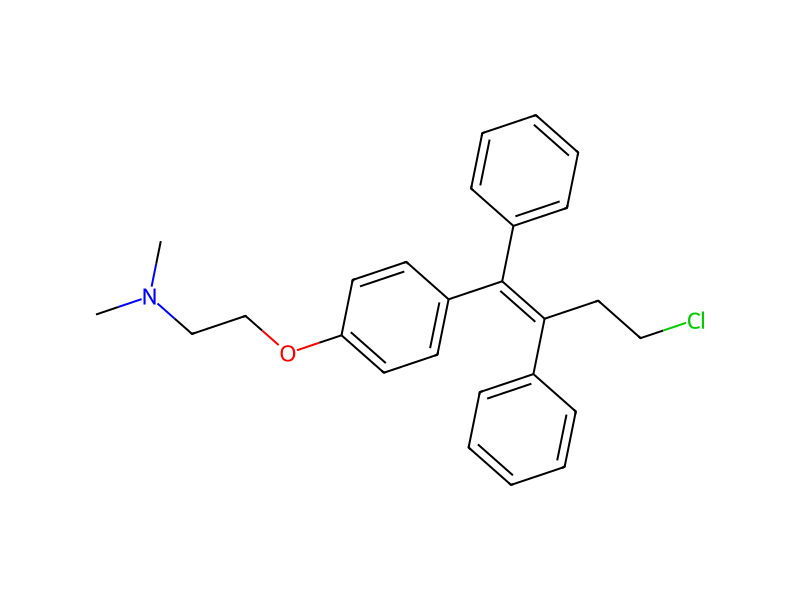
基本情報
- CAS
89778-26-7- 標準SMILES
CN(C)CCOc1ccc(/C(=C(/CCCl)c2ccccc2)c2ccccc2)cc1- InChIKey
XFCLJVABOIYOMF-QPLCGJKRSA-N- 分子式
- C26H28ClNO
- 平均分子量
- 406 g/mol
- 単同位体質量
- 405.1859422
概要
Toremifene is a tertiary amine, an aromatic ether and an organochlorine compound. It has a role as an antineoplastic agent, a bone density conservation agent, an estrogen receptor modulator and an estrogen antagonist. It derives from a hydride of a stilbene.
名称と識別子
- 優先名称
- Toremifene
- IUPAC
- 2-[4-[(Z)-4-chloro-1,2-diphenylbut-1-enyl]phenoxy]-N,N-dimethylethanamine
- 現地名
- トレミフェン
- 英語名
- Toremifene
- 分子式
- C26H28ClNO
- 分子量
- 405.96
名称と別名
toremifene89778-26-7AcapodeneFarestoneToremifenoToremifenumChlortamoxifenToremipheneGTx-0067NFE54O27TJ33.157K(Z)-2-(4-(4-Chloro-1,2-diphenyl-1-butenyl)phenoxy)-N,N-dimethylethanamine
名称をさらに表示
トレミフェン2-[4-[(Z)-4-クロロ-1,2-ジフェニル-1-ブテニル]フェノキシ]-N,N-ジメチルエタンアミン1-[2-(ジメチルアミノ)エトキシ]-4-[(Z)-1,2-ジフェニル-4-クロロ-1-ブテニル]ベンゼン(2-{4-[(1Z)-4-クロロ-1,2-ジフェニルブタ-1-エン-1-イル]フェノキシ}エチル)ジメチルアミンToremifene-d6Toremifene USP/EP/BP(2-[4-((Z)-4-CHLORO-1,2-DIPHENYL-BUT-1-ENYL)-PHENOXY]-ETHYL)-DIMETHYL-AMINEC08166101083Z-ToreMifeneD6-Toremifene2-diphenyl-1-butenyl)phenoxy)-n,n-dimethyl-2-(4-(4-chloro-(z)-ethanamin
CHEBI:9635DTXSID3023689(2-{4-[(1Z)-4-chloro-1,2-diphenylbut-1-en-1-yl]phenoxy}ethyl)dimethylamineEthanamine, 2-(4-(4-chloro-1,2-diphenyl-1-butenyl)phenoxy)-N,N-dimethyl-, (Z)-ETHANAMINE, 2-(4-((1Z)-4-CHLORO-1,2-DIPHENYL-1-BUTEN-1-YL)PHENOXY)-N,N-DIMETHYL-(2-(4-((1Z)-4-chloro-1,2-diphenylbut-1-en-1-yl)phenoxy)ethyl)dimethylamine2-(4-((Z)-4-chloro-1,2-di(phenyl)but-1-enyl)phenoxy)-N,N-dimethylethanamine2-[4-[(Z)-4-chloro-1,2-di(phenyl)but-1-enyl]phenoxy]-N,N-dimethylethanamine
データベース識別子
- CAS
89778-26-7- PubChem CID
- 3005573
- DTXSID
DTXSID3023689- ChEMBL
CHEMBL1655- ChEBI
CHEBI:9635- UNII
- 7NFE54O27T
- EC Number
- 618-298-1
- Nikkaji
- J33.157K
物性
構造計算による物性
- XLogP
- 7.2
- 極性表面積
- 12.5 Ų
- 水素結合供与体数
- 0
- 水素結合受容体数
- 2
- 回転可能結合数
- 9
- 重原子数
- 29
- 形式電荷
- 0
- 複雑度
- 483
実験および物理化学的性質
DrugsPharmaceuticals -> Listed in ZINC15
LogP6.8
Solubility4.09e-04 g/L
Human Drugs
EMA approved medicines: Human medicine
Pharmaceuticals
Endocrine DisruptorsPotential endocrine disrupting compound
Melting Point
108-110 °C
108 - 110 °C
Physical DescriptionSolid
Collision Cross Section203.3 Ų [M+H]+ [CCS Type: DT; Buffer gas: N2; Ionization: ESI+; Dataset: TOXCAST; Source Identifier: DTXSID2021367]
物理化学的性質
- 融点
- 108 · 108-110°C
- 沸点
- 535.1 · 535.1±50.0 °C(Predicted)
- 比重(密度)
- 1.104 · 1.104±0.06 g/cm3(Predicted)
- 貯蔵温度
- -20 °C · Store at -20°C
- 溶解性
- 25 ℃: · 25℃: DMSO 120mg/mL ;Water <1mg/mL; Ethanol <1mg/mL
- 酸解離定数(Pka)
- 8.69 · 8.69±0.28(Predicted)
- 外見
- Powder
- 色
- White to light yellow
- 安定性
- Light sensitive
- InChI
- InChI=1S/C26H28ClNO/c1-28(2)19-20-29-24-15-13-23(14-16-24)26(22-11-7-4-8-12-22)25(17-18-27)21-9-5-3-6-10-21/h3-16H,17-20H2,1-2H3/b26-25-
- InChIKey
- XFCLJVABOIYOMF-QPLCGJKRSA-N
- SMILES
- C(/C1C=CC=CC=1)(\C1C=CC(=CC=1)OCCN(C)C)=C(\C1C=CC=CC=1)/CCCl
- CAS データベース
- 89778 · 89778-26-7(CAS DataBase Reference)
化学的性質
化学的特性White-to-Off-White Solid
安全と法規制
毒性情報
Hepatotoxicity
Toremifene has been associated with mild-to-moderate serum ALT or AST elevations in 5% to 19% of patients, but these abnormalities are usually transient and not associated with symptoms or jaundice. Elevations above 5 times the ULN are uncommon (
Carcinogen Classification
Toremifene
Group 3: Not classifiable as to its carcinogenicity to humans
Volume 66: (1996) Some Pharmaceutical Drugs
1996
1996
Drug Induced Liver Injury
Benchmark Dataset for the Liver Toxicity Knowledge Base (LTKB)
toremifene
Fareston
Antineoplastic agents
3
less-DILI-concern drugs
安全データ
- hazard_class
- 9
化学と産業
薬理情報
ATC Code
L - Antineoplastic and immunomodulating agents
QL - Antineoplastic and immunomodulating agents
Protein BindingToremifen is primarily bound to albumin (92%), 2% bound to α1-acid glycoprotein, and 6% bound to β1-globulin in the serum.
Pharmacodynamics
Toremifene is an antineoplastic hormonal agent primarily used in the treatment of advanced breast cancer. Toremifene is a nonsteroidal agent that has demonstrated potent antiestrogenic properties in animal test systems. The antiestrogenic effects may be related to its ability to compete with estrogen for binding sites in target tissues such as breast. Toremifene inhibits the induction of rat mammary carcinoma induced by dimethylbenzanthracene (DMBA) and causes the regression of already established DMBA-induced tumors. In this rat model, Toremifene appears to exert its antitumor effects by binding the estrogen receptors. In cytosols derived from human breast adenocarcinomas, Toremifene competes with estradiol for estrogen receptor protein.
Mechanism of Action
Toremifene is a nonsteroidal triphenylethylene derivative. Toremifene binds to estrogen receptors and may exert estrogenic, antiestrogenic, or both activities, depending upon the duration of treatment, animal species, gender, target organ, or endpoint selected. The antitumor effect of toremifene in breast cancer is believed to be mainly due to its antiestrogenic effects, in other words, its ability to compete with estrogen for binding sites in the cancer, blocking the growth-stimulating effects of estrogen in the tumor. Toremifene may also inhibit tumor growth through other mechanisms, such as induction of apoptosis, regulation of oncogene expression, and growth factors.
Biological Half-Life5 days
Metabolism/Metabolites
Hepatic. Mainly by CYP3A4 to N-demethyltoremifene, which exhibits antiestrogenic effects but has weak antitumor potency in vivo.
Toremifene has known human metabolites that include N-desmethyltoremifene.
FDA Pharmacological Classification
7NFE54O27T
TOREMIFENE
Established Pharmacologic Class [EPC] - Estrogen Agonist/Antagonist
Mechanisms of Action [MoA] - Selective Estrogen Receptor Modulators
Toremifene is an Estrogen Agonist/Antagonist. The mechanism of action of toremifene is as a Selective Estrogen Receptor Modulator.
MeSH Pharmacological Classification
Antineoplastic agents that are used to treat hormone-sensitive tumors. Hormone-sensitive tumors may be hormone-dependent, hormone-responsive, or both. A hormone-dependent tumor regresses on removal of the hormonal stimulus, by surgery or pharmacological block. Hormone-responsive tumors may regress when pharmacologic amounts of hormones are administered regardless of whether previous signs of hormone sensitivity were observed. The major hormone-responsive cancers include carcinomas of the breast, prostate, and endometrium; lymphomas; and certain leukemias. (From AMA Drug Evaluations Annual 1994, p2079)
A structurally diverse group of compounds distinguished from ESTROGENS by their ability to bind and activate ESTROGEN RECEPTORS but act as either an agonist or antagonist depending on the tissue type and hormonal milieu. They are classified as either first generation because they demonstrate estrogen agonist properties in the ENDOMETRIUM or second generation based on their patterns of tissue specificity. (Horm Res 1997;48:155-63)
Agents that inhibit BONE RESORPTION and/or favor BONE MINERALIZATION and BONE REGENERATION. They are used to heal BONE FRACTURES and to treat METABOLIC BONE DISEASES such as OSTEOPOROSIS.
Absorption, Distribution and Excretion
Well absorbed
Toremifene is extensively metabolized, principally by CYP3A4 to N-demethyltoremifene, which is also antiestrogenic but with weak in vivo antitumor potency.
580 L
5 L/h
Cellular LocationsCytoplasm
用途と製造
Use ClassificationPharmaceuticals
応用分野
説明Toremifene is an antiestrogenic anticancer agent effective in the treatment of advanced recurrent breast cancer in postmenopausal patients. It is claimed to be more effective than tamoxifen in several rat mammary tumor models. Side-effects are mild, including hot flushes and sweating.
使用An antiestrogen and antineoplastic. Nonsteroidal antiestrogen structurally similar to tamoxifen
上流・下流製品情報
上流原料
サプライヤー64 社
北京华美互利生物化工010-56205725 · [email protected]
上海阿拉丁生化科技股份有限公司400-6206333 13167063860 · [email protected]
南通飞宇生物科技有限公司0513-68819626 15152877458 · [email protected]
Career Henan Chemica Co+86-0371-86658258 +86-13203830695 · [email protected]
武汉布林科技有限公司3456065315 13260619011 · [email protected]
LGM Pharma1-(800)-881-8210 · [email protected]
上海将来实业股份有限公司400-0066400 13621662912 · [email protected]
United Life Science020-82099279 18988941402 · [email protected]
MedBio脉铂医药021-69568360 18916172912 · [email protected]
学研惠(武汉)科技有限公司15727060112 · [email protected]
MedChemexpress LLC021-58955995 · [email protected]
上海稳同科技有限公司02151600108 13062666369 · [email protected]
济南精合医药科技有限公司0531-88811783 · [email protected]
宝鸡缔都医药化工有限公司029-81145305 17791533577 · [email protected]
ChemeGen 中国18818260767 · [email protected]
深圳振强药物研发有限公司0755-66853366 13670046396 · [email protected]
广州爱纯医药科技有限公司020-39119399 18927568969 · [email protected]
上海喀露蓝科技有限公司18149758185 18149758185 · [email protected]
上海湄水化工科技有限公司021-60549325 18616193163
上海将来实业股份有限公司400-0066400 13621662912 · [email protected]
上海将来实业股份有限公司021-61552785 · [email protected]
天津普西唐生物医药科技有限公司010-60605840 · [email protected]
常州翔龙医药科技有限公司18915873328 18915873328 · [email protected]
广州市慈铭生物科技有限公司020-38082199,29065168,38082986,29878298,29866629,4000192398
Chongqing jooe co., ltd+86-15223382610 · [email protected]
江苏奥赛康药业有限公司13585114296 13585114296 · [email protected]
艾吉析科技(上海)有限公司17721401538;17717235263 17721401538 · [email protected]
上海石洋化工有限公司+86-021-56795779 +86-13651600618 · [email protected]
风咏生物(AbMole)021-10000000 13000000000 · [email protected]
上海珞珐生化科技有限公司021-51111890 15317326293 · [email protected]
成都华纯科技有限公司400-1166-196 15982826727 · [email protected]
南京罗迈美生物科技有限公司[email protected]
成都新弘材料科技有限公司010-88886666-01 13112345678 · [email protected]
上海特伯化学科技有限公司021-58170097 · [email protected]
苏州爱玛特生物科技有限公司0512-56316828 400-867-5858;400-867-5858 · [email protected]
Shanghai Acmec Biochemical Technology Co., Ltd.+86-18621343501 · [email protected]
Musechem+1-800-259-7612 · [email protected]
上海臻励生物科技有限公司021-16621358918; 18516310516;16621358918;13045646768 · [email protected]
武汉峰耀同辉化学制品有限公司027-87466105 15377573527 · [email protected]
山东锦湖化学有限公司18653796880 · [email protected]
河南天孚化工有限公司+86-0371-55170693 +86-19937530512 · [email protected]
厦门盈融达化工有限公司+86-0592-6210733 · [email protected]
天津希恩思生化科技有限公司400-6387771-6039 18920764717 · [email protected]
ATK CHEMICAL COMPANY LIMITED+undefined-21-51877795 · [email protected]
南京昊绿生物科技有限公司025-84622273 17361806303 · [email protected]
成都圣美凯生物科技有限公司028-85157043 15882256948 · [email protected]
合肥瑞科昇生物科技有限公司0551-66336380 18956014586 · [email protected]
Aladdin Scientific[email protected]
Wuhan Topule Biopharmaceutical Co., Ltd+86-18327326525 · [email protected]
上海迈瑞尔生化科技有限公司18621169109 · [email protected]
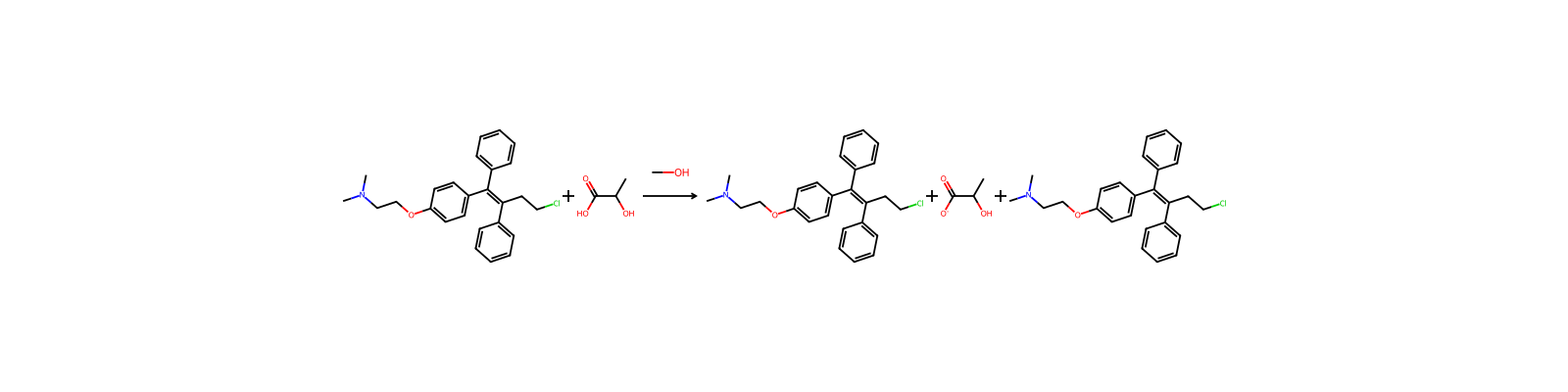
関連反応
4 件


化合物ノート
読み込み中…