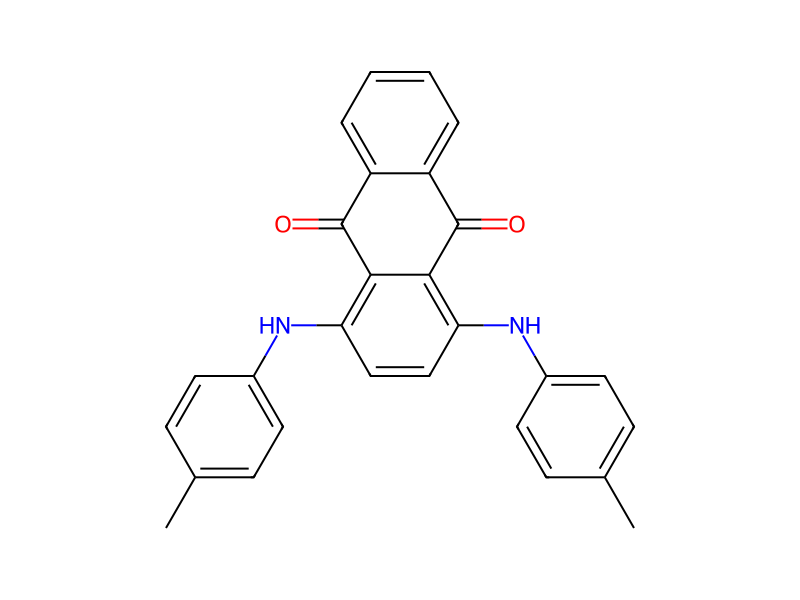
基本情報
- 標準SMILES
Cc1ccc(Nc2ccc(Nc3ccc(C)cc3)c3c2C(=O)c2ccccc2C3=O)cc1- InChIKey
TVRGPOFMYCMNRB-UHFFFAOYSA-N- 分子式
- C28H22N2O2
- 平均分子量
- 418.5 g/mol
- 単同位体質量
- 418.16812794
名称と識別子
- 優先名称
- Cyanine Green G Base
- IUPAC
- 1,4-bis(4-methylanilino)anthracene-9,10-dione
- 現地名
- キニザリン グリン SS
- 英語名
- Solvent Green 3
- 分子式
- C28H22N2O2
- 分子量
- 418.49
名称と別名
名称をさらに表示
データベース識別子
- CAS
128-80-3- PubChem CID
- 31416
- DTXSID
DTXSID9044376- UNII
- 4QP5U84YF7
- EC Number
- 204-909-5
- Nikkaji
- J33.356E
物性
構造計算による物性
- XLogP
- 7.8
- 極性表面積
- 58.2 Ų
- 水素結合供与体数
- 2
- 水素結合受容体数
- 4
- 回転可能結合数
- 4
- 重原子数
- 32
- 形式電荷
- 0
- 複雑度
- 619
実験および物理化学的性質
Color/Form
Dark burgundy
Dark violet needles
Solid at 20 °C
Solubility
In 2-methoxymethanol, 2 mg/mL; in ethanol 0.3 mg/mL
Soluble in 3.4 g/100 mL alcohol at 25 °C. Soluble in hydrochloric and sulfuric acid. Sparingly soluble in methanol, ethyl ether.
Slightly soluble in acetone, ethyl acetate, mineral oil, oleic acid, stearic acid. Soluble in benzene, toluene.
Other Experimental Properties
Blue solution in concentrated H2SO4 giving a blue-green precipitate on dilution
Heat of reaction: 299 cal/g (green smoke mixture)
Activation energy for thermal decomposition: 183.7 kJ/mol
During combustion of an organic dye, 90-95% sublimes, 5-10% undergoes thermal decomposition and rearrangement but no ring openings occur. Major decomposition products include polyaromatic hydrocarbons and polynuclear organic materials. /Organic Dyes/
物理化学的性質
- 融点
- 220 · 220-221 °C
- 沸点
- 536.24 °C · 536.24°C (rough estimate)
- 比重(密度)
- 1.1816 · 1.1816 (rough estimate)
- 蒸気圧
- 0 Pa · 0Pa at 25℃
- 屈折率
- 1.58 · 1.5800 (estimate)
- 貯蔵温度
- Keep in dark place,Inert atmosphere,Room temperature
- 溶解性
- アセトン(微量)、DMSO(微量)、メタノール(微量)
- 外見
- powder
- 酸解離定数(Pka)
- -0.02 · -0.02±0.20(Predicted)
- 色
- ベリーダークパープル
- 水溶解度
- 10 μg/L · 10μg/L at 25℃
- Merck
- 14 · 14,8065
- Henry's Law Constant
- 6.6 · 6.6×1010 mol/(m3Pa) at 25℃, HSDB (2015)
- 主な用途
- 診断アッセイの製造血液学組織学
- 化粧品成分の機能
- ヘアカラーリング着色剤
- InChI
- 1S/C28H22N2O2/c1-17-7-11-19(12-8-17)29-23-15-16-24(30-20-13-9-18(2)10-14-20)26-25(23)27(31)21-5-3-4-6-22(21)28(26)32/h3-16,29-30H,1-2H3
- InChIKey
- TVRGPOFMYCMNRB-UHFFFAOYSA-N
- SMILES
- Cc1ccc(Nc2ccc(Nc3ccc(C)cc3)c4C(=O)c5ccccc5C(=O)c24)cc1
- LogP
- 8.2 at · 8.2 at 40℃
- CAS データベース
- 128 · 128-80-3(CAS DataBase Reference)
- NISTの化学物質情報
- 1 · Anthraquinone, 1,4-bis(4,4'-ditoluidino)-(128-80-3)
- EPAの化学物質情報
- 1 · 1,4-Di(4'-toluidino)anthraquinone (128-80-3)
化学的性質
化学的特性Solvent Green 3 is black fine crystalline powder
安全と法規制
GHS分類
GHS Classification
This chemical does not meet GHS hazard criteria for 97.8% (2848 of 2913) of all reports.
Not Classified
Aggregated GHS information provided per 2913 reports by companies from 14 notifications to the ECHA C&L Inventory.
危険有害性情報
Regulatory Information
Chemical: 9,10-Anthracenedione, 1,4-bis[(4-methylphenyl)amino]-
REACH registered substance: 1,4-bis(p-tolylamino)anthraquinone (EC: 204-909-5)
9,10-Anthracenedione, 1,4-bis[(4-methylphenyl)amino]-: Does not have an individual approval but may be used under an appropriate group standard
FDA Requirements
All batches of this color additive when used as in externally applied drugs shall meet the specifications, uses and restrictions, and labeling regulations contained in 21 CFR Part 74 and be certified in accordance with regulations in 21 CFR Part 80.
All batches of this color additive when used as in externally applied cosmetics shall meet the specifications, uses and restrictions, and labeling regulations contained in 21 CFR Part 74 and be certified in accordance with regulations in 21 CFR Part 80.
All batches of this color additive when used as a medical device shall meet the specifications, uses and restrictions, and labeling regulations contained in 21 CFR Part 74 and be certified in accordance with regulations in 21 CFR Part 80.
A batch of this straight color may be certified, in accordance with 21 CFR Part 82, for use in externally applied drugs and cosmetics, if such batch conforms to the requirements of 21 CFR 82.5 and to the specifications in 21 CFR Part 82.
Certificates issued for D&C Green No. 6, its lakes and all mixtures containing this color additive are cancelled and have no effect as pertains to their use in ingested drugs and cosmetics after May 4, 1982 and use of the color additive in the manufacture of ingested drugs or cosmetics after this date will result in adulteration.
安全と保護具
Disposal Methods
SRP: The most favorable course of action is to use an alternative chemical product with less inherent propensity for occupational harm/injury/toxicity or environmental contamination. Recycle any unused portion of the material for its approved use or return it to the manufacturer or supplier. Ultimate disposal of the chemical must consider: the material's impact on air quality; potential migration in soil or water; effects on animal and plant life; and conformance with environmental and public health regulations.
毒性情報
Environmental Fate
TERRESTRIAL FATE: Based on a classification scheme(1), an estimated Koc value of 4.8X10+6(SRC), determined from a structure estimation method(2), indicates that D&C Green No. 6 is expected to be immobile in soil(SRC). Volatilization of D&C Green No. 6 from moist soil surfaces is not expected to be an important fate process(SRC) given an estimated Henry's Law constant of 1.5X10⁻¹⁶ atm-cu m/mole(SRC), using a fragment constant estimation method(3). D&C Green No. 6 is not expected to volatilize from dry soil surfaces(SRC) based upon an estimated vapor pressure of 7.0X10⁻¹³ mm Hg at 25 °C(SRC), determined from a fragment constant method(4). D&C Green No. 6 was shown to be susceptible to photolysis on soil, with two photoproducts detected, not identified(5). Biodegradation data in soil were not available(SRC, 2011).
AQUATIC FATE: Based on a classification scheme(1), an estimated Koc value of 4.8X10+6(SRC), determined from a structure estimation method(2), indicates that D&C Green No. 6 is expected to adsorb to suspended solids and sediment(SRC). Volatilization from water surfaces is not expected(3) based upon an estimated Henry's Law constant of 1.5X10⁻¹⁶ atm-cu m/mole(SRC), developed using a fragment constant estimation method(4). According to a classification scheme(5), an estimated BCF of 500(SRC), from an estimated log Kow of 8.69(6) and a regression-derived equation(7), suggests the potential for bioconcentration in aquatic organisms is high, provided the compound is not metabolized by the organism(SRC). Biodegradation data in water were not available(SRC, 2011).
ATMOSPHERIC FATE: According to a model of gas/particle partitioning of semivolatile organic compounds in the atmosphere(1), D&C Green No. 6, which has an estimated vapor pressure of 7.0X10⁻¹³ mm Hg at 25 °C(SRC), determined from a fragment constant method(2), is expected to exist solely in the particulate phase in the ambient atmosphere. Particulate-phase D&C Green No. 6 may be removed from the air by wet or dry deposition(SRC). D&C Green No. 6 absorbs light at wavelengths 644 nm(3), and therefore may be susceptible to direct photolysis by sunlight(SRC).
Ecotoxicity Excerpts
/AQUATIC SPECIES/ Solvent Yellow 33 and a Solvent Green 3 mixture (30:70 mixture of Solvent Yellow 33 and Solvent Green 3) were not acutely toxic to seven of nine freshwater species when tested at the solubility limits of the dyes in freshwater. A solubility limit solution of the Solvent Green 3 mixture killed 50% of the rainbow trout tested for 96 hr but was non-toxic when diluted by 50%. Both dyes caused a reduction in green algal growth at solubility limits. The Solvent Green 3 mixture was the most detrimental causing a 98-99% reduction in growth after 5 days of exposure.
Soil Adsorption/Mobility
Using a structure estimation method based on molecular connectivity indices(1), the Koc of D&C Green No. 6 can be estimated to be 4.8X10+6(SRC). According to a classification scheme(2), this estimated Koc value suggests that D&C Green No. 6 is expected to be immobile mobility in soil.
Artificial Pollution Sources
D&C Green No. 6's production and use in coloring fats, oils, waxes, hydrocarbon solvents, hydrocarbon-base wood stains, cellulose acetate, polystyrene and soap, in the preparation of oleic or stearic rotogravure inks(1) and for sutures(2) may result in its release to the environment through various waste streams(SRC). Its use in smoke formulations for military communication grenades(3) will result in its direct release to the environment(SRC).
Environmental Bioconcentration
An estimated BCF of 500 was calculated in fish for D&C Green No. 6(SRC), using an estimated log Kow of 8.69(1) and a regression-derived equation(2). According to a classification scheme(3), this BCF suggests the potential for bioconcentration in aquatic organisms is high(SRC), provided the compound is not metabolized by the organism(SRC).
Volatilization from Water/Soil
The Henry's Law constant for D&C Green No. 6 is estimated as 1.5X10⁻¹⁶ atm-cu m/mole(SRC) using a fragment constant estimation method(1). This Henry's Law constant indicates that D&C Green No. 6 is expected to be essentially nonvolatile from water and moist soil surfaces(2). D&C Green No. 6 is not expected to volatilize from dry soil surfaces(SRC) based upon an estimated vapor pressure of 7.0X10⁻¹³ mm Hg(SRC), determined from a fragment constant method(3).
Non-Human Toxicity Excerpts
/LABORATORY ANIMALS: Acute Exposure/ Solvent green 3 produced no skin irritation when applied to intact or abraded skin of rabbits and produced ''minimal'' erythema in the eyes of rabbits.
/LABORATORY ANIMALS: Subchronic or Prechronic Exposure/ The quinoline dye 2-(2'-quinolyl)-1,3-indandione or Solvent Yellow 33 (SY) and the anthraquinone dye 1,4-di-p-toluidinoanthraquinone or Solvent Green 3 (SG) are used in many manufactured products including military smoke grenades. During manufacturing, SY or a combination of both SY and SG can be released into the air, exposing factory workers by inhalation to these dye compounds. The potential inhalation toxicity of these compounds was tested by exposing F344/N rats to different concentrations of SY or SY/SG dye mixture (30:70 w/w) for 6 hr/day, 5 days/week for 4 or 13 weeks. In the 4-week studies, rats were exposed to SY aerosols at average concentrations of 10 +/- 5, 51 +/- 10, or 230 +/- 30 mg/cu m (means +/- SD) or SY/SG aerosols at average concentrations of 11 +/- 5, 49 +/- 11, or 210 +/- 50 mg/cu m (means +/- SD). Rats exposed to the highest concentration of SY or SY/SG had body weights that were approximately 8% or 7% less, respectively, than their controls after exposure. Rats exposed to the highest concentration of SY/SG for 4 weeks also had reduced pulmonary gas exchange efficiency, airflow obstruction, mild pulmonary inflammation, slight Type II pulmonary epithelial cell hyperplasia, and proliferation of vacuolated alveolar macrophages. In the 13-week studies, rats were exposed to SY aerosols at average concentrations of 1.0 +/- 0.2, 10.8 +/- 1.8, or 100 +/- 17 mg/ cu m (means +/- SD) or SY/SG aerosols at average concentrations of 1.1 +/- 0.5, 10.2 +/- 3.1, or 101 +/- 23 mg/cu m (means +/- SD). Animals exposed to the highest concentration of SY or SY/SG for 13 weeks had body weights that were approximately 5 or 9% less, respectively, than their controls after exposure and had accumulation of vacuolated alveolar macrophages in lungs. Rats exposed to the highest concentration of SY/SG dye mixture for 13 weeks also had indications of mild pulmonary inflammation and slight Type II pulmonary epithelial cell hyperplasia. Very little SY was found in lungs after any exposures, indicating its clearance from lungs was at a rapid rate. However, significant amounts of the SG component of the SY/SG mixture were detected in lungs after each exposure. Lung clearance half-times of SG from the 13-week exposure were estimated to be approximately 280 days. In summary, neither test material appeared to be highly toxic following inhalation. However, the slightly higher toxicity observed for SY/SG over SY alone is probably related to the longer lung retention of the SG component of the dye mixture.
/GENOTOXICITY/ Mutagenicity testing was conducted for two dyes used in military marker signaling grenades: CI-Solvent-Yellow-33, and a yellow/green dye containing CI-Solvent-Yellow-33 and CI-Solvent-Green-3. Mutagenicity tests using the Salmonella reversion assay and the L5178Y(+/-) mouse lymphoma assay were carried out. Tests were also performed for sister chromatid exchange (SCE) induction in-vivo in C57BL/6J-mice. The Salmonella reversion assay and the L5178Y/TK(+/-) mouse lymphoma assay were also used to test a 99.9 percent pure sample of the yellow dye with and without exogenous activation. No induction of SCEs in-vivo was caused by CI-Solvent-Yellow-33 nor the mixture of dyes. The standard plate incorporation test and seven Salmonella strains were used to test all three dyes. Negative results were obtained with and without exogenous activation in (TA98), (TA1535), and (TA1538). A positive test was obtained with (TA1537) using the more than 99.9 percent pure yellow dye. With S-9 activation in (TA100), all three dyes gave weakly positive results. Clearly positive results were obtained in (TA102) and (TA104) with and without S-9 activation. Mutation was induced at the thymidine-kinase locus in mouse lymphoma cells. Large and small colony trifluorothymidine resistant mutants were produced. The dyes were also clastogenic. A slightly positive response in the presence of S-9 was noted for the purified yellow dye on further testing for SCE induction in mouse lymphoma cells. /Thus/ ... the yellow dye is mutagenic.
/GENOTOXICITY/ Solvent green 3 is not mutagenic in the Salmonella typhimurium strains with or without activation, according to one report, but ... positive results /were reported/ in both the S. typhimurium assay and the thymidine kinase locus mouse lymphoma assay.
Environmental Abiotic Degradation
D&C Green No. 6 is not expected to undergo hydrolysis in the environment due to the lack of functional groups that hydrolyze under environmental conditions(1). D&C Green No. 6 absorbs light at wavelengths 644 nm(2), and therefore may be susceptible to direct photolysis by sunlight(SRC). The compound is susceptible to photodegradation depending on the surrounding conditions(3). D&C Green No. 6 was shown to be susceptible to photolysis on soil, with two photoproducts detected, not identified(4).
Probable Routes of Human Exposure
NIOSH (NOES Survey 1981-1983) has statistically estimated that 55,064 workers (41,703 of these were female) were potentially exposed to D&C Green No. 6 in the US(1). Occupational exposure to D&C Green No. 6 may occur through inhalation and dermal contact with this compound at workplaces where D&C Green No. 6 is produced or used. Use data indicate that the general population may be exposed to D&C Green No. 6 via dermal contact with consumer products containing D&C Green No. 6(SRC).
Environmental Fate/Exposure Summary
D&C Green No. 6's production and use in coloring fats, oils, waxes, hydrocarbon solvents, hydrocarbon-base wood stains, cellulose acetate, polystyrene and soap, in the preparation of oleic or stearic rotogravure inks and for sutures may result in its release to the environment through various waste streams. Its use in smoke formulations for military communication grenades will result in its direct release to the environment. If released to air, an estimated vapor pressure of 7.0X10⁻¹³ mm Hg at 25 °C indicates D&C Green No. 6 will exist solely in the particulate phase in the atmosphere. Particulate-phase D&C Green No. 6 will be removed from the atmosphere by wet or dry deposition. D&C Green No. 6 absorbs light at wavelengths 644 nm, and therefore may be susceptible to direct photolysis by sunlight. If released to soil, D&C Green No. 6 is expected to have to be immobile based upon an estimated Koc of 4.8X10+6. Volatilization from moist soil surfaces is not expected to be an important fate process based upon an estimated Henry's Law constant of 1.5X10⁻¹⁶ atm-cu m/mole. D&C Green No. 6 is not expected to volatilize from dry soil surfaces based upon its vapor pressure. D&C Green No. 6 was shown to be susceptible to photolysis on soil, with two photoproducts detected, not identified. Biodegradation data in soil or water were not available. If released into water, D&C Green No. 6 is expected to adsorb to suspended solids and sediment based upon the estimated Koc. Volatilization from water surfaces is not expected to be an important fate process based upon this compound's estimated Henry's Law constant. An estimated BCF of 500 suggests the potential for bioconcentration in aquatic organisms is high, provided the compound is not metabolized by the organism. Hydrolysis is not expected to be an important environmental fate process since this compound lacks functional groups that hydrolyze under environmental conditions (pH 5 to 9). Occupational exposure to D&C Green No. 6 may occur through inhalation and dermal contact with this compound at workplaces where D&C Green No. 6 is produced or used. Use data indicate that the general population may be exposed to D&C Green No. 6 via dermal contact with consumer products containing D&C Green No. 6. (SRC)
Antidote and Emergency Treatment
/SRP:/ Immediate first aid: Ensure that adequate decontamination has been carried out. If patient is not breathing, start artificial respiration, preferably with a demand valve resuscitator, bag-valve-mask device, or pocket mask, as trained. Perform CPR if necessary. Immediately flush contaminated eyes with gently flowing water. Do not induce vomiting. If vomiting occurs, lean patient forward or place on the left side (head-down position, if possible) to maintain an open airway and prevent aspiration. Keep patient quiet and maintain normal body temperature. Obtain medical attention. /Poisons A and B/
/SRP:/ Basic treatment: Establish a patent airway (oropharyngeal or nasopharyngeal airway, if needed). Suction if necessary. Watch for signs of respiratory insufficiency and assist ventilations if needed. Administer oxygen by nonrebreather mask at 10 to 15 L/min. Monitor for pulmonary edema and treat if necessary ... . Monitor for shock and treat if necessary ... . Anticipate seizures and treat if necessary ... . For eye contamination, flush eyes immediately with water. Irrigate each eye continuously with 0.9% saline (NS) during transport ... . Do not use emetics. For ingestion, rinse mouth and administer 5 mL/kg up to 200 mL of water for dilution if the patient can swallow, has a strong gag reflex, and does not drool ... . Cover skin burns with dry sterile dressings after decontamination ... . /Poisons A and B/
/SRP:/ Advanced treatment: Consider orotracheal or nasotracheal intubation for airway control in the patient who is unconscious, has severe pulmonary edema, or is in severe respiratory distress. Positive-pressure ventilation techniques with a bag valve mask device may be beneficial. Consider drug therapy for pulmonary edema ... . Consider administering a beta agonist such as albuterol for severe bronchospasm ... . Monitor cardiac rhythm and treat arrhythmias as necessary ... . Start IV administration of D5W /SRP: "To keep open", minimal flow rate/. Use 0.9% saline (NS) or lactated Ringer's if signs of hypovolemia are present. For hypotension with signs of hypovolemia, administer fluid cautiously. Watch for signs of fluid overload ... . Treat seizures with diazepam or lorazepam ... . Use proparacaine hydrochloride to assist eye irrigation ... . /Poisons A and B/
Non-Human Toxicity Values
LD50 Rat oral 3660 mg/kg
LD50 Rat oral 3 g/kg bw
LD50 Rat oral >10 g/kg bw
LD50 Rat oral >15 g/kg bw
LD50 Rabbit oral >10 g/kg bw
法規制情報
FDA Requirements
All batches of this color additive when used as in externally applied drugs shall meet the specifications, uses and restrictions, and labeling regulations contained in 21 CFR Part 74 and be certified in accordance with regulations in 21 CFR Part 80.
All batches of this color additive when used as in externally applied cosmetics shall meet the specifications, uses and restrictions, and labeling regulations contained in 21 CFR Part 74 and be certified in accordance with regulations in 21 CFR Part 80.
All batches of this color additive when used as a medical device shall meet the specifications, uses and restrictions, and labeling regulations contained in 21 CFR Part 74 and be certified in accordance with regulations in 21 CFR Part 80.
A batch of this straight color may be certified, in accordance with 21 CFR Part 82, for use in externally applied drugs and cosmetics, if such batch conforms to the requirements of 21 CFR 82.5 and to the specifications in 21 CFR Part 82.
Certificates issued for D&C Green No. 6, its lakes and all mixtures containing this color additive are cancelled and have no effect as pertains to their use in ingested drugs and cosmetics after May 4, 1982 and use of the color additive in the manufacture of ingested drugs or cosmetics after this date will result in adulteration.
安全データ
- wgk
- 2
- tsca
- TSCA listed
- rtecs
- CB5775000
- 毒性
- rat,LD50,intratracheal,250mg/kg (250mg/kg),"Prehled Prumyslove Toxikologie; Organicke Latky," Marhold, J., Prague, Czechoslovakia, Avicenum, 1986Vol. -, Pg. 1330, 1986.
- hs_code
- 32041200
- risk_code
- 36/37/38
- 化審法
- (4)-769, (5)-3131
- hazard_code
- Xi
- safety_code
- 24/25-22-26
- Hazard Classifications
- Eye Irrit. 2Skin Irrit. 2STOT SE 3
- ストレージクラス
- 11 - Combustible Solids
- 有毒物質データの
- 128-80-3(Hazardous Substances Data)
化学と産業
薬理情報
Biological Half-Life
The respiratory tract deposition, distribution in tissues, metabolism, and excretion of solvent yellow (2-(2'-quinolinyl)-1,3-indandione) were examined in rats after inhalation of (14)C labeled solvent yellow aerosols at 160 nanomoles/liter (nmol/L) solvent yellow in air. Solvent green (1,4-di-p-toluidinoanthraquinone) was also studied. The study was conducted using F344-rats exposed to solvent yellow aerosols or to a mixture of solvent yellow and solvent green (340nmol and 370nmol, respectively) for 60 minutes. Solvent yellow exhibited a half life of 2 to 3 hr, and was thus rapidly cleared from the respiratory tract after either exposure. A minimum estimated half life of 22 days was achieved for the retention of solvent green in the respiratory tract. ... The difference in the clearance times for solvent yellow and solvent green are possibly due to the different lipid solubilities of the dyes.
When inhaled, solvent green 3 clears very slowly from the lung (half live, 280 days).
Absorption, Distribution and Excretion
The respiratory tract deposition, distribution in tissues, metabolism, and excretion of solvent yellow (2-(2'-quinolinyl)-1,3-indandione) were examined in rats after inhalation of (14)C labeled solvent yellow aerosols at 160 nanomoles/liter (nmol/L) solvent yellow in air. Solvent green (1,4-di-p-toluidinoanthraquinone) was also studied. The study was conducted using F344-rats exposed to solvent yellow aerosols or to a mixture of solvent yellow and solvent green (340nmol and 370nmol, respectively) for 60 minutes. Solvent yellow exhibited a half life of 2 to 3 hr, and was thus rapidly cleared from the respiratory tract after either exposure. A minimum estimated half life of 22 days was achieved for the retention of solvent green in the respiratory tract. Samplings of other tissues during the 70hr postexposure period did not indicate the presence of solvent green. A total of 40 to 75 percent of the (14)C present in liver and kidney after either exposure was shown by high pressure liquid chromatography to be metabolites of solvent yellow. The feces proved to be the major pathway for excretion of solvent yellow and its metabolites, accounting for 74 percent of the initial body burden. The excretion half life was 14hr. Fourteen percent of the initial body burden was excreted in the urine with this half life being 10hr. Solvent yellow metabolites accounted for over 90 percent of the (14)C excreted in the urine. Only about 2 percent of the solvent yellow was metabolized to carbon dioxide. Only 10 percent of the initial (14)C deposited in the body remained there after 72hr. ...
In a study on the retention of solvent green 3 in the lungs, rats were given a suspension containing the dye. The authors observed that 87% of the initial dose remained in the lungs 24 hr after exposure.
用途と製造
Uses
Used for sutures; Approved for external drugs and cosmetics; [Merck Index]
Coloring fats, oils, waxes, hydrocarbon solvents, hydrocarbon-base wood stains, cellulose acetate, polystyrene and soap, and in the preparation of oleic or stearic rotogravure inks.
Coloring contact lenses; ... coloring polyethylene terephthalate surgical sutures, including sutures for ophthalmic use; ... coloring polyglycolic acid surgical sutures with diameter greater than U.S.P. size 8-0, including sutures for ophthalmic use; ... coloring poly(glycolic acid-co-trimethylene carbonate) sutures (also referred to as 1,4-dioxan-2,5-dione polymer with 1,3-dioxan-2-one) for general surgical use; and ... coloring polymethylmethacrylate support haptics of intraocular lenses.
Military smoke dye grenades used for communication
Use Classification
Fragrance Ingredients
Cosmetics -> Cosmetic colorant; Hair dyeing
General Manufacturing Information
9,10-Anthracenedione, 1,4-bis[(4-methylphenyl)amino]-: ACTIVE
Color additives were initially regulated in the United States under the U.S. Department of Agriculture's (USDA) Bureau of Chemistry. In 1906, the Food and Drugs Act was passed by Congress, which prohibited the use of poisonous or deleterious colors in confectionery and the coloring or staining of food to conceal damage or inferiority. In 1927, responsibility of the Food and Drugs Act was transferred to FDA. Increasing government oversight, the Federal Food, Drug, and Cosmetic Act (FFDCA) was passed in 1938 and established the three following categories for colors: FD&C: colors used in foods, drugs and cosmetics; D&C: colors used in drugs and cosmetics when in contact with mucous membranes or ingested; and Ext. D&C: colors used in products applied externally.
応用分野
使用Solvent Green 3 used in externally applied drugs and cosmetics: ibid. 47, 14138 (1982).
調製方法
製造方法1,4-Dihydroxyanthracene-9,10-dione and to p-Methylaniline (2 Moore) condensation.
上流・下流製品情報
上流原料
下流製品
サプライヤー50 社
補足説明
定義本品は、平成15年厚労省令第126号に示される緑色202号である。
関連反応
現在のフィルター条件では反応記録がありません。
関連ノート
読み込み中…