
基本情報
- 標準SMILES
CC(=O)OCC(CCn1cnc2cnc(N)nc21)COC(C)=O- InChIKey
GGXKWVWZWMLJEH-UHFFFAOYSA-N- 分子式
- C14H19N5O4
- 平均分子量
- 321.33 g/mol
- 単同位体質量
- 321.14370409
概要
Famciclovir is 2-Amino-9H-purine in which the hydrogen at position 9 is substituted by a 4-acetoxy-3-(acetoxymethyl)but-1-yl group. A prodrug of the antiviral penciclovir, it is used for the treatment of acute herpes zoster (shingles), for the treatment or suppression of recurrent genital herpes in immunocompetent patients and for the treatment of recurrent mucocutaneous herpes simplex infections in HIV infected patients. It has a role as an antiviral drug and a prodrug. It is a member of 2-aminopurines and an acetate ester.
名称と識別子
- 優先名称
- Famciclovir
- IUPAC
- [2-(acetyloxymethyl)-4-(2-aminopurin-9-yl)butyl] acetate
- 現地名
- ファムシクロビル
- 英語名
- Famciclovir
- 分子式
- C14H19N5O4
- 分子量
- 321.33
名称と別名
famciclovir104227-87-4FamvirBRL-42810FamciclovirumBRL 42810[2-(acetyloxymethyl)-4-(2-aminopurin-9-yl)butyl] acetateDTXSID00230382-[2-(2-amino-9H-purin-9-yl)ethyl]-1,3-propanediol diacetateBRL42810QIC03ANI029-[4-acetoxy-3-(acetoxymethyl)but-1-yl]-2-aminopurine
名称をさらに表示
ファンシクロビル二酢酸3-(2-アミノ-9H-プリン-9-イル)プロピリデンビス(メチレン)ファムビルファムシクロビル2-[2-(2-アミノ-9H-プリン-9-イル)エチル]-1,3-プロパンジオールジアセタート二酢酸2-[2-(2-アミノ-9H-プリン-9-イル)エチル]-1,3-プロパンジイルファムシクロビル (JAN)2-[(アセチルオキシ)メチル]-4-(2-アミノ-9H-プリン-9-イル)ブチル アセタートFCVfamcyclovirOravirFaMtrexFaMcivirAmciclovirFamciclover
NSC-758921CHEBI:49741,3-Propanediol, 2-(2-(2-amino-9H-purin-9-yl)ethyl)-, diacetate (ester)2-(2-(2-Amino-9H-purin-9-yl)ethyl)-1,3-propanediol diacetate (ester)9-(4-acetoxy-3-(acetoxymethyl)but-1-yl)-2-aminopurineDTXCID4030382-(2-(2-amino-9H-purin-9-yl)ethyl)-1,3-propanediol diacetateAcetic acid 2-acetoxymethyl-4-(2-amino-purin-9-yl)-butyl ester
データベース識別子
- CAS
104227-87-4- PubChem CID
- 3324
- DTXSID
DTXSID0023038- ChEMBL
CHEMBL880- ChEBI
CHEBI:4974- UNII
- QIC03ANI02
- EC Number
- 630-411-6
- Nikkaji
- J435.369B
物性
構造計算による物性
- XLogP
- 0
- 極性表面積
- 122 Ų
- 水素結合供与体数
- 1
- 水素結合受容体数
- 8
- 回転可能結合数
- 9
- 重原子数
- 23
- 形式電荷
- 0
- 複雑度
- 404
実験および物理化学的性質
Drugs
Pharmaceuticals
Pharmaceuticals -> Listed in ZINC15
LogP
0.6
0.32
Color/FormWhite shiny plates from ethyl acetate-hexane
Solubility
Solubility in water (25 °C): > 25% w/v initially; rapidly precipitates as sparingly soluble monohydrate (2-3% w/v)
Freely soluble in acetone, methanol; sparingly soluble in ethanol, isopropanol
1.32e+00 g/L
Human Drugs
Breast Feeding; Lactation; Milk, Human; Anti-Infective Agents; Antiviral Agents
FDA approved drugs -> Active ingredient
FDA approved drugs -> Active ingredient
DecompositionWhen heated to decomposition material emits toxic fumes of /nitrogen oxides/.
Melting Point
102-104 °C
102-104 °C
102 - 104 °C
Physical DescriptionSolid
Collision Cross Section
167.77 Ų [M+H]+ [CCS Type: TW; Method: calibrated with polyalanine and drug standards]
168.4 Ų [M+H]+ [CCS Type: TW; Method: calibrated with polyalanine and drug standards]
物理化学的性質
- 融点
- 102 · 102-104°C
- 沸点
- 550.2 · 550.2±60.0 °C(Predicted)
- 比重(密度)
- 1.4 · 1.40±0.1 g/cm3(Predicted)
- 貯蔵温度
- 2 · 2-8°C
- 溶解性
- 10 mg/mL以上 · DMSO:10mg/mL以上
- 酸解離定数(Pka)
- 4 · 4.00±0.10(Predicted)
- 外見
- 個体
- 色
- ホワイトからオフホワイト
- Henry's Law Constant
- 1 · 1.0×108 mol/(m3Pa) at 25℃, HSDB (2015)
- InChI
- InChI=1S/C14H19N5O4/c1-9(20)22-6-11(7-23-10(2)21)3-4-19-8-17-12-5-16-14(15)18-13(12)19/h5,8,11H,3-4,6-7H2,1-2H3,(H2,15,16,18)
- InChIKey
- GGXKWVWZWMLJEH-UHFFFAOYSA-N
- SMILES
- C(OC(=O)C)C(CCN1C2C(N=C1)=CN=C(N)N=2)COC(=O)C
- CAS データベース
- 104227 · 104227-87-4(CAS DataBase Reference)
化学的性質
化学的特性Off-White Powder
安全と法規制
GHS分類
GHS Classification
Danger
H319 (50%): Causes serious eye irritation [Warning Serious eye damage/eye irritation]
P203, P264+P265, P280, P305+P351+P338, P318, P337+P317, P405, and P501 (click each P-code to see the statement)
Aggregated GHS information provided per 4 reports by companies from 3 notifications to the ECHA C&L Inventory. Each notification may be associated with multiple companies.
危険有害性情報
Fire PotentialThis material is assumed to be combustible.
FDA Requirements
The Approved Drug Products with Therapeutic Equivalence Evaluations identifies currently marketed prescription drug products, including famciclovir, approved on the basis of safety and effectiveness by FDA under sections 505 of the Federal Food, Drug, and Cosmetic Act.
Toxic Combustion ProductsEmits toxic fumes under fire conditions.
Hazard Classes and CategoriesEye Irrit. 2 (50%)
Skin, Eye, and Respiratory Irritations
If breathed in, move person into fresh air. If not breathing, give artificial respiration.
In case of skin contact, wash off with soap and plenty of water.
In case of eye contact, flush eyes with water as a precaution.
If swallowed, never give anything by mouth to an unconscious person. Rinse mouth with water.
安全と保護具
Fire Fighting Procedures
Water spray, dry chemical, carbon dioxide or foam as appropriate for surrounding fire and materials.
As with all fires, evacuate personnel to a safe area. Firefighters should use self-contained breathing equipment and protective clothing.
Storage Conditions
Store Famvir at room temperature between 59 deg and 86 °F (15 deg to 30 °C).
Store in tight container as defined in the USP-NF. This material should be handled and stored per label instructions to ensure product integrity.
Recommended storage temperature: 2 - 8 °C
Cleanup Methods
Wear approved respiratory protection, chemically compatible gloves, and protective clothing. Wipe up spillage or collect spillage using a high-efficiency vacuum cleaner. Avoid breathing dust. Place spillage in appropriately labeled container for disposal. Wash spill site.
Disposal Methods
SRP: Expired or waste pharmaceuticals shall carefully take into consideration applicable DEA, EPA, and FDA regulations. It is not appropriate to dispose by flushing the pharmaceutical down the toilet or discarding to trash. If possible return the pharmaceutical to the manufacturer for proper disposal being careful to properly label and securely package the material. Alternatively, the waste pharmaceutical shall be labeled, securely packaged and transported by a state licensed medical waste contractor to dispose by burial in a licensed hazardous or toxic waste landfill or incinerator.
Dispose of waste in accordance with all applicable Federal, State and local laws.
Preventive Measures
Avoid exposure to heat and moisture.
As a general rule, when handling USP Reference Standards, avoid all contact and inhalation of dust, mists, and/or vapors associated with the material. Clean equipment and work surfaces with suitable detergent or solvent after use. After removing gloves, wash hands and other exposed skin thoroughly.
SRP: Local exhaust ventilation should be applied wherever there is an incidence of point source emissions or dispersion of regulated contaminants in the work area. Ventilation control of the contaminant as close to its point of generation is both the most economical and safest method to minimize personnel exposure to airborne contaminants. Ensure that the local ventilation moves the contaminant away from the worker.
As with all dry powders it is advisable to ground mechanical equipment in contact with dry material to dissipate the potential buildup of static electricity.
Personal Protective Equipment (PPE)
Airborne exposure should be controlled primarily by engineering controls such as general dilution ventilation, local exhaust ventilation, or process enclosure. Local exhaust ventilation is generally preferred to general exhaust because it can control the contaminant at its source, preventing dispersion into the work area. An industrial hygiene survey involving air monitoring may be used to determine the effectiveness of engineering controls. Effectiveness of engineering controls intended for use with highly potent materials should be assessed by use of nontoxic surrogate materials. Local exhaust ventilation such as a laboratory fume hood or other vented enclosure is recommended, particularly for grinding, crushing, weighing, or other dust-generating procedures.
Respiratory Protection: Where respirators are deemed necessary to reduce or control occupational exposures, use NIOSH-approved respiratory protection and have an effective respirator program in place. Gloves: Chemically compatible. For handling solutions, ensure that the glove material is protective against the solvent being used. Use handling practices that minimize direct hand contact. Employees who are sensitive to natural rubber (latex) should use nitrile or other synthetic nonlatex gloves. Use of powdered latex gloves should be avoided due to the risk of latex allergy. Eye Protection: Safety glasses with sideshields are recommended. Face shields or goggles may be required if splash potential exists or if corrosive materials are present. Approved eye protection (e.g., bearing the ANSI Z87 or CSA stamp) is preferred. Maintain eyewash facilities in the work area. Protective Clothing: For handling of laboratory scale quantities, a cloth lab coat is recommended. Where significant quantities are handled, work clothing may be necessary to prevent take-home contamination.
Handle with gloves. Gloves must be inspected prior to use. Use proper glove removal technique (without touching glove's outer surface) to avoid skin contact with this product. Dispose of contaminated gloves after use in accordance with applicable laws and good laboratory practices. Wash and dry hands.
毒性情報
Interactions
The conversion of 6-deoxy penciclovir to penciclovir is catalyzed by aldehyde oxidase. Interactions with other drugs metabolized by this enzyme and/or inhibiting this enzyme could potentially occur. Clinical interaction studies of famciclovir with cimetidine and promethazine, in vitro inhibitors of aldehyde oxidase, did not show relevant effects on the formation of penciclovir. Raloxifene, a potent aldehyde oxidase inhibitor in vitro, could decrease the formation of penciclovir. However, a clinical drug-drug interaction study to determine the magnitude of interaction between penciclovir and raloxifene has not been conducted.
Potential pharmacokinetic interaction with other drugs metabolized by aldehyde oxidase.
Potential increased plasma penciclovir concentrations when used concomitantly with other drugs eliminated by active renal tubular secretion (e.g., probenecid).
Hepatotoxicity
Famciclovir has been associated with a low rate of serum aminotransferase elevations during oral therapy. In pooled analyses of patients on long term suppressive therapy, 3.2% of famciclovir vs 1.5% of placebo recipients had ALT elevations above twice normal. The elevations were transient and asymptomatic and resolved even without dose modification. Since approval, cases of cholestatic jaundice have been reported to the sponsor, but there have been no published cases. Thus, clinically apparent liver disease due to famciclovir must be rare if it occurs at all.
Environmental Fate
TERRESTRIAL FATE: Based on a classification scheme(1), an estimated Koc value of 330(SRC), determined from a structure estimation method(2), indicates that famciclovir is expected to have moderate mobility in soil(SRC). Volatilization of famciclovir from moist soil surfaces is not expected to be an important fate process(SRC) given an estimated Henry's Law constant of 9.4X10⁻¹⁴ atm-cu m/mole(SRC), using a fragment constant estimation method(3). Famciclovir is not expected to volatilize from dry soil surfaces(SRC) based upon an estimated vapor pressure of 1.1X10⁻⁹ mm Hg at 25 °C(SRC), determined from a fragment constant method(2). Biodegradation data in soil were not available(SRC, 2013).
AQUATIC FATE: Based on a classification scheme(1), an estimated Koc value of 330(SRC), determined from a structure estimation method(2), indicates that famciclovir is expected to adsorb to suspended solids and sediment(SRC). Volatilization from water surfaces is not expected(3) based upon an estimated Henry's Law constant of 9.4X10⁻¹⁴ atm-cu m/mole(SRC), developed using a fragment constant estimation method(4). According to a classification scheme(5), an estimated BCF of 3(SRC), from an estimated log Kow of 0.64(6) and a regression-derived equation(2), suggests the potential for bioconcentration in aquatic organisms is low(SRC). Biodegradation data in water were not available(SRC, 2013).
ATMOSPHERIC FATE: According to a model of gas/particle partitioning of semivolatile organic compounds in the atmosphere(1), famciclovir, which has an estimated vapor pressure of 1.1X10⁻⁹ mm Hg at 25 °C(SRC), determined from a fragment constant method(2), is expected to exist solely in the particulate phase in the ambient atmosphere. Particulate-phase famciclovir may be removed from the air by wet and dry deposition(SRC). Famciclovir contains chromophores that absorb at wavelengths >290 nm(3) and, therefore, may be susceptible to direct photolysis by sunlight(SRC).
Adverse Effects
The most common adverse events reported by patients taking famciclovir include headaches, nausea, and diarrhea. More severe adverse effects following famciclovir treatment are rare. Among the most reported and studied severe adverse effects of famciclovir include hepatotoxicity and Steven Johnsons-syndrome. However, hepatotoxicity is rare and is more strongly associated with long-term use of famciclovir. There is no evidence indicating it is necessary to alter the dose of famciclovir in patients "with well-compensated hepatic impairment." A correlation exists with elevated alkaline phosphatase (ALT) levels in patients taking famciclovir compared to patients taking a placebo.
Milk Concentrations
There is no information on whether penciclovir is excreted in human milk after topical administration. However, following oral administration of famciclovir (the oral prodrug of penciclovir) to lactating rats, penciclovir was excreted in breast milk at concentrations higher than those seen in the plasma.
Toxicity Summary
There are no significant toxic side effects associated with famciclovir treatment, and thus there is no antidote. If a patient taking famciclovir experiences any side effects or suspects toxic effects, they should consult with their doctor as early as possible.
Effluent Concentrations
Antiviral drugs have been recently recognized as one of the emerging contaminants in the environment. These are discharged after therapeutic use through human excretion. Effluent containing high concentration of antiviral drugs discharged from production facilities is also a cause of concern to nearby aquatic bodies. There is an increased interest in their removal because they are highly bioactive. Some antiviral drugs are resistant to conventional methods of degradation, and there is a risk of development of antiviral resistance in humans and animals if exposed repeatedly for long periods. To date, the potential human, animal, and ecological risks associated with the discharge of these antiviral compounds to the environment are not well documented. This study presents a brief summary on occurrence, ecotoxicological risks, and physicochemical properties of antiviral drugs in the environment. The needs regarding removal, disposal, and treatment of antiviral drugs are also addressed(1). /Antiviral drugs/
Soil Adsorption/Mobility
Using a structure estimation method based on molecular connectivity indices(1), the Koc of famciclovir can be estimated to be 330(SRC). According to a classification scheme(2), this estimated Koc value suggests that famciclovir is expected to have moderate mobility in soil.
Human Toxicity Excerpts
/HUMAN EXPOSURE STUDIES/ There was no evidence of any clinically significant effects on sperm count, motility or morphology in 2 placebo-controlled clinical trials of Famvir (famciclovir [the oral prodrug of penciclovir], 250 mg b.i.d.; n=66) in immunocompetent men with recurrent genital herpes, when dosing and follow-up were maintained for 18 and 8 weeks, respectively (approximately 2 and 1 spermatogenic cycles in the human).
/CASE REPORTS/ The development of confusion and bradykinesia during famciclovir therapy for herpes zoster is reported in an 80-yr-old woman who received 500 mg of oral famciclovir 2 times/day for 7 days. The patient's pain and lesions improved markedly within 48 hr of the start of famciclovir therapy, but confusion, urinary incontinence, and periods of immobility developed. She was hospitalized and famciclovir was discontinued. By day 3 her mental status had improved but she experienced more pain and famciclovir was resumed at a dose of 250 mg 3 times/day. The neurologist diagnosed famciclovir related encephalopathy and dementia. ...
/CASE REPORTS/ A 67-year-old white female presented to the hospital for evaluation of large, bilateral palpable purpura; coalescing ulcers with central eschars; and small, red violaceous papules on her legs and groin. Approximately 2 months prior to this hospitalization, the woman was diagnosed with shingles of her left T1-T2 nerve distribution and was treated with famciclovir 500 mg 3 times daily, which was her first exposure to this medication. Her shingles resolved; however, on day 4 of treatment, she began to notice red spots on both of her legs that began to progressively blister and increase in size. She discontinued famciclovir at that time. The rash persisted and spread to her abdomen, groin, legs, feet, and toes. She underwent punch biopsy that revealed leukocytoclastic vasculitis (LCV). Workup was negative for antinuclear antibody, rheumatoid factor, hepatitis B and C virus, perinuclear-staining antineutrophil cytoplasmic antibodies, cytoplasmic-staining antineutrophil cytoplasmic antibodies, antibodies to extractable nuclear antigens, proteinase 3, and myeloperoxidase. The patient improved with daily oral steroids and local wound care. ... The most common cause of LCV is medication use, but it is a diagnosis of exclusion. It is hypothesized that drugs act as haptens, which cause an immune response. An objective causality assessment using the Naranjo probability scale suggested that famciclovir was the probable cause of LCV in this patient.
/GENOTOXICITY/ Famciclovir caused increases in polyploidy in human lymphocytes in vitro in the absence of chromosomal damage at a concentration of 1200 ug/mL.
Artificial Pollution SourcesFamciclovir's production and administration as an antiviral(1) may result in its release to the environment through various waste streams(SRC).
Environmental BiodegradationBiodegradation data for famciclovir in soil or water were not available. (SRC, 2013)
Drug Induced Liver Injury
Drug Induced Liver Injury Rank (DILIrank 2.0)
Famciclovir
Ambiguous-DILI-concern
3
Adverse reactions
DOI:10.1016/j.drudis.2016.02.015
法規制情報
FDA Requirements
The Approved Drug Products with Therapeutic Equivalence Evaluations identifies currently marketed prescription drug products, including famciclovir, approved on the basis of safety and effectiveness by FDA under sections 505 of the Federal Food, Drug, and Cosmetic Act.
安全データ
- wgk
- 3
- rtecs
- TY3164000
- hs_code
- 29335990
- risk_code
- 20/21/22-45-61
- hazard_code
- T
- safety_code
- 36/37/39-45-53-24/25
- ストレージクラス
- 11 - Combustible Solids
- 有毒物質データの
- 104227-87-4(Hazardous Substances Data)
化学と産業
薬理情報
ATC Code
S - Sensory organs
J - Antiinfectives for systemic use
QS - Sensory organs
QJ - Antiinfectives for systemic use
Protein Binding20-25%
Pharmacodynamics
Famciclovir is a prodrug that undergoes rapid biotransformation to the active antiviral compound penciclovir. Penciclovir is an anti-viral drug which has inhibitory activity against herpes simplex virus types 1 (HSV-1) and 2 (HSV-2) and varicella zoster virus (VZV). Therefore, herpes viral DNA synthesis and replication are selectively inhibited.
Mechanism of Action
Famciclovir undergoes rapid biotransformation to the active antiviral compound penciclovir, which has inhibitory activity against herpes simplex virus types 1 (HSV-1) and 2 (HSV-2) and varicella zoster virus (VZV). In cells infected with HSV-1, HSV-2 or VZV, viral thymidine kinase phosphorylates penciclovir to a monophosphate form that, in turn, is converted to penciclovir triphosphate by cellular kinases. In vitro studies demonstrate that penciclovir triphosphate inhibits HSV-2 DNA polymerase competitively with deoxyguanosine triphosphate. Consequently, herpes viral DNA synthesis and, therefore, replication are selectively inhibited.
Famciclovir is a prodrug of penciclovir, which has demonstrated inhibitory activity against herpes simplex virus types 1 (HSV-1) and 2 (HSV-2) and varicella zoster virus (VZV). In cells infected with HSV-1, HSV-2 or VZV, the viral thymidine kinase phosphorylates penciclovir to a monophosphate form that, in turn, is converted by cellular kinases to the active form penciclovir triphosphate. Biochemical studies demonstrate that penciclovir triphosphate inhibits HSV-2 DNA polymerase competitively with deoxyguanosine triphosphate. Consequently, herpes viral DNA synthesis and, therefore, replication are selectively inhibited. Penciclovir triphosphate has an intracellular half-life of 10 hours in HSV-1-, 20 hours in HSV-2- and 7 hours in VZV-infected cells grown in culture. However, the clinical significance of the intracellular half-life is unknown.
Biological Half-Life
10 hours
Elimination half-life of penciclovir after oral administration of famciclovir 1.6-3 hours. Intracellular half-life of penciclovir triphosphate in cells infected with herpes simplex virus (HSV)-1 or HSV-2 is 10 and 20 hours, respectively; intracellular half-life in varicella zoster virus (VZV)-infected cells is 7-14 hours.
The plasma elimination half-life of penciclovir was 2.0 + or - 0.3 hours after intravenous administration of penciclovir to 48 healthy male volunteers and 2.3 + or - 0.4 hours after oral administration of 500 mg famciclovir to 124 healthy male volunteers. The half-life in 17 patients with herpes zoster was 2.8 + or - 1.0 hours and 2.7 + or - 1.0 hours after single and repeated doses, respectively.
Metabolism/Metabolites
Hepatic
Famciclovir is deacetylated and oxidized to penciclovir. Penciclovir is phosphorylated to penciclovir triphosphate (the active metabolite) in cells infected with HSV-1, HSV-2, or VZV. The inactive metabolite 6-deoxy penciclovir is converted to penciclovir by aldehyde oxidase. Famciclovir not metabolized by CYP enzymes.
Following oral administration, famciclovir is deacetylated and oxidized to form penciclovir. Metabolites that are inactive include 6-deoxy penciclovir, monoacetylated penciclovir, and 6-deoxy monoacetylated penciclovir (5%, <0.5% and <0.5% of the dose in the urine, respectively). Little or no famciclovir is detected in plasma or urine. An in vitro study using human liver microsomes demonstrated that cytochrome P450 does not play an important role in famciclovir metabolism. The conversion of 6-deoxy penciclovir to penciclovir is catalyzed by aldehyde oxidase.
FDA Pharmacological Classification
QIC03ANI02
FAMCICLOVIR
Mechanisms of Action [MoA] - DNA Polymerase Inhibitors
Mechanisms of Action [MoA] - DNA Polymerase Inhibitors
Established Pharmacologic Class [EPC] - Herpes Simplex Virus Nucleoside Analog DNA Polymerase Inhibitor
Nucleoside Analog [EXT]
MeSH Pharmacological Classification
Agents used in the prophylaxis or therapy of VIRUS DISEASES. Some of the ways they may act include preventing viral replication by inhibiting viral DNA polymerase; binding to specific cell-surface receptors and inhibiting viral penetration or uncoating; inhibiting viral protein synthesis; or blocking late stages of virus assembly.
Compounds that inhibit cell production of DNA or RNA.
Absorption, Distribution and Excretion
77 %
Active tubular secretion contributes to the renal elimination of penciclovir.
1.08±0.17 L/kg [healthy male subjects following a single intravenous dose of penciclovir at 400 mg administered as a 1-hour intravenous infusion]
36.6 +/- 6.3 L/hr [healthy male]
Following oral administration of famciclovir to lactating rats, penciclovir was distributed into breast milk at concentrations higher than those observed in plasma.
Not known whether penciclovir crosses the placenta or is distributed into human milk.
Cellular LocationsCytoplasm
用途と製造
Uses
Used in the treatment of herpes simplex virus (HSV), varcilla zoster virus (VZV), and cytomegalovirus (CMV)
MEDICATION
MEDICATION (VET)
Antiviral Agents
Use (kg; approx.) in Germany (2009): >50
Methods of Manufacturing
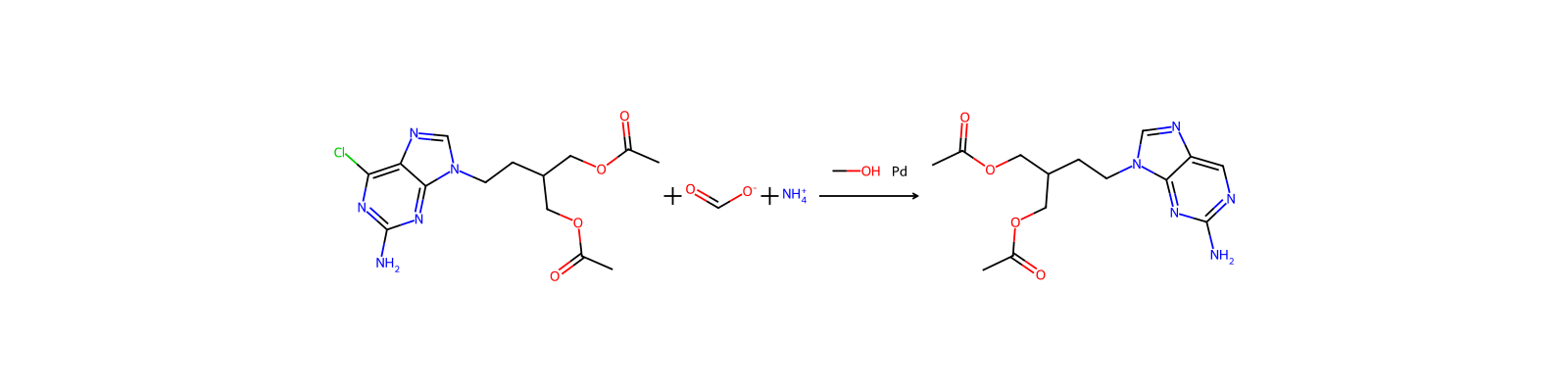
One method involves first the formation of 5-(2-hydroxy-ethyl)-2,2-dimethyl-1,3-dioxolane (I) by the reaction of triethylethane-1,1,2-tricarboxylate with THF and lithium aluminum hydride to form an oil which reacts with 2,2-dimethoxypropane in the presence of p-toluenesulfonic acid to yield I. The OH group is replaced by bromine using CBr4 and trimethyl phosphine. The bromo derivative is combined with 2-amino-6-chloropurine to alkylate in the 7-position. The dioxalane ring is opened by warming with dilute HCl and the resulting diol esterified with acetic anhydride using 4-(dimethylamino)pyridine as the acid scavenger.
Formulations/Preparations
Table: Famciclovir Preparations [Table#8089]
Oravir
General Manufacturing InformationCategorized under nucleoside analog groups which inhibit viral DNA polymerase
応用分野
説明Famciclovir, an effective oral prodrug of the antiviral penciclovir, was launched in the UK and shortly after in the U.S.A. for the treatment of shingles (herpes zoster). As the diacetyl ester of the 6-deoxy- penciclovir, famciclovir has significantly improved oral absorption. It is converted to penciclovir in vivo with a bioavailability of 41 % in rats. Penciclovir is phosphorylated, and hence activated onty in herpesvirus infected cells. This stable metabolite, penciclovir-triphosphate, is a strong inhibitor of herpesvirus DNA polymerases and of viral DNA synthesis with long lasting effects. The high selectivity of famciclovir/penciclovir to herpes family of viruses and their rather low toxicity may make this agent superior to other existing drugs.
使用sterol absorption inhibitor. Famciclovir (Famvir) a synthetic acyclic purine analog derived from guanine. It is the diacetyl ester (prodrug) of penciclovir, which exhibits no antiviral activity until hydrolyzed to penciclovir and its active metabolites. It is indicated for the management of acute herpes zoster infections. It has been shown to relieve acute symptoms as well as to shorten the duration of postherpetic neuralgia. It is also used for the treatment or suppression of recurrent episodes of genital herpes in immunocompetent patients and in the treatment of recurrent herpes simplex types 1 and 2 infections in patients with human immunodeficiency virus.
一般的な説明Famciclovir is a diacetyl prodrug of penciclovir.As a prodrug,it lacks antiviral activity. Penciclovir, 9-[4-hydroxy-3-hydroxymethylbut-1-yl] guanine, is an acyclic guanine nucleoside analog. The structure is similar to that of acyclovir,except in penciclovir, a side chain oxygen has beenreplaced by a carbon atom and an extra hydroxymethylgroup is present.VSV-infected cells, penciclovir is first phosphorylated byviral thymidine kinase41 and then further elaborated to thetriphosphate by host cell kinases. Penciclovir triphosphate isa competitive inhibitor of viral DNA polymerase. The pharmacokineticparameters of penciclovir are quite different fromthose of acyclovir. Although penciclovir triphosphate is about100-fold less potent in inhibiting viral DNA polymerase thanacyclovir triphosphate, it is present in the tissues for longerperiods and in much higher concentrations than acyclovir.
上流・下流製品情報
上流原料
サプライヤー50 社
国药集团化学试剂有限公司86-21-63210123 · [email protected]
北京华美互利生物化工010-56205725 · [email protected]
梯希爱(上海)化成工业发展有限公司021-67121386 · [email protected]
上海阿拉丁生化科技股份有限公司400-6206333 13167063860 · [email protected]
河北展药生物科技有限公司15369953316 +8615369953316 · [email protected]
Baoji Guokang Healthchem co.,ltd+8615604608665 15604608665 · [email protected]
Dayang Chem (Hangzhou) Co.,Ltd.+86-0571-88938639 17705817739 · [email protected]
LGM Pharma1-(800)-881-8210 · [email protected]
石家庄感拓生物科技有限公司[email protected]
Syntechem Co.,Ltd[email protected]
上海迈瑞尔生化科技有限公司4006356688 18621169109 · [email protected]
Wuhan EnTai Technology Development Co,.Ltd86-27-82330560 · [email protected]
武汉易泰科技有限公司上海分公司18930552037 · [email protected]
大连美仑生物技术有限公司0411-62910999 13889544652 · [email protected]
安耐吉化学&3A(安徽泽升科技股份有限公司)400-0056266 · [email protected]
上海瀚鸿科技股份有限公司021-54306202 13764082696 · [email protected]
Pure Chemistry Scientific Inc.001-857-928-2050 or 1-888-588-9418 · [email protected]
上海隆盛化工有限公司58099637 13585536065 · [email protected]
Zhejiang J&C Biological Technology Co.,Limited+1-2135480471 · [email protected]
孝感深远化工有限公司15527621225; 15527621225 · [email protected]
Hebei Qige Biological Technology Co. Ltd+86 +8618733132031
Wuhan NCE Biomedical Co.,Ltd.4000-027-021 |24 +86-13986109188 | +86-15623472865 | +81-08033611988
TCI AMERICA800-4238616 · [email protected]
TOKYO CHEMICAL INDUSTRY CO., LTD.03-36680489 · [email protected]
TCI Europe320-37350700 · [email protected]
深圳振强药物研发有限公司0755-66853366 13670046396 · [email protected]
广州爱纯医药科技有限公司020-39119399 18927568969 · [email protected]
南京生利德生物科技有限公司025-57798810 18652991625 · [email protected]
湖北威德利化学试剂有限公司186-02735115 18602735115 · [email protected]
湖北鑫源顺医药化工有限公司13971561712, 13995564702, 027-50664929 · [email protected]
上海湄水化工科技有限公司021-60549325 18616193163
上海将来实业股份有限公司021-61552785 · [email protected]
成都零六生物科技有限公司400-1166-196 13458535857 · [email protected]
上海御略医药科技有限公司021-60345187 13671753212 · [email protected]
凯试(上海)科技有限公司021-50135380 · [email protected]
湖北巨胜科技有限公司027-59599241 18871490274 · [email protected]
池州凯隆进出口贸易有限公司[email protected]
Sigma-Aldrich西格玛奥德里奇(上海)贸易有限公司021-61415566 800-8193336 · [email protected]
上海楼岚生物科技有限公司021-52996696,15000506266 15000506266
湖北源梦生物科技有限公司027-68897569 18120462897 · [email protected]
TargetMol中国(陶术生物)021-021-33632979 15002134094 · [email protected]
杭州六可生物科技有限公司+86-571-86912261 19975279805 · [email protected]
上海陶术生物科技股份有限公司+1-781-999-5354; +1-00000000000 · [email protected]
九鼎化学(上海)科技有限公司4009209199 · [email protected]
Henan Alfa Chemical Co., Ltd+8618339805032 · [email protected]
西安天广源生物科技有限公司+86-029-86333380 +86-18829239519 · [email protected]
sgtlifesciences pvt ltd+91-8790379245 · [email protected]
广州市齐云生物技术有限公司020-61288194 61288195 · [email protected]
上海源叶生物科技有限公司13636370518 · [email protected]
南京博米尔生物科技有限公司025-83453382-8005 · [email protected]
補足説明
定義ChEBI: 2-Amino-9H-purine in which the hydrogen at position 9 is substituted by a 4-acetoxy-3-(acetoxymethyl)but-1-yl group. A prodrug of the antiviral penciclovir, it is used for the treatment of acute herpes zoster (shingles), for the treatmen or suppression of recurrent genital herpes in immunocompetent patients and for the treatment of recurrent mucocutaneous herpes simplex infections in HIV infected patients.
関連反応
17 件


関連ノート
読み込み中…