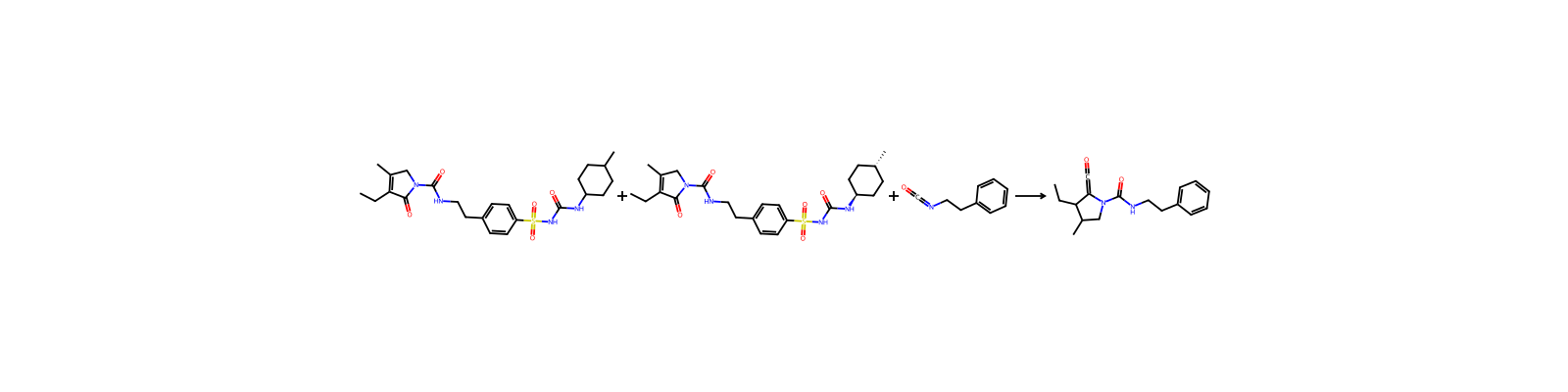
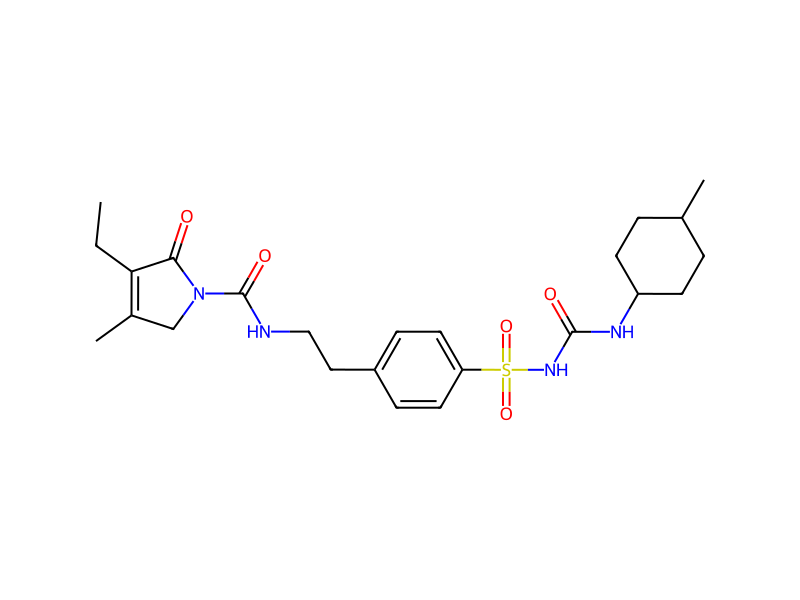
基本情報
- 標準SMILES
CCC1=C(C)CN(C(=O)NCCc2ccc(S(=O)(=O)NC(=O)NC3CCC(C)CC3)cc2)C1=O- InChIKey
WIGIZIANZCJQQY-UHFFFAOYSA-N- 分子式
- C24H34N4O5S
- 平均分子量
- 490.6 g/mol
- 単同位体質量
- 490.22499119
概要
Glimepiride is a sulfonamide, a N-acylurea and a N-sulfonylurea. It has a role as a hypoglycemic agent and an insulin secretagogue.
名称と識別子
- 優先名称
- 1H-Pyrrole-1-carboxamide, 3-ethyl-2,5-dihydro-4-methyl-N-2-4-(trans-4-methylcyclohexyl)aminocarbonylaminosulfonylphenylethyl-2-oxo-
- IUPAC
- 4-ethyl-3-methyl-N-[2-[4-[(4-methylcyclohexyl)carbamoylsulfamoyl]phenyl]ethyl]-5-oxo-2H-pyrrole-1-carboxamide
- 現地名
- CIS-グリメピリド
- 英語名
- cis-Glimepiride
- 分子式
- C24H34N4O5S
- 分子量
- 490.62
名称と別名
1H-Pyrrole-1-carboxamide, 3-ethyl-2,5-dihydro-4-methyl-N-2-4-(trans-4-methylcyclohexyl)aminocarbonylaminosulfonylphenylethyl-2-oxo-1H-Pyrrole-1-carboxamide, 3-ethyl-2,5-dihydro-4-methyl-N-[2-[4-[[[[(trans-4-methylcyclohexyl)amino]carbonyl]amino]sulfonyl]phenyl]ethyl]-2-oxo-1H-Pyrrole-1-carboxamide, 3-ethyl-2,5-dihydro-4-methyl-N-(2-(4-(((((trans-4-methylcyclohexyl)amino)carbonyl)amino)sulfonyl)phenyl)ethyl)-2-oxo-RefChem:439179glimepiride93479-97-1Amarylcis-Glimepiride684286-46-2GlimepiridaGlimepiridumGlimepirid
名称をさらに表示
CIS-グリメピリドGlimepiride imp Aimepiride ImpurityⅤGLIMEPIRIDE EP IMP AGlimepiride USP Impurity AGlimepiride EP impurity A -JGlimepiride Impurity (cis-isomer)Glimepiride USP Related Compound A1-[[4-[2-[[(3-Ethyl-4-methyl-2-oxo-
AmarelEndialGlimeprideHoe-490Glimepiride EP Impurity AHOE 490Glimepiride Impurity AGlimepiride, cis-
データベース識別子
- CAS
261361-60-8、684286-46-2、93479-97-1- PubChem CID
- 3476
- DTXSID
DTXSID20861130- ChEMBL
CHEMBL149223- ChEBI
CHEBI:5383- UNII
- 24T6XIR2MZ、6KY687524K
- EC Number
- 642-221-0
- Nikkaji
- J3.204.182E、J35.096F
物性
構造計算による物性
- XLogP
- 3.9
- 極性表面積
- 133 Ų
- 水素結合供与体数
- 3
- 水素結合受容体数
- 5
- 回転可能結合数
- 7
- 重原子数
- 34
- 形式電荷
- 0
- 複雑度
- 895
実験および物理化学的性質
Drugs
Pharmaceuticals
Pharmaceuticals -> Listed in ZINC15
LogP
3.5
2.67
Solubility
Partly miscible
3.84e-02 g/L
>73.6 [ug/mL] (The mean of the results at pH 7.4)
Melting Point207 °C
Physical DescriptionSolid
Collision Cross Section216.6 Ų [M+H]+ [CCS Type: TW; Method: Major Mix IMS/Tof Calibration Kit (Waters)]
物理化学的性質
- 融点
- 197 · 197-201°C
- 比重(密度)
- 1.29 · 1.29±0.1 g/cm3(Predicted)
- 貯蔵温度
- Refrigerator
- 溶解性
- クロロホルム(微量)、メタノール(微量、加温)
- 外見
- 個体
- 酸解離定数(Pka)
- 5.1 · 5.10±0.10(Predicted)
- 色
- オフホワイト
- 主な用途
- 医薬品(低分子化合物)
- InChIKey
- WIGIZIANZCJQQY-UWUNEBHHSA-N
- SMILES
- [S](=O)(=O)(NC(=O)N[C@@H]3CC[C@@H](CC3)C)c1ccc(cc1)CCNC(=O)N2CC(=C(C2=O)CC)C
化学的性質
化学的特性Off-White Solid
安全と法規制
GHS分類
GHS Classification
Warning
H302 (50%): Harmful if swallowed [Warning Acute toxicity, oral]
P203, P264, P270, P280, P301+P317, P318, P330, P405, and P501 (click each P-code to see the statement)
Aggregated GHS information provided per 2 reports by companies from 2 notifications to the ECHA C&L Inventory. Each notification may be associated with multiple companies.
危険有害性情報
Regulatory Information1H-Pyrrole-1-carboxamide, 3-ethyl-2,5-dihydro-4-methyl-N-2-4-(trans-4-methylcyclohexyl)aminocarbonylaminosulfonylphenylethyl-2-oxo-: Does not have an individual approval but may be used under an appropriate group standard
Hazard Classes and CategoriesRepr. 2 (50%)
安全データ
- wgk
- 3
- Hazard Classifications
- Repr. 2
- ストレージクラス
- 11 - Combustible Solids
化学と産業
薬理情報
ATC CodeA10BB12
Protein BindingPlasma protein binding of glimepiride is greater than 99.5%.
Pharmacodynamics
Glimepiride stimulates the secretion of insulin granules from the pancreatic beta cells and improves the sensitivity of peripheral tissues to insulin to increase peripheral glucose uptake, thus reducing plasma blood glucose levels and glycated hemoglobin (HbA1C) levels. A multi-center, randomized, placebo-controlled clinical trial evaluated the efficacy of glimepiride (1–8 mg) as monotherapy titrated over 10 weeks compared with placebo in T2DM subjects who were not controlled by diet alone. In this study, there was a reduction in fasting plasma glucose (FPG) by 46 mg/dL, post-prandial glucose (PPG) by 72 mg/dL, and HbA1c by 1.4% more than the placebo. In another randomized study comprising of patients with T2DM receiving either placebo or one of the three doses (1, 4, or 8 mg) of glimepiride during a 14-week study period, all glimepiride regimens significantly reduced FPG, PPG, and HbA1c values (P < 0.001) compared to placebo by the end of the study period. The 4- and 8-mg doses of glimepiride were more effective than the 1-mg dose; however, the 4-mg dose provided a nearly maximal antihyperglycemic effect.
Mechanism of Action
ATP-sensitive potassium channels on pancreatic beta cells that are gated by intracellular ATP and ADP. The hetero-octomeric complex of the channel is composed of four pore-forming Kir6.2 subunits and four regulatory sulfonylurea receptor (SUR) subunits. Alternative splicing allows the formation of channels composed of varying subunit isoforms expressed at different concentrations in different tissues. In pancreatic beta cells, ATP-sensitive potassium channels play a role as essential metabolic sensors and regulators that couple membrane excitability with glucose-stimulated insulin secretion (GSIS). When there is a decrease in the ATP:ADP ratio, the channels are activated and open, leading to K+ efflux from the cell, membrane hyperpolarization, and suppression of insulin secretion. In contrast, increased uptake of glucose into the cell leads to elevated intracellular ATP:ADP ratio, leading to the closure of channels and membrane depolarization. Depolarization leads to activation and opening of the voltage-dependent Ca2+ channels and consequently an influx of calcium ions into the cell. Elevated intracellular calcium levels causes the contraction of the filaments of actomyosin responsible for the exocytosis of insulin granules stored in vesicles. Glimepiride blocks the ATP-sensitive potassium channel by binding non-specifically to the B sites of both sulfonylurea receptor-1 (SUR1) and sulfonylurea receptor-2A (SUR2A) subunits as well as the A site of SUR1 subunit of the channel to promote insulin secretion from the beta cell.
Biological Half-LifeThe elimination half-life of glimepiride is approximately 5 to 8 hours, which can increase up to 9 hours following multiple doses.
Metabolism/Metabolites
Glimepiride is reported to undergo hepatic metabolism. Following either an intravenous or oral dose, glimepiride undergoes oxidative biotransformation mediated by CYP2C9 enzyme to form a major metabolite, cyclohexyl hydroxymethyl derivative (M1), that is pharmacologically active. M1 can be further metabolized to the inactive metabolite carboxyl derivative (M2) by one or several cytosolic enzymes. M1 retained approximately one third of the pharmacologic activity of its parent in an animal model, with a half-life of 3-6 hours. However, whether the glucose-lowering effect of M1 is clinically significant is not clear.
Glimepiride has known human metabolites that include Cyclohexylhydroymethylglimepiride.
Absorption, Distribution and Excretion
Glimepiride is completely absorbed after oral administration within 1 hour of administration with a linear pharmacokinetics profile. Following administration of a single oral dose of glimepiride in healthy subjects and with multiple oral doses with type 2 diabetes, the peak plasma concentrations (Cmax) were reached after 2 to 3 hours post-dose. Accumulation does not occur after multiple doses. When glimepiride was given with meals, the time to reach Cmax was increased by 12% while the mean and AUC (area under the curve) were decreased by 8 to 9%, respectively. In a pharmacokinetic study of Japanese patients with T2DM, Cmax value in once-daily dose was higher than those in twice-daily doses. The absolute bioavailability of glimepiride is reported to be complete following oral administration.
Following oral administration of glimepiride in healthy male subjects, approximately 60% of the total radioactivity was recovered in the urine in 7 days, with M1 and M2 accounting for 80-90% of the total radioactivity recovered in the urine. The ratio of M1 to M2 was approximately 3:2 in two subjects and 4:1 in one subject. Approximately 40% of the total radioactivity was recovered in feces where M1 and M2 accounted for about 70% of the radioactivity and a ratio of M1 to M2 being 1:3. No parent drug was recovered from urine or feces.
Following intravenous dosing in healthy subjects, the volume of distribution was 8.8 L (113 mL/kg).
A single-dose, crossover, dose-proportionality (1, 2, 4, and 8 mg) study in normal subjects and from a single- and multiple-dose, parallel, dose proportionality (4 and 8 mg) study in patients with type 2 diabetes (T2D) were performed. In these studies, the total body clearance was 52.1 +/- 16.0 mL/min, 48.5 +/- 29.3 mL/min in patients with T2D given a single oral dose, and 52.7 +/- 40.3 mL/min in patients with T2D given multiple oral doses. Following intravenous dosing in healthy subjects, the total body clearance was 47.8 mL/min.
Cellular LocationsMembrane
応用分野
使用cis-Glimepiride (Glimepiride EP Impurity A) is the cis-isomer of Glimepiride found in a bulk drug substance.
サプライヤー50 社
国药集团化学试剂有限公司86-21-63210123 · [email protected]
北京华美互利生物化工010-56205725 · [email protected]
梯希爱(上海)化成工业发展有限公司021-67121386 · [email protected]
上海阿拉丁生化科技股份有限公司400-6206333 13167063860 · [email protected]
T&W GROUP021-61551611 13296011611 · [email protected]
上海如吉生物科技发展有限公司+86-21-65211385-8001 36031160 · [email protected]
Jai Radhe Sales+(91)-(79)-26431096/65255722 · [email protected]
LGM Pharma1-(800)-881-8210 · [email protected]
武汉易泰科技有限公司上海分公司18930552037 · [email protected]
大连美仑生物技术有限公司0411-62910999 13889544652 · [email protected]
安耐吉化学&3A(安徽泽升科技股份有限公司)400-0056266 · [email protected]
武汉凯威斯科技有限公司86-027-67849912 · [email protected]
广州市亿邦医药科技有限公司+86 (20) 28996708,29078958,28139708,29076128,28133708,28139728,28139738,28133718,021-31663278,021-31663578,021-60538387
浙江海洲制药有限公司0576-88221739 · [email protected]
上海瀚鸿科技股份有限公司021-54306202 13764082696 · [email protected]
嘉兴市艾森化工有限公司0573-85285100 18627885956 · [email protected]
Pure Chemistry Scientific Inc.001-857-928-2050 or 1-888-588-9418 · [email protected]
武汉威顺达科技发展有限公司86-027-88774375 · [email protected]
MedChemexpress LLC021-58955995 · [email protected]
孝感深远化工有限公司15527621225; 15527621225 · [email protected]
济南精合医药科技有限公司0531-88811783 · [email protected]
云南西力生物技术股份有限公司0871-65217109 · [email protected]
天津希恩思生化科技有限公司400 638 7771 · [email protected]
湖南汇百侍生物科技有限公司0731-85526065 13308475853 · [email protected]
河南多贝化工有限公司0370-2785118 17550508557 · [email protected]
上海源叶生物科技有限公司13636370518 · [email protected]
成都宇洋高科技发展有限责任公司+86-28-61777709 · [email protected]
上海思域化工科技有限公司86-21-34053660 · [email protected]
西安康培基生物科技有限公司86-029-85456576 · [email protected]
AdooQ BioScience, LLC+1 (866) 930-6790 · [email protected]
Wuhan NCE Biomedical Co.,Ltd.4000-027-021 |24 +86-13986109188 | +86-15623472865 | +81-08033611988
上海遐瑞医药科技有限公司+86 21 61551611
TCI AMERICA800-4238616 · [email protected]
TOKYO CHEMICAL INDUSTRY CO., LTD.03-36680489 · [email protected]
TCI Europe320-37350700 · [email protected]
卡迪亚医药科技有限公司0371-86615086 18203638366 0371-86159066 13526786601
深圳振强药物研发有限公司0755-66853366 13670046396 · [email protected]
上海诺宝化工有限公司+86(0)21 60484900
南京杜莱生物技术有限公司025-84699383-8003;025-846993838003-8003 18013301590 · [email protected]
广州爱纯医药科技有限公司020-39119399 18927568969 · [email protected]
南京生利德生物科技有限公司025-57798810 18652991625 · [email protected]
沧州那瑞化学科技有限公司+86-317-3563899 · [email protected]
上海汇凯化学科技有限公司021-61995394 18916691159 · [email protected]
上海倍卓生物科技有限公司021-61119791,13386096464 · [email protected]
湖北鑫源顺医药化工有限公司13971561712, 13995564702, 027-50664929 · [email protected]
上海将来实业股份有限公司021-61552785 · [email protected]
雷丁试剂0510-85629785 18013409632 · [email protected]
上海御略医药科技有限公司021-60345187 13671753212 · [email protected]
南京百鑫德诺生物科技有限公司025-58849295 · [email protected]
广州市慈铭生物科技有限公司020-38082199,29065168,38082986,29878298,29866629,4000192398
関連反応
1 件
関連ノート
読み込み中…