
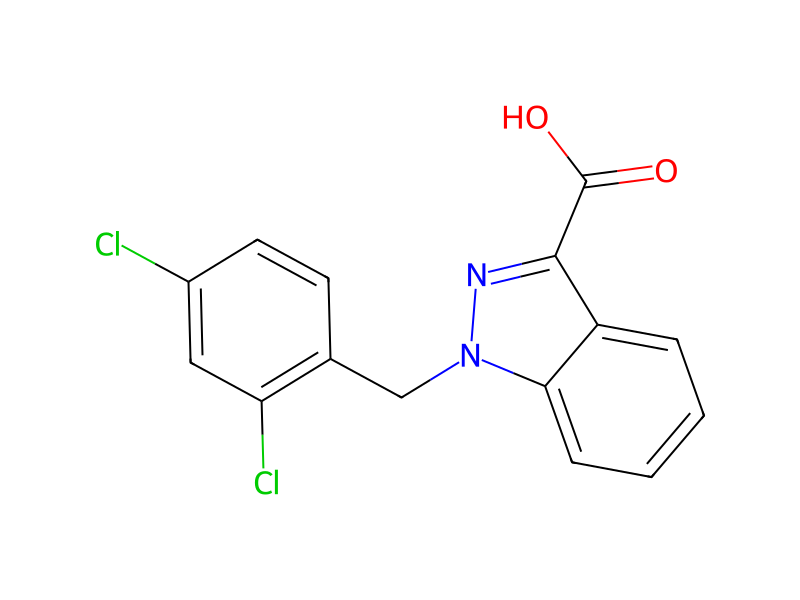
基本情報
- 標準SMILES
O=C(O)c1nn(Cc2ccc(Cl)cc2Cl)c2ccccc12- InChIKey
WDRYRZXSPDWGEB-UHFFFAOYSA-N- 分子式
- C15H10Cl2N2O2
- 平均分子量
- 321.2 g/mol
- 単同位体質量
- 320.01193292
概要
Lonidamine is a member of the class of indazoles that is 1H-indazole that is substituted at positions 1 and 3 by 2,4-dichlorobenzyl and carboxy groups, respectively. It has a role as an antispermatogenic agent, a geroprotector, an antineoplastic agent and an EC 2.7.1.1 (hexokinase) inhibitor. It is a dichlorobenzene, a monocarboxylic acid and a member of indazoles.
名称と識別子
- 優先名称
- Lonidamine
- IUPAC
- 1-[(2,4-dichlorophenyl)methyl]indazole-3-carboxylic acid
- 現地名
- ロニダミン
- 英語名
- Lonidamine
- 分子式
- C15H10Cl2N2O2
- 分子量
- 321.16
名称と別名
lonidamine50264-69-21-(2,4-Dichlorobenzyl)-1H-indazole-3-carboxylic acidDiclondazolic acidDoridaminaLonidaminaLonidaminumAF 18901-[(2,4-dichlorophenyl)methyl]indazole-3-carboxylic acid1-(2,4-Dichlorbenzyl)-indazole-3-carboxylic acidDTXSID50207821-(2,4-dichlorobenzyl)indazole-3-carboxylic acid
名称をさらに表示
1-(2,4-ジクロロベンジル)-1H-インダゾール-3-カルボン酸ドリダミナジクロンダゾール酸ロニダミン1-[(2,4-ジクロロフェニル)メチル]-1H-インダゾール-3-カルボン酸dicalonidaminaf1890LonidnmineLONIDAMINGAF-1890:DICALonidamine, >=99%
NSC-741419NSC-758419U78804BIDR1H-Indazole-3-carboxylic acid, 1-((2,4-dichlorophenyl)methyl)-DTXCID90782CHEBI:501381H-Indazole-3-carboxylic acid, 1-[(2,4-dichlorophenyl)methyl]-1-((2,4-dichlorophenyl)methyl)indazole-3-carboxylic acid
データベース識別子
- CAS
50264-69-2- PubChem CID
- 39562
- DTXSID
DTXSID5020782- ChEMBL
CHEMBL1257030- ChEBI
CHEBI:50138- UNII
- U78804BIDR
- EC Number
- 256-510-0
- Nikkaji
- J10.376D
物性
構造計算による物性
- XLogP
- 4.3
- 極性表面積
- 55.1 Ų
- 水素結合供与体数
- 1
- 水素結合受容体数
- 3
- 回転可能結合数
- 3
- 重原子数
- 21
- 形式電荷
- 0
- 複雑度
- 396
実験および物理化学的性質
DrugsPharmaceuticals -> Listed in ZINC15
物理化学的性質
- 融点
- 207 · 207-209°C
- 沸点
- 537.9 · 537.9±45.0 °C(Predicted)
- 比重(密度)
- 1.4835 · 1.4835 (rough estimate)
- 屈折率
- 1.607 · 1.6070 (estimate)
- 貯蔵温度
- 2 · Sealed in dry,2-8°C
- 溶解性
- DMSO に可溶 (最大 25 mg/ml)。
- 酸解離定数(Pka)
- 3 · 3.00±0.10(Predicted)
- 外見
- 個体
- 色
- 白い
- 安定性
- -20 °C · -20°C の DMSO 溶液で最大 1 か月間保存できます。
- InChI
- InChI=1S/C15H10Cl2N2O2/c16-10-6-5-9(12(17)7-10)8-19-13-4-2-1-3-11(13)14(18-19)15(20)21/h1-7H,8H2,(H,20,21)
- InChIKey
- WDRYRZXSPDWGEB-UHFFFAOYSA-N
- SMILES
- N1(CC2=CC=C(Cl)C=C2Cl)C2=C(C=CC=C2)C(C(O)=O)=N1
- CAS データベース
- 50264 · 50264-69-2(CAS DataBase Reference)
安全と法規制
GHS分類
GHS Classification
Danger
H302 (100%): Harmful if swallowed [Warning Acute toxicity, oral]
P203, P264, P270, P280, P301+P317, P318, P330, P405, and P501 (click each P-code to see the statement)
Aggregated GHS information provided per 42 reports by companies from 4 notifications to the ECHA C&L Inventory. Each notification may be associated with multiple companies.
危険有害性情報
Hazard Classes and CategoriesAcute Tox. 4 (100%)
安全データ
- wgk
- 3
- rtecs
- NK7886000
- 毒性
- LD50 in mice, rats (mg/kg): 900, 1700 orally; 435, 525 i.p. (Heywood)
- hs_code
- 29339900
- risk_code
- 60-22-40
- hazard_code
- T
- safety_code
- 53-22-36/37/39-45
- Hazard Classifications
- Acute Tox. 4 OralCarc. 2Repr. 1B
- ストレージクラス
- 6.1C - Combustible acute toxic Cat.3toxic compounds or compounds which causing chronic effects
化学と産業
薬理情報
ATC Code
L - Antineoplastic and immunomodulating agents
QL - Antineoplastic and immunomodulating agents
Mechanism of Action
Lonidamine is an orally administered small molecule that inhibits glycolysis by the inactivation of hexokinase. Hexokinase is an enzyme that catalyzes glucose, the first step in glycolysis. The inhibition of hexokinase by lonidamine is well established. In addition, there is evidence that lonidamine may increase programmed cell death. This stems from the observation that mitochondria and mitochondria-bound hexokinase are crucial for induction of apoptosis; agents that directly effect mitochondria may, therefore, trigger apoptosis. Indeed, in vitro models with lonidamine exhibit the hallmarks of apoptosis, including mitochondrial membrane depolarization, release of cytochrome C, phosphatidylserine externalization, and DNA fragmentation. [PMID: 16986057]
Metabolism/MetabolitesLonidamine has known human metabolites that include (2S,3S,4S,5R)-6-[1-[(2,4-Dichlorophenyl)methyl]indazole-3-carbonyl]oxy-3,4,5-trihydroxyoxane-2-carboxylic acid.
MeSH Pharmacological Classification
Substances that inhibit or prevent the proliferation of NEOPLASMS.
Agents, either mechanical or chemical, which destroy spermatozoa in the male genitalia and block spermatogenesis.
Drugs used to potentiate the effectiveness of radiation therapy in destroying unwanted cells.
Agents destructive to the protozoal organisms belonging to the suborder TRYPANOSOMATINA.
応用分野
説明Lonidamine is an antineoplastic agent reportedly effective for the treatment of various cancers, including lung, breast, prostate and brain tumors. Its clinical effect appears to be associated with changes in cellular energy metabolism.
使用contraceptive, spermicidal
上流・下流製品情報
上流原料
サプライヤー50 社
郑州阿尔法化工有限公司+86-18530059196 · [email protected]
衢州润东化工有限公司0570-8789886 18892685668 · [email protected]
湖北永阔科技有限公司027-59223108 15972152991 · [email protected]
上海阿拉丁生化科技股份有限公司400-6206333 13167063860 · [email protected]
Shanghai Biolang Biotechnology Co., Ltd.+86-15970428662 +86-13397199602 · [email protected]
湖北万得化工有限公司15377098680 15377098680 · [email protected]
成都超九八生物科技有限公司13348960310 13348960310 · [email protected]
LGM Pharma1-(800)-881-8210 · [email protected]
上海将来实业股份有限公司400-0066400 13621662912 · [email protected]
武汉易泰科技有限公司上海分公司18930552037 · [email protected]
上海晶抗生物工程有限公司021-54721350 13524668266 · [email protected]
大连美仑生物技术有限公司0411-62910999 13889544652 · [email protected]
安耐吉化学&3A(安徽泽升科技有限公司)021-58432009 400-005-6266 · [email protected]
南京圣亿来化工有限公司19951936396 · [email protected]
MedBio脉铂医药021-69568360 18916172912 · [email protected]
上海景颜化工科技有限公司13817811078 · [email protected]
VDM Biochemicals0330-2528181 · [email protected]
MedChemexpress LLC021-58955995 · [email protected]
湖北广奥生物科技有限公司027-02702759223056 18162699093 · [email protected]
上海三牧化工技术有限公司021-38681880 13817889927
云南西力生物技术股份有限公司0871-65217109 · [email protected]
Wuhan Demeikai Biotechnology Co., Ltd+8618942921723 · [email protected]
上海源叶生物科技有限公司13636370518 · [email protected]
TOKYO CHEMICAL INDUSTRY CO., LTD.03-36680489 · [email protected]
TCI Europe320-37350700 · [email protected]
深圳康特腾科技有限公司86-0755-86635001 · [email protected]
广州爱纯医药科技有限公司020-39119399 18927568969 · [email protected]
南京生利德生物科技有限公司025-57798810 18652991625 · [email protected]
上海旺瑜生物科技有限公司021-59501308 18321645636 · [email protected]
上海湄水化工科技有限公司021-60549325 18616193163
上海将来实业股份有限公司400-0066400 13621662912 · [email protected]
上海将来实业股份有限公司021-61552785 · [email protected]
HBCChem, Inc.+1-510-219-6317 · [email protected]
湖南华腾制药有限公司400-8592883 · [email protected]
上海麦克林生化科技股份有限公司15221275939 15221275939 · [email protected]
杭州杰恒化工有限公司0571-87396432 · [email protected]
湖北巨胜科技有限公司027-59599241 18871490274 · [email protected]
池州凯隆进出口贸易有限公司[email protected]
Sigma-Aldrich西格玛奥德里奇(上海)贸易有限公司021-61415566 800-8193336 · [email protected]
桦特昇生物科技(武汉)有限公司027-59207879 1972026995 18140587686 · [email protected]
南京熙泽医药科技有限公司025-66023220 15250997978 · [email protected]
TargetMol中国(陶术生物)021-021-33632979 15002134094 · [email protected]
上海昕凯医药科技有限公司21-619849051-1 18521059765 · [email protected]
上海陶术生物科技股份有限公司+1-781-999-5354; +1-00000000000 · [email protected]
BOC Sciences16314854226; +8616314854226 · [email protected]
武汉鑫儒化工有限公司15927387915 15337108568
厦门志信化学有限公司+86-5922680277 +86-13806087780 · [email protected]
上海珞珐生化科技有限公司021-51111890 15317326293 · [email protected]
上海思言生物科技有限公司021-50908862,442785678,326799392 18721037013 · [email protected]
北京华威锐科化工科技有限公司89508211 18501085097 · [email protected]
補足説明
定義ChEBI: A member of the class of indazoles that is 1H-indazole that is substituted at positions 1 and 3 by 2,4-dichlorobenzyl and carboxy groups, respectively.
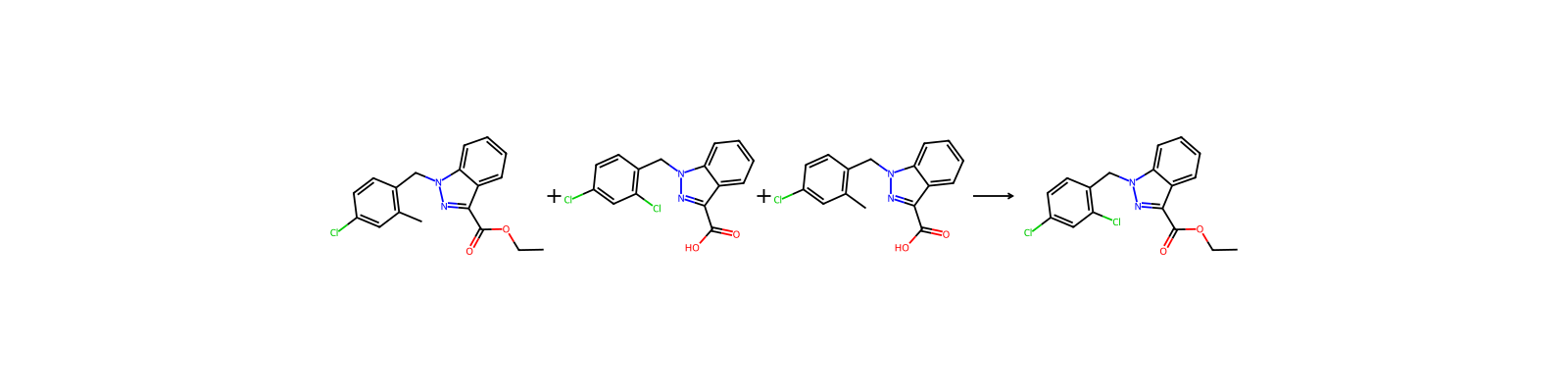
関連反応
3 件

関連ノート
読み込み中…