
ロジウム(II)アセタート (ダイマー)
Acetic acid, rhodium salt (4:2)
データを補完しています。しばらくしてからページを更新すると最新の内容を表示できます

基本情報
- CAS
15956-28-2- 標準SMILES
CC(=O)O.CC(=O)O.CC(=O)O.CC(=O)O.[Rh].[Rh]- InChIKey
DRGVLUZIGUIMLB-UHFFFAOYSA-N- 分子式
- C8H16O8Rh2
- 平均分子量
- 446.02 g/mol
名称と識別子
- 優先名称
- Acetic acid, rhodium salt (4:2)
- IUPAC
- acetic acid;bis(rhodium)
- 現地名
- ロジウム(II)アセタート (ダイマー)
- 英語名
- Rhodium(II) acetate dimer
- 分子式
- C8H12O8Rh2
- 分子量
- 441.99
名称と別名
Acetic acid, rhodium salt (4:2)NSC156310ロジウム(II)アセタート (ダイマー)酢酸ロジウム(II)二量体酢酸ロジウム(II)ダイマー(無水)ジロジウム(II)テトラアセタートテトラキス(アセタト)ジロジウム(II)二ロジウム(II)テトラキスアセタート水和物酢酸ロジウム(II), 二量体酢酸ロジウム(II)二量体, 98+%酢酸ロジウム(II)ダイマー酢酸ロジウム(II)ダイマー, 99%
名称をさらに表示
Rh2(OAc)4RHODIUM ACETATE DIMERDIRHODIUM(II) TETRAACETATEdirhodiumtetraacetatetetrakis(acetato)dirhodiumtetraacRh2(CH3CO2)4Dimer acid rhodiumRHODIUM(11) ACETATErhodiumdiacetatedimer
データベース識別子
- CAS
15956-28-2- PubChem CID
- 423677
物性
構造計算による物性補完中
- 極性表面積
- 149 Ų
- 水素結合供与体数
- 4
- 水素結合受容体数
- 8
- 回転可能結合数
- 0
- 重原子数
- 18
- 形式電荷
- 0
- 複雑度
- 181
物理化学的性質
- 融点
- 205 °C · 205 °C
- 貯蔵温度
- Inert atmosphere,Room Temperature
- 溶解性
- メタノール+水(微量)
- 外見
- 粉
- 色
- 緑から濃い緑
- 水溶解度
- 水のような水溶液に溶けます。エタノールにわずかに溶ける
- 安定性
- 吸湿性
- InChI
- InChI=1S/4C2H4O2.2Rh/c4*1-2(3)4;;/h4*1H3,(H,3,4);;/q;;;;2*+2/p-4
- InChIKey
- ANSVJOOIUURYRN-UHFFFAOYSA-N
- SMILES
- CC1=O[Rh+2]234O=C(C)[O-][Rh+2]2(O=C(C)[O-]3)(O=C(C)[O-]4)[O-]1
化学的性質
化学的特性Rhodium(II) acetate dimer is Emerald Green Powder. Soluble in methanol. It is soluble in water, while the relative solubility of copper acetate in water is small.
安全と法規制
安全情報は参考情報です。供給元の安全データシート(SDS)、適用法令、専門家による評価に代わるものではありません。
安全データ
- wgk
- 3
- tsca
- No
- rtecs
- VI9361000
- hs_code
- 28439000
- risk_code
- 36/38
- 安衛法
- 57,57-2
- hazard_code
- Xi
- safety_code
- 37/39-26-15
- Hazard Classifications
- Eye Irrit. 2Skin Irrit. 2
- ストレージクラス
- 11 - Combustible Solids
化学と産業
応用分野
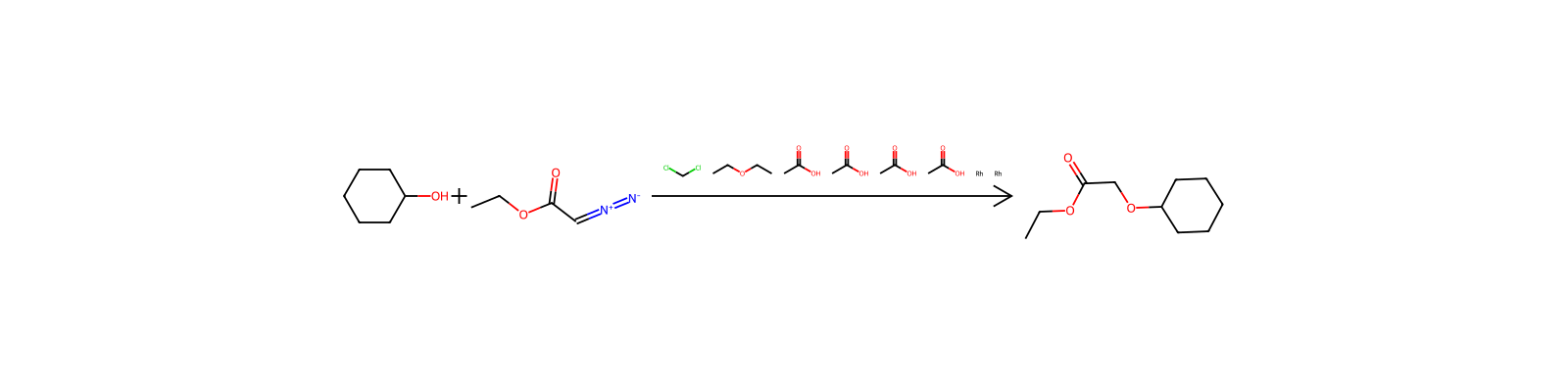
使用Rhodium (II) Acetate Dimer is a effective catalyst for ylide formation and it is also catalyst for cyclopropanation of alkenes, oxidation of alcohols, cyclization reactions involving -diazo carbonyl groups, insertion into C-H and X-H bonds (X-H is NH or SH or OH). More reactive and useful in differentiating ribonucleosides and deoxynucleosides. It is also used in functionalizing fullerenes into polymers. Efficient catalyst for hydrogen transfer from 2-propanol to cyclohexanone and other unsaturated compounds.
調製方法
製造方法Rhodium(II) acetate dimer synthesis: A suspension of 10.0g. of Rh(OH)3.H20 in 400 ml. of glacial acetic acid dissolved upon refluxing for 18 hr. to give a deep emerald-green solution. Most of the acetic acid was evaporated on a steam bath; remaining traces mere removed by heating the residue at 120° for 1hr. The residue was then extracted with boiling acetone until the extract was colorless rather than bluish green. The extract was quickly passed through a fritted glass filter, concentrated on a steam bath to 1/3 its original volume, and placed in the freezing compartment of a refrigerator for 18hr. The resulting large dark green crystals were collected on a filter, washed with small portions of ice-cold acetone, and dried at 110°. When first collected, the product is the weak adduct [Rh(OOCCH3)2(CH3)2C0]2; however, acetone is lost fairly readily at room temperature and immediately in the drying oven; yield, 6.2g. (48%).
純化方法Dissolve 5g of the salt in boiling MeOH (ca 600mL) and filter. Concentrate it to 400mL and chill overnight at ca 0o to give dark green crystals of the MeOH adduct. Concentration of the mother liquors gives a further crop of [Rh(OAc)2]2.2MeOH. The adduct is then heated at 45o in a vacuum for 2hours (all MeOH is lost) to leave the emerald green crystals of the actetate. [Legzdins et al. J Chem Soc (A) 3322 1970.] Alternatively dissolve the acetate in glacial AcOH and reflux for a few hours to give an emerald green solution. Evaporate most of the AcOH on a steam bath, then heat the residue at 120o/1hour. Extract the residue with boiling Me2CO. Filter, concentrate to half its volume and keep at 0o/18hours. Collect the crystals, wash them with ice cold Me2CO and dry them at 110o. It is soluble in most organic solvents with which it forms adducts including Me3N and Me2S and gives solutions with different colours varying from green to orange and red. [UV: Johnson et al. Inorg Chem 2 960 1963, Beilstein 1 H 124.]
関連反応
102 件



化合物ノート
読み込み中…