
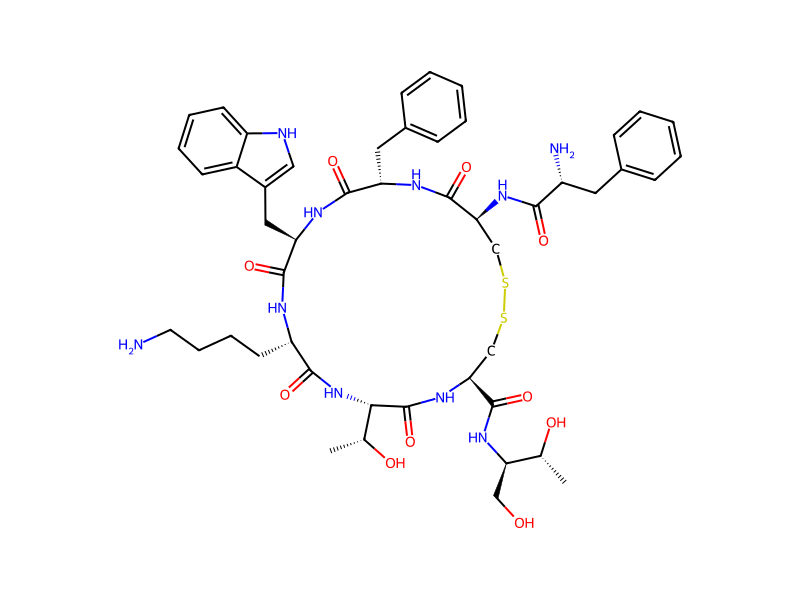
基本情報
- 標準SMILES
C[C@@H](O)[C@@H]1NC(=O)[C@H](CCCCN)NC(=O)[C@@H](Cc2c[nH]c3ccccc23)NC(=O)[C@H](Cc2ccccc2)NC(=O)[C@@H](NC(=O)[C@H](N)Cc2ccccc2)CSSC[C@@H](C(=O)N[C@H](CO)[C@@H](C)O)NC1=O- InChIKey
DEQANNDTNATYII-OULOTJBUSA-N- 分子式
- C49H66N10O10S2
- 平均分子量
- 1,019.2 g/mol
- 単同位体質量
- 1,018.44048031
概要
Acromegaly is a disorder caused by excess growth hormone (GH), increasing the growth of body tissues and causing metabolic dysfunction. In most cases, it results from an anterior pituitary growth hormone-releasing tumor. Typically, the feet, hands, and face grow abnormally large; organomegaly and insulin resistance may also occur. Acromegaly is a life-threatening disease requiring life-long management. Octreotide is a long-acting drug with pharmacologic activities that mimic those of the natural hormone, somatostatin, which inhibits the secretion of growth hormone. Additionally, it is used for the treatment of acromegaly and symptoms arising from various tumors, including carcinoid tumors and vasoactive intestinal tumors (VIPomas). In the past, octreotide has been administered solely by injection. On June 26, 2020, the first approved delayed-release oral somatostatin analog, Mycapssa, received FDA approval for the long term maintenance treatment of acromegaly. This drug was developed by Chiasma Inc.
名称と識別子
- 優先名称
- Octreotide
- IUPAC
- (4R,7S,10S,13R,16S,19R)-10-(4-aminobutyl)-19-[[(2R)-2-amino-3-phenylpropanoyl]amino]-16-benzyl-N-[(2R,3R)-1,3-dihydroxybutan-2-yl]-7-[(1R)-1-hydroxyethyl]-13-(1H-indol-3-ylmethyl)-6,9,12,15,18-pentaoxo-1,2-dithia-5,8,11,14,17-pentazacycloicosane-4-carboxamide
名称と別名
Octreotide83150-76-9OctreotidaOctreotidumRWM8CCW8GPSMS-201-995SMS995SMS-995DRG-0115D-Phenylalanyl-L-cysteinyl-L-phenylalanyl-D-tryptophyl-L-lysyl-L-threonyl-N-((1R,2R)-2-hydroxy-1-(hydroxymethyl)propyl)-L-cysteinamide cyclic (2->7)-disulfideDTXSID0048682L-Cysteinamide, D-phenylalanyl-L-cysteinyl-L-phenylalanyl-D-tryptophyl-L-lysyl-L-threonyl-N-(2-hydroxy-1-(hydroxymethyl)propyl)-, cyclic (2-7)-disulfide, (R-(R*,R*))-
名称をさらに表示
CHEBI:7726Compound 201995Octreotide Acetate SaltRefChem:59031SMS 201995Compound 201 995Compound 201-995Sandoz 201995
データベース識別子
- CAS
83150-76-9- PubChem CID
- 448601
- DTXSID
DTXSID0048682- ChEMBL
CHEMBL1680- UNII
- RWM8CCW8GP
物性
構造計算による物性
- XLogP
- 1
- 極性表面積
- 383 Ų
- 水素結合供与体数
- 13
- 水素結合受容体数
- 14
- 回転可能結合数
- 17
- 重原子数
- 71
- 形式電荷
- 0
- 複雑度
- 1,740
実験および物理化学的性質
Human Drugs
Breast Feeding; Lactation; Milk, Human; Antineoplastic Agents, Hormonal; Gastrointestinal Agents
EMA approved medicines: Human medicine
Medicines for disorders of the pituitary hormone system
Melting Point153-156
安全と法規制
危険有害性情報
Regulatory InformationOctreotide: Does not have an individual approval but may be used under an appropriate group standard
毒性情報
Hepatotoxicity
Mild, transient, asymptomatic elevations in serum aminotransferase levels occur in a small proportion of patients receiving octreotide, and in some individuals the elevations are persistent and worsen over time and may require drug discontinuation. In addition, several instances of acute, clinically apparent liver injury attributable to octreotide have been described. The onset is generally within 1 to 6 months of starting therapy and injury may be more frequent with higher doses. Most cases of liver injury associated with octreotide therapy have been asymptomatic and anicteric, and marked by prominent elevations in serum ALT and AST with normal or near normal serum alkaline phosphatase, GGT and bilirubin. In some instances, however, jaundice has arisen, particularly with rechallenge. There have been no instances of acute liver failure or vanishing bile duct syndrome associated with octreotide, and a characteristic feature of the injury is the rapidity of improvement upon stopping the injections or infusions. Several instances of marked aminotransferase elevations with rapid improvements on stopping have been reported in newborns and infants with congenital hyperinsulinemia who were treated with continuous infusions of high doses of octreotide.
Adverse Effects
* Gastrointestinal abnormalities (34% to 61%) are transient and usually mild to moderate. They include diarrhea, nausea, abdominal discomfort, gallbladder abnormalities, such as cholelithiasis and microlithiasis, biliary sediment and sludge due to alteration of fat absorption, and possibly by decreasing motility of the gallbladder.
Toxicity Summary
Limited studies have assessed octreotide toxicity. However, isolated studies have shown a mild degree of bone marrow suppression and impairment in spermatogenesis due to inhibition of serum inhibin B and concomitant increase in FSH in supratherapeutic doses. There is a need to conduct significantly larger studies and trials to define and establish the therapeutic index of octreotide and identify its toxic effects and its management.
Drug Induced Liver Injury
Drug-Induced Liver Injury Severity and Toxicity (DILIst)
octreotide
DILI Positive
Intravenous
DOI:10.1016/j.drudis.2019.09.022
Effects During Pregnancy and Lactation◉ Summary of Use during Lactation
化学と産業
薬理情報
ATC Code
H - Systemic hormonal preparations, excl. sex hormones and insulins
QH - Systemic hormonal preparations, excl. sex hormones and insulin
H01CB02
Protein BindingApproximately 65% of the dose is bound in the plasma to lipoproteins and albumin.
Pharmacodynamics
Octreotide mimics the naturally occurring hormone known as somatostatin. Like somatostatin, it demonstrates activity against growth hormone and glucagon, treating the disordered tissue growth and insulin regulation in patients with acromegaly. In addition, octreotide relieves the flushing and diarrhea associated with gastrointestinal tumors by reducing splanchnic blood flow and various gastrointestinal hormones associated with diarrhea. Product labeling warns that octreotide may reduce gallbladder contractility, bile secretion, and the release of thyroid-stimulating hormone (TSH) in healthy volunteers. In addition, reports of decreased vitamin B12 in patients treated with octreotide have been made. Ensure to monitor vitamin B12 levels in patients taking octreotide.
Mechanism of Action
Octreotide binds to somatostatin receptors coupled to phospholipase C through G proteins and leads to smooth muscle contraction in the blood vessels. Downstream effects that stimulate phospholipase C, the production of 1, 4,5-inositol triphosphate, and action on the L-type calcium channels lead to the inhibition of growth hormone, treating the various growth-hormone and metabolic effects of acromegaly. Octreotide's suppression of luteinizing hormone (LH), reduction in splanchnic blood flow, and inhibition of serotonin, gastrin, vasoactive intestinal peptide, secretin, motilin, and pancreatic polypeptide provide relief for the gastrointestinal and flushing symptoms of carcinoid and/or VIPoma tumors.
Biological Half-Life
After a subcutaneous dose, the plasma half-life is estimated to be 0.2 hours. The average elimination half-lives for subcutaneous and oral administration ranged from 2.3 - 2.7 hours and did not differ significantly. One pharmacokinetic study revealed a plasma half-life ranging from 72-113 minutes.
Metabolism/MetabolitesOctreotide has been reported to be heavily metabolized in the liver.
FDA Pharmacological Classification
RWM8CCW8GP
OCTREOTIDE
Established Pharmacologic Class [EPC] - Somatostatin Analog
Mechanisms of Action [MoA] - Somatostatin Receptor Agonists
Octreotide is a Somatostatin Analog. The mechanism of action of octreotide is as a Somatostatin Receptor Agonist.
OCTREOTIDE
MeSH Pharmacological Classification
Drugs used for their effects on the gastrointestinal system, as to control gastric acidity, regulate gastrointestinal motility and water flow, and improve digestion.
Antineoplastic agents that are used to treat hormone-sensitive tumors. Hormone-sensitive tumors may be hormone-dependent, hormone-responsive, or both. A hormone-dependent tumor regresses on removal of the hormonal stimulus, by surgery or pharmacological block. Hormone-responsive tumors may regress when pharmacologic amounts of hormones are administered regardless of whether previous signs of hormone sensitivity were observed. The major hormone-responsive cancers include carcinomas of the breast, prostate, and endometrium; lymphomas; and certain leukemias. (From AMA Drug Evaluations Annual 1994, p2079)
Absorption, Distribution and Excretion
After a subcutaneous dose, octreotide is absorbed completely upon administration. After the administration of an oral delayed-release capsule, peak concentrations were found to be 33% lower than after subcutaneous administration. The Cmax was attained at 1.67–2.5 hours after oral administration versus 30 minutes for the subcutaneous route. At 20 mg twice a day in patients with acromegaly, peak concentration was 2.5 mg/nL versus 5.30 ng/mL at 40 mg twice a day. AUC increases in proportion with the dose, regardless of the route.
About 32% of an oral octreotide dose is excreted into the urine and 30-40% is excreted by the liver into the feces.. About 11% of the unchanged parent drug is found in the urine, and 2% of the unchanged parent drug can be recovered in the feces.
In a pharmacokinetic study, the volume of distribution was 13.6 L in healthy volunteers. One pharmacokinetic study revealed a volume of distribution ranging from 18.1-30.4L after intravenous administration in healthy volunteers.
The total body clearance of octreotide is 7-10 L/h. One pharmacokinetic study revealed a total body clearance of 11.4 L/h.
用途と製造
UsesUse (kg) in USA (2002): 1
関連反応
8 件


関連ノート
読み込み中…