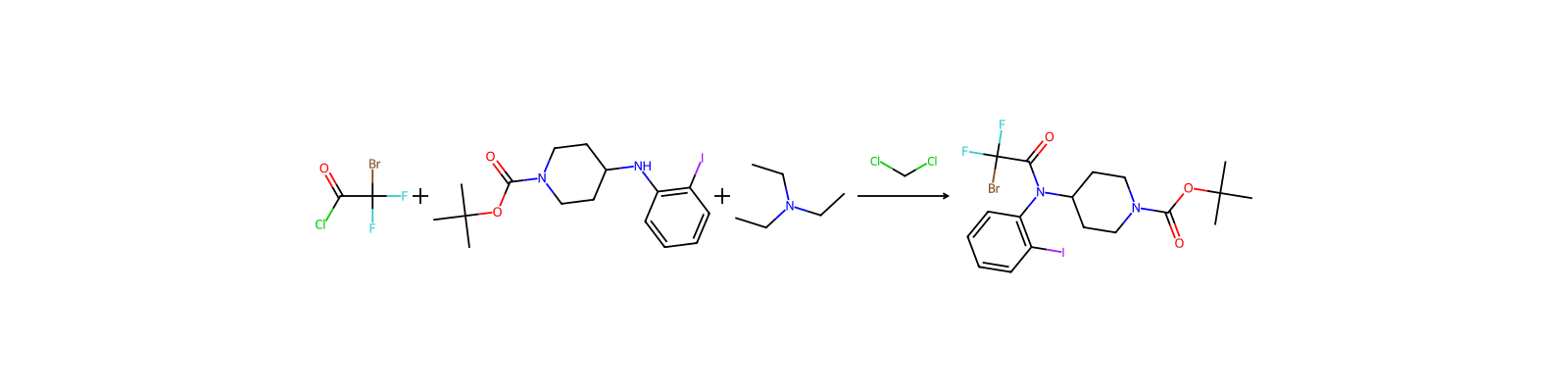
ブロモジフルオロアセチルクロライド 塩化物 臭化物
Bromodifluoroacetyl chloride
HCID 520892
データを補完しています。しばらくしてからページを更新すると最新の内容を表示できます

基本情報
- CAS
3832-48-2- 標準SMILES
O=C(Cl)C(F)(F)Br- InChIKey
LYJKGSALBRSKNL-UHFFFAOYSA-N- 分子式
- C2BrClF2O
- 平均分子量
- 193.37 g/mol
- 単同位体質量
- 191.87891
概要
Bromodifluoroacetyl chloride is an organobromide compound. It is used as a starting material for the synthesis of (biologically active) _,_-difluoro-_-lactams and the synthesis of trifluoromethylated C-nucleosides. Bromine is a halogen element with the symbol Br and atomic number 35. Diatomic bromine does not occur naturally, but bromine salts can be found in crustal rock. (L625, L681)
名称と識別子
- 優先名称
- Bromodifluoroacetyl chloride
- IUPAC
- 2-bromo-2,2-difluoroacetyl chloride
- 現地名
- ブロモジフルオロアセチルクロライド 塩化物 臭化物
- 英語名
- Bromodifluoroacetyl chloride
- 分子式
- C2BrClF2O
- 分子量
- 193.37
名称と別名
Bromodifluoroacetyl chloride3832-48-22-bromo-2,2-difluoroacetyl chlorideDTXSID90334487RefChem:570341DTXCID002855772-Bromo-2,2-difluoro-ethanoyl chloride671-811-0bromo(difluoro)acetyl chlorideMFCD00069081Bromodifluoroacetylchloridebromodifluoroacetic chloride
名称をさらに表示
ブロモジフルオロアセチルクロライド 塩化物 臭化物ブロモジフルオロアセチル=クロリド塩化ブロモジフルオロアセチルブロモジフルオロアセチルクロリドブロモジフルオロアセチルクロライドBromodifluoroacetylchloride97%acetyl chloride, bromodifluoro-Bromodifluoroacetyl chloride 97%2-Bromo-2,2-difluoroethanoyl chlorideAcetyl chloride, 2-bromo-2,2-difluoro-Bromodifluoroacetyl Chloride extrapure, 97%
2-bromanyl-2,2-bis(fluoranyl)ethanoyl chlorideA824108Bromodi(fluoro)acetyl chlorideSCHEMBL11613142-bromo-2,2-difluoro-acetyl chlorideAKOS005173358FS-4964DB-022977
物性
構造計算による物性補完中
- XLogP
- 2.3
- 極性表面積
- 17.1 Ų
- 水素結合供与体数
- 0
- 水素結合受容体数
- 3
- 回転可能結合数
- 1
- 重原子数
- 7
- 形式電荷
- 0
- 複雑度
- 93.7
物理化学的性質
- 沸点
- 50 °C · 50 °C
- 比重(密度)
- 2.053 · 2.053±0.06 g/cm3(Predicted)
- 屈折率
- 1.3853 · 1.3853
- 外見
- liquid
- 色
- Clear, colourless
- InChI
- InChI=1S/C2BrClF2O/c3-2(5,6)1(4)7
- InChIKey
- LYJKGSALBRSKNL-UHFFFAOYSA-N
- SMILES
- C(Cl)(C(Br)(F)F)=O
- CAS データベース
- 3832 · 3832-48-2(CAS DataBase Reference)
安全と法規制
安全情報は参考情報です。供給元の安全データシート(SDS)、適用法令、専門家による評価に代わるものではありません。
GHS分類
GHS Classification
Danger
H226 (90.9%): Flammable liquid and vapor [Warning Flammable liquids]
P210, P233, P240, P241, P242, P243, P260, P264, P280, P301+P330+P331, P302+P361+P354, P303+P361+P353, P304+P340, P305+P354+P338, P316, P321, P363, P370+P378, P403+P235, P405, and P501 (click each P-code to see the statement)
Aggregated GHS information provided per 44 reports by companies from 3 notifications to the ECHA C&L Inventory. Each notification may be associated with multiple companies.
危険有害性情報
Hazard Classes and CategoriesFlam. Liq. 3 (90.9%)
毒性情報
Treatment
EYES: irrigate opened eyes for several minutes under running water. INGESTION: do not induce vomiting. Rinse mouth with water (never give anything by mouth to an unconscious person). Seek immediate medical advice. SKIN: should be treated immediately by rinsing the affected parts in cold running water for at least 15 minutes, followed by thorough washing with soap and water. If necessary, the person should shower and change contaminated clothing and shoes, and then must seek medical attention. INHALATION: supply fresh air. If required provide artificial respiration.
Health Effects
Bromine vapour causes irritation and direct damage to the mucous membranes. Elemental bromine also burns the skin. The bromide ion is a central nervous system depressant and chronic exposure produces neuronal effects. This is called bromism and can result in central reactions reaching from somnolence to coma, cachexia, exicosis, loss of reflexes or pathologic reflexes, clonic seizures, tremor, ataxia, loss of neural sensitivity, paresis, papillar edema of the eyes, abnormal speech, cerebral edema, delirium, aggressiveness, and psychoses. (L625, L626, L627)
化学と産業
薬理情報
Metabolism/Metabolites
Bromine is mainly absorbed via inhalation, but may also enter the body through dermal contact. Bromine salts can be ingested. Due to its reactivity, bromine quickly forms bromide and may be deposited in the tissues, displacing other halogens. (L626)
用途と製造
Uses
It is used as a starting material for the synthesis of (biologically active) _,_-difluoro-_-lactams and the synthesis of trifluoromethylated C-nucleosides. Diatomic bromine does not occur naturally, but bromine salts can be found in crustal rock.
上流・下流製品情報
下流製品
関連反応
4 件