
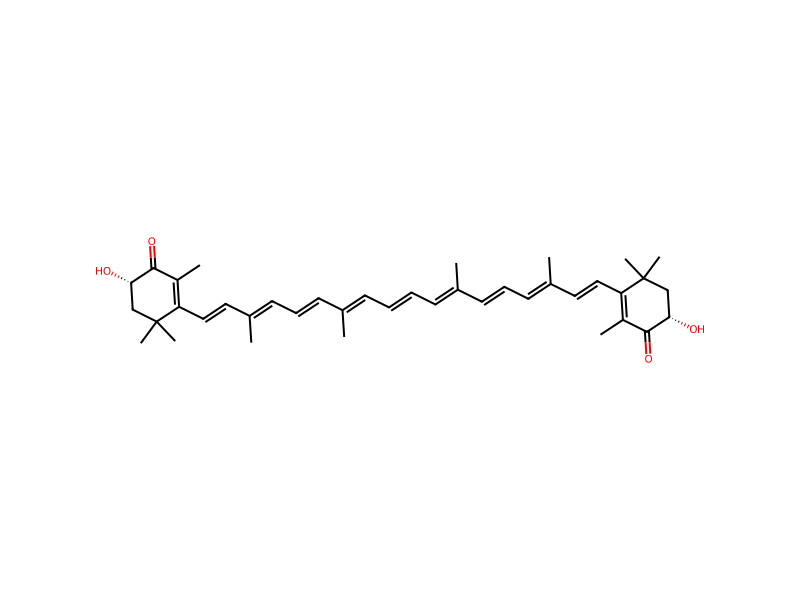
基本情報
- 標準SMILES
CC1=C(/C=C/C(C)=C/C=C/C(C)=C/C=C/C=C(C)/C=C/C=C(C)/C=C/C2=C(C)C(=O)[C@@H](O)CC2(C)C)C(C)(C)C[C@H](O)C1=O- InChIKey
MQZIGYBFDRPAKN-UWFIBFSHSA-N- 分子式
- C40H52O4
- 平均分子量
- 596.8 g/mol
- 単同位体質量
- 596.38656014
概要
Astaxanthin is a carotenone that consists of beta,beta-carotene-4,4'-dione bearing two hydroxy substituents at positions 3 and 3' (the 3S,3'S diastereomer). A carotenoid pigment found mainly in animals (crustaceans, echinoderms) but also occurring in plants. It can occur free (as a red pigment), as an ester, or as a blue, brown or green chromoprotein. It has a role as an antioxidant, an anticoagulant, an animal metabolite, a plant metabolite and a food colouring. It is a carotenol and a carotenone. It derives from a hydride of a beta-carotene.
名称と識別子
- 優先名称
- Astaxanthin
- IUPAC
- (6S)-6-hydroxy-3-[(1E,3E,5E,7E,9E,11E,13E,15E,17E)-18-[(4S)-4-hydroxy-2,6,6-trimethyl-3-oxocyclohexen-1-yl]-3,7,12,16-tetramethyloctadeca-1,3,5,7,9,11,13,15,17-nonaenyl]-2,4,4-trimethylcyclohex-2-en-1-one
- 現地名
- アスタキサンチン
- 英語名
- Astaxanthin
- 分子式
- C40H52O4
- 分子量
- 596.85
名称と別名
Astaxanthin472-61-7Ovoesterall-trans-AstaxanthinBioAstinAstaREALAstaxanthine(3S,3'S)-AstaxanthinCarophyll Pink(3S,3'S)-3,3'-Dihydroxy-beta,beta-carotene-4,4'-dione8XPW32PR7INSC-635689
名称をさらに表示
(3S,3'S)-3,3'-ジヒドロキシ-β,β-カロテン-4,4'-ジオンall-trans-アスタキサンチンアスタキサンチンall-E-アスタキサンチン(3S,3'S)-trans-アスタキサンチン(3S,3'S)-アスタキサンチン天然アスタキサンチンアスタキサンチン標準品アスタキサンチン ((3S,3'S)-3,3'-DIHYDROXY-Β,Β-CAROTENE-4,4'-DIONE)(3S,3′S)-3,3′-ジヒドロキシ-β,β-カロテン-4,4′-ジオン(3S,3′S)-trans-アスタキサンチン(6S)-6-ヒドロキシ-3-[(1E,3E,5E,7E,9E,11E,13E,15E,17E)-18-[(4S)-4-ヒドロキシ-2,6,6-トリメチル-3-オキソシクロヘキサ-1-エン-1-イル]-3,7,12,16-テトラメチルオクタデカ-1,3,5,7,9,11,13,15,17-ノナエン-1-イル]-2,4,4-トリメチルシクロヘキサ-2-エン-1-オン(3S,3′S)-アスタキサンチンAstaxanthin PowderAstaxanthin oilHAEMATOCOCCUS PLUVIALISHaeMatococcus PowderAXNtrans-Astaxanthin
CHEBI:40968DTXSID008937773,3'-Dihydroxy-beta-carotene-4,4'-dionebeta,beta-Carotene-4,4'-dione, 3,3'-dihydroxy-, (3S,3'S)-E9AI950EAHRefChem:115249DTXCID101323822207-451-4
データベース識別子
- CAS
472-61-7- PubChem CID
- 5281224
- DTXSID
DTXSID00893777- ChEMBL
CHEMBL1255871- ChEBI
CHEBI:40968- UNII
- 8XPW32PR7I
- EC Number
- 207-451-4
- Nikkaji
- J11.883D
物性
構造計算による物性
- XLogP
- 10.3
- 極性表面積
- 74.6 Ų
- 水素結合供与体数
- 2
- 水素結合受容体数
- 4
- 回転可能結合数
- 10
- 重原子数
- 44
- 形式電荷
- 0
- 複雑度
- 1,340
実験および物理化学的性質
DrugsPharmaceuticals -> Listed in ZINC15
LipidsLipids -> Prenol Lipids [PR] -> Isoprenoids [PR01] -> C40 isoprenoids (tetraterpenes) [PR0107]
Food Additives
Foods -> FDA Regulatory Status of Color Additives
COLOR OR COLORING ADJUNCT -> FDA Substance added to food
Color/FormNeedles from acetone/light petroleum
Melting Point
182-183 °C
Reported as shiny purple platelets with gold luster from pyridine; MP: 216 °C; readily soluble in pyridine
182.5 °C
Physical DescriptionSolid
Other Experimental PropertiesStout, blue-black needles, MP 203-205 °C (vac) /Diacetate/
物理化学的性質
- 融点
- 215 · 215-216 °C
- 沸点
- 568.55 °C · 568.55°C (rough estimate)
- 比重(密度)
- 0.998 · 0.9980 (rough estimate)
- 屈折率
- 1.476 · 1.4760 (estimate)
- 貯蔵温度
- -20 °C · -20°C
- 溶解性
- 1 mg/mL · DMSO:可溶1mg/mL(加温)
- 外見
- 粉
- 酸解離定数(Pka)
- 12.33 · 12.33±0.70(Predicted)
- 色
- 、ピンクから非常に濃い紫
- 安定性
- 光に敏感
- 主な用途
- 洗浄剤化粧品食品および飲料パーソナルケア
- 化粧品成分の機能
- スキンコンディショニング
- InChIKey
- MQZIGYBFDRPAKN-SODZLZBXSA-N
- SMILES
- C(/C1=C(C(=O)[C@@H](O)CC1(C)C)C)=C\C(\C)=C\C=C\C(\C)=C\C=C\C=C(/C)\C=C\C=C(/C)\C=C\C1=C(C(=O)[C@@H](O)CC1(C)C)C |&1:5,37,r|
- LogP
- 8.163 · 8.163 (est)
- CAS データベース
- 472 · 472-61-7
化学的性質
化学的特性Drak-Purple Solid
安全と法規制
GHS分類
GHS Classification
This chemical does not meet GHS hazard criteria for 60% (3 of 5) of all reports.
H413 (40%): May cause long lasting harmful effects to aquatic life [Hazardous to the aquatic environment, long-term hazard]
P273, and P501 (click each P-code to see the statement)
Aggregated GHS information provided per 5 reports by companies from 2 notifications to the ECHA C&L Inventory.
危険有害性情報
Regulatory Information
Chemical: .beta.,.beta.-Carotene-4,4'-dione, 3,3'-dihydroxy-, (3S,3'S)-
Regulation (EC) No 258/1997
FDA RequirementsCertification of this color additive when used as a food is not necessary for the protection of the public health, and therefore batches thereof are exempt from the certification pursuant to section 721(c) of the act.
Special ReportsHussein G et al; Astaxanthin, A Carotenoid with Potential in Human Health and Nutrition; J Nat Prod 69 (3): 443-9 (2006)
Hazard Classes and CategoriesAquatic Chronic 4 (40%)
安全と保護具
Disposal Methods
SRP: At the time of review, criteria for land treatment or burial (sanitary landfill) disposal practices are subject to significant revision. Prior to implementing land disposal of waste residue (including waste sludge), consult with environmental regulatory agencies for guidance on acceptable disposal practices.
毒性情報
Interactions
The present study investigated the in vivo protective effect of astaxanthin isolated from the Xanthophyllomyces dendrorhous mutant against ethanol-induced gastric mucosal injury in rats. The rats were treated with 80% ethanol for 3 d after pretreatment with two doses of astaxanthin (5 and 25 mg/kg of body weight respectively) for 3 d, while the control rats received only 80% ethanol for 3 days. The oral administration of astaxanthin (5 and 25 mg/kg of body weight) showed significant protection against ethanol-induced gastric lesion and inhibited elevation of the lipid peroxide level in gastric mucosa. In addition, pretreatment with astaxanthin resulted in a significant increase in the activities of radical scavenging enzymes such as superoxide dismutase, catalase, and glutathione peroxidase. A histologic examination clearly indicated that the acute gastric mucosal lesion induced by ethanol nearly disappeared after pretreatment with astaxanthin.
Human Toxicity Excerpts
/ALTERNATIVE and IN VITRO TESTS/ Astaxanthin is a carotenoid found in plants and algae; it provides the color of marine seafood such as salmon, lobster, or shrimp. Carotenoids are antioxidants and exhibit other biological functions, including effects on gap junctional communication important for homeostasis, growth control, and development of cells. Cancer cells have an impaired gap junctional intercellular communication. The objective of the present study was to determine the effects of astaxanthin and canthaxanthin on gap junctional intercellular communication in vitro. Primary human skin fibroblasts were exposed to carotenoids from 0.001 to 10 umol/L, and gap junctional communication was measured with a dye transfer assay. After incubation with canthaxanthin for 24 and 72 h, intercellular communication increased, whereas it was strongly diminished by astaxanthin at levels > 0.1 umol/L. Inhibition was reversed when astaxanthin was withdrawn. Western blot analysis showed that after exposure to canthaxanthin, the amount of the gap junction protein connexin43 was increased. Incubation with astaxanthin led to a change in the phosphorylation pattern of connexin43, shifting from higher to lower phosphorylation states. We suggest that astaxanthin affects channel function by changing the phosphorylation pattern of connexin43.
Non-Human Toxicity Excerpts
/ALTERNATIVE and IN VITRO TESTS/ Astaxanthin (AST), primarily a carotenoid of marine origin, responsible for the pink coloration of salmon, shrimp and lobster, has received relatively little attention. As with other carotenoids, its highly lipophilic properties complicate delivery to model systems. To overcome this issue we have synthesized a novel tetrasodium diphosphate astaxanthin (pAST) derivative with aqueous dispersibility of 25.21 mg/ml. pAST was delivered to C3H/10T1/2 cells in an aqueous/ethanol solution and compared with non-esterified AST dissolved in tetrahydrofuran. We show pAST to (i) upregulate connexin 43 (Cx43) protein expression; (ii) increase the formation of Cx43 immunoreactive plaques; (iii) upregulate gap junctional intercellular communication (GJIC); and (iv) cause 100% inhibition of methylcholanthrene-induced neoplastic transformation at 10(-6) M. In all these assays, pAST was superior to non-esterified AST itself; in fact, pAST exceeded the potency of all other previously tested carotenoids in this model system. Cleavage of pAST to non-esterified (free) AST and uptake into cells was also verified by HPLC; however, levels of free AST were approximately 100-fold lower than in cells treated with AST itself, suggesting that pAST possesses intrinsic activity. The dual properties of water dispersibility (enabling parenteral administration in vivo) and increased potency should prove extremely useful in the future development of cancer chemopreventive agents. /Tetrasodium diphosphate astaxanthin derivative/
/ALTERNATIVE and IN VITRO TESTS/ Astaxanthin, a carotenoid without provitamin A activity, enhances murine T-helper (Th) cell clone-mediated antibody (Ab) production with suboptimal antigen (Ag) challenges. It also suppresses interferon-gamma (IFN-gamma) production by cloned murine Th1 cells. beta-Carotene is less effective than astaxanthin. This study evaluates the effects of various carotenoids with various relative polarity, provitamin A activity, and antioxidant activity. Carotenoids tested include astaxanthin, cantaxanthin, zeaxanthin, lutein, and lycopene, and their effects were tested at a concentration at which astaxanthin's effect was most potent. A.E7 and CDC35 cells are used as representative type 1 and type 2 Th cell (Th1 and Th2) clones, respectively. In the Th1 clone, astaxanthin, but not other carotenoids, suppressed IFN-gamma production and increased the number of Ab-secreting cells with the use of primed spleen cells. With cultures of Th1 cells and unprimed spleen cells, astaxanthin and zeaxanthin augmented the number of immunoglobulin M Ab-secreting cells. In the cultures of Th2 clone and primed spleen cells, astaxanthin, but not other carotenoids, enhanced the number of Ab-secreting cells. With unprimed spleen cells, lycopene suppressed Th2 clone-mediated Ab production. Interleukin-5 production by the Th2 clone was not significantly altered with the carotenoids tested, irrespective of the use of unprimed or primed spleen cells. Carotenoid actions on Th cells may vary in each carotenoid and do not seem to be closely associated with carotenoid antioxidant activity or relative polarity.
/OTHER TOXICITY INFORMATION/ The aim of this study was to evaluate the influence of alpha-tocopherol and astaxanthin on low-density lipoprotein (LDL) oxidation lag time and atherosclerotic lesion formation in Watanabe heritable hyperlipidemic (WHHL) rabbits. Thirty-one, 3-month-old WHHL rabbits were divided into three experimental groups. One group (n=10) was fed standard rabbit feed alone and served as a control, a second group (n=11) was supplied with the same feed containing 500 mg alpha-tocopherol/kg and a third group (n=10) was given a feed containing 100 mg astaxanthin/kg. Plasma lipids, lipoproteins and LDL oxidation lag time were followed for 24 weeks. At the end of the treatment period, the animals were killed and the thoracic aorta was used for evaluation of the degree of atherosclerosis. Color photographs of the intimal surface of the vessel were taken for determination of the atherosclerotic area. Cross-sections of the thoracic aorta were used for histological examination and for determination of intimal thickening. Specimens of the vessel were used for determination of the tissue cholesterol content. Plasma cholesterol remained at a high level during the time of the experiment and there were no differences between the experimental groups. After 24 weeks, the LDL oxidation lag time was 53.7 + or - 1.7 min, 109 + or - 4 min (P<0.001) and 56.4 + or - 3.4 min (P=0.47) in the control, alpha-tocopherol and astaxanthin groups, respectively. In the thoracic aorta, the atherosclerotic area was 80.7 + or - 5.1%, 67.1 + or - 6.7% (P=0.13) and 75.2 + or - 5.7% (P=0.49) in the control, alpha-tocopherol and astaxanthin groups, respectively. The intimal thickening was 45.6 + or - 3.2%, 44.0 + or - 4.1% (P=0.89) and 40.0 + or - 4.5% (P=0.33) in the control, alpha-tocopherol and astaxanthin groups, respectively. Finally, the cholesterol content was 107 + or - 9 mol/g, 95.7 + or - 11.5 mol/g (P=0.31) and 101 + or - 5 mol/g (P=0.33) in the control, alpha-tocopherol and astaxanthin groups, respectively. It can be concluded that alpha-tocopherol but not astaxanthin prolonged the LDL oxidation lag time. The two antioxidative substances did not prevent atherogenesis in WHHL rabbits in this setting.
Antidote and Emergency Treatment
/SRP:/ Basic treatment: Establish a patent airway (oropharyngeal or nasopharyngeal airway, if needed). Suction if necessary. Watch for signs of respiratory insufficiency and assist ventilations if needed. Administer oxygen by nonrebreather mask at 10 to 15 L/min. Monitor for pulmonary edema and treat if necessary ... . Monitor for shock and treat if necessary ... . Anticipate seizures and treat if necessary ... . For eye contamination, flush eyes immediately with water. Irrigate each eye continuously with 0.9% saline (NS) during transport ... . Do not use emetics. For ingestion, rinse mouth and administer 5 ml/kg up to 200 ml of water for dilution if the patient can swallow, has a strong gag reflex, and does not drool ... . Cover skin burns with dry sterile dressings after decontamination ... . /Poisons A and B/
/SRP:/ Advanced treatment: Consider orotracheal or nasotracheal intubation for airway control in the patient who is unconscious, has severe pulmonary edema, or is in severe respiratory distress. Positive-pressure ventilation techniques with a bag valve mask device may be beneficial. Consider drug therapy for pulmonary edema ... . Consider administering a beta agonist such as albuterol for severe bronchospasm ... . Monitor cardiac rhythm and treat arrhythmias as necessary ... . Start IV administration of D5W /SRP: "To keep open", minimal flow rate/. Use 0.9% saline (NS) or lactated Ringer's if signs of hypovolemia are present. For hypotension with signs of hypovolemia, administer fluid cautiously. Watch for signs of fluid overload ... . Treat seizures with diazepam or lorazepam ... . Use proparacaine hydrochloride to assist eye irrigation ... . /Poisons A and B/
法規制情報
FDA RequirementsCertification of this color additive when used as a food is not necessary for the protection of the public health, and therefore batches thereof are exempt from the certification pursuant to section 721(c) of the act.
安全データ
- wgk
- 3
- hs_code
- 29339990
- risk_code
- 20/21/22-36/37/38
- hazard_code
- Xn
- safety_code
- 24/25-36-26
- ストレージクラス
- 11 - Combustible Solids
- 有毒物質データの
- 472-61-7(Hazardous Substances Data)
化学と産業
薬理情報
Metabolism/Metabolites
One force-fed meal containing labelled (14)C-astaxanthin and (3)H-canthaxanthin or (3)H-zeaxanthin was given to eight mature female rainbow trout. Ninety-six hours after the test meal ingestion, trout were killed and liver, skin, muscle and ovaries were dissected out. Astaxanthin accumulated slightly more in muscle than canthaxanthin but in all tissues astaxanthin and canthaxanthin were very significantly more concentrated than zeaxanthin. (3)H-zeaxanthin metabolites were found only in the liver, whereas (14)C-phoenicoxanthin was the only metabolic pigment from (14)C-astaxanthin detected and was found in all investigated tissues. (3)H-astaxanthin was found in the liver of all trout indicating that (3)H-canthaxanthin and (3)H-zeaxanthin were astaxanthin precursors, and that salmonids probably possess carotenoid oxidative pathways unknown until now. Labelled retinol1 and retinol2 were detected only in the liver and (3)H-zeaxanthin was largely the predominant precursor of these two vitamin A forms.
The effects of feed intake, growth rate and temperature (8 and 12 degrees C) on apparent digestibility coefficients (ADC), blood uptake of individual astaxanthin E/Z isomers and metabolism of astaxanthin (3,3'-dihydroxy-beta,beta-carotene-4,4'-dione) were determined in Atlantic salmon. Accumulation of idoxanthin (3,4,3'-trihydroxy-beta,beta-carotene-4-one) in plasma was used to indicate metabolic transformation of astaxanthin.
Absorption, Distribution and Excretion
Apparent astaxanthin (3,3'-dihydroxy-beta,beta-carotene-4,4'-dione) digestibility coefficients (ADC) and carotenoid compositions of the muscle, liver, whole kidney and plasma were compared in Atlantic salmon (Salmo salar) and Atlantic halibut (Hippoglossus hippoglossus) fed a diet supplemented with 66 mg astaxanthin kg(-1) dry matter for 112 days. The astaxanthin source consisted of 75% all-E-, 3% 9Z- and 22% 13Z-astaxanthin, of (3R,3'R)-, (3R,3'S; meso)-, and (3S,3'S)-astaxanthin in a 1:2:1 ratio. The ADC of astaxanthin was significantly higher in Atlantic halibut than in Atlantic salmon after 56 and 112 days of feeding (P < 0.05). The ADC of all-E-astaxanthin was significantly higher than ADC of 9Z-astaxanthin (P < 0.05). Considerably more carotenoids were present in all plasma and tissue samples of salmon than in halibut. Retention of astaxanthin in salmon muscle was 3.9% in salmon and 0 in halibut. All-E-astaxanthin accumulated selectively in the muscle of salmon, and in plasma of salmon and halibut compared with diet. 13Z-astaxanthin accumulated selectively in liver and whole kidney of salmon and halibut, when compared with plasma. A reductive pathway for astaxanthin metabolism in halibut similar to that of salmon was shown by the presence of 3',4'-cis and trans glycolic isomers of idoxanthin (3,3',4'-trihydroxy-beta,beta-carotene-4'-one) in plasma, liver and whole kidney. In conclusion, the higher ADC of astaxanthin in halibut than Atlantic salmon may be explained by lower feed intake in halibut, and the lower retention of astaxanthin by a higher capacity to transform astaxanthin metabolically.
The present studies were performed to investigate the metabolism of astaxanthin (Ax) in Atlantic salmon, especially in the liver of salmon. The investigations were undertaken in vivo salmon that were fed a diet containing 60 ppm 15, 15' (14)C-labelled Ax prior to sacrifice. The samples of blood, bile, liver, gastrointestinal tract and contents, muscle, skin, remaining carcass and feces were taken for scintillation counting. The highest radioactivity (71.36%) of (14)C-labelled Ax was found in the gastrointestinal contents and feces, 7.13% in the bile and 10.68% in the samples of liver, muscle, and skin at the end of the experiments. The metabolites of (14)C-labelled Ax were extracted from the bile of the salmon and analyzed using thin-layer chromatography (TLC) and high performance liquid chromatography (HPLC). Predominant (14)C-labelled Ax and its cis-isomers were found and no conjugation of (14)C-labelled Ax was observed. These results indicate that (14)C-labelled Ax was not conjugated into larger colorless compound in Atlantic salmon liver.
Cellular LocationsExtracellular
用途と製造
Uses
The carotenoid pigment astaxanthin has important applications in the nutraceutical, cosmetics, food and feed industries.
Astaxanthin is a carotenoid widely used in salmonid and crustacean aquaculture to provide the pink color characteristic of that species.
General Manufacturing Information
Much of the interest in astaxanthin is due to the fact that it is responsible for the characteristic color in the plumage of birds such as flamingos, in the exoskeleton of marine invertebrates such as lobsters, crabs, and shrimps, and in fish such as trout and salmon, whose pink color is due to the storage of the pigment in their flesh. Lack of the characteristic pink color in pen-reared salmonids renders them less acceptable. Astaxanthin can restore the pink color in seafood, resulting in better marketability.
応用分野
解説3,3′-dihydroxy-β,β-carotene-4,4′-dione.C40H52O4(596.82).カロテノイドに属する重要な色素の一つ.植物ではフクジュ草属Adonis annuaなどの花弁に分布する.動物における分布はきわめて広く,カニやエビなどの甲殻類にもっとも普通であるが,きょく皮動物,軟体動物,腔腸動物などの無脊椎動物や魚類にも見いだされる.遊離の状態あるいは脂肪酸エステルとして存在するほか,タンパク質と結合して色素タンパク質として存在することも多い.これらの色素タンパク質はかなり不安定で,単なる加熱や有機溶媒の作用により容易に分解して,赤色のアスタキサンチンを与える.加熱によって,エビ,カニなどの殻が赤くなるのはこのためである.遊離のアスタキサンチンあるいは色素タンパク質を含む試料をアセトンで抽出し,メタノール,石油エーテルで処理して単離する.紫色の板状結晶.融点216 ℃(ピリジンから再結晶).λmax 513,493,476 nm(ピリジン).クロロホルム,ピリジンに可溶,石油エーテル,メタノールに難溶.アルカリ性で酸素によってすみやかに酸化されてアスタセン(β,β-カロテン-3,3′,4,4′-テトロン.C40H48O4.紫色の板状結晶.融点240~243 ℃(封管中).λmax 500 nm(ピリジン))にかわる.それゆえ,アスタキサンチンを含む試料からアルカリによるけん化を含む操作で色素を抽出すると,アスタキサンチンは得られず,もっぱらアスタセンが単離される.
使用Astaxanthin is a carotenoid pigment found primarily in marine animals including shrimp and salmon. It is a potent lipid-soluble antioxidant.
一般的な説明all-trans-Astaxanthin is a ketocarotenoid, most commonly identified in marine and aquatic animals, including krill, wild salmon, rainbow trout, microalgae, shells of lobster, shrimp, seafood products, etc. It is biologically known as a vitamin A precursor, and exhibits strong antioxidant property, much higher compared to vitamin E and β-carotene. Its role in food and the medicinal industry is also well-defined.
上流・下流製品情報
上流原料
補足説明
定義本品は、次の化学式で表されるカロチノイド系色素である。
関連反応
15 件






関連ノート
読み込み中…