ダイゼイン
ダイゼイン · ダイジェイン · 3-(p-ヒドロキシフェニル)-7-ヒドロキシクロモン · ジメチルビオカニンB · 4',7-ジヒドロキシイソフラボン · 3-(4-ヒドロキシフェニル)-7-ヒドロキシ-4H-1-ベンゾピラン-4-オン · ダイゼオール · 7-ヒドロキシ-3-(4-ヒドロキシフェニル)-4H-1-ベンゾピラン-4-オン
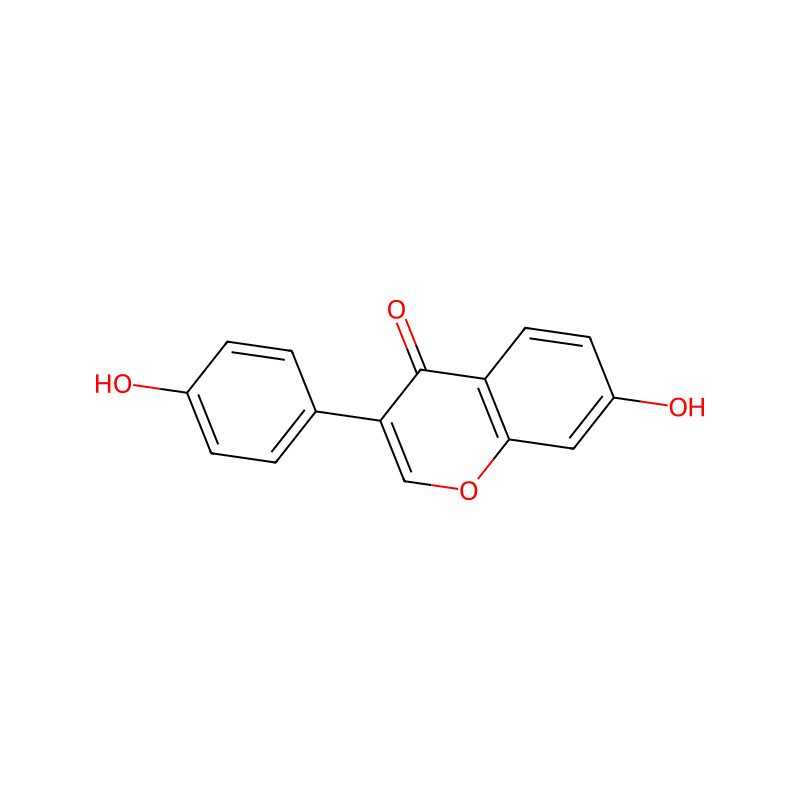
識別子と物理属性
| CAS No. | 486-66-8 |
|---|---|
| 分子式 | C15H10O4 |
| 平均分子量 | 254.24 g/mol |
| 単同位体質量 | 254.0579088 g/mol |
| SMILES | O=c1c(-c2ccc(O)cc2)coc2cc(O)ccc12 |
| InChIKey | ZQSIJRDFPHDXIC-UHFFFAOYSA-N |
| PubChem CID | 5281708 |
| ChEMBL | CHEMBL8145 |
| ChEBI | CHEBI:28197 |
| EC No. | 207-635-4 |
| DTXSID | DTXSID9022310 |
| 現地名 | ダイゼイン |
化学・物理的性質
| XLogP | 2.5 |
|---|---|
| 極性表面積 | 66.8 |
| 水素結合供与体数 | 2 |
| 水素結合受容体数 | 4 |
| 回転可能結合数 | 1 |
| 重原子数 | 19 |
| 形式電荷 | 0 |
| 複雑度 | 382 |
| 医薬品 | Pharmaceuticals -> Listed in ZINC15 |
| 脂質 | Polyketides [PK] -> Flavonoids [PK12] -> Isoflavonoids [PK1205] |
| Endocrine Disruptors | Potential endocrine disrupting compound |
| 融点 | 323 °C315-323°C (dec.) |
| Physical Description | Solid |
| Collision Cross Section | 155.8 Ų [M+H]+ [CCS Type: DTBuffer gas: N2Ionization: ESI+Dataset: TOXCASTSource Identifier: DTXSID9022310]162.33 Ų [M-H]- [CCS Type: DTMethod: stepped-field]172 Ų [M+Na]+ |
| 沸点 | 317.45°C (rough estimate) |
| 密度 | 1.1629 (rough estimate) |
| 屈折率 | 1.4300 (estimate) |
| 貯蔵条件 | 2-8°C |
| 溶解度 | DMSO: 10 mg/mL不溶性 |
| 外観・状態 | 粉 |
| pKa(酸解離定数) | 7.01±0.20(Predicted) |
| 色 | ホワイトからオフホワイト |
| 由来生物 | synthetic |
| Merck | 14,2801 |
| BRN | 231523 |
| 主な用途 | 食品および飲料 |
| 化粧品成分の機能 | スキンコンディショニング - その他 |
| InChI | 1S/C15H10O4/c16-10-3-1-9(2-4-10)13-8-19-14-7-11(17)5-6-12(14)15(13)18/h1-8,16-17H |
| InChIKey | ZQSIJRDFPHDXIC-UHFFFAOYSA-N |
| SMILES | Oc1ccc(cc1)C2=COc3cc(O)ccc3C2=O |
| LogP(分配係数) | 2.632 (est) |
| CAS データベース | 486-66-8(CAS DataBase Reference) |
| EPAの化学物質情報 | 4H-1-Benzopyran-4-one, 7-hydroxy-3-(4-hydroxyphenyl)- (486-66-8) |
化学的特性
Off-White Crystalline Solid
安全性と法規制
| GHS 分類 | This chemical does not meet GHS hazard criteria for 3.7% (3 of 81) of reports.WarningH315 (95.1%): Causes skin irritation [Warning Skin corrosion/irritation]P264, P264+P265, P280, P302+P352, P305+P351+P338, P321, P332+P317, P337+P317, and P362+P364 (click each P-code to see the statement)Aggregated GHS information provided per 81 reports by companies from 5 notifications to the ECHA C&L Inventory. Each notification may be associated with multiple companies. |
|---|---|
| 規制情報 | 4H-1-Benzopyran-4-one, 7-hydroxy-3-(4-hydroxyphenyl)-: Does not have an individual approval but may be used as a component in a product covered by a group standard. It is not approved for use as a chemical in its own right. |
| Hazard Classes and Categories | Skin Irrit. 2 (95.1%) |
| Carcinogen Classification | No indication of carcinogenicity to humans (not listed by IARC). |
| 水環境危害等級(WGK) | 3 |
| RTECS 番号 | DJ3100040 |
| 税関コード | 29329990 |
| 危険文句(R) | 36/38 |
| 危険表示 | Xi |
| 安全措置(S) | 24-26-37/39 |
| 危険等級 | IRRITANTEye Irrit. 2Skin Irrit. 2 |
| 貯蔵分類 | 11 - Combustible Solids |
用途
解説
ダイゼイン,イソフラボン類の一つ.マメ科Pueraria thunbergiana Benth.の根に含まれ,またGlycine hispida L.の種子では配糖体ダイジンとして存在する植物エストロゲンの一種.マメ科の植物に存在し、大豆や豆腐などの食品にも含まれる。体内で雌性ホルモンと似たはたらきをするファイトエストロゲンの一つとして知られる。無色の柱状晶.融点315~320 ℃(300 ℃ より黒変する).λmax 250 nm(log ε 4.44).水に不溶,アルコール類,アセトンに可溶.アルカリに溶けて,溶液は紫外線下で蛍光を発する.塩化鉄(Ⅲ)溶液で呈色しない.
説明
Daidzein mainly comes from leguminous plants, the seeds of soybean (dadou), red clover grass, or all Pueraria roots. Its medicinal value was first recorded in Shen Nong Ben Cao Jing 2838 BC.Daidzein, one of the main soy isoflavones, is also the main component of radix puerariae (Gegen) which is the dry root of kudzu leguminous plants. Radix puerariae can reduce fever, produce saliva, and relieve diarrhea. Its chemical composition is complicated, including puerarin, xyloside, soy flavonoids, soybean flavonoid glycosides, beta-sitosterol, daidzin, daidzein. The main effective components are puerarin and daidzein
来歴
Daidzein is a kind of isoflavone compound, which was first synthetized by researchers in China. It has been widely used in drugs, food supplements, and cosmetics. Because of two phenolic hydroxyl structures, Daidzein has poor water solubility, poor liposolubility, and strong first-pass effect, leading to the low bioavailability of oral absorption, which limits its widely clinical usage. Ipriflavone is a kind of isoflavone modified from Daidzein, which has been used for the treatment of osteoporosis in Japan and some European countries. The effects of a series of amino alkoxy derivatives of ipriflavones on inhibiting the bone absorption were evaluated. The researchers found that 7-amino alkoxy derivative works best. When Daidzein was alkylated or acylated at 7-hydroxyl selectively, the stability was increased, and thus the proliferation of MCF-7 cell was inhibited.
使用
Inactive analog of Genistein (Cat. #G350000). Blocks the G1 phase of the cell cycle in Swiss 3T3 cells by inhibiting casein kinase II activity1. Daidzein has also been shown to inhibit the action of GABA on recombinant GABAA receptors2. uv max:250 nm (log e 4.44)
一般的な説明
Daidzein is an endocrine-active estrogenic isoflavone. This phytoestrogen is capable to bind to estrogen to exert estrogenic effects in vivo. It can naturally be found in soybean seed and flour.