
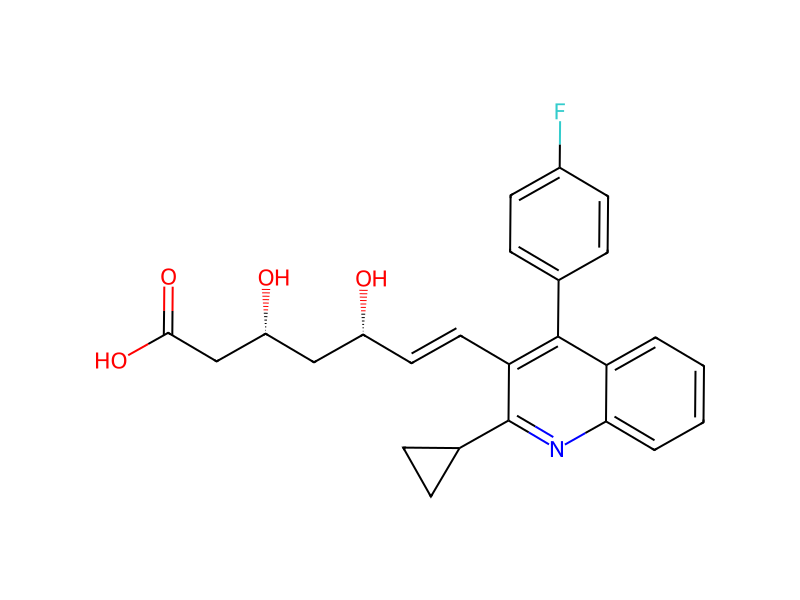
基本情報
- 標準SMILES
O=C(O)C[C@H](O)C[C@H](O)/C=C/c1c(C2CC2)nc2ccccc2c1-c1ccc(F)cc1- InChIKey
VGYFMXBACGZSIL-MCBHFWOFSA-N- 分子式
- C25H24FNO4
- 平均分子量
- 421.5 g/mol
- 単同位体質量
- 421.16893647
概要
Pitavastatin is a dihydroxy monocarboxylic acid that is (6E)-7-[2-cyclopropyl-4-(4-fluorophenyl)quinolin-3-yl]hept-6-enoic acid in which the two hydroxy groups are located at positions 3 and 5 (the 3R,5S-stereoisomer). Used as its calcium salt for treatment of hypercholesterolemia (elevated levels of cholesterol in the blood) on patients unable to sufficiently lower their cholesterol levels by diet and exercise. It has a role as an antioxidant. It is a member of quinolines, a dihydroxy monocarboxylic acid, a member of cyclopropanes, a member of monofluorobenzenes and a statin (synthetic). It is a conjugate acid of a pitavastatin(1-).
名称と識別子
- 優先名称
- Pitavastatin
- IUPAC
- (E,3R,5S)-7-[2-cyclopropyl-4-(4-fluorophenyl)quinolin-3-yl]-3,5-dihydroxyhept-6-enoic acid
名称と別名
Pitavastatin147511-69-1ItavastatinpitavastatineNK 104pitavastatinumPitavastatina(3R,5S,6E)-7-[2-cyclopropyl-4-(4-fluorophenyl)quinolin-3-yl]-3,5-dihydroxyhept-6-enoic acidNK-104NIKITA6-Heptenoic acid, 7-[2-cyclopropyl-4-(4-fluorophenyl)-3-quinolinyl]-3,5-dihydroxy-, (3R,5S,6E)-M5681Q5F9P
名称をさらに表示
(3R,5S,6E)-7-(2-Cyclopropyl-4-(4-fluorophenyl)quinolin-3-yl)-3,5-dihydroxyhept-6-enoic acidNSC-760423K-924 component Pivastatin(E,3R,5S)-7-[2-cyclopropyl-4-(4-fluorophenyl)quinolin-3-yl]-3,5-dihydroxyhept-6-enoic acidDTXSID1048384CHEBI:32020P-872441(3R,5S,6E)-7-(2-Cyclopropyl-4-(p-fluorophenyl)-3-quinolyl)-3,5-dihydroxy-6-heptenoic acid
データベース識別子
- CAS
147511-69-1- PubChem CID
- 5282452
- DTXSID
DTXSID1048384- ChEMBL
CHEMBL1201753- ChEBI
CHEBI:32020- UNII
- M5681Q5F9P
- EC Number
- 643-092-3
- Nikkaji
- J1.195.500B、J640.860E
物性
構造計算による物性
- XLogP
- 3.5
- 極性表面積
- 90.7 Ų
- 水素結合供与体数
- 3
- 水素結合受容体数
- 6
- 回転可能結合数
- 8
- 重原子数
- 31
- 形式電荷
- 0
- 複雑度
- 631
実験および物理化学的性質
Drugs
Pharmaceuticals -> Statins
Pharmaceuticals -> Antilipidemics
Pharmaceuticals -> Listed in ZINC15
SolubilityVery slightly soluble
Human DrugsBreast Feeding; Lactation; Milk, Human; Anticholesteremic Agents; Hypolipidemic Agents; Hydroxymethylglutaryl-CoA Reductase Inhibitors
Optical Rotation
MW: 881.00. White to pale-yellow, odorless powder. Lipophilic. Specific optical rotation: +23.1 deg at 20 °C/D (c = 1 in acetonitrile/water). freely soluble in pyridine, chlorform, dilute hydrochloric acid, tetrahydrofuran; soluble in ethylene glycol; sparingly soluble in octanol; slightly soluble in methanol; very slightly soluble in water, ethanol. Practically insoluble in acetonitrile, diethyl ether. Hydgroscopic; slightly unstable in light. /Pitavasatin calcium salt/
Collision Cross Section202.3 Ų [M+H]+ [CCS Type: DT; Buffer gas: N2; Ionization: APCI+; Dataset: TOXCAST; Source Identifier: DTXSID4046448]
Other Experimental PropertiesMW: 493.45. MP: 138-139 °C. Specific optical rotation: +8.84 deg at 32 °C/D (c = 0.92 in chloroform). Soluble in acetonitrile /Pitavastatin lactone/
安全と法規制
GHS分類
GHS Classification
Warning
H361 (100%): Suspected of damaging fertility or the unborn child [Warning Reproductive toxicity]
P203, P260, P263, P264, P270, P280, P318, P405, and P501 (click each P-code to see the statement)
The GHS information provided by 1 company from 1 notification to the ECHA C&L Inventory.
危険有害性情報
FDA Requirements
The Approved Drug Products with Therapeutic Equivalence Evaluations identifies currently marketed prescription drug products, including pitavastatin calcium, approved on the basis of safety and effectiveness by FDA under sections 505 of the Federal Food, Drug, and Cosmetic Act. /Pitavastatin calcium/
Hazard Classes and CategoriesRepr. 2 (100%)
安全と保護具
Storage ConditionsStore at room temperature between 15 °C and 30 °C (59 deg to 86 °F). Protect from light.
Disposal Methods
SRP: Expired or waste pharmaceuticals shall carefully take into consideration applicable DEA, EPA, and FDA regulations. It is not appropriate to dispose by flushing the pharmaceutical down the toilet or discarding to trash. If possible return the pharmaceutical to the manufacturer for proper disposal being careful to properly label and securely package the material. Alternatively, the waste pharmaceutical shall be labeled, securely packaged and transported by a state licensed medical waste contractor to dispose by burial in a licensed hazardous or toxic waste landfill or incinerator.
毒性情報
Interactions
Pitavastatin is a substrate of organic anionic transport polypeptide (OATP) 1B1 (OATP2). Drugs that inhibit OATP1B1 (e.g., cyclosporine, erythromycin, rifampin) can increase bioavailability of pitavastatin.
Concomitant use of pitavastatin (2 mg once daily) and ezetimibe (10 mg for 7 days) decreased pitavastatin peak plasma concentration and AUC by 2 and 0.2%, respectively, and increased ezetimibe peak plasma concentration and AUC by 9 and 2%, respectively.
Erythromycin substantially increases pitavastatin exposure.1 Following concomitant use of pitavastatin (4 mg as a single dose on day 4) and erythromycin (500 mg 4 times daily for 6 days), pitavastatin peak plasma concentration and AUC were increased by 3.6- and 2.8-fold, respectively; such effects were considered clinically important. The interaction between pitavastatin and erythromycin probably resulted partly from erythromycin-induced inhibition of organic anionic transport polypeptide (OATP)1B1-mediated hepatic uptake of pitavastatin. If used concomitantly with erythromycin, dosage of pitavastatin should not exceed 1 mg once daily.
Concomitant use of pitavastatin (4 mg once daily on days 1-5 and 11-15) and extended-release diltiazem hydrochloride (240 mg on days 6-15) increased pitavastatin peak plasma concentration and AUC by 15 and 10%, respectively, and decreased diltiazem peak plasma concentration and AUC by 7 and 2%, respectively.
For more Interactions (Complete) data for Pitavastatin (20 total), please visit the HSDB record page.
Hepatotoxicity
Less information is available on the potential hepatotoxicity of pitavastatin in comparison to other more widely used statins. In large clinical trials, pitavastatin therapy was associated with mild, asymptomatic and usually transient serum aminotransferase elevations in approximately 1% of patients, but levels above 3 times the upper limit of normal (ULN) were infrequent and no cases of clinically apparent hepatitis were reported from the preregistration clinical trials. Since marketing of pitavastatin, however, the sponsor has received reports of jaundice, hepatitis and hepatic failure including fatal cases. However, the clinical features and typical course of the liver injury associated with pitavastatin have not been defined in the published literature. On the other hand, the other statins have all been implicated in cases of clinically apparent acute liver injury that typically arise after 1 to 6 months of therapy with either a cholestatic or hepatocellular pattern of serum enzyme elevations. Rash, fever and eosinophilia are uncommon, but some cases have been marked by autoimmune features including autoantibodies, chronic hepatitis on liver biopsy and a clinical response to corticosteroid therapy. This pattern has yet to be shown to apply to pitavastatin.
Adverse Effects
The most commonly reported adverse effects related to pitavastatin use include back pain, constipation, diarrhea, myalgia, and pain in the extremities. Reports exist of rash, pruritus, and urticaria. There are also reports of myopathy and rhabdomyolysis, leading to acute renal failure. Pitavastatin use can also cause lab abnormalities, including elevated creatine phosphokinase, transaminases (aspartate aminotransferase [AST]/serum glutamic-oxaloacetic transaminase, or alanine aminotransferase [ALT]/serum glutamic-pyruvic transaminase), alkaline phosphatase, bilirubin, and glucose. High fasting serum glucose levels and high HgA1c levels have also occurred with pitavastatin use.
Toxicity Summary
IDENTIFICATION AND USE: Pitavastatin, a hydroxymethylglutaryl-CoA (HMG-CoA) reductase inhibitor (i.e., statin), is an antilipemic agent. It is used as an adjunct to lifestyle modifications for the management of dyslipidemias. HUMAN EXPOSURE AND TOXICITY: Pitavastatin is contraindicated for use in pregnant women or patients with active liver disease, including unexplained, persistent elevations in serum aminotransferase concentrations. Cases of myopathy and rhabdomyolysis with acute renal failure secondary to myoglobinuria have been reported with HMG-CoA reductase inhibitors, including pitavastatin. These risks can occur at any dose level, but increase in a dose-dependent manner. Cases of fatal and nonfatal hepatic failure have also been reported rarely in patients receiving pitavastatin. ANIMAL STUDIES: In a 92-week carcinogenicity study in mice given pitavastatin, at the maximum tolerated dose of 75 mg/kg/day there was an absence of drug-related tumors. However, in a 92-week carcinogenicity study in rats given pitavastatin at 1, 5, 25 mg/kg/day by oral gavage, there was a significant increase in the incidence of thyroid follicular cell tumors at 25 mg/kg/day. Embryo-fetal developmental studies were conducted in pregnant rats treated with 3, 10, 30 mg/kg/day pitavastatin by oral gavage during organogenesis. No adverse effects were observed at 3 mg/kg/day. Embryo-fetal developmental studies were conducted in pregnant rabbits treated with 0.1, 0.3, 1 mg/kg/day pitavastatin by oral gavage during the period of fetal organogenesis. Maternal toxicity consisting of reduced body weight and abortion was observed at all doses tested. In perinatal/postnatal studies in pregnant rats given oral gavage doses of pitavastatin at 0.1, 0.3, 1, 3, 10, 30 mg/kg/day from organogenesis through weaning, maternal toxicity consisting of mortality at 0.3 mg/kg/day and impaired lactation at all doses contributed to the decreased survival of neonates in all dose groups. Pitavastatin had no adverse effects on male and female rat fertility at oral doses of 10 and 30 mg/kg/day, respectively. Pitavastatin was not mutagenic in the Ames test with Salmonella typhimurium and Escherichia coli with and without metabolic activation, the micronucleus test following a single administration in mice and multiple administrations in rats, the unscheduled DNA synthesis test in rats, and a Comet assay in mice. In the chromosomal aberration test, clastogenicity was observed at the highest doses tested which also elicited high levels of cytotoxicity.
A common side effect of pitavastatin toxicity is myalgia. In the setting of overdose, there is no known treatment. Patients should be provided with supportive measures and should receive treatment for any symptoms. Given the high protein binding ratio of pitavastatin, hemodialysis would not be beneficial.
Human Toxicity Excerpts
/SIGNS AND SYMPTOMS/ Cases of myopathy and rhabdomyolysis with acute renal failure secondary to myoglobinuria have been reported with HMG-CoA reductase inhibitors, including Livalo. These risks can occur at any dose level, but increase in a dose-dependent manner.
/SIGNS AND SYMPTOMS/ Cases of fatal and nonfatal hepatic failure have been reported rarely in patients receiving statins, including pitavastatin, during postmarketing surveillance.
/EPIDEMIOLOGY STUDIES/ ... We conducted a meta-analysis and employed indirect comparisons to identify differing risk effects across statins. We included any randomized clinical trial (RCT) of atorvastatin, fluvastatin, lovastatin, pitavastatin, pravastatin, rosuvastatin and simvastatin used for cardiovascular disease event prevention. The main outcome was adverse events [all-cause mortality, cancers, rhabdomylosis, diabetes, aspartate and alanine aminotransferase (AST/ALT), and creatinine kinase (CK) increases beyond the upper limit of normal]. In order to evaluate the relative effects of each drug on adverse events, we calculated adjusted indirect comparisons of the adverse-event outcomes. Seventy-two trials involving 159,458 patients met our inclusion criteria. Overall, statin treatments significantly increased the rate of diabetes when compared to controls (OR: 1.09; 95% CI: 1.02-1.16) and elevated AST (OR: 1.31; 95% CI: 1.04-1.66) and ALT (OR: 1.28; 95% CI: 1.11-1.48) levels when compared to controls. Using indirect comparisons, we also found that atorvastatin significantly elevated AST levels compared to pravastatin (OR: 2.21; 95% CI: 1.13-4.29) and simvastatin significantly increased CK levels when compared to rosuvastatin (OR: 4.39; 95% CI: 1.01-19.07). Higher dose studies had increased risk of AST elevations. Although statins are generally well tolerated, there are risks associated with almost all drugs. With few exceptions, statins appear to exert a similar risk across individual drugs.
/ALTERNATIVE and IN VITRO TESTS/ /The purpose of this study was/ to determine the effect of different statins on the induction of diabetes mellitus. Four statins (atorvastatin, pravastatin, rosuvastatin, and pitavastatin) were used. Cytotoxicity, insulin secretion, glucose-stimulated insulin secretion, and G0/G1 phase cell cycle arrest were investigated in human pancreas islet beta cells, and glucose uptake and signaling were studied in human skeletal muscle cells (HSkMCs). Human pancreas islet beta cells treated with 100 nM atorvastatin, pravastatin, rosuvastatin, and pitavastatin had reduced cell viability (32.12%, 41.09%, 33.96%, and 29.19%, respectively) compared to controls. Such cytotoxic effect was significantly attenuated by decreasing the dose to 10 and 1 nM, ranged from 1.46% to 17.28%. Cells treated with 100 nM atorvastatin, pravastatin, rosuvastatin, and pitavastatin had a reduction in the rate of insulin secretion rate by 34.07%, 30.06%, 26.78%, and 19.22%, respectively. The inhibitory effect was slightly attenuated by decreasing the dose to 10 and 1 nM, ranging from 10.84% to 29.60%. Insulin secretion stimulated by a high concentration of glucose (28 mmol/L) was significantly higher than a physiologic concentration of glucose (5.6 mmol/L) in all treatment groups. The glucose uptake rates at a concentration of 100 nM were as follows: atorvastatin (58.76%) < pravastatin (60.21%) < rosuvastatin (72.54%) < pitavastatin (89.96%). We also found that atorvastatin and pravastatin decreased glucose transporter (GLUT)-2 expression and induced p-p38 MAPK levels in human pancreas islet beta cells. Atorvastatin, pravastatin, and rosuvastatin inhibited GLUT-4, p-AKT, p-GSK-3beta, and p-p38 MAPK levels in HSkMCs. Statins similar but different degree of effects on pancreas islet beta cells damage and induce insulin resistance in HSkMC.
For more Human Toxicity Excerpts (Complete) data for Pitavastatin (9 total), please visit the HSDB record page.
Non-Human Toxicity Excerpts
/LABORATORY ANIMALS: Chronic Exposure or Carcinogenicity/ In a 26-week transgenic mouse (Tg rasH2) carcinogenicity study where animals were given pitavastatin at 30, 75, and 150 mg/kg/day by oral gavage, no clinically significant tumors were observed.
/LABORATORY ANIMALS: Chronic Exposure or Carcinogenicity/ In a 92-week carcinogenicity study in mice given pitavastatin, at the maximum tolerated dose of 75 mg/kg/day with systemic maximum exposures (AUC) 26 times the clinical maximum exposure at 4 mg/day, there was an absence of drug-related tumors.
/LABORATORY ANIMALS: Developmental or Reproductive Toxicity/ The effects of (+)-monocalcium bis((3R,5S,6E)-7-(2-cyclopropyl-4-(4-fluorophenyl)-3-quinolyl)-3,5-dihydroxy-6- heptenoate) (NK-104), a novel HMG-CoA reductase inhibitor, on fertility of parent animals and fetal development were studied in Crj:CD(SD) rats. NK-104 was administered orally at daily dose levels of 2, 10 and 30 mg/kg. Males were treated with NK-104 for 70 days prior to mating, during the 3-week mating period and for about 7 days until the day of terminal sacrifice. Initially, 50 mg/kg of NK-104 was given to the highest dose group of males for the first 36 days of premating period. Three rats, however, died during this period. Therefore, thereafter the dose level was lowered from 50 mg/kg to 30 mg/kg in the highest dose group. Females were treated for 14 days prior to mating, during the mating period and through day 7 of gestation. Among the parent animals, reduced body weight gain and decreased food intake were noted in the male maximum dose group during the period given 50 mg/kg, and 3 animals died on days 14, 21 and 23 of premating period. The reduced body weight gain and decrease of food intake were noted to continue after the dose level was reduced to 30 mg/kg. At autopsy, white discoloration and thickening of the forestomach mucosa were observed in this group. No treatment-related effects were observed on general condition, body weight, food intake or gross pathology in the female groups. Examinations on the parent animals revealed no adverse effects of NK-104 on the parameters of reproductive function such as estrous cycle, copulation index, fertility index or number of corpora lutea. No treatment-related effects were observed in any groups on the number of implantations, implantation index, fetal mortality, number of live fetuses, sex ratio, fetal weight, placental appearance, placental weight, properties of amniotic fluid or externals. Based on these results, it is concluded that the non-toxic dose of NK-104 was 10 mg/kg for general toxicity in parent animals and 30 mg/kg for reproductive function of parent animals and for fetuses.
/LABORATORY ANIMALS: Developmental or Reproductive Toxicity/ In a 92-week carcinogenicity study in rats given pitavastatin at 1, 5, 25 mg/kg/day by oral gavage there was a significant increase in the incidence of thyroid follicular cell tumors at 25 mg/kg/day, which represents 295 times human systemic exposures based on AUC at the 4 mg/day maximum human dose.
For more Non-Human Toxicity Excerpts (Complete) data for Pitavastatin (10 total), please visit the HSDB record page.
Populations at Special Risk
Livalo is contraindicated in women who are or may become pregnant. Serum cholesterol and triglycerides (TG) increase during normal pregnancy, and cholesterol products are essential for fetal development.
Pitavastatin should be used with caution in patients who consume substantial amounts of alcohol. The drug is contraindicated in patients with active liver disease, including unexplained, persistent elevations in serum aminotransferase concentrations.
Antidote and Emergency Treatment
/SRP:/ Immediate first aid: Ensure that adequate decontamination has been carried out. If patient is not breathing, start artificial respiration, preferably with a demand valve resuscitator, bag-valve-mask device, or pocket mask, as trained. Perform CPR if necessary. Immediately flush contaminated eyes with gently flowing water. Do not induce vomiting. If vomiting occurs, lean patient forward or place on the left side (head-down position, if possible) to maintain an open airway and prevent aspiration. Keep patient quiet and maintain normal body temperature. Obtain medical attention. /Poisons A and B/
/SRP:/ Basic treatment: Establish a patent airway (oropharyngeal or nasopharyngeal airway, if needed). Suction if necessary. Watch for signs of respiratory insufficiency and assist ventilations if needed. Administer oxygen by nonrebreather mask at 10 to 15 L/min. Monitor for pulmonary edema and treat if necessary ... . Monitor for shock and treat if necessary ... . Anticipate seizures and treat if necessary ... . For eye contamination, flush eyes immediately with water. Irrigate each eye continuously with 0.9% saline (NS) during transport ... . Do not use emetics. For ingestion, rinse mouth and administer 5 mL/kg up to 200 mL of water for dilution if the patient can swallow, has a strong gag reflex, and does not drool ... . Cover skin burns with dry sterile dressings after decontamination ... . /Poisons A and B/
/SRP:/ Advanced treatment: Consider orotracheal or nasotracheal intubation for airway control in the patient who is unconscious, has severe pulmonary edema, or is in severe respiratory distress. Positive-pressure ventilation techniques with a bag valve mask device may be beneficial. Consider drug therapy for pulmonary edema ... . Consider administering a beta agonist such as albuterol for severe bronchospasm ... . Monitor cardiac rhythm and treat arrhythmias as necessary ... . Start IV administration of D5W TKO /SRP: "To keep open", minimal flow rate/. Use 0.9% saline (NS) or lactated Ringer's (LR) if signs of hypovolemia are present. For hypotension with signs of hypovolemia, administer fluid cautiously. Watch for signs of fluid overload ... . Treat seizures with diazepam or lorazepam ... . Use proparacaine hydrochloride to assist eye irrigation ... . /Poisons A and B/
There is no known specific treatment in the event of overdose of pitavastatin. In the event of overdose, the patient should be treated symptomatically and supportive measures instituted as required. Hemodialysis is unlikely to be of benefit due to high protein binding ratio of pitavastatin.
Effects During Pregnancy and Lactation◉ Summary of Use during Lactation
法規制情報
FDA Requirements
The Approved Drug Products with Therapeutic Equivalence Evaluations identifies currently marketed prescription drug products, including pitavastatin calcium, approved on the basis of safety and effectiveness by FDA under sections 505 of the Federal Food, Drug, and Cosmetic Act. /Pitavastatin calcium/
化学と産業
薬理情報
ATC Code
C - Cardiovascular system
QC - Cardiovascular system
Protein BindingPitavstatin is more than 99% protein bound in human plasma, mainly to albumin and alpha 1-acid glycoprotein.
Pharmacodynamics
Pitavastatin is an oral antilipemic agent which inhibits HMG-CoA reductase. It is used to lower total cholesterol, low density lipoprotein-cholesterol (LDL-C), apolipoprotein B (apoB), non-high density lipoprotein-cholesterol (non-HDL-C), and trigleride (TG) plasma concentrations while increasing HDL-C concentrations. High LDL-C, low HDL-C and high TG concentrations in the plasma are associated with increased risk of atherosclerosis and cardiovascular disease. The total cholesterol to HDL-C ratio is a strong predictor of coronary artery disease and high ratios are associated with higher risk of disease. Increased levels of HDL-C are associated with lower cardiovascular risk. By decreasing LDL-C and TG and increasing HDL-C, rosuvastatin reduces the risk of cardiovascular morbidity and mortality. Elevated cholesterol levels, and in particular, elevated low-density lipoprotein (LDL) levels, are an important risk factor for the development of CVD. Use of statins to target and reduce LDL levels has been shown in a number of landmark studies to significantly reduce the risk of development of CVD and all-cause mortality. Statins are considered a cost-effective treatment option for CVD due to their evidence of reducing all-cause mortality including fatal and non-fatal CVD as well as the need for surgical revascularization or angioplasty following a heart attack. Evidence has shown that even for low-risk individuals (with <10% risk of a major vascular event occurring within 5 years) statins cause a 20%-22% relative reduction in major cardiovascular events (heart attack, stroke, coronary revascularization, and coronary death) for every 1 mmol/L reduction in LDL without any significant side effects or risks. **Skeletal Muscle Effects** Pitavastatin may cause myopathy (muscle pain, tenderness, or weakness with creatine kinase (CK) above ten times the upper limit of normal) and rhabdomyolysis (with or without acute renal failure secondary to myoglobinuria). Rare fatalities have occurred as a result of rhabdomyolysis with statin use, including pitavastatin. Predisposing factors for myopathy include advanced age (≥65 years), female gender, uncontrolled hypothyroidism, and renal impairment. In most cases, muscle symptoms and CK increases resolved when treatment was promptly discontinued. As dosages of pitavastatin greater than 4mg per day were associated with an increased risk of severe myopathy, the product monograph recommends a maximum daily dose of 4mg once daily. The risk of myopathy during treatment with pitavstatin may be increased with concurrent administration of interacting drugs such as [fenofibrate], [niacin], [gemfibrozil], and [cyclosporine]. Cases of myopathy, including rhabdomyolysis, have been reported with HMG-CoA reductase inhibitors coadministered with [colchicine], and caution should therefore be exercised when prescribing these two medications together. Real-world data from observational studies has suggested that 10-15% of people taking statins may experience muscle aches at some point during treatment. **Hepatic Dysfunction** Increases in serum transaminases have been reported with pitavastatin. In most cases, the elevations were transient and either resolved or improved on continued therapy or after a brief interruption in therapy. There have been rare postmarketing reports of fatal and non-fatal hepatic failure in patients taking statins, including pitavastatin. Patients who consume substantial quantities of alcohol and/or have a history of liver disease may be at increased risk for hepatic injury. **Increases in HbA1c and Fasting Serum Glucose Levels** Increases in HbA1c and fasting serum glucose levels have been reported with statins, including pitavastatin. Optimize lifestyle measures, including regular exercise, maintaining a healthy body weight, and making healthy food choices. An in vitro study found that [atorvastatin], [pravastatin], [rosuvastatin], and [pitavastatin] exhibited a dose-dependent cytotoxic effect on human pancreas islet β cells, with reductions in cell viability of 32, 41, 34 and 29%, respectively, versus control. Moreover, insulin secretion rates were decreased by 34, 30, 27 and 19%, respectively, relative to control.
Mechanism of Action
Pitavastatin is a statin medication and a competitive inhibitor of the enzyme HMG-CoA (3-hydroxy-3-methylglutaryl coenzyme A) reductase, which catalyzes the conversion of HMG-CoA to mevalonate, an early rate-limiting step in cholesterol biosynthesis. Pitavastatin acts primarily in the liver, where decreased hepatic cholesterol concentrations stimulate the upregulation of hepatic low density lipoprotein (LDL) receptors which increase hepatic uptake of LDL, thereby reducing circulating LDL-C levels. In vitro and in vivo animal studies also demonstrate that statins exert vasculoprotective effects independent of their lipid-lowering properties, also known as the pleiotropic effects of statins. This includes improvement in endothelial function, enhanced stability of atherosclerotic plaques, reduced oxidative stress and inflammation, and inhibition of the thrombogenic response. Statins have also been found to bind allosterically to β2 integrin function-associated antigen-1 (LFA-1), which plays an important role in leukocyte trafficking and in T cell activation.
Hepatic ATP-binding cassette transporter A1 (ABCA1) plays a key role in high-density lipoprotein (HDL) production by apolipoprotein A-I (ApoA-I) lipidation. 3-Hydroxy-3-methylglutaryl coenzyme A (HMG-CoA) reductase inhibitors, statins, increase ABCA1 mRNA levels in hepatoma cell lines ... . We investigated how statins increase ABCA1 in rat hepatoma McARH7777 cells. Pitavastatin, atorvastatin, and simvastatin increased total ABCA1 mRNA levels, whereas pravastatin had no effect. Pitavastatin also increased ABCA1 protein. Hepatic ABCA1 expression in rats is regulated by both liver X receptor (LXR) and sterol regulatory element-binding protein (SREBP2) pathways. Pitavastatin repressed peripheral type ABCA1 mRNA levels and its LXR-driven promoter, but activated the liver-type SREBP-driven promoter, and eventually increased total ABCA1 mRNA expression. Furthermore, pitavastatin increased peroxisome proliferator-activated receptor a (PPARa) and its downstream gene expression. Knockdown of PPARa attenuated the increase in ABCA1 protein, indicating that pitavastatin increased ABCA1 protein via PPARa activation, although it repressed LXR activation. Furthermore, the degradation of ABCA1 protein was retarded in pitavastatin-treated cells. These data suggest that pitavastatin increases ABCA1 protein expression by dual mechanisms: SREBP2-mediated mRNA transcription and PPARa-mediated ABCA1 protein stabilization, but not by the PPAR-LXR-ABCA1 pathway.
Pitavastatin competitively inhibits 3-hydroxy-3-methylglutaryl-coenzyme A (HMG-CoA) reductase, which is a rate-determining enzyme involved with biosynthesis of cholesterol, in a manner of competition with the substrate so that it inhibits cholesterol synthesis in the liver. As a result, the expression of low-density lipoprotein (LDL)-receptors followed by the uptake of LDL from blood to liver is accelerated and then the plasma total cholesterol (TC) decreases. Further, the sustained inhibition of cholesterol synthesis in the liver decreases levels of very low density lipoproteins.
Statin use in individuals with chronic obstructive pulmonary disease (COPD) with coexisting cardiovascular disease is associated with a reduced risk of exacerbations. ... To explore the mechanisms involved, we investigated the effect of statin on endothelial cell function, especially endothelial cell tight junctions. We primarily assessed whether pitavastatin could help mitigate the development of emphysema induced by continuous cigarette smoking (CS) exposure. We also investigated the activation of liver kinase B1 (LKB1)/AMP-activated protein kinase (AMPK) signaling, which plays a role in maintaining endothelial functions, important tight junction proteins, zonula occludens (ZO)-1 and claudin-5 expression, and lung microvascular endothelial cell permeability. RESULTS: We found that pitavastatin prevented the CS-induced decrease in angiomotin-like protein 1 (AmotL1)-positive vessels via the activation of LKB1/AMPK signaling and IFN-gamma-induced hyperpermeability of cultured human lung microvascular endothelial cells by maintaining the levels of AmotL1, ZO-1, and claudin-5 expression at the tight junctions. Our results indicate that the maintenance of lung microvascular endothelial cells by pitavastatin prevents tight junction protein dysfunctions induced by CS. ...
Biological Half-Life
The mean plasma elimination half-life is approximately 12 hours.L48616]
A mean of 15% of radioactivity of orally administered, single 32 mg (14)C-labeled pitavastatin dose was excreted in urine, whereas a mean of 79% of the dose was excreted in feces within 7 days. The mean plasma elimination half-life is approximately 12 hours.
Metabolism/Metabolites
The principal route of pitavastatin metabolism is glucuronidation via liver uridine 5'-diphosphate glucuronosyltransferase (UGT) with subsequent formation of pitavastatin lactone. There is only minimal metabolism by the cytochrome P450 system. Pitavastatin is marginally metabolized by CYP2C9 and to a lesser extent by CYP2C8. The major metabolite in human plasma is the lactone, which is formed via an ester-type pitavastatin glucuronide conjugate by UGTs (UGT1A3 and UGT2B7).
Pitavastatin has been studied for its effects on hepatic microsomal drug metabolism in rats, and the activities of several drug-metabolizing enzymes have been measured. No induction of the drug metabolizing enzymes (aniline hydroxylase, aminopyrine N-demethylase, 7-ethoxycoumarin O-deethylase and UDP-glucuronic acid transferase) was found in the pitavastatin group compared to the control after the multiple administrations of pitavastatin at the dosage of 1-10 mg/kg per day for 7 days. Based on several different in vitro approaches, it is concluded that CYP2C9 is the enzyme responsible for the metabolism of pitavastatin and no metabolite is present in renal and intestinal microsomes. The CYP2C9 polymorphism was not involved in the pitavastatin metabolism. No inhibitory effect in CYP-mediated metabolism was detected on the tolbutamide 4-hydroxylation (CYP2C9) and testosterone 6 beta-hydroxylation (CYP3A4) in the presence of pitavastatin. The results suggested that pitavastatin did not affect the drug-metabolizing systems.
Pitavastatin is marginally metabolized by CYP2C9 and to a lesser extent by CYP2C8. The major metabolite in human plasma is the lactone which is formed via an ester-type pitavastatin glucuronide conjugate by uridine 5'-diphosphate (UDP) glucuronosyltransferase (UGT1A3 and UGT2B7).
To elucidate any potential species differences, the in vitro metabolism of pitavastatin and its lactone was studied with hepatic and renal microsomes from rats, dogs, rabbits, monkeys and humans. With the addition of UDP-glucuronic acid to hepatic microsomes, pitavastatin lactone was identified as the main metabolite in several animals, including humans. Metabolic clearances of pitavastatin and its lactone in monkey hepatic microsome were much greater than in humans. M4, a metabolite of pitavastatin with a 3-dehydroxy structure, was converted to its lactone form in monkey hepatic microsomes in the presence of UDP-glucuronic acid as well as to pitavastatin. These results implied that lactonization is a common pathway for drugs such as 5-hydroxy pentanoic acid derivatives. The acid forms were metabolized to their lactone forms because of their structural characteristics. UDP-glucuronosyltransferase is the key enzyme responsible for the lactonization of pitavastatin, and overall metabolism is different compared with humans owing to the extensive oxidative metabolism of pitavastatin and its lactone in monkey.
FDA Pharmacological Classification
M5681Q5F9P
PITAVASTATIN
Established Pharmacologic Class [EPC] - HMG-CoA Reductase Inhibitor
Mechanisms of Action [MoA] - Hydroxymethylglutaryl-CoA Reductase Inhibitors
Pitavastatin is a HMG-CoA Reductase Inhibitor. The mechanism of action of pitavastatin is as a Hydroxymethylglutaryl-CoA Reductase Inhibitor.
PITAVASTATIN
MeSH Pharmacological ClassificationCompounds that inhibit HYDROXYMETHYLGLUTARYL COA REDUCTASES. They have been shown to directly lower CHOLESTEROL synthesis.
Absorption, Distribution and Excretion
Pitavastatin peak plasma concentrations are achieved about 1 hour after oral administration. Both Cmax and AUC0-inf increased in an approximately dose-proportional manner for single pitavastatin doses from 1 mg to 24 mg once daily. The absolute bioavailability of pitavastatin oral solution is 51%. The Cmax and AUC of pitavastatin did not differ following evening or morning drug administration. In healthy volunteers receiving 4 mg pitavastatin, the percent change from baseline for LDL-C following evening dosing was slightly greater than that following morning dosing. Pitavastatin was absorbed in the small intestine but very little in the colon. Administration of pitavastatin with a high fat meal (50% fat content) decreases pitavastatin Cmax by 43% but does not significantly reduce pitavastatin AUC. Compared to other statins, pitavastatin has a relatively high bioavailability, which has been suggested to occur due to enterohepatic reabsorption in the intestine following intestinal absorption. Genetic differences in the OATP1B1 (organic-anion-transporting polypeptide 1B1) hepatic transporter encoded by the SCLCO1B1 gene (Solute Carrier Organic Anion Transporter family member 1B1) have been shown to impact pitavastatin pharmacokinetics. Evidence from pharmacogenetic studies of the c.521T>C single nucleotide polymorphism (SNP) in the gene encoding OATP1B1 (SLCO1B1) demonstrated that pitavastatin AUC was increased 3.08-fold for individuals homozygous for 521CC compared to homozygous 521TT individuals. Other statin drugs impacted by this polymorphism include [simvastatin], [pitavastatin], [atorvastatin], and [rosuvastatin]. Individuals with the 521CC genotype may be at increased risk of dose-related adverse effects including myopathy and rhabdomyolysis due to increased exposure to the drug.
A mean of 15% of radioactivity of orally administered, single 32 mg <sup>14</sup>C-labeled pitavastatin dose was excreted in urine, whereas a mean of 79% of the dose was excreted in feces within 7 days.L48616]
The mean volume of distribution is approximately 148 L.
Following a single dose, the apparent mean oral clearance of pitavastatin is 43.4 L/h.
/MILK/ It is not known whether pitavastatin is excreted in human milk, however, it has been shown that a small amount of another drug in this class passes into human milk. Rat studies have shown that pitavastatin is excreted into breast milk.
This study was addressed to understand the underlying mechanism of the substrate-dependent effect of genetic variation in SLCO1B1, which encodes OATP1B1 (organic anion transporting polypeptide) transporter, on the disposition of two OATP1B1 substrates, pravastatin and pitavastatin, in relation to their transport activities. The uptake of pravastatin, pitavastatin, and fluvastatin was measured in oocytes overexpressing SLCO1B1*1a and SLCO1B1*15 to compare the alterations of in-vitro transporting activity. After 40-mg pravastatin or 4-mg pitavastatin was administered to 11 healthy volunteers with homozygous genotypes of SLCO1B1*1a/*1a and SLCO1B1*15/*15, the pharmacokinetic parameters of pravastatin and pitavastatin were compared among participants with SLCO1B1*1a/*1a and SLCO1B1*15/*15 genotypes. The uptake of pravastatin and pitavastatin in SLCO1B1*15 overexpressing oocytes was decreased compared with that in SLCO1B1*15, but no change occurred with fluvastatin. The fold change of in-vitro intrinsic clearance (Clint) for pitavastatin in SLCO1B1*15 compared with SLCO1B1*1a was larger than that of pravastatin (P<0.0001). The clearance (Cl/F) of pitavastatin was decreased to a greater degree in participant with SLCO1B1*15/*15 compared with that of pravastatin in vivo (P<0.01), consistent with in-vitro study. As a result, Cmax and area under the plasma concentration-time curve of these nonmetabolized substrates were increased by SLCO1B1*15 variant. The greater decrease in the transport activity for pitavastatin in SLCO1B1*15 variant compared with SLCO1B1*1a was, however, associated with the greater effect on the pharmacokinetics of pitavastatin compared with pravastatin in relation to the SLCO1B1 genetic polymorphism. This study suggests that substrate dependency in the consequences of the SLCO1B1*15 variant could modulate the effect of SLCO1B1 polymorphism on the disposition of pitavastatin and pravastatin.
Cellular LocationsMembrane
用途と製造
Uses
MEDICATION
Hydroxymethylglutaryl-CoA Reductase Inhibitors
Methods of ManufacturingPreparation: Y. Fujikawa et al., European Patent Office patent 304063; eidem, United States of America patent 5011930 (1989, 1991 both to Nissan Chem. Ind.)
Formulations/PreparationsTable: Pitavastatin Calcium Preparations [Table#8396]
関連反応
8 件






関連ノート
読み込み中…