
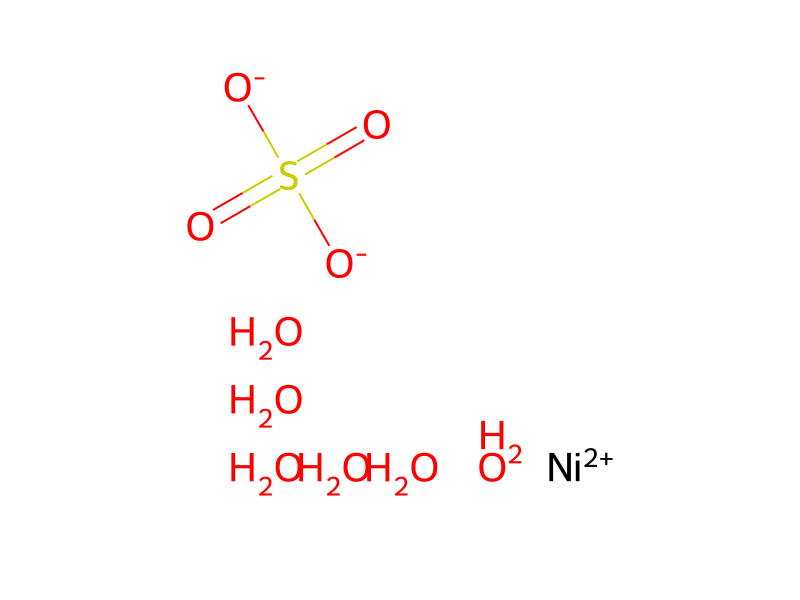
基本情報
- 標準SMILES
O.O.O.O.O.O.O=S(=O)([O-])[O-].[Ni+2]- InChIKey
RRIWRJBSCGCBID-UHFFFAOYSA-L- 分子式
- H12NiO10S
- 平均分子量
- 262.85 g/mol
- 単同位体質量
- 261.950459
名称と識別子
- 優先名称
- Nickel sulfate hexahydrate
- IUPAC
- nickel(2+);sulfate;hexahydrate
名称と別名
Nickel(II) sulfate hexahydrate10101-97-0NICKEL SULFATE HEXAHYDRATENickel(2+) sulfate hexahydrateNickel sulphate hexahydrateNickel monosulfate hexahydrateNickelous sulfate hexahydratenickel(II) sulphate hexahydrateDTXSID7020928nickelous sulphate hexahydrateNICCOLUM SULPHURICUMJC9WZ4FK68
名称をさらに表示
DTXCID70928Nickel(II) sulfate hexahydrate (1:1:6)Sulfuric acid, nickel(2+) salt, hexahydrateCHEBI:53437Sulfuric acid, nickel(2+) salt (1:1), hexahydrateRefChem:6061nickel(2+);sulfate;hexahydrateMFCD00149813
データベース識別子
- CAS
10101-97-0- PubChem CID
- 5284429
- DTXSID
DTXSID7020928- ChEBI
CHEBI:53437- UNII
- JC9WZ4FK68
- EC Number
- 600-152-3
物性
構造計算による物性
- 極性表面積
- 94.6 Ų
- 水素結合供与体数
- 6
- 水素結合受容体数
- 10
- 回転可能結合数
- 0
- 重原子数
- 12
- 形式電荷
- 0
- 複雑度
- 62
実験および物理化学的性質
Density
2.07 (NTP, 1992) - Denser than water; will sink
2.031 @25 °C
Solubilitygreater than or equal to 100 mg/mL at 68 °F (NTP, 1992)
Boiling PointDecomposes at 1544 °F (NTP, 1992)
Melting Point127.9 °F (transition point) (NTP, 1992)
Vapor Pressure0 mmHg at 68 °F Essentially (NTP, 1992)
Physical Description
Nickel sulfate hexahydrate appears as blue or emerald-green crystalline material. Toxic and carcinogenic. Two known phases. Alpha-form (blue tetragonal) converts to beta-form (green monoclinic) at 127.9 °F. Becomes blue and opaque at room temperature. Odorless. Sweet astringent taste. Somewhat efflorescent. Greenish-yellow anhydrous salt is formed at 536 °F. (NTP, 1992)
Liquid; Other Solid; Liquid
Blue to emerald-green crystals that are water soluble; [CAMEO]
安全と法規制
GHS分類
GHS Classification
This chemical does not meet GHS hazard criteria for 0.6% (2 of 326) of reports.
Danger
H302+H332 (54.9%): Harmful if swallowed or if inhaled [Warning Acute toxicity, oral; acute toxicity, inhalation];H302 (96%): Harmful if swallowed [Warning Acute toxicity, oral];H315 (98.8%): Causes skin irritation [Warning Skin corrosion/irritation];H317 (93.6%): May cause an allergic skin reaction [Warning Sensitization, Skin];H332 (98.8%): Harmful if inhaled [Warning Acute toxicity, inhalation];H334 (99.1%): May cause allergy or asthma symptoms or breathing difficulties if inhaled [Danger Sensitization, respiratory];H341 (99.1%): Suspected of causing genetic defects [Warning Germ cell mutagenicity];H350 (54.6%): May cause cancer [Danger Carcinogenicity];H350i (50.3%): May cause cancer by inhalation [Danger Carcinogenicity];H360 (54.6%): May damage fertility or the unborn child [Danger Reproductive toxicity];H360D (55.2%): May damage the unborn child [Danger Reproductive toxicity];H372 (99.1%): Causes damage to organs through prolonged or repeated exposure [Danger Specific target organ toxicity, repeated exposure];H400 (98.8%): Very toxic to aquatic life [Warning Hazardous to the aquatic environment, acute hazard];H410 (99.1%): Very toxic to aquatic life with long lasting effects [Warning Hazardous to the aquatic environment, long-term hazard]
P203, P233, P260, P261, P264, P270, P271, P272, P273, P280, P284, P301+P317, P302+P352, P304+P340, P317, P318, P319, P321, P330, P332+P317, P333+P317, P342+P316, P362+P364, P391, P403, P405, and P501 (click each P-code to see the statement)
Aggregated GHS information provided per 326 reports by companies from 25 notifications to the ECHA C&L Inventory. Each notification may be associated with multiple companies.;Reported as not meeting GHS hazard criteria per 2 of 326 reports by companies.;There are 24 notifications provided by 324 of 326 reports by companies with hazard statement code(s).;Information may vary between notifications depending on impurities, additives, and other factors. The percentage value in parenthesis indicates the notified classification ratio from companies that provide hazard codes. Only hazard codes with percentage values above 10% are shown. For more detailed information, please visit ECHA C&L website.
危険有害性情報
Regulatory Information
Sulfuric acid, nickel(2+) salt (1:1), hexahydrate is listed on the EPA's Chemical Data Reporting (CDR) system. Manufacturers and importers of Sulfuric acid, nickel(2+) salt (1:1), hexahydrate are required to report information about their production and use of this chemical to the EPA under the Toxic Substances Control Act (TSCA). (40 eCFR Part 711)
Nickel (II) sulphate, hexahydrate: HSNO Approval: HSR005114 Approved with controls
The New Jersey Worker and Community Right to Know Act requires public and private employers to provide information about hazardous substances at their workplaces. (N.J.S.A. 34:5A-1 et. seq.)
DOT LabelClass 9
Fire HazardsFlash point data for this chemical are not available. It is probably combustible. (NTP, 1992)
Health Hazards
SYMPTOMS: Symptoms of exposure to this class of compounds include irritation of the skin, eyes and respiratory tract; skin sensitization and a dermatitis known as "nickel itch". This begins with a sensation of burning and itching in the hand, followed by erythema and a nodular eruption on the web of the fingers, wrists and forearms. The nodules may become pustules or may ulcerate. In the chronic stage, pigmented or depigmented plaque may be formed. It may also be accompanied by lichenification resembling atopic or neurodermatitis. Other symptoms may include diarrhea, allergic skin rash, giddiness, coughing, sore throat, shortness of breath, irritation of the gastrointestinal tract, abdominal pain, eye damage, nasal or lung damage, and liver and kidney damage. It may cause nausea, vomiting, central nervous system depression and myocardial weakness. Other symptoms include local astringent action, emesis, hyperglycemia, weakness, headache, palpitations and capillary damage (especially in the brain and adrenals). It may also cause asthma, burning pain in the mouth and throat, tenesmus, retching, hemolysis, hematuria, anuria, jaundice, hypotension, collapse and convulsions. Chronic eczema and fever may occur. Pulmonary fibrosis and pulmonary edema have been reported. Pneumonitis has also been reported. Prolonged exposure to excessive concentrations of dust may cause chronic pulmonary disorders. Chronic repeated application of solutions of this class of compounds to the skin may cause erythematous, papular and granulomatous reactions in susceptible individuals.;ACUTE/CHRONIC HAZARDS: This compound is toxic by ingestion. It is also harmful if inhaled. It is an irritant of the skin, eyes and respiratory tract. When heated to decomposition it emits toxic fumes of sulfur oxides. (NTP, 1992)
Hazards Summary
Reported health effects include contact dermatitis, asthma, GI irritation, liver and kidney damage, and pneumonitis. [CAMEO] Chronic inhalation studies of rats and mice show pulmonary inflammation; [ACGIH] SeeNickel and linked occupational diseases.
Reactive GroupSalts, Acidic
Reactivity Profile
NICKEL SULFATE HEXAHYDRATE is incompatible with strong acids, sulfur, Ni(NO3)2, wood and other combustibles. (NTP, 1992) At elevated temperature undergoes violent reaction with powdered aluminum or magnesium. When heated to decomposition it emits very toxic fumes of oxides of sulfur [Lewis, 3rd ed., 1993, p. 918].
Air and Water ReactionsWater soluble.
Hazard Classes and Categories
Acute Tox. 4 (96%);Skin Irrit. 2 (98.8%);Skin Sens. 1 (93.6%);Acute Tox. 4 (98.8%);Resp. Sens. 1 (99.1%);Muta. 2 (99.1%);Carc. 1A (54.6%);Carc. 1A (50.3%);Repr. 1B (54.6%);Repr. 1B (55.2%);STOT RE 1 (99.1%);Aquatic Acute 1 (98.8%);Aquatic Chronic 1 (99.1%)
Acute toxicity (Oral) - Category 3;Respiratory sensitization - Category 1;Skin sensitization - Category 1;Carcinogenicity - Category 1A;Specific target organ toxicity - Repeated exposure - Category 1 (respiratory system), Category 2 (liver, testis)
Carcinogens
安全と保護具
Fire FightingFires involving this material can be controlled with a dry chemical, carbon dioxide or Halon extinguisher. (NTP, 1992)
First Aid
EYES: First check the victim for contact lenses and remove if present. Flush victim's eyes with water or normal saline solution for 20 to 30 minutes while simultaneously calling a hospital or poison control center. Do not put any ointments, oils, or medication in the victim's eyes without specific instructions from a physician. IMMEDIATELY transport the victim after flushing eyes to a hospital even if no symptoms (such as redness or irritation) develop.;SKIN: IMMEDIATELY flood affected skin with water while removing and isolating all contaminated clothing. Gently wash all affected skin areas thoroughly with soap and water. If symptoms such as redness or irritation develop, IMMEDIATELY call a physician and be prepared to transport the victim to a hospital for treatment.;INHALATION: IMMEDIATELY leave the contaminated area; take deep breaths of fresh air. IMMEDIATELY call a physician and be prepared to transport the victim to a hospital even if no symptoms (such as wheezing, coughing, shortness of breath, or burning in the mouth, throat, or chest) develop. Provide proper respiratory protection to rescuers entering an unknown atmosphere. Whenever possible, Self-Contained Breathing Apparatus (SCBA) should be used; if not available, use a level of protection greater than or equal to that advised under Protective Clothing.;INGESTION: Some heavy metals are VERY TOXIC POISONS, especially if their salts are very soluble in water (e.g., lead, chromium, mercury, bismuth, osmium, and arsenic). IMMEDIATELY call a hospital or poison control center and locate activated charcoal, egg whites, or milk in case the medical advisor recommends administering one of them. Also locate Ipecac syrup or a glass of salt water in case the medical advisor recommends inducing vomiting. Usually, this is NOT RECOMMENDED outside of a physician's care. If advice from a physician is not readily available and the victim is conscious and not convulsing, give the victim a glass of activated charcoal slurry in water or, if this is not available, a glass of milk, or beaten egg whites and IMMEDIATELY transport victim to a hospital. If the victim is convulsing or unconscious, do not give anything by mouth, assure that the victim's airway is open and lay the victim on his/her side with the head lower than the body. DO NOT INDUCE VOMITING. IMMEDIATELY transport the victim to a hospital.;OTHER: Since this chemical is a known or suspected carcinogen you should contact a physician for advice regarding the possible long term health effects and potential recommendation for medical monitoring. Recommendations from the physician will depend upon the specific compound, its chemical, physical and toxicity properties, the exposure level, length of exposure, and the route of exposure. (NTP, 1992)
Nonfire Spill Response
SMALL SPILLS AND LEAKAGE: If you spill this chemical, you should dampen the solid spill material with water, then transfer the dampened material to a suitable container. Use absorbent paper dampened with water to pick up any remaining material. Seal your contaminated clothing and the absorbent paper in a vapor-tight plastic bag for eventual disposal. Wash all contaminated surfaces with a soap and water solution. Do not reenter the contaminated area until the Safety Officer (or other responsible person) has verified that the area has been properly cleaned.;STORAGE PRECAUTIONS: You should store this material at ambient temperatures. (NTP, 1992)
Isolation and Evacuation
Excerpt from ERG Guide 171 [Substances (Low to Moderate Hazard)]:;IMMEDIATE PRECAUTIONARY MEASURE: Isolate spill or leak area in all directions for at least 50 meters (150 feet) for liquids and at least 25 meters (75 feet) for solids.;SPILL: Increase the immediate precautionary measure distance, in the downwind direction, as necessary.;FIRE: If tank, rail tank car or highway tank is involved in a fire, ISOLATE for 800 meters (1/2 mile) in all directions; also, consider initial evacuation for 800 meters (1/2 mile) in all directions. (ERG, 2024)
Threshold Limit Values (TLV)0.1 [mg/m3], inhalable fraction, as Ni
Permissible Exposure Limit (PEL)1.0 [mg/m3], as Ni
Protective Action Criteria (PAC)
1.3 [mg/m3]
8.7 [mg/m3]
52 [mg/m3]
Personal Protective Equipment (PPE)
RECOMMENDED RESPIRATOR: Where the neat test chemical is weighed and diluted, wear a NIOSH-approved half face respirator equipped with an organic vapor/acid gas cartridge (specific for organic vapors, HCl, acid gas and SO2) with a dust/mist filter. (NTP, 1992)
Immediately Dangerous to Life or Health (IDLH)
10 mg Ni/m3 ; A potential occupational carcinogen. (NIOSH, 2024)
10.0 [mg/m3], as Ni
毒性情報
Adverse Effects
Occupational hepatotoxin - Secondary hepatotoxins: the potential for toxic effect in the occupational setting is based on cases of poisoning by human ingestion or animal experimentation.;Skin Sensitizer - An agent that can induce an allergic reaction in the skin.;Asthma - Reversible bronchoconstriction (narrowing of bronchioles) initiated by the inhalation of irritating or allergenic agents.;Toxic Pneumonitis - Inflammation of the lungs induced by inhalation of metal fumes or toxic gases and vapors.
Carcinogen Classification
Nickel Sulfate Hexahydrate
TR-454: Toxicology and Carcinogenesis Studies of Nickel Sulfate Hexahydrate (CASRN 10101-97-0) in F344/N Rats and B6C3F1 Mice (Inhalation Studies) (1996 )
11/29/94
No Evidence
No Evidence
No Evidence
法規制情報
Regulatory Information
Sulfuric acid, nickel(2+) salt (1:1), hexahydrate is listed on the EPA's Chemical Data Reporting (CDR) system. Manufacturers and importers of Sulfuric acid, nickel(2+) salt (1:1), hexahydrate are required to report information about their production and use of this chemical to the EPA under the Toxic Substances Control Act (TSCA). (40 eCFR Part 711)
Nickel (II) sulphate, hexahydrate: HSNO Approval: HSR005114 Approved with controls
The New Jersey Worker and Community Right to Know Act requires public and private employers to provide information about hazardous substances at their workplaces. (N.J.S.A. 34:5A-1 et. seq.)
化学と産業
薬理情報
MeSH Pharmacological Classification
Drugs that act locally on cutaneous or mucosal surfaces to produce inflammation; those that cause redness due to hyperemia are rubefacients; those that raise blisters are vesicants and those that penetrate sebaceous glands and cause abscesses are pustulants; tear gases and mustard gases are also irritants.
用途と製造
Uses
Used in nickel plating as a mordant in dyeing and to make catalysts and other nickel compounds; [Merck Index] Mainly used as an electrolyte in nickel plating baths; [Ullmann]
Electroplating [Category: Plate];Textiles (Printing, Dyeing, or Finishing) [Category: Industry]
U.S. Production2023: 415,475 lb;2022: 181,463 lb;2021: 83,102 lb;2020: 82,892 lb
Industry UsesPlating agent;Etching agent;Chelating agent
General Manufacturing InformationAll Other Chemical Product and Preparation Manufacturing
関連反応
2 件

関連ノート
読み込み中…