
ベンゼンジアゾニウム·テトラフルオロボラート
Benzenediazonium tetrafluoroborate
データを補完しています。しばらくしてからページを更新すると最新の内容を表示できます
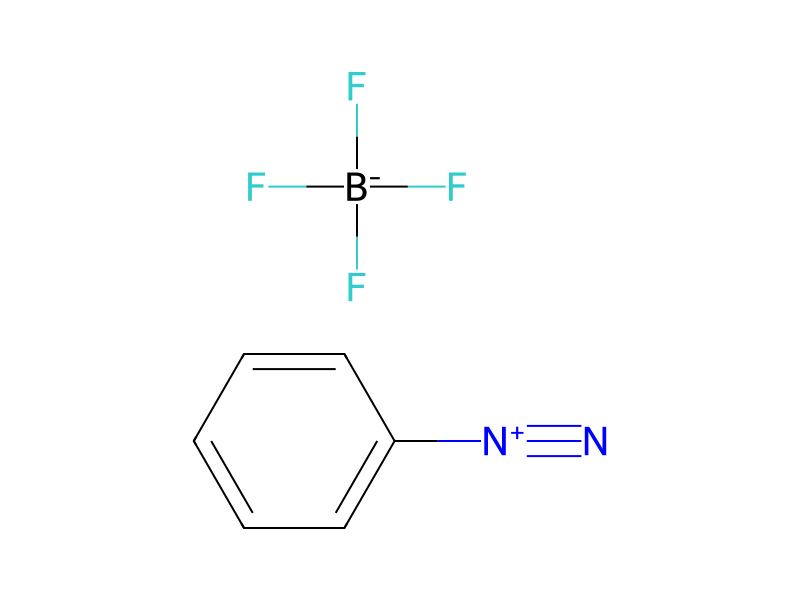
基本情報
- CAS
369-57-3- 標準SMILES
F[B-](F)(F)F.N#[N+]c1ccccc1- InChIKey
JNCLVGMBRSKDED-UHFFFAOYSA-N- 分子式
- C6H5BF4N2
- 平均分子量
- 191.92 g/mol
- 単同位体質量
- 192.048191
名称と識別子
- 優先名称
- Benzenediazonium tetrafluoroborate
- IUPAC
- benzenediazonium tetrafluoroborate
- 現地名
- ベンゼンジアゾニウム·テトラフルオロボラート
- 英語名
- Benzenediazonium,tetrafluoroborate
- 分子式
- BF4*C6H5N2
- 分子量
- 0
名称と別名
Benzenediazonium tetrafluoroborate369-57-3Phenyldiazonium tetrafluoroborateDTXSID5021467Benzenediazonium fluoborateBenzenediazonium fluoroboratePhenyldiazonium fluoborate (salt)RefChem:117393DTXCID501467820-352-6BENZENEDIAZONIUM,TETRAFLUOROBORATEbenzenediazonium;tetrafluoroborate
名称をさらに表示
ベンゼンジアゾニウム·テトラフルオロほう素アニオンベンゼンジアゾニウム·テトラフルオロボラートベンゼンジアゾニウム・テトラフルオロボラートベンゼンジアゾニウム・テトラフルオロほう素アニオンジアゾニオベンゼン・テトラフルオロボラートCcris 5461Sildenafil Impurity 44Diazobenzene tetrafluoroborateBenzenediazonium·tetrafluoroboronanion
Benzenediazonium, tetrafluoroboranuideMFCD00968947C6H5BF4N2SCHEMBL237168SCHEMBL28241318SCHEMBL29095313JNCLVGMBRSKDED-UHFFFAOYSA-Nbenzenediazonium; tetrafluoroboranuide
データベース識別子
- CAS
369-57-3- PubChem CID
- 5284485
- DTXSID
DTXSID5021467- EC Number
- 820-352-6
物性
構造計算による物性補完中
- 極性表面積
- 28.2 Ų
- 水素結合供与体数
- 0
- 水素結合受容体数
- 6
- 回転可能結合数
- 0
- 重原子数
- 13
- 形式電荷
- 0
- 複雑度
- 124
実験および物理化学的性質
Chemical ClassesMetals -> Metalloid Compounds (Boron)
物理化学的性質
- 融点
- 121 · 121-122 °C (decomp)
- 比重(密度)
- 1.53 g/cm3 · 1.53 g/cm3(Temp: 25 °C)
- 溶解性
- 2 O; · fairly sol polar solvents such as acetonitrile, acetone, pyridine, DMF, DMSO, and HMPA with decomposition; slightly sol water; insol hydrocarbons and Et2O; solubilized in nonpolar media by crown ethers.
- 色
- 80 °C · colorless solid after recrystallization; turns pink at 80 °C
安全と法規制
安全情報は参考情報です。供給元の安全データシート(SDS)、適用法令、専門家による評価に代わるものではありません。
GHS分類
GHS Classification
Danger
H228 (66.7%): Flammable solid [Danger Flammable solids]
P210, P240, P241, P260, P261, P264, P264+P265, P270, P271, P280, P301+P317, P302+P352, P304+P340, P305+P351+P338, P319, P321, P330, P332+P317, P337+P317, P362+P364, P370+P378, P403+P233, P405, and P501 (click each P-code to see the statement)
Aggregated GHS information provided per 3 reports by companies from 3 notifications to the ECHA C&L Inventory. Each notification may be associated with multiple companies.
危険有害性情報
Hazards SummaryCauses dermatitis in oral and subcutaneous lethal-dose studies of hamsters; [RTECS] See Diazobenzenesulfonic acid. See 4-Nitrobenzenediazonium tetrafluoroborate. See Potassium tetrafluoroborate.
Hazard Classes and CategoriesFlam. Sol. 1 (66.7%)
安全データ
- 毒性
- mmo-sat 10 mmol/L CNREA8 42,1446,82
化学と産業
応用分野
使用Benzenediazonium Tetrafluoroborate is much higher stability than the corresponding chlorides; shock-insensitive; often used when pure, isolated arenediazonium salts are needed; reagent for introducing aryl, arylazo, arylhydrazono, or amino groups; forms fluoroarenes upon heating; building block for heterocycles.
調製方法
製造方法Preparative Methods of Benzenediazonium Tetrafluoroborate: The most commonly used procedures consist in diazotization of an aromatic amine (ArNH2) with NaNO2 in aqueous HCl or H2SO4 followed by precipitation of the salt with added NaBF4 or fluoroboric acid. Alternatively, the diazotization can be carried out directly in 40-50% aqueous HBF4. Aromatic amines that do not dissolve in aqueous mineral acids can be reacted with NO+BF4 - in an anhydrous organic solvent or in liquid SO2. This method can also be applied to N-(trimethylsilyl)anilines and for the preparation of those salts that are not easily isolated from water. An improved, high-yielding one-pot procedure employs ArNH2, t-BuONO, and BF3. Et2O in an anhydrous organic solvent, typically CH2Cl2.
上流・下流製品情報
上流原料
下流製品
関連反応
17 件


化合物ノート
読み込み中…