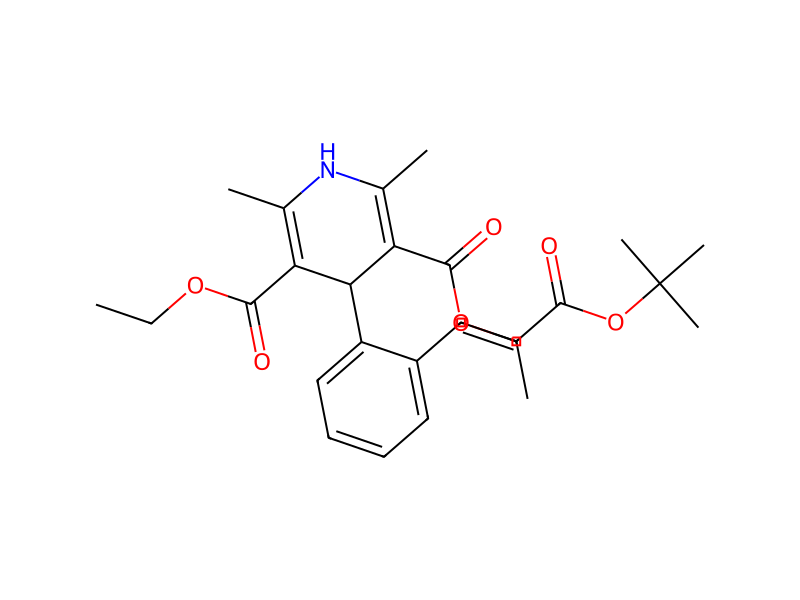
基本情報
- CAS
103890-78-4- 標準SMILES
CCOC(=O)C1=C(C)NC(C)=C(C(=O)OCC)C1c1ccccc1/C=C/C(=O)OC(C)(C)C- InChIKey
GKQPCPXONLDCMU-CCEZHUSRSA-N- 分子式
- C26H33NO6
- 平均分子量
- 455.5 g/mol
- 単同位体質量
- 455.23078778
概要
Lacidipine is a tert-butyl ester and a cinnamate ester.
名称と識別子
- 優先名称
- Lacidipine
- IUPAC
- diethyl 2,6-dimethyl-4-[2-[(E)-3-[(2-methylpropan-2-yl)oxy]-3-oxoprop-1-enyl]phenyl]-1,4-dihydropyridine-3,5-dicarboxylate
- 現地名
- ラシジピン
- 英語名
- Lacidipine
- 分子式
- C26H33NO6
- 分子量
- 455.54
名称と別名
Lacidipine103890-78-4LacipilMotensGR-43659XLacidipinoLacidipinumGR 43659XMolapDTXSID1046429diethyl 2,6-dimethyl-4-[2-[(E)-3-[(2-methylpropan-2-yl)oxy]-3-oxoprop-1-enyl]phenyl]-1,4-dihydropyridine-3,5-dicarboxylateDTXCID9026429
名称をさらに表示
ラシジピン4-[2-[(1E)-3-(1,1-ジメチルエトキシ)-3-オキソ-1-プロペニル]フェニル]-1,4-ジヒドロ-2,6-ジメチル-3,5-ピリジンジカルボン酸ジエチル4-[2-[(E)-3-(1,1-ジメチルエトキシ)-3-オキソ-1-プロペニル]フェニル]-1,4-ジヒドロ-2,6-ジメチル-3,5-ピリジンジカルボン酸ジエチル4-[2-[(E)-3-(tert-ブチルオキシ)-3-オキソ-1-プロペニル]フェニル]-2,6-ジメチル-1,4-ジヒドロピリジン-3,5-ジカルボン酸ジエチル3,5-ジエチル 4-{2-[(1E)-3-(tert-ブトキシ)-3-オキソプロパ-1-エン-1-イル]フェニル}-2,6-ジメチル-1,4-ジヒドロピリジン-3,5-ジカルボキシラートβ-GPALacidipinSN-305LACIREXGX-1048CALDINE
260080034N3,5-diethyl 4-{2-[(1E)-3-(tert-butoxy)-3-oxoprop-1-en-1-yl]phenyl}-2,6-dimethyl-1,4-dihydropyridine-3,5-dicarboxylate3,5-diethyl 4-(2-((1E)-3-(tert-butoxy)-3-oxoprop-1-en-1-yl)phenyl)-2,6-dimethyl-1,4-dihydropyridine-3,5-dicarboxylatediethyl 2,6-dimethyl-4-(2-((E)-3-((2-methylpropan-2-yl)oxy)-3-oxoprop-1-enyl)phenyl)-1,4-dihydropyridine-3,5-dicarboxylateRefChem:924456C08CA09diethyl 2,6-dimethyl-4-(2-((E)-2-((2-methylpropan-2-yl)oxycarbonyl)ethenyl)phenyl)-1,4-dihydropyridine-3,5-dicarboxylateLACIDIPINE [USAN]
物性
構造計算による物性
- XLogP
- 4.5
- 極性表面積
- 90.9 Ų
- 水素結合供与体数
- 1
- 水素結合受容体数
- 7
- 回転可能結合数
- 11
- 重原子数
- 33
- 形式電荷
- 0
- 複雑度
- 805
実験および物理化学的性質
DrugsPharmaceuticals -> Listed in ZINC15
LogP4.43
物理化学的性質
- 融点
- 174 · 174-175°C
- 沸点
- 558.4 · 558.4±50.0 °C(Predicted)
- 比重(密度)
- 1.127 · 1.127±0.06 g/cm3(Predicted)
- 貯蔵温度
- 2 · 2-8°C
- 溶解性
- 20 mg/mL、透明 · DMSO:可溶20mg/mL、透明
- 外見
- 粉
- 酸解離定数(Pka)
- 3 · 3.00±0.70(Predicted)
- 色
- 白からベージュ
- Merck
- 14 · 14,5331
- InChI
- InChI=1S/C26H33NO6/c1-8-31-24(29)21-16(3)27-17(4)22(25(30)32-9-2)23(21)19-13-11-10-12-18(19)14-15-20(28)33-26(5,6)7/h10-15,23,27H,8-9H2,1-7H3/b15-14+
- InChIKey
- GKQPCPXONLDCMU-CCEZHUSRSA-N
- SMILES
- C1(C)NC(C)=C(C(OCC)=O)C(C2=CC=CC=C2/C=C/C(OC(C)(C)C)=O)C=1C(OCC)=O
- CAS データベース
- 103890 · 103890-78-4(CAS DataBase Reference)
化学的性質
安全と法規制
GHS分類
GHS Classification
Warning
H302 (97.9%): Harmful if swallowed [Warning Acute toxicity, oral]
P264, P270, P301+P317, P330, and P501 (click each P-code to see the statement)
Aggregated GHS information provided per 48 reports by companies from 5 notifications to the ECHA C&L Inventory.
危険有害性情報
Hazard Classes and CategoriesAcute Tox. 4 (97.9%)
安全データ
- wgk
- 3
- rtecs
- US7970200
- 毒性
- mouse,LD50,intraperitoneal,80200ug/kg (80.2mg/kg),SKIN AND APPENDAGES (SKIN): HAIR: OTHERSENSE ORGANS AND SPECIAL SENSES: PTOSIS: EYEBEHAVIORAL: SOMNOLENCE (GENERAL DEPRESSED ACTIVITY),Yakuri to Chiryo. Pharmacology and Therapeutics. Vol. 22, Pg. 335, 1994.
- risk_code
- 22
- hazard_code
- Xn
- Hazard Classifications
- Acute Tox. 4 Oral
- ストレージクラス
- 11 - Combustible Solids
化学と産業
薬理情報
ATC Code
C - Cardiovascular system
QC - Cardiovascular system
Protein BindingLacidipine is highly protein-bound (more than 95%) to predominantly albumin and to a lesser extent, alpha-1-glycoprotein.
Pharmacodynamics
acidipine is a specific and potent calcium antagonist with a predominant selectivity for calcium channels in the vascular smooth muscle. Its main action is to dilate predominantly peripheral and coronary arteries, reducing peripheral vascular resistance and lowering blood pressure. Following the oral administration of 4 mg lacidipine to volunteer subjects, a minimal prolongation of QTc interval has been observed (mean QTcF increase between 3.44 and 9.60 ms in young and elderly volunteers).
Mechanism of Action
By blocking the voltage-dependent L-type calcium channels, it prevents the transmembrane calcium influx. Normally, calcium ions serve as intracellular messengers or activators in exictable cells including vascular smooth muscles. The influx of calcium ultimately causes the excitation and depolarization of the tissues. Lacidipine inhibits the contractile function in the vascular smooth muscle and reduce blood pressure. Due to its high membrane partition coefficient, some studies suggest that lacidipine may reach the receptor via a two-step process; it first binds and accumulates in the membrane lipid bilayer and then diffuses within the membrane to the calcium channel receptor. It is proposed that lacidipine preferentially blocks the inactivated state of the calcium channel. Through its antioxidant properties shared amongst other dihydropyridine calcium channel blockers, lacidipine demonstrates an additional clinical benefit. Its antiatherosclerotic effects are mediated by suppressing the formation of reactive oxygen species (ROS) and subsequent inflammatory actions by chemokines, cytokines and adhesion molecules, thus reducing atherosclerotic lesion formation. Lacidipine may also suppress cell proliferation and migration in smooth muscle cells and suppress the expression of matrix metalloproteinases, which affects the stability of atheromatous plaques.
Biological Half-LifeThe average terminal half-life of lacidipine ranges from between 13 and 19 hours at steady state.
関連反応
0 件
現在のフィルター条件では反応記録がありません。
化合物ノート
読み込み中…