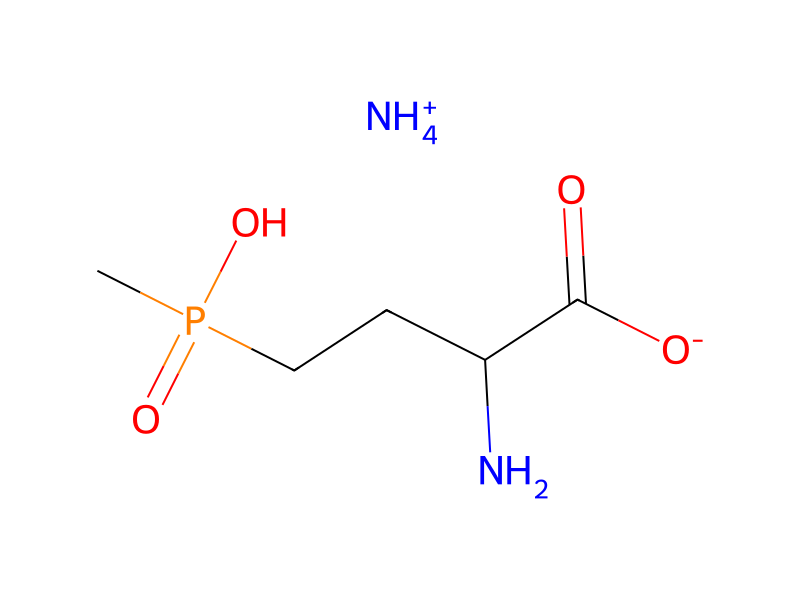
基本情報
- 標準SMILES
CP(=O)(O)CCC(N)C(=O)[O-].[NH4+]- InChIKey
ZBMRKNMTMPPMMK-UHFFFAOYSA-N- 分子式
- C5H15N2O4P
- 平均分子量
- 198.16 g/mol
- 単同位体質量
- 198.07694359
概要
Glufosinate-Ammonium is a synthetic organophosphate glutamine synthetase inhibitor and neurotoxin that is used as a pesticide. It is characterized as a highly soluble and volatile white to light yellow crystalline solid with a slightly pungent odor, and exposure occurs by inhalation, ingestion, or contact.
名称と識別子
- 優先名称
- Glufosinate-Ammonium
- IUPAC
- azanium 2-amino-4-[hydroxy(methyl)phosphoryl]butanoate
名称と別名
名称をさらに表示
データベース識別子
- CAS
73777-50-1、77182-82-2- PubChem CID
- 53597
- DTXSID
DTXSID1024120- UNII
- LBR207X9DF
- EC Number
- 278-636-5
物性
構造計算による物性
- 極性表面積
- 104 Ų
- 水素結合供与体数
- 3
- 水素結合受容体数
- 5
- 回転可能結合数
- 3
- 重原子数
- 12
- 形式電荷
- 0
- 複雑度
- 187
実験および物理化学的性質
Pesticides
Pesticide -> EPA IRIS
Pesticides -> Herbicides, Other
Pesticide
Solubility
Water solubility 1370 g/l (+/- 11%)
In organic solvents at 20 °C, g/100 ml: acetone = 0.016, toluene = 0.014, n-hexane = 0.02, ethanol = 0.065, ethyl acetate = 0.014
In water, 1,370 g/l @ 22 °C
安全と法規制
GHS分類
GHS Classification
Danger
H302: Harmful if swallowed [Warning Acute toxicity, oral]
P203, P260, P261, P264, P270, P271, P280, P301+P317, P302+P352, P304+P340, P317, P318, P319, P321, P330, P362+P364, P405, and P501 (click each P-code to see the statement)
Danger
H302+H312+H332 (66.8%): Harmful if swallowed, in contact with skin or if inhaled [Warning Acute toxicity, oral; acute toxicity, dermal; acute toxicity, inhalation]
P203, P260, P261, P264, P270, P271, P273, P280, P301+P317, P302+P352, P304+P340, P308+P316, P317, P318, P319, P321, P330, P362+P364, P391, P405, and P501 (click each P-code to see the statement)
危険有害性情報
Regulatory Information
Hazard Traits - Reproductive Toxicity
Council Directive (EEC) No 414/1991 (Repealed by Reg. EC No 1107/2009 (amended))
Glufosinate-ammonium is listed in the dataset of EPA Human Health Benchmarks for Pesticides under the Safe Drinking Water Act (40 eCFR 141)
REACH registered substance: Ammonium 2-amino-4-(hydroxymethylphosphinyl)butyrate (EC: 278-636-5)
Glufosinate-ammonium: Does not have an individual approval but may be used under an appropriate group standard
FIFRA Requirements
Tolerances are established for residues of the herbicide glufosinate ammonium (butonic acid, 2-amino-4-(hydroxymethylphosphinyl)-, monoammonium salt) and its metabolite, 3-methylphosphinico-propionic acid, expressed as 2-amino-4-(hydroxmethylphosphinyl)butanoic acid equivalents, in or on the following food commodities: almond, hulls; apple; banana; banana, pulp; cattle, fat; cattle, meat; cattle, meat byproducts; egg; goat, fat; goat, meat; goat, meat byproducts; grape; hog, fat; hog, meat; hog, meat byproducts; horse, fat; horse, meat; horse, meat byproducts; milk; nut, tree group; potato; potato chips; potato granules and flakes; poultry, fat; poultry, meat; poultry, meat byproducts; sheep, fat; sheep, meat; and sheep, meat byproducts.
Tolerances are established for the combined residues of glufosinate ammonium (butonic acid, 2-amino-4-(hydroxymethylphosphinyl)-, monoammonium salt) and its metabolites, 2-acetamido-4methylphosphinico-butanoic acid and 3-methylphosphinico-propionic acid, expressed as 2-amino-4-(hydroxymethylphosphinyl)butanoic acid equivalents, in or on the following food commodities derived from transgenic canola, transgenic field corn, transgenic soybeans and transgenic sugar beets that are tolerant to the herbicide glufosinate ammonium as follows: aspirated grain fractions; beet, sugar, molasses; beet, sugar, roots; beet, sugar, tops (leaves); canola, meal; canola, seed; corn, field, forage; corn, field, grain; corn, field, stover; soybean, hulls; and soybean.
New Active Ingredients ... includes pesticide active ingredients initially registered after November 1, 1984, that currently have active product registrations. By law, these newer pesticides are not subject to the reregistration program. They must, however, meet the new safety standard of the FQPA, and will be reviewed on a 15-year cycle under the registration review program. ... Active Ingredient Number: 128850; Tpye of Pesticide: conventional-herbicide; Use Site: food use, ornamentals, turf, etc.; Year: 1993.
Hazard Classes and Categories
Acute Tox. 4 (100%)
Reproductive toxicity - category 1B
Acute toxicity (Oral) - Category 4
Repr. 1B
安全と保護具
Disposal Methods
SRP: At the time of review, criteria for land treatment or burial (sanitary landfill) disposal practices are subject to significant revision. Prior to implementing land disposal of waste residue (including waste sludge), consult with environmental regulatory agencies for guidance on acceptable disposal practices.
Allowable Tolerances
Tolerances are established for residues of the herbicide glufosinate ammonium (butonic acid, 2-amino-4-(hydroxymethylphosphinyl)-, monoammonium salt) and its metabolite, 3-methylphosphinico-propionic acid, expressed as 2-amino-4-(hydroxmethylphosphinyl)butanoic acid equivalents, in or on the following food commodities: almond, hulls: 0.50 ppm; apple: 0.05 ppm; banana: 0.03 ppm; banana, pulp: 0.20 ppm; cattle, fat: 0.05 ppm; cattle, meat: 0.05 ppm; cattle, meat byproducts: 0.10 ppm; egg: 0.05 ppm; goat, fat: 0.05 ppm; goat, meat: 0.05 ppm; goat, meat byproducts: 0.10 ppm; grape: 0.05 ppm; hog, fat: 0.05 ppm; hog, meat: 0.05 ppm; hog, meat byproducts: 0.10 ppm; horse, fat: 0.05 ppm; horse, meat: 0.05 ppm; horse, meat byproducts: 0.10 ppm; milk: 0.02 ppm; nut, tree group: 0.10 ppm; potato: 0.80 ppm; potato chips: 1.60 ppm; potato granules and flakes: 2.00 ppm; poultry, fat: 0.05 ppm; poultry, meat: 0.05 ppm; poultry, meat byproducts: 0.10 ppm; sheep, fat: 0.05 ppm; sheep, meat: 0.05 ppm; and sheep, meat byproducts: 0.10 ppm.
Tolerances are established for the combined residues of glufosinate ammonium (butonic acid, 2-amino-4-(hydroxymethylphosphinyl)-, monoammonium salt) and its metabolites, 2-acetamido-4methylphosphinico-butanoic acid and 3-methylphosphinico-propionic acid, expressed as 2-amino-4-(hydroxymethylphosphinyl)butanoic acid equivalents, in or on the following food commodities derived from transgenic canola, transgenic field corn, transgenic soybeans and transgenic sugar beets that are tolerant to the herbicide glufosinate ammonium as follows: aspirated grain fractions: 25.0 ppm; beet, sugar, molasses: 5.0 ppm; beet, sugar, roots: 0.9 ppm; beet, sugar, tops (leaves): 1.5 ppm; canola, meal: 1.1 ppm; canola, seed: 0.4 ppm; corn, field, forage: 4.0 ppm; corn, field, grain: 0.2 ppm; corn, field, stover: 6.0 ppm; soybean, hulls: 5.0 ppm; and soybean: 2.0 ppm.
毒性情報
Ecotoxicity Values
LC50 Japanese quail >5000 mg/kg (8 day dietary)
LC50 Rainbow trout 710 mg/l (96 hr) /Conditions of bioassay not specified./
LC50 Bluegill >1000 mg/l (96 hr) /Conditions of bioassay not specified./
LC50 Carp >1000 mg/l (96 hr) /Conditions of bioassay not specified./
LC50 Golden orfe >1000 mg/l (96 hr) /Conditions of bioassay not specified./
Environmental Fate
TERRESTRIAL FATE: Based on a classification scheme(1), an observed Koc range of 9.6 to 1,229 (recommended avg of 430)(2) indicates that glufosinate-ammonium can have low to high mobility in soil(SRC). Field studies have indicated that glufosinate-ammonium rarely leaches below 10-15 cm in soil(3,4), presumably because of rapid microbial degradation(3). Microbial degradation occurs rapidly in soil with transformation to 3-methylphosphinyl-propionic acid and 2-methylphosphinyl-acetic acid and ultimately to carbon dioxide(4-6). The aerobic half-life in soil is typically 3-11 days(2,4-6) with an anaerobic half-life of 5-10 days(2). Field dissipation half-lives 6-20 days (avg 13 days) are reported(2). A laboratory batch and in situ microcosm study(7) demonstrated that glufosinate-ammonium can be persistent and transported in an aquifer with relatively low clay content and little labile organic carbon.
AQUATIC FATE: Based on a classification scheme(1), an observed Koc range of 9.6 to 1,229 (recommended avg of 430)(2) indicates that glufosinate-ammonium can have low to high adsorption to suspended solids and sediment(SRC). Volatilization from water surfaces is not expected(3) based upon an estimated Henry's Law constant of 4.4X10⁻¹⁴ atm-cu m/mole(4). According to a classification scheme(5), an estimated BCF of 3.2(SRC), from a log Kow of <0.10(4), and a regression-derived equation(6) suggests the potential for bioconcentration in aquatic organisms is low(SRC). The aqueous hydrolysis rate of glufosinate-ammonium is reported to be <0.0023/day at 25 °C and pH 5,7 and 9(2) which corresponds to a half-life of greater than 300 days(SRC). The aqueous photolysis rate of glufosinate-ammonium is also reported to be <0.0023/day(2) which corresponds to a half-life of greater than 300 days(SRC).
ATMOSPHERIC FATE: According to a model of gas/particle partitioning of semivolatile organic compounds in the atmosphere(1), glufosinate-ammonium, which has an estimated vapor pressure of 9.1X10⁻¹² mm Hg at 25 °C(SRC), determinded from a fragment constant method(2), is expected to exist solely in particulate phase in the ambient atmosphere. Particulate-phase glufosinate-ammonium may be removed from the air by wet and dry deposition(SRC).
EPA IRIS Information
Glufosinate-ammonium
Urinary
4 x 10 ^-4 mg/kg-day
Soil Adsorption/Mobility
Glufosinate-ammonium has observed Koc values ranging from 9.6 in sand to 1,229 in volcanic ash(1); the average recommended Koc is 430(1). According to a classification scheme(2), this Koc range suggests that glufosinate-ammonium can have high to low mobility in soil.
Field studies have indicated that glufosinate-ammonium rarely leaches below 10-15 cm in soil(1,2), presumably because of rapid microbial degradation(1).
Human Toxicity Excerpts
/HUMAN EXPOSURE STUDIES/ ... In acute oral BASTA poisoning, patients develop a variety of clinical signs, including disturbed consciousness, convulsions, & apnea. These effects are suspected to be due to the effects of glufosinate on the CNS. ... A 60-yr-old man ingested 500 mL of BASTA herbicide ... He developed not only unconsciousness, respiratory distress, & convulsions but also an incr in urine output (7885 mL/d), elevated serum sodium (167 mEq/L), elevated plasma osmolality (332 mOsm/kg), & a decr in both urine osmolality (200 mOsm/kg) & urine specific gravity (1.003), which suggested the development of diabetes insipidus. The plasma level of antidiuretic hormone remained within the normal range (1.3 pg/mL), despite high plasma osmolality. The admin of desmopressin was successful in normalizing urine volume, specific gravity, & osmolality. Serum sodium corrected gradually within 48 hrs. /BASTA/
/CASE REPORTS/ ...A 65-yr-old male ingested BASTA, which contains 20% w/v of glufosinate ammonium, about 300 ml, more than the estimated human toxic dose. Four and a half hours after ingestion, he showed speech ataxia and systemic tremor. He was prophylactically intubated before the occurrence of serious respiratory failure. After 5 days of artificial ventilation he was extubated and discharged without any sequelae. We studied the serial change of serum glufosinate concn every 3-6 hr and assessed the urinary excretion of glufosinate every 24 hr. The absorbed amount of glufosinate was estimated from the cumulative excreted in urine. ... The changes in serum glufosinate concn exhibited T1/2alpha of 1.84 and T1/2beta of 9.59 hr. The apparent distribution volume at beta-phase and the total body clearance were 1.44 l/kg and 86.6 ml/min, respectively. Renal clearance was estimated to be 77.9 ml/min... /BASTA/
/CASE REPORTS/ ...A 69-yr-old female was admitted to the emergency department after taking 500 ml of BASTA. On arrival she was conscious, and gut decontamination, hemodialysis and hemoperfusion were performed. However, 8-1/2 hrs after ingestion, general convulsions occurred. Her serum CK increased to a peak of 24,900 IU/L on the third day of admission. An 87-yr-old male was admitted to the emergency department 3-1/2 hrs after taking 200 ml of BASTA and receiving gastric lavage at a local emergency room. On arrival he was conscious, and serial activated charcoal and hemodialysis was performed. Blood concn of glufosinate ammonium after hemodialysis decreased from 1.56 ug/ml to 0.68 ug/ml. Thirty hours after admission he had general convulsions. Glufosinate ammonium was not detected in the cerebrospinal fluid 6 hr after the convulsions. His serum CK increased to a peak of 17,870 IU/L on the 5th day of admission. /BASTA/
/CASE REPORTS/ ... A case of a 64-yr-old man who ingested glufosinate ... /was reported/. The patient suffered mental disturbances and hematological changes together with GI effects shortly after ingesting the poison, and later developed generalized convulsions, impaired respiration and circulatory failure. During recovery he exhibited loss of short-term memory (retrograde and anterograde amnesia). Neurotoxicity is a characteristic of glufosinate poisoning, although the mechanism is not clear. From the analysis of clinical symptoms of previously published cases, glufosinate toxicity appears to arise both from the active ingredient and the surfactant in the formulation. /PHOSPHINOTHRICIN/
For more Human Toxicity Excerpts (Complete) data for GLUFOSINATE-AMMONIUM (6 total), please visit the HSDB record page.
Environmental Biodegradation
AEROBIC: Laboratory degradation studies using 14-C radio-labeled glufosinate-ammonium (applied rate of 2 ppm) and three prairie soils as inoculum found that degradation occurred more rapidly at 20 °C than 10 °C(1); at 20 °C, the soil half-life was 3-7 days and at 10 °C the half-life was 8-11 days(1); in all soils, glufosinate-ammonium was biologically transformed to degradation products that underwent further slow degradation with release of [14-C] carbon dioxide(1); over a 90-day incubation period at 20 °C, between 28-55% of applied radioactivity was released as [14-C] carbon dioxide(1).
AEROBIC: Laboratory degradation studies at 22 °C using 14-C radio-labeled glufosinate-ammonium and two Ontario soils as inoculum found rapid degradation of glufosinate-ammonium(1); in the Fox sandy loam soil, the initial half-life was 3-4 days while in the Guelph loam soil the initial half-life was just over 4 days(1); after a 22-day incubation period, 10-12% of applied radioactivity was recovered in 14C-carbon dioxide, 8-11% remained as glufosinate, 53-61% was in the degradation product MPPA-3 (3-(methylphosphinyl)propionic acid) and 13-16% was in the degradation product MPPA-2 (2-(methylphosphinyl)acetic acid)(1). An Ontario forest degradation study using 14-C radio-labeled glufosinate-ammonium observed a half-life of 4.3 days(2); MPAA-3 and MPAA-2 were the two main metabolites(2).
AEROBIC: Glufosinate-ammonium was found to be persistent in an aerobic sandy aquifer material in laboratory batch and in situ microcosm studies at concentrations of 50-400 ppb(1); at 50 ppb, the initial half-life was about 20 days, but after 20 days, the glufosinate-ammonium concentration remained steady (about 25 ppb) throughout the 70 day incubation period(1); at 400 ppb in the in situ microcosm, glufosinate-ammonium concentrations remained between 275-350 ppb for 55 days before falling to 200 ppb at 75 days(1); the research suggests that in an aquifer with relatively low clay content and little labile organic carbon, glufosinate-ammonium will be persistent and transport will be essentially unretarded(1).
法規制情報
FIFRA Requirements
Tolerances are established for residues of the herbicide glufosinate ammonium (butonic acid, 2-amino-4-(hydroxymethylphosphinyl)-, monoammonium salt) and its metabolite, 3-methylphosphinico-propionic acid, expressed as 2-amino-4-(hydroxmethylphosphinyl)butanoic acid equivalents, in or on the following food commodities: almond, hulls; apple; banana; banana, pulp; cattle, fat; cattle, meat; cattle, meat byproducts; egg; goat, fat; goat, meat; goat, meat byproducts; grape; hog, fat; hog, meat; hog, meat byproducts; horse, fat; horse, meat; horse, meat byproducts; milk; nut, tree group; potato; potato chips; potato granules and flakes; poultry, fat; poultry, meat; poultry, meat byproducts; sheep, fat; sheep, meat; and sheep, meat byproducts.
Tolerances are established for the combined residues of glufosinate ammonium (butonic acid, 2-amino-4-(hydroxymethylphosphinyl)-, monoammonium salt) and its metabolites, 2-acetamido-4methylphosphinico-butanoic acid and 3-methylphosphinico-propionic acid, expressed as 2-amino-4-(hydroxymethylphosphinyl)butanoic acid equivalents, in or on the following food commodities derived from transgenic canola, transgenic field corn, transgenic soybeans and transgenic sugar beets that are tolerant to the herbicide glufosinate ammonium as follows: aspirated grain fractions; beet, sugar, molasses; beet, sugar, roots; beet, sugar, tops (leaves); canola, meal; canola, seed; corn, field, forage; corn, field, grain; corn, field, stover; soybean, hulls; and soybean.
New Active Ingredients ... includes pesticide active ingredients initially registered after November 1, 1984, that currently have active product registrations. By law, these newer pesticides are not subject to the reregistration program. They must, however, meet the new safety standard of the FQPA, and will be reviewed on a 15-year cycle under the registration review program. ... Active Ingredient Number: 128850; Tpye of Pesticide: conventional-herbicide; Use Site: food use, ornamentals, turf, etc.; Year: 1993.
化学と産業
薬理情報
Mechanism of Action
...Glufosinate ammonium is a structural analogue of glutamate & acts in plants by inhibition of glutamine synthetase leading to a complete breakdown of ammonia metab. Owing to the structural analogy of glufosinate ammonium to glutamate, its effect on various glutamate-utilizing systems needed to be investigated in mammals. Although in laboratory animals glufosinate ammonium causes an inhibition of glutamine synthetase activity in different tissues, this inhibition led to slight increases of glutamate and ammonia levels at high sublethal and lethal doses only. After oral admin for 28 days, glufosinate ammonium had no effect on glutathione & carbohydrate metab & no effect on biosynthesis of non-essential amino acids in rats & dogs. Glufosinate ammonium does not interfere with various neurotransmitter receptors in vitro & does not influence the catecholamine neurotransmitter tissue concn after iv application. The results of these studies show that ... in mammals the inhibition of glutamine synthetase activity in various tissues does not lead to a breakdown of ammonia metab. The mammalian metab ... compensates for this inhibition of glutamine synthetase activity by various other metabolic pathways ...
Metabolism/Metabolites
The principal metabolite in urine & feces is 3-[hydroxy(methyl)phosphinoyl]propionic acid.
In plants, degradation of glufosinate-ammonium involves deamination, decarboxylation, & finally beta-oxidation to carbon dioxide.
用途と製造
Uses
Used as broad spectrum post-emergence herbicide for grapes, orchards, plantations, ornamentals, and non-cropland; Also used as crop desiccant; [HSDB]
Farming (Pesticides) [Category: Industry]
For Glufosinate-ammonium (USEPA/OPP Pesticide Code: 128850) Active products with label matches. /SRP: Registered for use in the U.S. but approved pesticide uses may change periodically and so federal, state, and local authorities must be consulted for currently approved uses./
Herbicide that can be applied post-emergence in noncrop areas and as a directed spray in field-grown and container nursery stock. It is nonselective and controls a broad spectrum and annual and perennial grass and broadleaf weeds.
Herbicide for a wide spectrum of annual, perennial broadleaf weeds and grasses in grapes, orchards, plantations, and ornamentals; along drains, canals, noncropland, and for desiccation of agricultural crops.
Formulations/Preparations
USEPA/OPP Pesticide Code 128850; Trade Names: HOE 039866, Basta, Ignite ISC Herbicide, HOE 00661.
Aqueous solution
Soluble concentrate
BASTA
関連反応
現在のフィルター条件では反応記録がありません。
関連ノート
読み込み中…