

基本情報
- CAS
25186-34-9- 標準SMILES
NC=CC=O- InChIKey
UCRYVFBKCBUURB-UHFFFAOYSA-N- 分子式
- C3H5NO
- 平均分子量
- 71.08 g/mol
名称と識別子
- 優先名称
- 3-Aminoacrolein
- IUPAC
- 3-aminoprop-2-enal
- 英語名
- 3-Aminoacrolein
- 分子式
- C3H5NO
- 分子量
- 71.08
名称と別名
3-Aminoacrolein3-aminoprop-2-enal25186-34-9(Z)-3-Amino-propenal3-aminoacrylaldehyde3-aminopropenal3-amino acrolein3-amino-prop-2-enal3-aminoprop-2-en-1-oneSCHEMBL1449289SCHEMBL3051609SCHEMBL9071468
名称をさらに表示
Z-3-Amino-propel3-Amino-2-propenalZ-3-Amino-propenal(Z)-b-Aminoacrolein2-Propenal, 3-amino- (9CI)
UCRYVFBKCBUURB-UHFFFAOYSA-NSB36187DB-082915
データベース識別子
- CAS
25186-34-9- PubChem CID
- 53977912
- EC Number
- 182-571-7
物性
構造計算による物性
- XLogP
- -0.2
- 極性表面積
- 43.1 Ų
- 水素結合供与体数
- 1
- 水素結合受容体数
- 2
- 回転可能結合数
- 1
- 重原子数
- 5
- 形式電荷
- 0
- 複雑度
- 48.9
物理化学的性質
- 融点
- 104 · 104-105℃
- 沸点
- 295 ℃ · 295℃
- 比重(密度)
- 0.978 · 0.978
- 闪点
- 132 ℃ · 132℃
- 溶解性
- sol alcohol and water.
- 酸解離定数(Pka)
- 5.5 · 5.50±0.70(Predicted)
- 外見
- yellow solid
安全と法規制
GHS分類
GHS Classification
Danger
H301 (100%): Toxic if swallowed [Danger Acute toxicity, oral]
P260, P261, P262, P264, P270, P271, P273, P280, P301+P316, P301+P330+P331, P302+P352, P302+P361+P354, P304+P340, P305+P354+P338, P316, P319, P321, P330, P361+P364, P363, P403+P233, P405, and P501 (click each P-code to see the statement)
The GHS information provided by 1 company from 1 notification to the ECHA C&L Inventory.
危険有害性情報
Hazard Classes and CategoriesAcute Tox. 3 (100%)
化学と産業
調製方法
製造方法3-Aminoacrolein is highly reactive towards self-condensation and is best when freshly prepared. One method of preparation involves the reaction of Ammonia with Propargyl Aldehyde (propynal) in the presence of ethanol in a sealed tube. This method is somewhat erratic, propargaldehyde is not commercially available, and the stereochemistry of the resulting double bond is most likely trans. A modified route, proceeding through 1,1,3,3-tetraethoxypropane, has also been reported. The most satisfactory preparation of β-aminoacrolein involves the partial hydrogenation of isoxazole.3,4 A solution of commercially available isoxazole (5 g, 0.073 mol) in anhyd MeOH (100 mL) containing 1.0 g of Raney Nickel was hydrogenated at 40 psi until one equivalent of hydrogen had been absorbed and hydrogen uptake had ceased (eq 1). The mixture was filtered to remove the catalyst and the solvent was evaporated to give 4.2 g (82%) of a yellow solid, mp 96-97 °C. Recrystallization from chloroform-petroleum ether (1:1) gave crystals, mp 104-105 °C.
サプライヤー6 社
常州琬瑶生物科技有限公司051989185693 15312551983 · [email protected]
杰达维(上海)医药科技发展有限公司/J & W PharmLab021-64340559 · [email protected]
上海卡洛化学有限公司21-33526724 18930996265 · [email protected]
HANGZHOU LEAP CHEM CO., LTD.+86-571-87711850 +86-15355479329 · [email protected]
上海智乾生物科技有限公司[email protected]
Richest Group Ltd18017061086 · [email protected]
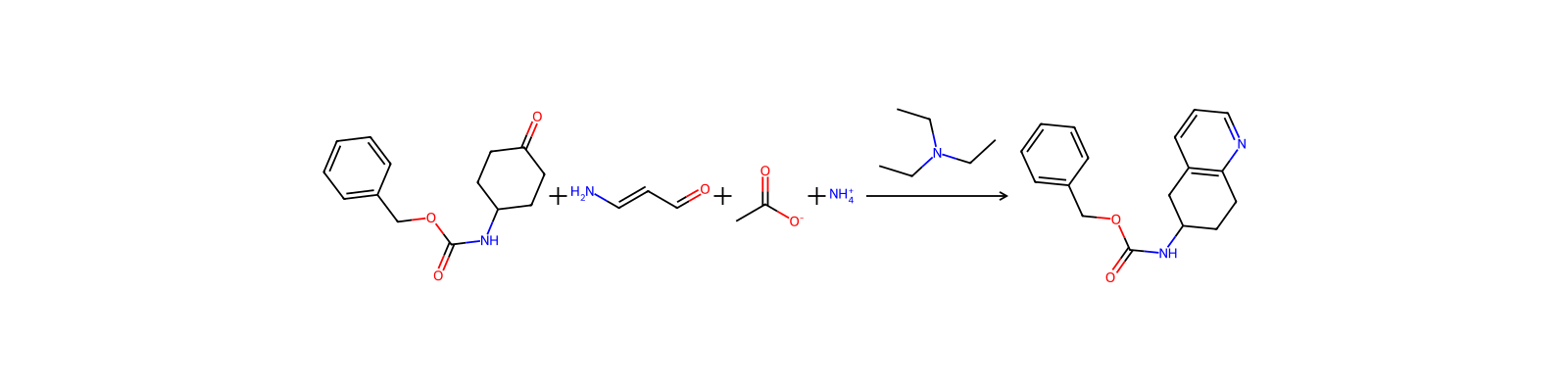
関連反応
5 件


化合物ノート
読み込み中…