
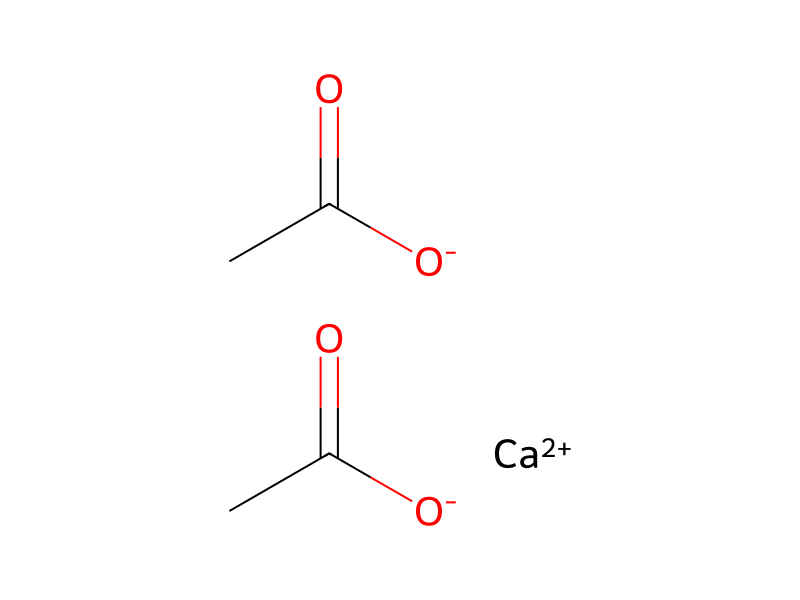
基本情報
- 標準SMILES
CC(=O)[O-].CC(=O)[O-].[Ca+2]- InChIKey
VSGNNIFQASZAOI-UHFFFAOYSA-L- 分子式
- C4H6O4.Ca
- 平均分子量
- 158.17 g/mol
- 単同位体質量
- 157.98919965
概要
Calcium acetate is the calcium salt of acetic acid. It is used, commonly as a hydrate, to treat hyperphosphataemia (excess phosphate in the blood) in patients with kidney disease: the calcium ion combines with dietary phosphate to form (insoluble) calcium phosphate, which is excreted in the faeces. It has a role as a chelator. It contains an acetate.
名称と識別子
- 優先名称
- Calcium Acetate
- IUPAC
- calcium diacetate
名称と別名
Calcium acetate62-54-4Calcium diacetateAcetic acid, calcium saltLime acetatePhosLoLime pyroligniteAcetate of limeTeltozanBrown acetateGray Acetate of LimeBrown Acetate of Lime
名称をさらに表示
PhoslyraSorbo-calcionGray acetatePhoslo Gelcapscalcium ethanoateFEMA No. 2228EliphosCalcarea acetica
データベース識別子
- CAS
62-54-4- PubChem CID
- 6116
- DTXSID
DTXSID0020234- ChEMBL
CHEMBL1200800- ChEBI
CHEBI:3310- UNII
- Y882YXF34X
- EC Number
- 200-540-9
- Nikkaji
- J4.823B
物性
構造計算による物性
- 極性表面積
- 80.3 Ų
- 水素結合供与体数
- 0
- 水素結合受容体数
- 4
- 回転可能結合数
- 0
- 重原子数
- 9
- 形式電荷
- 0
- 複雑度
- 25.5
実験および物理化学的性質
Chemical ClassesMetals -> Organic Acids, Metal Salts
Cosmetics
Cosmetic ingredients (Calcium Acetate) -> CIR (Cosmetic Ingredient Review)
Viscosity controlling
pH
6,0-9,0 (10 % aqueous solution)
0.2 molar aq soln: 7.6 /Monohydrate form/
OdorSLIGHT ODOR OF ACETIC ACID
Food AdditivesCOLOR OR COLORING ADJUNCT, FIRMING AGENT, FLAVORING AGENT OR ADJUVANT, PH CONTROL AGENT, PROCESSING AID, SEQUESTRANT, STABILIZER OR THICKENER, TEXTURIZER -> FDA Substance added to food
Density
1.50 kg/l
1.5 g/cm³
1.5 @25 °C
Color/Form
COLORLESS CRYSTALS
Rod-shaped crystals
White, hydrogroscopic, crystalline solid
Solubility
37.4 G IN 100 CC OF WATER @ 0 °C; 29.7 G IN 100 CC OF WATER @ 100 °C; SLIGHTLY SOL IN ALCOHOL
Practically insol in acetone and benzene
Solubility in water: very good
Human Drugs
FDA approved drugs -> Active ingredient
FDA approved drugs -> Active ingredient
Decomposition
When heated to decomposition ... emits acrid smoke and fumes.
160 °C
Melting Point> 160 °C
Food Contact SubstancesFCS -> FDA Inventory of Food Contact Substances Listed in 21 CFR
安全と法規制
GHS分類
GHS Classification
This chemical does not meet GHS hazard criteria for 88.9% (503 of 566) of all reports.
Warning
H315 (11%): Causes skin irritation [Warning Skin corrosion/irritation]
P264, P264+P265, P280, P302+P352, P305+P351+P338, P321, P332+P317, P337+P317, and P362+P364 (click each P-code to see the statement)
Aggregated GHS information provided per 566 reports by companies from 7 notifications to the ECHA C&L Inventory. Each notification may be associated with multiple companies.
危険有害性情報
Regulatory Information
Chemical: Acetic acid, calcium salt (2:1)
Directive (EC) No 46/2002
Acetic acid, calcium salt (2:1) is listed on the EPA's Chemical Data Reporting (CDR) system. Manufacturers and importers of Acetic acid, calcium salt (2:1) are required to report information about their production and use of this chemical to the EPA under the Toxic Substances Control Act (TSCA). (40 eCFR Part 711)
Status: Active Update: 27-04-2023 https://echa.europa.eu/registration-dossier/-/registered-dossier/13608
Calcium acetate: Non hazardous
Other Safety InformationIMAP assessments - Acetic acid, calcium salt: Human health tier I assessment
Fire HazardsCombustible under specific conditions.
Hazards SummaryClassified as generally recognized as safe (GRAS) in food; [HSDB] Poisonous by intravenous route; IV LD50 (mouse) = 52 mg/kg; [Sax] A skin, eye, and respiratory tract irritant; [ICSC] An irritant; [MSDSonline] See Calcium.
FDA Requirements
Substance added directly to human food affirmed as generally recognized as safe (GRAS).
Calcium acetate is an indirect food additive for use as a component of resinous and polymeric coatings.
Calcium acetate used as a sequestrant is generally recognized as safe when used in accordance with good manufacturing or feeding practice.
EPA Safer ChemicalChemical: Calcium acetate
Chemical DangersDecomposes above 160 °C . This produces acetone vapour and calcium carbonate. Reacts violently with strong acids. This produces acetic acid fumes.
Hazard Classes and CategoriesSkin Irrit. 2 (11%)
安全と保護具
Fire FightingUse water spray, powder.
First Aid Measures
Fresh air, rest.
Rinse and then wash skin with water and soap.
First rinse with plenty of water for several minutes (remove contact lenses if easily possible), then refer for medical attention.
Rinse mouth. Give one or two glasses of water to drink. Refer for medical attention .
Safe StorageSeparated from strong acids. Dry. Well closed.
Storage ConditionsKEEP WELL CLOSED.
Disposal Methods
SRP: At the time of review, criteria for land treatment or burial (sanitary landfill) disposal practices are subject to significant revision. Prior to implementing land disposal of waste residue (including waste sludge), consult with environmental regulatory agencies for guidance on acceptable disposal practices.
Spillage DisposalPersonal protection: particulate filter respirator adapted to the airborne concentration of the substance. Sweep spilled substance into covered containers. Wash away remainder with plenty of water.
Eye PreventionWear safety spectacles.
Fire PreventionNO open flames.
Inhalation RiskA nuisance-causing concentration of airborne particles can be reached quickly when dispersed.
Skin PreventionProtective gloves.
Exposure PreventionPREVENT DISPERSION OF DUST!
Ingestion PreventionDo not eat, drink, or smoke during work.
毒性情報
InteractionsConcurrent administration /of calcium acetate and oral tetracyclines/ may decrease the bioavailability of tetracyclines.
Exposure RoutesThe substance can be absorbed into the body by inhalation and by ingestion.
Toxicity SummarySafe in the present practices of use and concentration. Ingredient, concentration, and use information are available in documents discoverable at https://cir-reports.cir-safety.org
Signs and Symptoms
Cough. Sore throat.
Redness.
Redness. Pain.
Diarrhoea. Vomiting.
Human Toxicity ExcerptsPoison by intravenous and intraperitoneal routes.
Drug Induced Liver Injury
Drug Induced Liver Injury Rank (DILIrank 2.0)
Calcium acetate
vNo-DILI-concern
0
No match
DOI:10.1016/j.drudis.2016.02.015
Non-Human Toxicity Values
LD50 Mouse ip 75 mg/kg
LD50 Mouse iv 52 mg/kg
法規制情報
FDA Requirements
Substance added directly to human food affirmed as generally recognized as safe (GRAS).
Calcium acetate is an indirect food additive for use as a component of resinous and polymeric coatings.
Calcium acetate used as a sequestrant is generally recognized as safe when used in accordance with good manufacturing or feeding practice.
化学と産業
薬理情報
ATC Code
V - Various
QV - Various
Pharmacodynamics
Patients with advanced renal insufficiency (creatinine clearance less than 30 ml/min) exhibit phosphate retention and some degree of hyperphosphatemia. The retention of phosphate plays a pivotal role in causing secondary hyperparathyroidism associated with osteodystrophy, and soft-tissue calcification. The mechanism by which phosphate retention leads to hyperparathyroidism is not clearly delineated. Therapeutic efforts directed toward the control of hyperphosphatemia include reduction in the dietary intake of phosphate, inhibition of absorption of phosphate in the intestine with phosphate binders, and removal of phosphate from the body by more efficient methods of dialysis. The rate of removal of phosphate by dietary manipulation or by dialysis is insufficient. Dialysis patients absorb 40% to 80% of dietary phosphorus. Therefore, the fraction of dietary phosphate absorbed from the diet needs to be reduced by using phosphate binders in most renal failure patients on maintenance dialysis. Calcium acetate when taken with meals combines with dietary phosphate to form insoluble calcium phosphate which is excreted in the feces. Maintenance of serum phosphorus below 6.0 mg/dl is generally considered as a clinically acceptable outcome of treatment with phosphate binders. Calcium acetate is highly soluble at neutral pH, making the calcium readily available for binding to phosphate in the proximal small intestine.
Mechanism of ActionCalcium acetate and other calcium salts are phosphate binders. They work by binding with the phosphate in the food you eat, so that it is eliminated from the body without being absorbed.
FDA Pharmacological Classification
CALCAREA ACETICA
Increased Coagulation Factor Activity [PE]; Blood Coagulation Factor [EPC]; Cations, Divalent [CS]; Calcium [CS]
CALCIUM ACETATE
Blood Coagulation Factor [EPC]; Phosphate Binder [EPC]; Increased Coagulation Factor Activity [PE]; Phosphate Chelating Activity [MoA]; Calcium [CS]; Cations, Divalent [CS]
MeSH Pharmacological ClassificationChemicals that bind to and remove ions from solutions. Many chelating agents function through the formation of COORDINATION COMPLEXES with METALS.
Absorption, Distribution and Excretion
40% is absorbed in the fasting state and approximately 30% is absorbed in the nonfasting state following oral administration.
Calcium acetate when taken with meals, combines with dietary phosphate to form insoluble calcium phosphate which is excreted in the feces.
用途と製造
Uses
CIR ingredient: Calcium Acetate
Used in dyeing, tanning, and curing skins; Also used in lubricants, food stabilizers, corrosion inhibitors, antifoam additives in antifreezes, and antiseptics ; Also used as a firming agent for potatoes, an esterification catalyst, and a drug to restrict phosphate absorption in patients with chronic renal failure and oxalate absorption in patients with inflammatory bowel disease; [HSDB]
Using Disinfectants or Biocides [Category: Clean]
Preparing and mounting animal skins (taxidermy) [Category: Hobbies]
Mfr of acetic acid, acetone; in dying, tanning and curing skins; in lubricants; as food stabilizer; as corrosion inhibitor.
One of the more commonly used antifoam additives in /modern/ formulated antifreezes
U.S. Imports(1984) 6.40X10+7 g
U.S. Production
2023: 400,000 - <550,000 lb
(1984) 3.28X10+8 g
Consumer UsespH regulating agent
Industry UsespH regulating agent
Methods of Manufacturing
Gmelin's, Calcium (8th ed) 28B, 162-164, 982-991 (1958); Electrolytic prepn: Schmidt, Z Anorg Allgem Chem 270, 188 (1952).
Action of pyroligneous acid on calcium hydroxide; the solution being filtered and evaporated to dryness yields gray acetate of lime. /Monohydrate/
Calcium acetate is produced by passing acetic acid vapor over heated lime
Formulations/Preparations
Grades: Technical (80% basis); reagent; CP; pure; brown; gray; FCC /Monohydrate/
Powder: food, pharmaceutical grades; agglomerated, technical, USP, FCC grades; purified grade
Household ProductsInformation on 17 consumer products that contain Calcium Acetate in the following categories is provided:
Use Classification
EPA Safer Chemical Functional Use Classes -> Processing Aids and Additives
Safer Chemical Classes -> Green circle - The chemical has been verified to be of low concern
Food additives
Food Additives -> ACIDITY_REGULATOR; PRESERVATIVE; STABILIZER -> JECFA Functional Classes
Cosmetics -> Viscosity controlling
General Manufacturing Information
Pesticide, Fertilizer, and Other Agricultural Chemical Manufacturing
Acetic acid, calcium salt (2:1): ACTIVE
/EFFECTIVE LEVEL OF CALCIUM ACETATE AGAINST ROPE IS 0.4-1.0%./
FEMA NUMBER 2228
関連反応
58 件







関連ノート
読み込み中…