ホームMCPワークベンチSkills
ホームワークベンチ通知マイページ
llms.txt · MCPガイドプライバシーポリシー · 利用規約 · サポートv1.8.1
  1. ホーム
  2. /化合物

Bromotrichloromethane

HCID 6383
反応を作成
印刷

データを補完しています。しばらくしてからページを更新すると最新の内容を表示できます

基本情報概要名称と識別子物性安全と法規制化学と産業関連反応化合物ノート
部分構造検索類似構造を探す

基本情報

CAS
75-62-7
標準SMILES
ClC(Cl)(Cl)Br
InChIKey
XNNQFQFUQLJSQT-UHFFFAOYSA-N
分子式
CBrCl3
平均分子量
198.27 g/mol
単同位体質量
195.8249

概要

A potent liver poison. In rats, bromotrichloromethane produces about three times the degree of liver microsomal lipid peroxidation as does carbon tetrachloride.

名称と識別子

優先名称
Bromotrichloromethane
IUPAC
bromo(trichloro)methane
英語名
Bromotrichloro methane
分子式
CBrCl3
分子量
198.2737

名称と別名

BROMOTRICHLOROMETHANE75-62-7TrichlorobromomethaneMethane, bromotrichloro-Carbon bromotrichlorideMonobromotrichloromethaneCarbon trichlorobromideTrichloromethyl bromideDTXSID7023930IKJ30QXM63NSC-8017DTXCID003930
名称をさらに表示
RefChem:121643200-886-0bromo(trichloro)methaneCBrCl3bromotrichloro methaneCaswell No. 118CCl3BrEPA Pesticide Chemical Code 008708

データベース識別子

CAS
75-62-7
PubChem CID
6383
DTXSID
DTXSID7023930
ChEMBL
CHEMBL160802
UNII
IKJ30QXM63
EC Number
200-886-0
Nikkaji
J48.655H

物性

構造計算による物性補完中

XLogP
2.9
極性表面積
0 Ų
水素結合供与体数
0
水素結合受容体数
0
回転可能結合数
0
重原子数
5
形式電荷
0
複雑度
28.4

実験および物理化学的性質

Chemical ClassesOther Classes -> Halogenated Aliphatics, Saturated
SpringerMaterials PropertiesSchoenflies notation
PesticidesPesticide -> EPA IRIS
OdorCHLOROFORM-LIKE ODOR
Density · 2 件

2.012 @ 25 °C

2.012 @25 °C

Viscosity3.29X10-3 Pa.s @ -21 °C
Color/FormCOLORLESS HEAVY LIQUID
Solubility · 3 件

INSOL IN WATER; SOL IN ALL PROP IN ALCOHOL & ETHER

MISCIBLE WITH MANY ORG LIQUIDS

Very soluble in ether and ethanol

Boiling Point · 2 件

105 °C

104.2 °C @760 [mm Hg]

DecompositionWhen heated to decomposition it emits very toxic fumes of /hydrogen chloride/ and /hydrogen bromide/.
Melting Point-5.7 °C

安全と法規制

安全情報は参考情報です。供給元の安全データシート(SDS)、適用法令、専門家による評価に代わるものではありません。

GHS分類

GHS Classification · 4 件

Warning

H302 (79.5%): Harmful if swallowed [Warning Acute toxicity, oral]

P261, P264, P264+P265, P270, P271, P280, P301+P317, P302+P352, P304+P340, P305+P351+P338, P317, P319, P321, P330, P332+P317, P337+P317, P362+P364, P403+P233, P405, and P501 (click each P-code to see the statement)

Aggregated GHS information provided per 190 reports by companies from 8 notifications to the ECHA C&L Inventory. Each notification may be associated with multiple companies.

危険有害性情報

Regulatory Information · 3 件

Chemical: Methane, bromotrichloro-

REACH registered substance: Bromotrichloromethane (EC: 200-886-0)

Bromotrichloromethane: Does not have an individual approval but may be used under an appropriate group standard

Hazards SummaryIntraperitoneal LD50 (rat) = 119 mg/kg; Causes CNS depression; [ChemIDplus] Causes liver injury in animal studies; [HSDB]
Hazard Classes and CategoriesAcute Tox. 4 (79.5%)
Critical Temperature and PressureCritical temperature: 333 °C; critical pressure: 49 atm
Hazardous Reactivities and IncompatibilitiesDURING UNCATALYZED ADDITION OF BROMOTRICHLOROMETHANE TO ETHYLENE VIOLENT EXPLOSION OCCURRED.

安全と保護具

Disposal Methods · 1 件

SRP: At the time of review, criteria for land treatment or burial (sanitary landfill) disposal practices are subject to significant revision. Prior to implementing land disposal of waste residue (including waste sludge), consult with environmental regulatory agencies for guidance on acceptable disposal practices.

化学と産業

薬理情報

Mechanism of ActionCardiac arrhythmia, possibly aggravated by elevated levels of catecholamines due to stress ... is suggested as the cause of these adverse responses, which may lead to death. /Fluorocarbons/
Metabolism/Metabolites · 3 件

AFTER ORAL ADMIN OF BROMOTRICHLOROMETHANE TO RATS, FORMATION OF RADICAL CBRCL2 AND CCL3 BY LIVER METABOLISM MAY OCCUR.

UTILIZING THE SPIN-TRAPPING AGENT PHENYL-TERT-BUTYL NITRONE, A FREE RADICAL, CCL3, WAS DETECTED WHICH IS PRODUCED FROM CARBON TETRACHLORIDE OR BROMOTRICHLOROMETHANE DURING ENZYMIC OXIDATION OF NADPH BY RAT LIVER MICROSOMES.

THE FREE CHLOROFORM RADICAL, BISALLYL RADICAL, & BROMODICHLOROMETHANE RADICAL WERE DETECTED IN RAT LIVERS POISONED WITH BROMOTRICHLOROMETHANE.

用途と製造

Uses · 4 件

Used in organic synthesis and as a flame retardant; [HSDB]

ORGANIC SYNTHESIS

FLAME RETARDANT

Addition /to isoprene/ is induced using bromotrichloromethane in a 3:1 mol ratio to isoprene by x-irradiation at 60 Gy/min. The main reaction yields a mixture of ca 75% 1,4 and 25% 4,1 addition product

Methods of ManufacturingAt 225-275 °C bromination of the /chloroform/ vapor yields bromochloromethanes: CCl3Br, CCl2Br2, CClBr3
General Manufacturing InformationMethane, bromotrichloro-: ACTIVE

関連反応

64 件
反応記録を作成
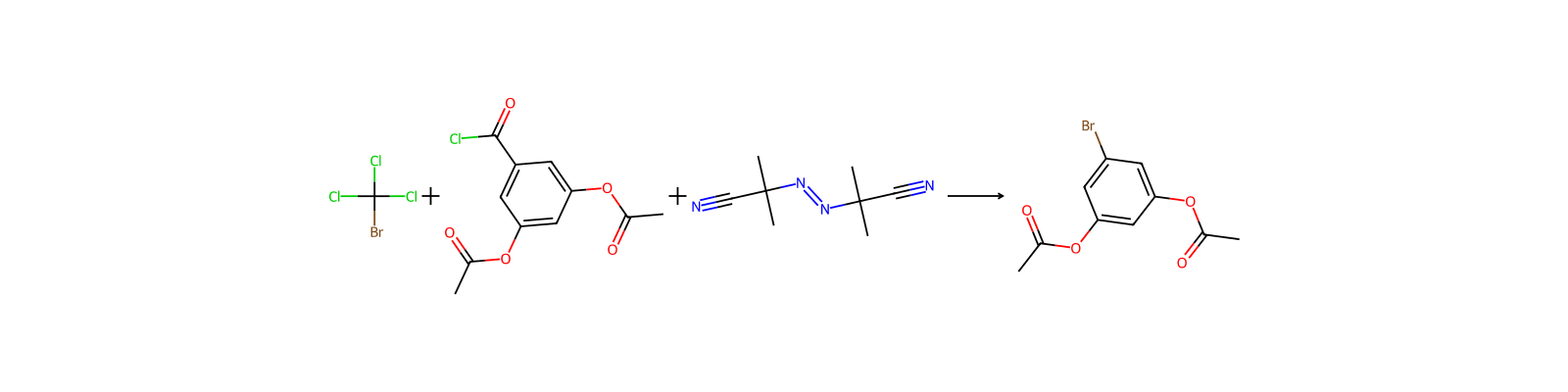
HRID 63200 の反応式
HRID 63200反応物としてuspto-grants-2016_09
HRID 70027 の反応式
HRID 70027反応物としてuspto-grants-2014_09
HRID 100733 の反応式
HRID 100733反応物としてTraining data from https://doi.org/10.1039/C8SC04228D (2/10)
HRID 102089 の反応式
HRID 102089反応物としてTraining data from https://doi.org/10.1039/C8SC04228D (2/10)
HRID 126658 の反応式
HRID 126658反応物としてTraining data from https://doi.org/10.1039/C8SC04228D (2/10)
HRID 229632 の反応式
HRID 229632反応物としてuspto-grants-2009_07
HRID 229634 の反応式
HRID 229634反応物としてuspto-grants-2009_07
HRID 245938 の反応式
HRID 245938反応物としてuspto-grants-2014_02
前へ1 / 8 ページ

化合物ノート

このページの内容基本情報概要名称と識別子物性安全と法規制化学と産業関連反応化合物ノート
Vapor Pressure · 3 件

39.0 [mmHg]

39 mm Hg at 25 °C

39 [mm Hg] @25 °C

物理化学的性質

融点
-5.7 °C · -5.7 °C
沸点
105 °C · 105 °C
比重(密度)
2.012 g/cm3 · 2.012 g/cm3(Temp: 25 °C)
Protective Action Criteria (PAC) · 3 件

0.71 [mg/m3]

7.9 [mg/m3]

47 [mg/m3]

毒性情報

Interactions · 5 件

HEPATOCYTES FROM LIVERS OF RATS FED A SEMISYNTHETIC VITAMIN E-SUPPLEMENTED DIET WERE SLIGHTLY MORE PROTECTED FROM PEROXIDATION AND CELLULAR DAMAGE INDUCED BY BROMOTRICHLOROMETHANE TREATMENT THAN WERE HEPATOCYTES FROM RATS FED A VITAMIN E-DEFICIENT DIET.

WHEN INCUBATED FOR 15 MIN IN AIR WITH RAT LIVER MICROSOMES FROM PHENOBARBITAL-TREATED RATS, A NADPH-GENERATING SYSTEM, AND GSH (5 MILLIMOLAR), BROMOTRICHLOROMETHANE WAS CONVERTED TO DIGLUTATHIONYL DITHIOCARBONATE.

WHEN ISOLATED RAT HEPATOCYTES WERE INCUBATED WITH 2 MILLIMOLAR BROMOTRICHLOROMETHANE, INCR IN THE NUMBER OF CELLS TAKING UP TRYPAN BLUE, RELEASING LACTATE DEHYDROGENASE OR FORMING MALONDIALDEHYDE WAS OFFSET BY ADDING 1X10⁻⁴ MOLAR 2-HYDROXYESTRADIOL OR (+)-CYANIDANOL-3.

PROTECTIVE EFFECTS OF CADMIUM ACETATE IN TRICHLOROBROMOMETHANE POISONING.

For more Interactions (Complete) data for BROMOTRICHLOROMETHANE (6 total), please visit the HSDB record page.

Environmental Fate · 3 件

TERRESTRIAL FATE: Based on a classification scheme(1), an estimated Koc value of 567(SRC), determined from an estimated log Kow(2,SRC) and a regression-derived equation(3), indicates that bromotrichloromethane is expected to have low mobility in soil(SRC). Volatilization of bromotrichloromethane from moist soil surfaces is expected (SRC) given an estimated Henry's Law constant of 3.7X10⁻⁴ atm-cu m/mole(SRC), using a fragment constant estimation method(4). The potential for volatilization of bromotrichloromethane from dry soil surfaces may exist(SRC) based on a measured vapor pressure of 39 mm Hg(5). Based upon the highly halogenated structure of bromotrichloromethane, biodegradation in soil is expected to be slow(6,SRC).

AQUATIC FATE: Based on a classification scheme(1), an estimated Koc value of 567(SRC), determined from an estimated log Kow of 2.5(2,SRC) and a regression-derived equation(3), indicates that bromotrichloromethane is expected to adsorb to suspended solids and sediment in water(SRC). Volatilization from water surfaces is expected(3) based upon an estimated Henry's Law constant of 3.7X10⁻⁴ atm-cu m/mole(SRC), developed using a fragment constant estimation method(4). Using this Henry's Law constant and an estimation method(3), volatilization half-lives for a model river and model lake are 3.7 hrs and 6.6 days, respectively(SRC). According to a classification scheme(5), an estimated BCF of 49(SRC), from an estimated log Kow(2) and a regression-derived equation(6), suggests the potential for bioconcentration in aquatic organisms is moderate. Based upon the highly halogenated structure of bromotrichloromethane, biodegradation in water is expected to be slow(7).

ATMOSPHERIC FATE: According to a model of gas/particle partitioning of semivolatile organic compounds in the atmosphere(1), bromotrichloromethane, which has a measured vapor pressure of 39 mm Hg at 25 °C(2), is expected to exist solely as a vapor in the ambient atmosphere. Based on bromotrichloromethane's structural similarity to bromotrifluoromethane, it is expected to slowly degrade in the atmosphere by reaction with photochemically-produced hydroxyl radicals(SRC); the half-life for bromotrichloromethane's reaction in air is estimated to be greater than 44 years(3), based on bromotrifluoromethane's rate constant of <5.0X10⁻¹⁶ cu cm/molecule-sec at 25 °C(3). Photolysis may occur based on bromotrichloromethane's structural similarity to other halogenated methane compounds but not at an environmentally important rate(4).

Food Survey ValuesBromotrichloromethane was identified as a volatile compound from bacon(1). Bromotrichloromethane was identified as a meat volatile from pork(2).
Adverse EffectsNeurotoxin - Acute solvent syndrome
Milk ConcentrationsTrace amounts of bromotrichloromethane were identified in pasteurized milk(1).
EPA IRIS InformationBromotrichloromethane
Soil Adsorption/Mobility · 1 件

The Koc of bromotrichloromethane is estimated as approximately 567(SRC), using an estimated log Kow of 2.5(1,SRC) and a regression-derived equation(2). According to a classification scheme(3), this estimated Koc value suggests that bromotrichloromethane is expected to have low mobility in soil(SRC).

Natural Pollution SourcesBromotrichloromethane has been identified as a volatile compound in both bacon(1) and pork(2).
Human Toxicity ExcerptsToxic by ingestion and inhalation of fumes.
Artificial Pollution SourcesBromotrichloromethane's production and use in organic syntheses(1) may result in its release to the environment(SRC).
Environmental BiodegradationBiodehalogenation of bromotrichloromethane by hydrogenolysis occurred in cultures with Pseudomonas putida(1). Based upon the highly halogenated structure of bromotrichloromethane, biodegradation is expected to be slow(2).
Environmental Bioconcentration · 1 件

An estimated BCF value of 49 was calculated for bromotrichloromethane(SRC), using an estimated log Kow of 2.5(1,SRC) and a regression-derived equation(2). According to a classification scheme(3), this BCF value suggests that bioconcentration in aquatic organisms is moderate(SRC).

安全データ

注意喚起語
警告
危険有害性情報
コード 危険有害性情報 危険有害性クラス 区分 注意喚起語 シンボル P コード H302