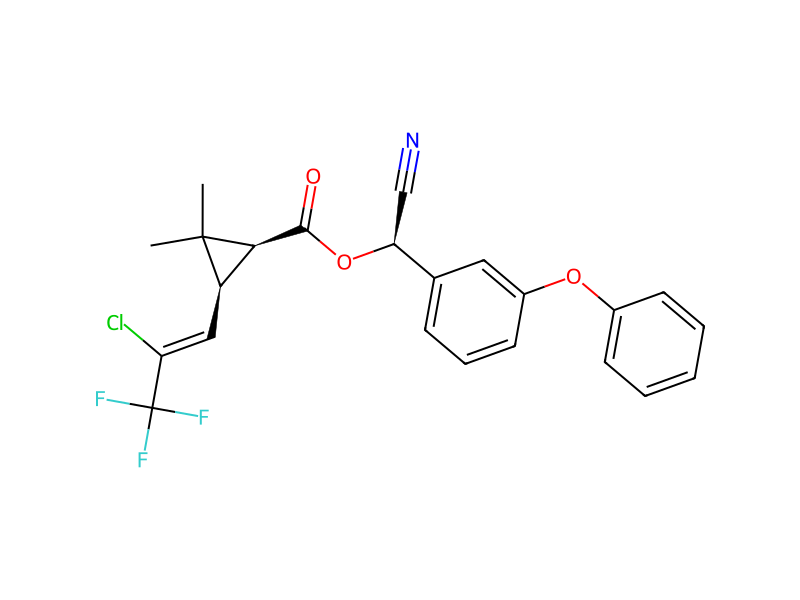
基本情報
- CAS
76703-65-6- 標準SMILES
CC1(C)[C@H](/C=C(\Cl)C(F)(F)F)[C@@H]1C(=O)O[C@@H](C#N)c1cccc(Oc2ccccc2)c1- InChIKey
ZXQYGBMAQZUVMI-GCMPRSNUSA-N- 分子式
- C23H19ClF3NO3
- 平均分子量
- 449.8 g/mol
概要
(1S)-cis-(alphaR)-cyhalothrin is a cyclopropanecarboxylate ester.
名称と識別子
- 優先名称
- lambda-Cyhalothrin
- IUPAC
- trans-[(R)-cyano-(3-phenoxyphenyl)methyl] (1S,3S)-3-[(Z)-2-chloro-3,3,3-trifluoroprop-1-enyl]-2,2-dimethylcyclopropane-1-carboxylate
- 現地名
- rac-3α*-[(Z)-2-クロロ-3,3,3-トリフルオロ-1-プロペニル]シクロプロパン-1α*-カルボン酸[(S*)-シアノ(3-フェノキシフェニル)メチル]
- 英語名
- λ-Cyhalothrin
- 分子式
- C23H19ClF3NO3
- 分子量
- 449.85
名称と別名
名称をさらに表示
データベース識別子
- CAS
76703-65-6、91465-08-6- PubChem CID
- 6440557
- DTXSID
DTXSID7032559- ChEMBL
CHEMBL2251732- ChEBI
CHEBI:39327- UNII
- 375WQ7596S、Z44TGV333K
- EC Number
- 415-130-7
- Nikkaji
- J3.235.957D
物性
構造計算による物性
- XLogP
- 6.1
- 極性表面積
- 59.3 Ų
- 水素結合供与体数
- 0
- 水素結合受容体数
- 7
- 回転可能結合数
- 7
- 重原子数
- 31
- 形式電荷
- 0
- 複雑度
- 736
実験および物理化学的性質
Pesticides
Insecticides
Active substance -> EU Pesticides database: Approved
Pesticide
Collision Cross Section
190.4 Ų [M+Na]+ [CCS Type: DT; Buffer gas: N2; Ionization: ESI+; Dataset: TOXCAST; Source Identifier: DTXSID7032559]
199.44 Ų [M+H]+ [CCS Type: TW; Buffer gas: N2; Ionization: GC-APCI+; Note: drift peak 1 (of 2)]
物理化学的性質
- 融点
- 49.2 °C · 49.2°C
- 沸点
- 187 · 187-190°C
- 比重(密度)
- 1.3225 · 1.3225 (estimate)
- 貯蔵温度
- 2 · Sealed in dry,2-8°C
- 溶解性
- Chloroform (Sparingly), DMSO (Slightly), Methanol (Slightly)
- 外見
- Solid
- 色
- White to off-white
- Merck
- 13 · 13,2787
- Henry's Law Constant
- 5 · 5.0×101 mol/(m3Pa) at 25℃, Maniere et al. (2011)
- 安定性
- Light Sensitive
- InChI
- 1S/C23H19ClF3NO3/c1-22(2)17(12-19(24)23(25,26)27)20(22)21(29)31-18(13-28)14-7-6-10-16(11-14)30-15-8-4-3-5-9-15/h3-12,17-18,20H,1-2H3/b19-12-/t17-,18+,20-/m0/s1
- InChIKey
- ZXQYGBMAQZUVMI-GCMPRSNUSA-N
- SMILES
- CC1(C)[C@@H](\C=C(/Cl)C(F)(F)F)[C@H]1C(=O)O[C@H](C#N)c2cccc(Oc3ccccc3)c2
- LogP
- 7 · 7.000
- CAS データベース
- 91465 · 91465-08-6(CAS DataBase Reference)
- NISTの化学物質情報
- «LAMBDA»-cyhalothrin(91465-08-6)
- EPAの化学物質情報
- .lambda.-Cyhalothrin (91465-08-6)
化学的性質
化学的特性olorless to beige powder; or viscous yellowish-brown liquid. Mild odor. Liquid formulations containing organic solvents may be flammable.
安全と法規制
GHS分類
GHS Classification
Danger
H301: Toxic if swallowed [Danger Acute toxicity, oral]
P260, P264, P270, P271, P273, P280, P284, P301+P316, P302+P352, P304+P340, P316, P317, P320, P321, P330, P362+P364, P391, P403+P233, P405, and P501 (click each P-code to see the statement)
Danger
H301+H311 (10.8%): Toxic if swallowed or in contact with skin [Danger Acute toxicity, oral; acute toxicity, dermal]
P260, P262, P264, P264+P265, P270, P271, P273, P280, P284, P301+P316, P302+P352, P304+P340, P305+P351+P338, P308+P316, P316, P317, P320, P321, P330, P337+P317, P361+P364, P362+P364, P391, P403+P233, P405, and P501 (click each P-code to see the statement)
危険有害性情報
Regulatory Information
Regulation (EC) No 178/2002 (amended)
Lambda cyhalothrin is listed in the dataset of EPA Human Health Benchmarks for Pesticides under the Safe Drinking Water Act (40 eCFR 141)
00/80/EC, 2010/77/EU, Reg. (EU) 2015/1885, Reg. (EU) 2016/146, Reg. (EU) 2018/155, Reg. (EU) 2023/114, Reg. (EU) 2024/324, Reg. (EU) 2026/1421, Reg. (EU) No 2019/724, Reg. (EU) No 540/2011
REACH registered substance: A mixture of: α-cyano-3-phenoxybenzyl (Z)-(1R,3R)-[(S)-3-(2-chloro-3,3,3-trifluoro-prop-1-enyl)]-2,2-dimethylcyclopropanecarboxylate; α-cyano-3-phenoxybenzyl (Z)-(1S,3S)-[(R)-3-(2-chloro-3,3,3-trifluoro-prop-1-enyl)]-2,2-dimethylcyclopropanecarboxylate (EC: 415-130-7)
Lambda-cyhalothrin: HSNO Approval: HSR003295 Approved with controls
Hazard Classes and Categories
Acute Tox. 3 (100%)
Acute toxicity - category 2
Acute toxicity (Oral) - Category 3
Acute toxicity (Inhalation: Dusts and mists) - Category 2
Acute Tox. 2 *
安全と保護具
First Aid Measures
Fresh air, rest.
Remove contaminated clothes. Rinse and then wash skin with water and soap.
First rinse with plenty of water for several minutes (remove contact lenses if easily possible), then refer for medical attention.
Do NOT induce vomiting. Refer for medical attention .
Spillage Disposal
Personal protection: particulate filter respirator adapted to the airborne concentration of the substance. Do NOT let this chemical enter the environment. Sweep spilled substance into sealable containers. Carefully collect remainder. Then store and dispose of according to local regulations. Do NOT wash away into sewer.
毒性情報
Treatment
Following oral exposure, the treatment is symptomatic and supportive and includes monitoring for the development of hypersensitivity reactions with respiratory distress. Provide adequate airway management when needed. Gastric decontamination is usually not required unless the pyrethrin product is combined with a hydrocarbon. Following inhalation exposure, move patient to fresh air. monitor for respiratory distress. If cough or difficulty breathing develops, evaluate for respiratory tract irritation, bronchitis, or pneumonitis. Administer oxygen and assist ventilation as required. Treat bronchospasm with inhaled beta2 agonist and oral or parenteral corticosteroids. In case of eye exposure, irrigate exposed eyes with copious amounts of room temperature water for at least 15 minutes. If irritation, pain, swelling, lacrimation, or photophobia persist, the patient should be seen in a health care facility. If the contamination occurs through dermal exposure, Remove contaminated clothing and wash exposed area thoroughly with soap and water. A physician may need to examine the area if irritation or pain persists. Vitamin E topical application is highly effective in relieving parenthesis. (L363)
Health Effects
At high doses, signs of poisoning attributable to cyhalothrin include profuse salivation and pulmonary edema, clonic seizures, opisthotonos (i.e., the spine is bent forward such that a supine body rests on its head and heels), coma, and death. At lower doses, commonly observed effects include paresthesia and erythema. (L863)
Exposure Routes
The substance can be absorbed into the body by inhalation of dust or mist and by ingestion.
Inhalation (L857) ; oral (L857) ; dermal (L857) ; eye contact (L857).
Toxicity Summary
Both type I and type II pyrethroids exert their effect by prolonging the open phase of the sodium channel gates when a nerve cell is excited. They appear to bind to the membrane lipid phase in the immediate vicinity of the sodium channel, thus modifying the channel kinetics. This blocks the closing of the sodium gates in the nerves, and thus prolongs the return of the membrane potential to its resting state. The repetitive (sensory, motor) neuronal discharge and a prolonged negative afterpotential produces effects quite similar to those produced by DDT, leading to hyperactivity of the nervous system which can result in paralysis and/or death. Other mechanisms of action of pyrethroids include antagonism of gamma-aminobutyric acid (GABA)-mediated inhibition, modulation of nicotinic cholinergic transmission, enhancement of noradrenaline release, and actions on calcium ions. They also inhibit calium channels and Ca2+, Mg2+-ATPase. (T10, T18, L857)
Signs and Symptoms
Burning sensation. Convulsions. Cough. Laboured breathing. Shortness of breath. Sore throat.
Redness. Pain.
Redness. Pain.
Abdominal pain. Cough.
Following dermal exposure to cyhalothrin, feelings of numbness, itching, burning, stinging, tingling, or warmth may occur, that could last for a few hours. Dizziness, headache, nausea, muscle twitching, reduced energy, and changes in awareness can result from inhalation or ingestion of large amounts of cyhalothrin. Paralysis can occur after exposure. (L857)
ICSC Environmental Data
The substance is very toxic to aquatic organisms. This substance may be hazardous to the environment. Special attention should be given to mammals and bees. The substance may cause long-term effects in the aquatic environment. This substance does enter the environment under normal use. Great care, however, should be taken to avoid any additional release, for example through inappropriate disposal.
RAIS Toxicity Values
0.00093
OPP
USGS Health-Based Screening Levels for Evaluating Water-Quality
lambda-Cyhalothrin
Pesticide
6.2
Acute HHBP for children; The acute dietary exposure assessment is protective of chronic dietary exposures.
Smith, C.D. and Nowell, L.H., 2024. Health-Based Screening Levels for evaluating water-quality data (3rd ed.). DOI:10.5066/F71C1TWP
EPA Human Health Benchmarks for Pesticides
Lambda cyhalothrin
0.00093
6.2
Children
Human Health Benchmarks for Pesticides - 2021 Update
安全データ
- wgk
- 3
- rtecs
- GZ1227780
- ridadr
- UN 2810 6.1/PG 3
- 毒性
- LD50 (technical grade) in male, female rats (mg/kg): 79, 56 orally; 632, 696 dermally (Jutsum)
- risk_code
- 21-25-26-50/53-20/21/22
- hazard_code
- T+;N,N,T+,Xn
- safety_code
- 1/2-28-36/37/39-38-45-60-61-13
- hazard_class
- 6.1
- packing_group
- III
- 毒劇物取締法
- III
- Hazard Classifications
- Acute Tox. 2 InhalationAcute Tox. 3 DermalAcute Tox. 3 OralAquatic Acute 1Aquatic Chronic 1
- ストレージクラス
- 6.1A - Combustible acute toxic Cat. 1 and 2very toxic hazardous materials
化学と産業
薬理情報
Metabolism/Metabolites
Cyhalothrin has been shown to be well absorbed after oral administration, extensively metabolized, and eliminated as polar conjugates in urine. The main route of metabolism is, as anticipated, via hydrolysis of the ester linkage. The cyclopropane-carboxylic acid moiety is subsequently excreted via the urine as the glucuronide conjugate. The 3-phenoxybenzyl moiety is further metabolized by loss of the nitrile group, oxidation of the aldehyde form to a carboxylic acid, aromatic hydroxylation at the 4' position, and formation of the 4- O-sulfate conjugate of 3-(4-hydroxyphenoxy)benzoic acid. (L871)
MeSH Pharmacological Classification
Chemicals that kill or inhibit the growth of fungi in agricultural applications, on wood, plastics, or other materials, in swimming pools, etc.
Pesticides designed to control insects that are harmful to man. The insects may be directly harmful, as those acting as disease vectors, or indirectly harmful, as destroyers of crops, food products, or textile fabrics.
用途と製造
応用分野
使用Insecticide; pyrethrin analog
上流・下流製品情報
上流原料
下流製品
サプライヤー8 社
関連反応
現在のフィルター条件では反応記録がありません。
化合物ノート
読み込み中…