
HRID 132509反応物として
9,10-Dibromoanthracene
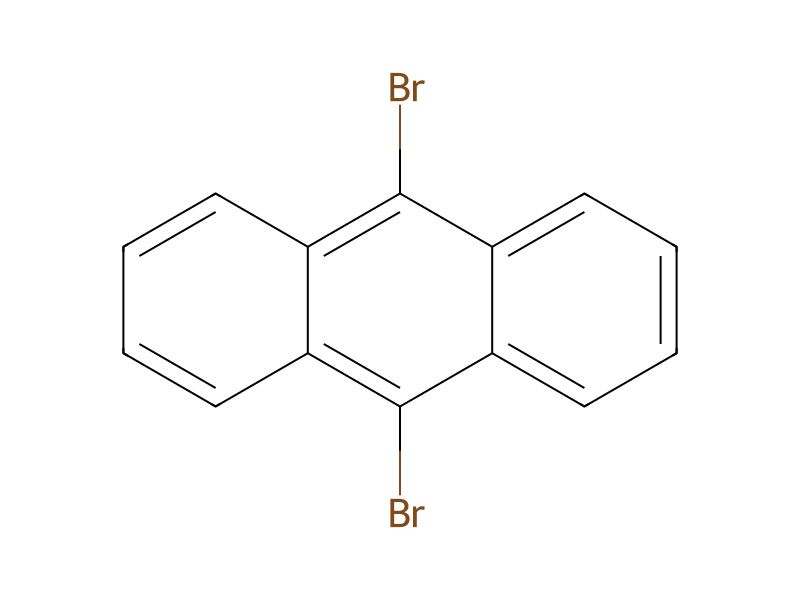
523-27-3Brc1c2ccccc2c(Br)c2ccccc12BRUOAURMAFDGLP-UHFFFAOYSA-N523-27-3DTXSID5049312CHEMBL3183379安全情報は参考情報です。供給元の安全データシート(SDS)、適用法令、専門家による評価に代わるものではありません。
Warning
H315 (16.3%): Causes skin irritation [Warning Skin corrosion/irritation]
P261, P264, P264+P265, P271, P273, P280, P302+P352, P304+P340, P305+P351+P338, P319, P321, P332+P317, P337+P317, P362+P364, P391, P403+P233, P405, and P501 (click each P-code to see the statement)
Aggregated GHS information provided per 49 reports by companies from 6 notifications to the ECHA C&L Inventory. Each notification may be associated with multiple companies.
用途有機合成原料。
説明9,10-Dibromoanthracene is an organic chemical compound containing anthracene with two bromine atoms substituted on its central ring. As a symmetrically brominated anthracene derivative, it is bearing functional groups to extend its conjugation further mainly via C-C bond forming i.e. Stille and Suzuki coupling reactions. It is notable in that it was the first single molecule to have a chemical reaction observed by an atomic force microscope and scanning tunneling microscopy. It is a low-molecular-weight organic semiconductor. It can used as an initiator in visible-spectrum solar-light-mediated benzylic C–H oxygenation through solar light or the blue LED activate[1-2].
使用9,10-Dibromoanthracene is a dibrominated polycyclic aromatic hydrocarbon (PAH). 9,10-Dibromoanthracene is often used as an energy acceptor and activator in reactions that produce chemiluminescence.
製造方法9,10-Dibromoanthracene is synthesized by the bromination of anthracene. The bromination reaction is carried out at room temperature using carbon tetrachloride as a solvent. Using 80-85% anthracene as raw material, adding bromine to react for half an hour, the yield is 83-88%.
純化方法Recrystallise it from toluene, xylene or CCl4 (yellow needles), and sublime it in a vacuum [Johnston et al. J Am Chem Soc 109 1291 1987]. [Heilbron & Heaton Org Synth Coll Vol I 207 1941, Beilstein 5 H 665.]


化学的特性Yellow to yellow-green fluffy powder. Melting point 226°C. It can be sublimated and oxidized to generate anthraquinone. It is soluble in hot benzene and hot toluene, but only slightly soluble in alcohol, ether, and cold benzene. It is insoluble in water.