
4,4-ビス[(tert-ブチル)ペルオキシ]ペンタン酸ブチル
Pentanoic acid, 4,4-bis((1,1-dimethylethyl)dioxy)-, butyl ester
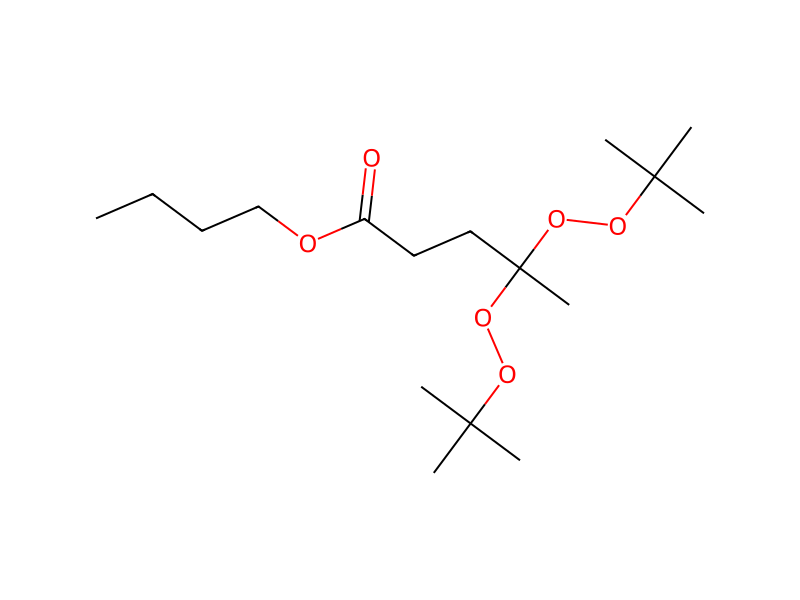
基本情報
- CAS
995-33-5- 標準SMILES
CCCCOC(=O)CCC(C)(OOC(C)(C)C)OOC(C)(C)C- InChIKey
BXIQXYOPGBXIEM-UHFFFAOYSA-N- 分子式
- C17H34O6
- 平均分子量
- 334.4 g/mol
- 単同位体質量
- 334.2355388
概要
This solid peroxide is sensitive to heat. Storage of this material must be done so with stringent temperature control measures. Its explosion hazard is also mitigated by mixing the peroxide with an inert solid.
名称と識別子
- 優先名称
- Pentanoic acid, 4,4-bis((1,1-dimethylethyl)dioxy)-, butyl ester
- IUPAC
- butyl 4,4-bis(tert-butylperoxy)pentanoate
- 現地名
- 4,4-ビス[(tert-ブチル)ペルオキシ]ペンタン酸ブチル
- 英語名
- Butyl 4,4-bis(tert-butyldioxy)valerate
- 分子式
- C17H34O6
- 分子量
- 334.45
名称と別名
Butyl 4,4-bis(tert-butyldioxy)valerate995-33-5EINECS 213-626-6Pentanoic acid, 4,4-bis((1,1-dimethylethyl)dioxy)-, butyl esterPentanoic acid, 4,4-bis[(1,1-dimethylethyl)dioxy]-, butyl esterRefChem:859977213-626-6butyl 4,4-bis(tert-butylperoxy)pentanoateButyl 4,4-di(tert-butylperoxy)valerateButyl 4,4'-bis(tert-butylperoxy)valerate (Technical Grade)varox dcp-40kevarox dcp-40c
名称をさらに表示
4,4-ビス(tert-ブチルペルオキシ)吉草酸ブチルトリゴノックス174,4-ビス(tert-ブチルペルオキシ)ペンタン酸ブチル4,4-ビス[(tert-ブチル)ペルオキシ]ペンタン酸ブチルブチル4,4-ビス(tert-ブチルペルオキシ)バレレートトリゴノックス17/40nブチル4,4ビス(tブチルパ-オキシ)バレレ-トn-ブチルー4,4-ビス(t-ブチルパーオキシ)バレレート4,4-ビス-(第三級ブチルペルオキシ)吉草酸-n-ブチルブチル 4,4-ビス(tert-ブチルペルオキシ)ペンタノアート4,4-ビス(t-ブチルパーオキシ)吉草酸n-ブチルrigonox 17Trigonox 17Perhexa V 40Luperox 230XLTrigonox 17/40butyl 4,4-di(butylperoxy)valerate
varox 230-xlvarox 118Butyl 4,4-bis(tert-butylperoxy)pentanoate; Butyl 4,4-bis(tert-butylperoxy)valerate;Butyl 4,4-di-tert-butylperoxyvalerate; Butyl 4,4'-bis(tert-butylperoxy)valerate;n-butyl 4,4-bis(t-butylperoxy) valerateSCHEMBL44038DTXSID10613664,4-bis[(1,1-dimethylethyl)dioxy]-pentanoicacibutylesterbutyl-4,4-bis(tert.-butyl peroxy)valerate
物性
構造計算による物性
- XLogP
- 3.8
- 極性表面積
- 63.2 Ų
- 水素結合供与体数
- 0
- 水素結合受容体数
- 6
- 回転可能結合数
- 13
- 重原子数
- 23
- 形式電荷
- 0
- 複雑度
- 322
実験および物理化学的性質
Physical Description
This solid peroxide is sensitive to heat. Storage of this material must be done so with stringent temperature control measures. Its explosion hazard is also mitigated by mixing the peroxide with an inert solid.
This solid peroxide is sensitive to heat. Storage of this material must be done so with stringent temperature control measures. Its explosion hazard is also mitigated by mixing the peroxide with an inert solid.
Dry Powder; CBI
物理化学的性質
- 沸点
- 363.9 · 363.9±37.0 °C(Predicted)
- 比重(密度)
- 0.9669 g/cm3 · 0.9669 g/cm3
- 蒸気圧
- 0.053 Pa · 0.053Pa at 25℃
- 溶解性
- Chloroform (Slightly), DMSO (Slightly), Ethyl Acetate (Slightly)
- 外見
- Oil
- 色
- Colourless
- 水溶解度
- 2.16 mg/L · 2.16mg/L at 20.2℃
- 安定性
- Possibly Shock Sensitive
- LogP
- 6.34 at · 6.34 at 55℃
- EPAの化学物質情報
- 4 · Butyl 4,4-di(tert-butylperoxy)valerate (995-33-5)
化学的性質
安全と法規制
安全情報は参考情報です。供給元の安全データシート(SDS)、適用法令、専門家による評価に代わるものではありません。
GHS分類
GHS Classification
Danger
H242 (100%): Heating may cause a fire [Danger Self-reactive substances and mixtures; Organic peroxides]
P210, P234, P235, P240, P273, P280, P370+P378, P391, P403, P410, P411, P420, and P501 (click each P-code to see the statement)
Aggregated GHS information provided per 22 reports by companies from 4 notifications to the ECHA C&L Inventory. Each notification may be associated with multiple companies.
危険有害性情報
Regulatory Information
Chemical: Pentanoic acid, 4,4-bis[(1,1-dimethylethyl)dioxy]-, butyl ester
Pentanoic acid, 4,4-bis[(1,1-dimethylethyl)dioxy]-, butyl ester is listed on the EPA's Chemical Data Reporting (CDR) system. Manufacturers and importers of Pentanoic acid, 4,4-bis[(1,1-dimethylethyl)dioxy]-, butyl ester are required to report information about their production and use of this chemical to the EPA under the Toxic Substances Control Act (TSCA). (40 eCFR Part 711)
REACH registered substance: Butyl 4,4-bis(tert-butyldioxy)valerate (EC: 213-626-6)
Butyl 4,4-bis(tert-butyldioxy)valerate: Does not have an individual approval but may be used as a component in a product covered by a group standard. It is not approved for use as a chemical in its own right.
DOT LabelOrganic Peroxide
Fire HazardsExcerpt from ERG Guide 146 [Organic Peroxides (Heat, Contamination and Friction Sensitive)]:
Health HazardsExcerpt from ERG Guide 146 [Organic Peroxides (Heat, Contamination and Friction Sensitive)]:
Reactive Group
Peroxides, Organic
Peroxides, Organic
Reactivity Alerts
Strong Oxidizing Agent
Explosive
化学と産業
用途と製造
U.S. Production2023: <75,000 lb
Consumer UsesNot Known or Reasonably Ascertainable
Industry UsesCBI
General Manufacturing Information
Rubber Product Manufacturing
Pentanoic acid, 4,4-bis[(1,1-dimethylethyl)dioxy]-, butyl ester: ACTIVE
応用分野
一般的な説明Butyl 4,4-bis(tert-butyldioxy)valerate is sensitive to heat. Storage of Butyl 4,4-bis(tert-butyldioxy)valerate must be done so with stringent temperature control measures. It's explosion hazard is also mitigated by mixing the peroxide with an inert solid.
関連反応
1 件
化合物ノート
読み込み中…