
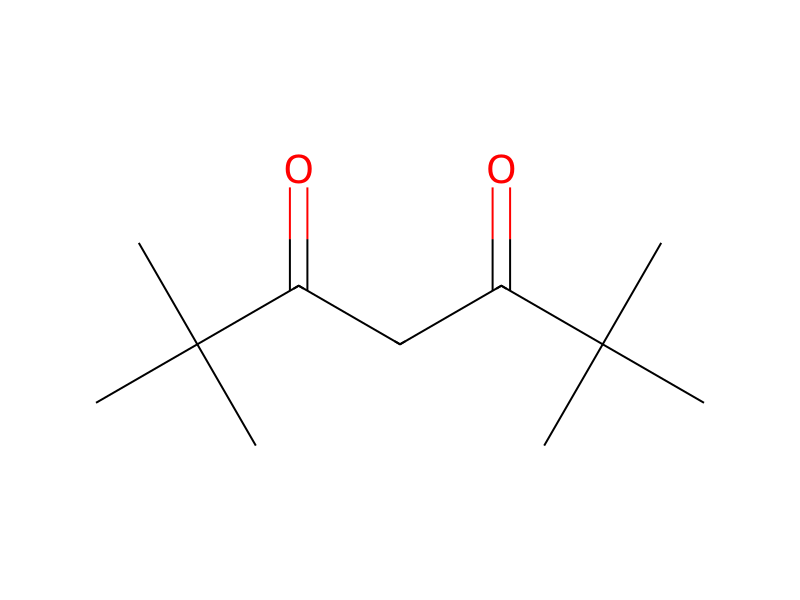
基本情報
- 標準SMILES
CC(C)(C)C(=O)CC(=O)C(C)(C)C- InChIKey
YRAJNWYBUCUFBD-UHFFFAOYSA-N- 分子式
- C11H20O2
- 平均分子量
- 184.27 g/mol
- 単同位体質量
- 184.14632988
名称と識別子
- 優先名称
- 2,2,6,6-Tetramethyl-3,5-heptanedione
- IUPAC
- 2,2,6,6-tetramethylheptane-3,5-dione
- 現地名
- ジピバロイルメタン
- 英語名
- 2,2,6,6-Tetramethyl-3,5-heptanedione
- 分子式
- C11H20O2
- 分子量
- 184.28
名称と別名
1118-71-4Dipivaloylmethane2,2,6,6-Tetramethyl-3,5-heptanedione3,5-Heptanedione, 2,2,6,6-tetramethyl-DTXSID7049396R8UI909HOYNSC-1742962,2,6,6,-tetramethyl-3,5-heptanedioneDTXCID4029355RefChem:134758214-268-32,2,6,6-Tetramethylheptane-3,5-dione
名称をさらに表示
ジピバロイルメタン2,2,6,6-テトラメチル-3,5-ヘプタンジオン2,2,6,6-テトラメチル3,5-ヘプタンジオン2,2,6,6-テトラメチル-3,5-ヘプタン-ジオン2,2,6,6-テトラメチル-3,5-ヘプタジオン2,2,6,6-テトラメチルヘプタン-3,5-ジオン2,2,6,6‐テトラメチル‐3,5‐ヘプタンジオン2,2,6,6-テトラメチル-3,5-ヘプタンジオン, 98%2,2,6,6-Tetramethyl heptanedione2,2,6,6-Tetramethyl-3,5-heptadionebutan-1-ol,propan-2-ol,titaniumdpm-h5-heptanedione6-Tetramethyl-3
MFCD000088482,2,6,6-tetramethyl-heptane-3,5-dioneUNII-R8UI909HOY1,3-Di-tert-butyl-1,3-propanedione; Dipivaloylmethane; NSC 174296dipivaloyl methaneEINECS 214-268-3TMHDNSC 174296
データベース識別子
- CAS
1118-71-4- PubChem CID
- 70700
- DTXSID
DTXSID7049396- ChEMBL
CHEMBL3186481- UNII
- R8UI909HOY
- EC Number
- 214-268-3
- Nikkaji
- J4.487C
物性
構造計算による物性
- XLogP
- 2.6
- 極性表面積
- 34.1 Ų
- 水素結合供与体数
- 0
- 水素結合受容体数
- 2
- 回転可能結合数
- 4
- 重原子数
- 13
- 形式電荷
- 0
- 複雑度
- 189
物理化学的性質
- 融点
- 400 °C · >400 °C (decomp)
- 沸点
- 72 · 72-73 °C/6 mmHg (lit.)
- 比重(密度)
- 0.883 g/mL · 0.883 g/mL at 25 °C (lit.)
- 屈折率
- 20 · n20/D 1.459(lit.)
- 闪点
- 153 °F · 153 °F
- 貯蔵温度
- Sealed in dry,Room Temperature
- 溶解性
- 混ぜにくい。
- 外見
- 液体
- 酸解離定数(Pka)
- 11.6 · 11.60±0.10(Predicted)
- 比重
- 0.883 · 0.883
- 色
- 無色透明~微黄色透明
- BRN
- 1447269 · 1447269
- InChI
- 1S/C11H20O2/c1-10(2,3)8(12)7-9(13)11(4,5)6/h7H2,1-6H3
- InChIKey
- YRAJNWYBUCUFBD-UHFFFAOYSA-N
- SMILES
- CC(C)(C)C(=O)CC(=O)C(C)(C)C
- LogP
- 2.818 · 2.818 (est)
- CAS データベース
- 1118 · 1118-71-4(CAS DataBase Reference)
- EPAの化学物質情報
- 3 · 3,5-Heptanedione, 2,2,6,6-tetramethyl- (1118-71-4)
化学的性質
化学的特性CLEAR COLOURLESS TO SLIGHTLY YELLOW LIQUID
安全と法規制
安全データ
- wgk
- 3
- tsca
- TSCA listed
- ridadr
- UN 1993 / PGIII
- hs_code
- 29141900
- risk_code
- 22-40-36/37/38
- 消防法
- 危-4-2-III
- hazard_code
- Xn
- safety_code
- 24/25-36-26-22
- ストレージクラス
- 10 - Combustible liquids
化学と産業
応用分野
使用2,2,6,6-tetramethyl-3,5-heptanedione was used in the synthesis of α-aryl-β-diketones1 and dicyanamidobenzene-bridge diruthenium complex.
一般的な説明Acylation, a replacement to silylation, allows the conversion of compounds that consist of active hydrogens (-OH, -SH and -NH) into esters, thioesters, and amides via the action of a carboxylic acid or derivative. The carbonyl group adjacent to the halogenated carbons is known to improve the electron capture detector (ECD) response. Acylation has several advantages:It enhances the stability of compounds by protecting unstable groups.It may confer volatility on substances like carbohydrates or amino acids, that have several polar groups that they are non-volatile and usually decompose on heating.It facilitates the separations not possible with underivatized compounds.Compounds are detectable at very low levels with an ECD.2,2,6,6-Tetramethyl-3,5-heptanedione is a reagent used to form fragmentation-directing derivatives for GC/MS analysis.
上流・下流製品情報
上流原料
下流製品
サプライヤー50 社
国药集团化学试剂有限公司86-21-63210123 · [email protected]
梯希爱(上海)化成工业发展有限公司021-67121386 · [email protected]
衢州润东化工有限公司0570-8789886 18892685668 · [email protected]
上海阿拉丁生化科技股份有限公司400-6206333 13167063860 · [email protected]
INTATRADE GmbH+49 3493/605464 · [email protected]
T&W GROUP021-61551611 13296011611 · [email protected]
爱斯特(成都)生物制药股份有限公司+86-28-85122536 85324413 · [email protected]
韶远科技(上海)有限公司021-50795510 4000665055 · [email protected]
瑞果(苏州)新材料有限公司0512-87813132-801 13913535368
上海将来实业股份有限公司400-0066400 13621662912 · [email protected]
上海迈瑞尔生化科技有限公司4006356688 18621169109 · [email protected]
武汉易泰科技有限公司上海分公司18930552037 · [email protected]
宁波亿诺化学品有限公司86-574-27787657 · [email protected]
阿法埃莎(中国)化学有限公司400-6106006 · [email protected]
上海德默医药科技有限公司400-021-7337 2355568890 · [email protected]
安耐吉化学&3A(安徽泽升科技股份有限公司)400-0056266 · [email protected]
武汉凯威斯科技有限公司86-027-67849912 · [email protected]
上海瀚鸿科技股份有限公司021-54306202 13764082696 · [email protected]
上海景颜化工科技有限公司13817811078 · [email protected]
嘉兴市艾森化工有限公司0573-85285100 18627885956 · [email protected]
维赛诺化学技术(北京)有限公司13811761079 · [email protected]
上海攀鸿化工科技有限公司021-56491756 13512199871 · [email protected]
上海辅欣医药科技有限公司021-50872116 13391048226 · [email protected]
武汉丰泰威远科技有限公司027-87465837 19945049750 · [email protected]
山东西亚化学有限公司13355009207 13355009207 · [email protected]
四川库利南科技有限公司400-1166-196 18981987031 · [email protected]
天津希恩思生化科技有限公司400 638 7771 · [email protected]
郑州阿尔法化工有限公司13333829863 13333829863 · [email protected]
上海钰康生物科技有限公司15618758386 15618758386 · [email protected]
Connect Chemicals GmbH+49 2102 2077 19 · [email protected]
同创医药(苏州)有限公司0512-63263366 18912765016 · [email protected]
河南多贝化工有限公司0370-2785118 17550508557 · [email protected]
上海思域化工科技有限公司86-21-34053660 · [email protected]
赛默飞世尔科技(中国)有限公司800-810-5118 · [email protected]
北京伊诺凯科技有限公司400-810-7969 010-59572699 · [email protected]
天津尚德药缘科技有限公司13132578992 · [email protected]
江苏艾康生物医药研发有限公司025-66113011 13913916777 · [email protected]
上海健超生物科技有限公司150-2103-5486 18017383231 · [email protected]
TCI AMERICA800-4238616 · [email protected]
TOKYO CHEMICAL INDUSTRY CO., LTD.03-36680489 · [email protected]
TCI Europe320-37350700 · [email protected]
深圳康特腾科技有限公司86-0755-86635001 · [email protected]
越林试剂021-62960152 · [email protected]
上海睿升化工科技有限公司+86-021-50935922
Clearsynth Labs Limited+91-22-26355700 · [email protected]
上海泽信化工科技有限公司021-60136491 15901897992
石家庄琪跃化工有限公司15369111890 · [email protected]
上海昶衍化工科技有限公司021-20242659 18930833303 · [email protected]
上海宸香医药科技有限公司021-20960837 · [email protected]
上海将来实业股份有限公司400-0066400 13621662912 · [email protected]
補足説明
定義2,2,6,6-Tetramethyl-3,5-heptanedioneis a stable, anhydrous reagent. It undergoes O-additions and C-additions. In various reactions, it acts as an air-stable ligand for metal catalysts. Furthermore, it serves as a substrate for heterocycles.
関連反応
350 件


関連ノート
読み込み中…