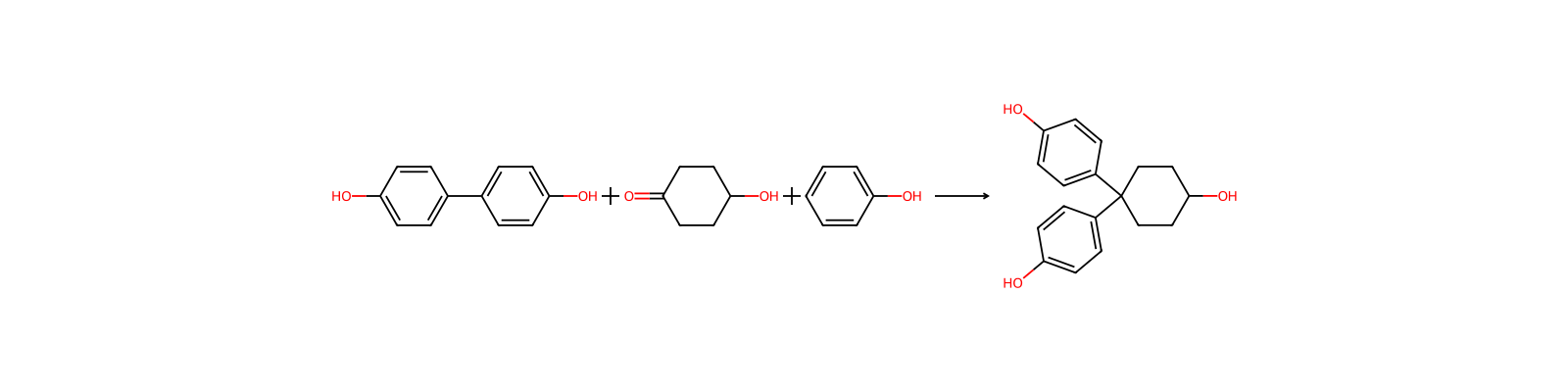
4,4'-ビフェノール
4,4'-Dihydroxybiphenyl
データを補完しています。しばらくしてからページを更新すると最新の内容を表示できます

基本情報
- CAS
92-88-6- 標準SMILES
Oc1ccc(-c2ccc(O)cc2)cc1- InChIKey
VCCBEIPGXKNHFW-UHFFFAOYSA-N- 分子式
- C12H10O2
- 平均分子量
- 186.21 g/mol
- 単同位体質量
- 186.06807956
名称と識別子
- 優先名称
- 4,4'-Dihydroxybiphenyl
- IUPAC
- 4-(4-hydroxyphenyl)phenol
- 現地名
- 4,4'-ビフェノール
- 英語名
- 4,4'-Biphenol
- 分子式
- C12H10O2
- 分子量
- 186.21
名称と別名
4,4'-Dihydroxybiphenyl92-88-64,4'-BIPHENOL4,4'-Biphenyldiol[1,1'-Biphenyl]-4,4'-diolBiphenyl-4,4'-diolp,p'-Biphenolp,p'-Diphenol4,4'-dihydroxydiphenylAntioxidant DOD4,4'-Dioxydiphenyl4,4'-Bisphenol
名称をさらに表示
4,4'-ビフェノール4,4'-ビ(フェノール)4'-ヒドロキシ-1,1'-ビフェニル-4-オール4,4'-ビフェニルジオールビフェニル-4,4'-ジオールp,p'-ビフェノール[1,1'-ビフェニル]-4,4'-ジオール4,4'-ジヒドロキシビフェニル1,1'-ビフェニル-4,4'-ジオールp,p'-ジフェノール4,4'-ビ[フェノール]4,4’ビフェノ-ル4,4′-ジヒドロキシビフェニル4,4′-ビフェニルジオールP,P′-ビフェノール4,4ジヒドロキシジフェニル4,4-ジヒドロキシ-ジフェニル4,4’-ジヒドロキシ-ジ-フェニル4,4'-ジヒドロキシ-ジフェニル4,4′‐ビフェニルジオールPPDPBIPHENOLDOD(1R,2R)-Cyclohexane-1,2-diolBIPHENOL SUBL5
p,p'-DihydroxybiphenylASM DOD(1,1'-Biphenyl)-4,4'-diolDihydroxybiphenylDTXSID1029120NSC-8711DTXCID709120GM-W06
データベース識別子
- CAS
92-88-6- PubChem CID
- 7112
- DTXSID
DTXSID1029120- ChEMBL
CHEMBL76398- ChEBI
CHEBI:34367- UNII
- R8994A0904
- EC Number
- 202-200-5
- Nikkaji
- J45.978J
物性
構造計算による物性補完中
- XLogP
- 3.6
- 極性表面積
- 40.5 Ų
- 水素結合供与体数
- 2
- 水素結合受容体数
- 2
- 回転可能結合数
- 1
- 重原子数
- 14
- 形式電荷
- 0
- 複雑度
- 145
実験および物理化学的性質
Vapor Pressure0.00000079 [mmHg]
Physical Description
Dry Powder; Other Solid
Off-white, light beige, or light gray odorless powder; [Acros Organics MSDS]
Kovats Retention Index
1979
2046
物理化学的性質
- 融点
- 280 · 280-282 °C(lit.)
- 沸点
- 280.69 °C · 280.69°C (rough estimate)
- 比重(密度)
- 1.22 · 1.22
- 蒸気圧
- 0 Pa · 0Pa at 25℃
- 屈折率
- 1.601 · 1.6010 (estimate)
- 貯蔵温度
- Sealed in dry,Room Temperature
- 酸解離定数(Pka)
- 9.74 · 9.74±0.26(Predicted)
- 外見
- 粉
- 色
- オフホワイトからライトベージュまたはライトグレー
- 水溶解度
- 難溶性
- BRN
- 1908886 · 1908886
- 化粧品成分の機能
- 漂白肌を保護する
- InChI
安全と法規制
安全情報は参考情報です。供給元の安全データシート(SDS)、適用法令、専門家による評価に代わるものではありません。
GHS分類
GHS Classification
This chemical does not meet GHS hazard criteria for 0.5% (1 of 211) of reports.
Warning
H312 (44.1%): Harmful in contact with skin [Warning Acute toxicity, dermal];H315 (26.1%): Causes skin irritation [Warning Skin corrosion/irritation];H317 (55.9%): May cause an allergic skin reaction [Warning Sensitization, Skin];H319 (25.6%): Causes serious eye irritation [Warning Serious eye damage/eye irritation];H335 (25.1%): May cause respiratory irritation [Warning Specific target organ toxicity, single exposure; Respiratory tract irritation];H411 (18.5%): Toxic to aquatic life with long lasting effects [Hazardous to the aquatic environment, long-term hazard];H412 (55.5%): Harmful to aquatic life with long lasting effects [Hazardous to the aquatic environment, long-term hazard]
P261, P264, P264+P265, P271, P272, P273, P280, P302+P352, P304+P340, P305+P351+P338, P317, P319, P321, P332+P317, P333+P317, P337+P317, P362+P364, P391, P403+P233, P405, and P501 (click each P-code to see the statement)
Aggregated GHS information provided per 211 reports by companies from 15 notifications to the ECHA C&L Inventory. Each notification may be associated with multiple companies.;Reported as not meeting GHS hazard criteria per 1 of 211 reports by companies.;There are 14 notifications provided by 210 of 211 reports by companies with hazard statement code(s).;Information may vary between notifications depending on impurities, additives, and other factors. The percentage value in parenthesis indicates the notified classification ratio from companies that provide hazard codes. Only hazard codes with percentage values above 10% are shown. For more detailed information, please visit ECHA C&L website.
危険有害性情報
Regulatory Information
Chemical: [1,1'-Biphenyl]-4,4'-diol
[1,1'-Biphenyl]-4,4'-diol is listed on the EPA's Chemical Data Reporting (CDR) system. Manufacturers and importers of [1,1'-Biphenyl]-4,4'-diol are required to report information about their production and use of this chemical to the EPA under the Toxic Substances Control Act (TSCA). (40 eCFR Part 711)
Status: Active Update: 30-03-2023 https://echa.europa.eu/registration-dossier/-/registered-dossier/15910;Status: Active Update: 07-03-2018 https://echa.europa.eu/registration-dossier/-/registered-dossier/22776
化学と産業
用途と製造
UsesUsed to make plastics and as a laboratory reagent; [ECHA REACH Registrations]
U.S. Production2023: 10,000,000 - <25,000,000 lb;2022: 10,000,000 - <25,000,000 lb;2021: 10,000,000 - <25,000,000 lb;2020: 10,000,000 - <25,000,000 lb
Consumer UsesMonomers
Industry UsesMonomers;Intermediate
General Manufacturing Information
All Other Chemical Product and Preparation Manufacturing;Plastics Material and Resin Manufacturing
[1,1'-Biphenyl]-4,4'-diol: ACTIVE
応用分野
用途有機合成原料,合成樹脂
使用4,4'-biphenol be used intermediate liquid crystal polymers raw materials. Synthetic polymers, due to its excellent heat resistance, it is used as polyester, urethane modified monomer, polycarbonate, polysulfone, and epoxy resin, for the manufacture of an excellent engineering plastics and composite materials. Antioxidant antioxidants for rubber and plastics. Dye intermediates or petroleum products stabilizer.
調製方法
4,4'-Biphenol can be synthesized in excellent yields by debutylation of 3,3',5,5'-tetra-tert-butyl-4,4'-dihydroxybiphenyl. Other production processes are the alkaline fusion of 4,4'-biphenyldisulfonic acid, the boil down of benzidinebisdiazonium salts, and the decarboxylation of 4,4'-dihydroxybiphenyl-2-carboxylic acid. Symmetrically alkylated 4,4'-dihydroxybiphenyls such as 4,4'-dihydroxy-2,2',3,3',5,5',6,6'-hexamethylbiphenyl are preferably obtained by the oxidative coupling of the corresponding substituted monophenols. Here, diphenoquinones are generally formed in the first step which must be reduced. Phenol itself always gives isomeric mixtures of dihydroxybiphenyls on coupling with various oxidants. These mixtures are also formed by alkaline fusion of 4,4'-dihydroxybiphenylsulfone.
関連反応
112 件


化合物ノート
読み込み中…