
Allidochlor
データを補完しています。しばらくしてからページを更新すると最新の内容を表示できます
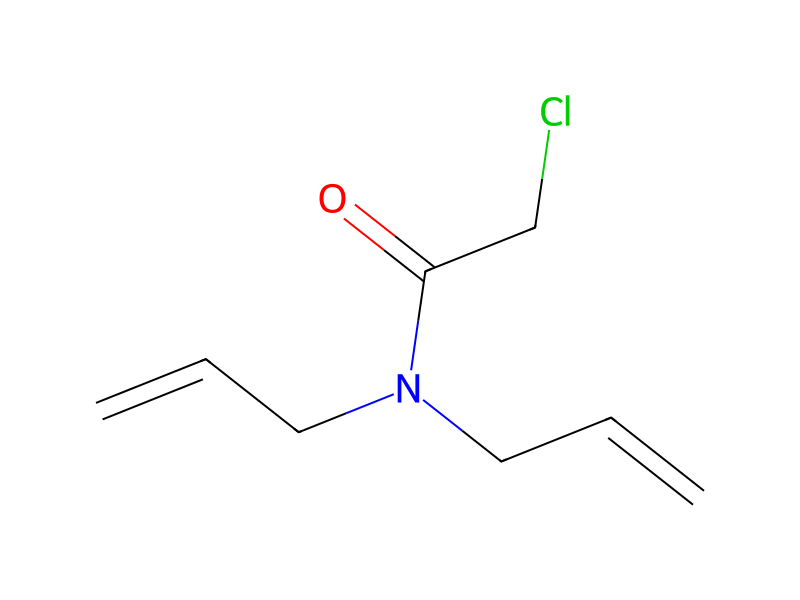
93-71-0C=CCN(CC=C)C(=O)CClMDBGGTQNNUOQRC-UHFFFAOYSA-NRandox is an amber liquid. (NTP, 1992)
93-71-0DTXSID2041591CHEMBL2251312、CHEMBL2252189CHEBI:82170Pesticides -> Herbicides, Other
Pesticide (Allidochlor) -> USDA PDB
1.088 at 77 °F (NTP, 1992) - Denser than water; will sink
1.088 @ 25 °C/15.6 °C
OILY AMBER LIQUID OR GRANULES
Liquid
Slighty soluble (NTP, 1992)
Soluble in alcohol, hexane and xylene
Soluble in ethanol
FAIRLY SOL IN PETROLEUM ETHER, TRICHLOROMETHANE
GREATER THAN 1.97% IN CARBON DISULFIDE @ 25 °C; GREATER THAN 50% IN CHLOROBENZENE, CHLOROFORM, CYCLOHEXANONE @ -50 °C; 50% IN ISOPROPYL ALCOHOL @ -18 °C; GREATER THAN 20% IN KEROSENE OR DIESEL OIL @ 49 °C
In water, 1.97X10+4 mg/l @ 25 °C
165 °F at 0.3 mmHg (NTP, 1992)
92 °C @ 2 mm Hg
安全情報は参考情報です。供給元の安全データシート(SDS)、適用法令、専門家による評価に代わるものではありません。
Warning
H302: Harmful if swallowed [Warning Acute toxicity, oral]
P264, P264+P265, P270, P273, P280, P301+P317, P302+P352, P305+P351+P338, P317, P321, P330, P332+P317, P337+P317, P362+P364, P391, and P501 (click each P-code to see the statement)
Warning
H302 (100%): Harmful if swallowed [Warning Acute toxicity, oral]
P264, P264+P265, P270, P273, P280, P301+P317, P302+P352, P305+P351+P338, P317, P321, P330, P332+P317, P337+P317, P362+P364, P391, and P501 (click each P-code to see the statement)
A moderate skin and eye irritant; High-dose animal studies: No adverse effects in 90-day studies of rats and dogs fed up to 200 ppm; Caused skin burns in rabbits; Convulsions, coma, and liver degeneration at lethal doses; [HSDB] May cause severe skin and eye irritation; [CAMEO] A skin and eye irritant; [eChemPortal: ESIS]
Acute Tox. 4 (100%)
Acute toxicity - category 4
Inhibition of cell respiration
...AMIDE HERBICIDES INHIBIT PHOTOLYSIS OF WATER (HILL REACTION). /AMIDE HERBICIDES/
...CDAA /N,N-DIALLYLCHLOROACETAMIDE/...MAY BE DEGRADED IN CORN.../BY A NONENZYMATIC REACTION/ WITH SUBSEQUENT HYDROLYSIS TO GLYCOLIC ACID & DIALLYLAMINE.
/METABOLISM OF N,N-DIALLYLCHLOROACETAMIDE (CDAA) WAS STUDIED IN CORN & SOYBEANS GROWN ON SOIL TREATED WITH CARBONYL-LABELED (14)C-CDAA/. GLYCOLIC ACID AND POSSIBLY LACTIC ACID OR GLYCERIC ACIDS WERE...THE MOST LIKELY METABOLITE CANDIDATES /AS SHOWN BY CHROMATOGRAPHIC ANALYSIS OF CORN AND SOYBEAN EXTRACTS/...EXAMINATION...OF SOYBEAN EXTRACTS 2 DAYS AFTER EMERGENCE INDICATED PRESENCE OF A COMPD BEHAVING LIKE GLYOXYLIC RATHER THAN GLYCOLIC ACID.
PLANT METABOLISM STUDIES OF /N,N-DIALLYLCHLOROACETAMIDE/ CDAA-(14)C INDICATED THAT THIS COMPOUND WAS DEGRADED INTO CO2 & GLYCOLLIC ACID WITH SUBSEQUENT INCORPORATION OF LABEL IN ALL FRACTIONS. CDAA ALSO REACTED WITH SENSITITIVE SULFHYDRYL GROUPS.
WHEN (14)C-CDAA /N,N-DIALLYLCHLOROACETAMIDE/ ADMIN AS SINGLE DOSE TO RATS, 86% WAS EXCRETED IN URINE DURING FIRST 48 HR; 16%, IN FECES. ABOUT 89% OF URINARY (14)C WAS THE MERCAPTURIC ACID OF CDAA. STUDIES ALSO SHOWED THAT CDAA REACTED NON-ENZYMATICALLY WITH GLUTATHIONE.
For more Metabolism/Metabolites (Complete) data for RANDOX (7 total), please visit the HSDB record page.
...CARBONYL-LABELED (14)C-DIALLYLCHLOROACETAMIDE TREATED PLANTS /WERE GROWN/ IN CLOSED SYSTEM... /IT WAS SHOWN/...THAT MORE THAN 50% OF RADIOACTIVITY ABSORBED THROUGH ROOT SYSTEM OF CORN SEEDLINGS WAS EVOLVED AS (14)CO2, INDICATING THAT PLANT READILY DEGRADED DIALLYLCHLOROACETAMIDE MOLECULE.
CORN & SOYBEANS WERE CAPABLE OF RAPID UPTAKE OF RADIOACTIVITY FROM SOIL TREATED WITH (14)C-CARBONYL DIALLYLCHLOROACETAMIDE. UPTAKE REACHED AT 4-5 DAYS FOLLOWING EMERGENCE, WITH...MAX SPECIFIC ACTIVITY OF 85,000 CPM/G DRY WT FOR SOYBEANS AT 5 DAYS & 30,000 CPM/G DAY WT FOR CORN AT 4 DAYS.
.../CORN/ PLANTS...TREATED WITH ALLYL-(14)C-DIALLYLCHLOROACETAMIDE & GROWN TO MATURITY.../THEN/ HARVESTED & FRACTIONATED... LOW LEVEL OF RADIOACTIVITY...DISTRIBUTED AMONG /HULLS, GERMS & ENDOSPERM/. ...RANDOM DISTRIBUTION OF RADIOACTIVITY...SUGGESTS...NO UNUSUAL METAB...FORMED...AS RESULT OF DEGRADATION OF ALLYLIC MOIETY...
読み込み中…
145 °C
DECOMP TEMP: 125 °C
0.0094 [mmHg]
9.40X10⁻³ mm Hg @ 20 °C
化学的特性Amber liquid or granules.Slightly soluble in water; soluble in alcohol, hexane, and xylene.
Acute Tox. 4 *
...ON CONTACT WITH ACIDS OR ACID FUMES, THEY EVOLVE HIGHLY TOXIC CHLORIDE FUMES. /CHLORIDES/
Incompatible with alkaline and acidic formulating substances.
EYES: First check the victim for contact lenses and remove if present. Flush victim's eyes with water or normal saline solution for 20 to 30 minutes while simultaneously calling a hospital or poison control center. Do not put any ointments, oils, or medication in the victim's eyes without specific instructions from a physician. IMMEDIATELY transport the victim after flushing eyes to a hospital even if no symptoms (such as redness or irritation) develop.
SMALL SPILLS AND LEAKAGE: If you spill this chemical, FIRST REMOVE ALL SOURCES OF IGNITION. Then, use absorbent paper to pick up all liquid spill material. Your contaminated clothing and absorbent paper should be sealed in a vapor-tight plastic bag for eventual disposal. Solvent wash all contaminated surfaces with 60-70% ethanol followed by washing with a soap and water solution. Do not reenter the contaminated area until the Safety Officer (or other responsible person) has verified that the area has been properly cleaned.
SRP: At the time of review, criteria for land treatment or burial (sanitary landfill) disposal practices are subject to significant revision. Prior to implementing land disposal of waste residue (including waste sludge), consult with environmental regulatory agencies for guidance on acceptable disposal practices.
MINIMUM PROTECTIVE CLOTHING: If Tyvek-type disposable protective clothing is not worn during handling of this chemical, wear disposable Tyvek-type sleeves taped to your gloves.
WEAR RUBBER GLOVES & GOGGLES.
WHEN COMBINED WITH TRICHLOROBENZYL CHLORIDE (TCBC), IT IS OFFERED AS A BROADER-SPECTRUM MIXT FOR WEED CONTROL IN CORN... COMBINATION, HOWEVER, DOES HAVE DISADVANTAGES OF CONSIDERABLY INCR IRRITATING PROPERTIES, /RESULTING FROM BOTH/...& PROLONGED PERSISTENCE IN SOIL...
N,N-DIALLYL-2,2-DICHLOROACETAMIDE AN EFFECTIVE PROTECTANT FOR CORN AGAINST INJURY BY THIOCARBAMATE HERBICIDES.
...STUDIES USING CO2 TRAIN SHOWED (14)CO2 LIBERATION FROM SOIL TREATED WITH EITHER (14)C-CARBONYL- OR (14)C-ALLYL-LABELED CDAA /N,N-DIALLYLCHLOROACETAMIDE/. AMT GENERATED REPRESENTED APPROX 20% OF TOTAL (14)CO2 TRAPPED. THUS SOME DECOMP...OCCURS IN SOIL.
DISSIPATION STUDIES IN SOIL USING CHEM ANAL FOR DETERMINATION...INDICATED RAPID LOSS OF PARENT COMPD. T/2 WAS ESTIMATED TO BE APPROX 16-18 DAYS & WAS FAIRLY REPRESENTATIVE OVER BROAD RANGE OF SOIL TYPES & CLIMATIC CONDITIONS. SOME...LOSS WOULD BE ATTRIBUTABLE TO VOLATILITY...
TERRESTRIAL FATE: Based on a classification scheme(1), an estimated Koc value of 230(SRC), determined from a structure estimation method(2), indicates that Randox is expected to have moderate mobility in soil(SRC). Volatilization of Randox from moist soil surfaces is not expected to be an important fate process(SRC) given an estimated Henry's Law constant of 1.07X10⁻⁷ atm-cu m/mole(SRC), derived from its vapor pressure, 9.40X10⁻³ mm Hg(4), and water solubility, 1.97X10+4 mg/l(3). Randox is not expected to volatilize from dry soil surfaces(SRC) based upon a vapor pressure of 9.40X10⁻³ mm Hg(4). Biodegradation may be important as one study found 100% degradation in 3 months in soil(5).
AQUATIC FATE: Based on a classification scheme(1), an estimated Koc value of 230(SRC), determined from an estimation method(2), indicates that Randox is expected to adsorb moderately to suspended solids and sediment(SRC). Volatilization from water surfaces is not expected(3) based upon an estimated Henry's Law constant of 1.07X10⁻⁷ atm-cu m/mole(SRC), derived from its vapor pressure, 9.40X10⁻³ mm Hg(8), and water solubility, 1.97X10+4 mg/l(4). According to a classification scheme(5), an estimated BCF of 5(SRC), from an estimated log Kow of 1.79(6) and a regression-derived equation(7), suggests the potential for bioconcentration in aquatic organisms is low. Biodegradation may be important as one study found 100% degradation in 3 months in soil(9).
ATMOSPHERIC FATE: According to a model of gas/particle partitioning of semivolatile organic compounds in the atmosphere(1), Randox, which has a vapor pressure of 9.40X10⁻³ mm Hg at 20 °C(2), is expected to exist solely as a vapor in the ambient atmosphere. Vapor-phase Randox is degraded in the atmosphere by reaction with photochemically-produced hydroxyl radicals(SRC); the half-life for this reaction in air is estimated to be 5 hrs(SRC), calculated from its rate constant of 7.55X10⁻¹¹ cu cm/molecule-sec at 25 °C(3) determined using a structure estimation method(3).
ADSORPTION /IN BASIC SOIL IS/ DIRECTLY PROP TO COLLOID CONTENT OF SOIL.
Duration of /chemical/ activity 3-6 weeks, depending on soil.
Using a structure estimation method based on molecular connectivity indices(1), the Koc for Randox can be estimated to be 230(SRC). According to a classification scheme(2), this estimated Koc value suggests that Randox is expected to have moderate mobility in soil.
...HERBICIDE APPLIED IN FULL STRENGTH TO SKIN CAUSES SEVERE IRRITATION AND TEMPORARY SENSITIVITY TO COLD (FOR 4-6 HR)... UNDILUTED MATERIAL IN THE EYE HAS PRODUCED SERIOUS OCULAR DAMAGE.
NATURE OF TOXIC SYNDROME AFTER ORAL ADMIN HAS NOT BEEN DESCRIBED.
Randox's former production and use(3) as a selective pre-planting or pre-emergence herbicide(1) resulted in its direct release to the environment through various waste streams(SRC). The material is believed to be no longer manufactured, or marketed for crop protection use(2).
MICROBIAL BREAKDOWN /IS/ RESPONSIBLE FOR MAJOR DECOMP.
AEROBIC: Randox degraded to innocuous levels in soil in 3 months using 8 California soils treated with concentrations of Randox ranging from 2.5 to 160 ppm(1).
An estimated BCF of 5 was calculated for Randox(SRC), using an estimated log Kow of 1.79(1) and a regression-derived equation(2). According to a classification scheme(3), this BCF suggests the potential for bioconcentration in aquatic organisms is low.
...IN ABSENCE OF ADSORPTIVE FORCES, 4 LB/ACRE VOLATILIZES IN LESS THAN 8 HR AT 7 °C OR ABOVE.
The Henry's Law constant for Randox is estimated as 1.07X10⁻⁷ atm-cu m/mole(SRC), derived from its vapor pressure, 9.40X10⁻³ mm Hg(1), and water solubility, 1.97X10+4 mg/l(2). This Henry's Law constant indicates that Randox is expected to be essentially nonvolatile from water surfaces(3). Randox's estimated Henry's Law constant(1,2) indicates that volatilization from moist soil surfaces will not occur(SRC). Randox is not expected to volatilize from dry soil surfaces(SRC) based upon a vapor pressure of 9.40X10⁻³ mm Hg(1).
MALE & FEMALE RATS--30 DAY DIET INCL 10% CDAA CORN OIL SOLN WITH DOSAGE OF 70 MG/KG DAILY--NO SIGNIFICANT GROWTH EFFECTS AFTER 30 DAYS. PATHOLOGICAL EXAM SHOWED EXCESSIVE PRODN OF MUCUS &...HYPEREMIA OF GASTRIC MUCOSA...HYPEREMIA OF WALLS OF SMALL INTESTINES, &...EXCESSIVE EPITHELIAL DETRIS IN CONVOLUTED TUBULES OF KIDNEY.
ORAL 90-DAY RAT & DOG INGESTED @ 20, 62, & 200 PPM REVEALED NO STATISTICAL ADVERSE EFFECTS DURING A STUDY OF 8 PARAMETERS. APPLICATION TO INTACT RABBIT SKIN RESULTED IN IRRITATION CONSISTING OF SEVERE ERYTHEMA & EDEMA WITH BLISTERING & SUBCUTANEOUS DAMAGE. VAPORS ARE MODERATELY IRRITATING. OUTWARD TOXICITY SYMPTOMS IN RATS SHOWED EXCESSIVE SALIVATION, DISCOMFORT, COMA, & CONVULSIONS. DIARRHEA OCCURRED IN ANIMALS SURVIVING 12-36 HR. LIVER DEGENERATION OCCURRED.
APPLICATION TO INTACT RABBIT SKIN RESULTED IN IRRITATION CONSISTING OF SEVERE ERYTHEMA & EDEMA WITH BLISTERING & SUBCUTANEOUS DAMAGE. VAPORS ARE MODERATELY IRRITATING.
OUTWARD TOXICITY SYMPTOMS IN RATS SHOWED EXCESSIVE SALIVATION, DISCOMFORT, COMA, & CONVULSIONS. DIARRHEA OCCURRED IN ANIMALS SURVIVING 12-36 HR. LIVER DEGENERATION OCCURRED.
HYDROLYSIS IS SECONDARY...TO MICROBIAL BREAKDOWN...RESPONSIBLE FOR DECOMP.
The rate constant for the vapor-phase reaction of Randox with photochemically-produced hydroxyl radicals has been estimated as 7.55X10⁻¹¹ cu cm/molecule-sec at 25 °C(SRC) using a structure estimation method(1). This corresponds to an atmospheric half-life of about 5 hours(SRC) at an atmospheric concentration of 5X10+5 hydroxyl radicals per cu cm(1).
/IT IS/ ABSORBED MAINLY BY COTYLEDONS OF GRASS SEEDLING. /IT IS/ PROBABLE THAT DIALLYLCHLOROACETAMIDE ACCUMULATES IN THE CROWN & FIRST INTERNODE OF SEEDLING.
For more Absorption, Distribution and Excretion (Complete) data for RANDOX (6 total), please visit the HSDB record page.
Formerly used as a selective pre-emergence herbicide for corn, soy beans, vegetables, and other crops; [HSDB]
No longer registered as a pesticide for use in the US; [HSDB]
Farming (Pesticides) [Category: Industry]
For Allidochlor (USEPA/OPP PC code 019301) there are 0 labels match./SRP: Not registered for current use in the U.S./
Herbicide (discontinued)
Selective pre-planting or pre-emergence herbicide /Former use/
Prepared from chloroacetyl chloride and diallylamine: Speziale, Hamm, J Am Chem Soc 78, 2556 (1956)...Bruce Hanslick, US patent 2,844,629 (1958 to Am Home Prods).
Prepared from chloroacetyl chloride and diallylamine
USEPA/OPP PC Code 019301; Trade Names: Randox, CP 6343, NCI-C04035.
4 LB/GALLON EMULSIFIABLE CONCENTRATE.
FOR CELERY, TOMATOES, POTATOES, RANDOX + VEGADEX HERBICIDES.
Granules, 20%.
Acetamide, 2-chloro-N,N-di-2-propen-1-yl-: ACTIVE
/RANDOX/ CONTROLS MANY ANNUAL GRASSES AND BROADLEAF IN CORN, SOYBEANS, SORGHUM, LIMA BEANS, SNAP BEANS, TOMATO TRANSPLANTS, DRY BEANS, CABBAGE, SWEET POTATOES, ONIONS, CELERY, SUGARCANE.
ALLIDOCHLOR IS A SELECTIVE PRE-EMERGENCE HERBICIDE...EG 0.025 PPM GIVES AN 80% INHIBITION OF GROWTH OF RYE GRASS.
THIS...HERBICIDE WAS...INTRODUCED...FOR USE IN CORN AND SOYBEANS TO CONTROL FOXTAIL, BROMEGRASS, CHEATGRASS, CRABGRASS, AND CERTAIN BROADLEAF WEEDS.
PREEMERGENCE (SPRAY OR GRANULAR, BAND OR BROADCAST), GROUND APPLICATION. POSTEMERGENCE, MULTIPLE TREATMENT ON ONIONS, & POSTEMERGENCE IN SUGARCANE. RATES: 4-5 LB/ACRE FOR MOST CROPS. ... USUAL CARRIER: SPRAY: WATER, 20 GPA OR MORE. MIN AGITATION...DURING APPLICATION. GRANULAR: ATTAPULGITE CLAY.
For more General Manufacturing Information (Complete) data for RANDOX (6 total), please visit the HSDB record page.
使用Pre-emergent herbicide.
一般的な説明Amber liquid.
定義An amide that modi- fies RNA and protein biosynthesis and inhibits cell division in primary meristems.