
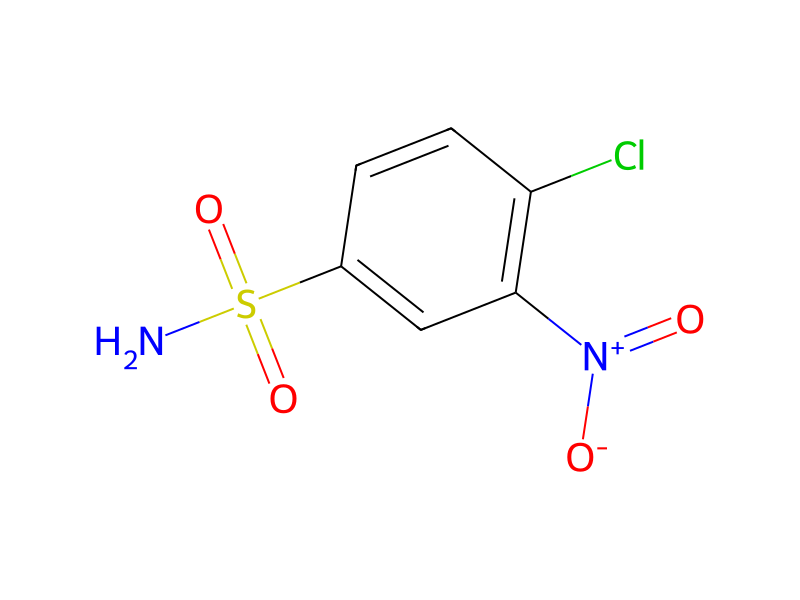
基本情報
- 標準SMILES
NS(=O)(=O)c1ccc(Cl)c([N+](=O)[O-])c1- InChIKey
SPZGXONNVLTQDE-UHFFFAOYSA-N- 分子式
- C6H5ClN2O4S
- 平均分子量
- 236.63 g/mol
- 単同位体質量
- 235.96585532
名称と識別子
- 優先名称
- 4-Chloro-3-nitrobenzenesulfonamide
- IUPAC
- 4-chloro-3-nitrobenzenesulfonamide
- 現地名
- 3-ニトロ-4-クロロベンゼンスルホンアミド
- 英語名
- 4-Chloro-3-nitrobenzenesulfonamide
- 分子式
- C6H5ClN2O4S
- 分子量
- 236.63
名称と別名
4-CHLORO-3-NITROBENZENESULFONAMIDEBenzenesulfonamide, 4-chloro-3-nitro-4-Chloro-3-nitrobenzenesulphonamideHSDB 2568UNII-2O1T5ZXF222O1T5ZXF22EINECS 202-559-8NSC 512314NSC-512314DTXSID80526494-CHLORO-3-NITROBENZENESULPHONAMIDE [HSDB]RefChem:98444
名称をさらに表示
4-クロロ-3-ニトロベンゼンスルホンアミド3-ニトロ-4-クロロベンゼンスルホンアミドYELLOW SULFONEBUTTPARK 76\07-884-Chloro-3-Nitrosulfonamide4-CHLORO-3-NITROSULFAMYLBENZENE2-NITROCHLOROBENZENE-4-SULFONAMIDEO-NITROCHLOROBENZENE-P-SULFONAMIDE4-chloro-3-nitro-benzenesulfonamid
DTXCID9031222Benzenesulfonamide, 4chloro3nitroSPZGXONNVLTQDE-UHFFFAOYSA-N97-09-63-Nitro-4-chlorobenzenesulfonamide4-chloro-3-nitrobenzene-1-sulfonamideMFCD000357834-Chloro-3-nitro-benzenesulfonamide
データベース識別子
- CAS
97-09-6- PubChem CID
- 7324
- DTXSID
DTXSID8052649- ChEMBL
CHEMBL51663- UNII
- 2O1T5ZXF22
- EC Number
- 202-559-8
- Nikkaji
- J30.819F
物性
構造計算による物性
- XLogP
- 0.8
- 極性表面積
- 114 Ų
- 水素結合供与体数
- 1
- 水素結合受容体数
- 5
- 回転可能結合数
- 1
- 重原子数
- 14
- 形式電荷
- 0
- 複雑度
- 320
実験および物理化学的性質
Chemical ClassesNitrogen Compounds -> Other Aromatics (Nitrogen)
LogP
log Kow = 0.66
1.91
Vapor Pressure0.0000018 [mmHg]
Physical DescriptionSolid; [MSDSonline]
物理化学的性質
- 融点
- 25 · 25-35 °C
- 沸点
- 175 · 175-176 °C
- 比重(密度)
- 1.5966 · 1.5966 (rough estimate)
- 屈折率
- 1.6 · 1.6000 (estimate)
- 貯蔵温度
- Inert atmosphere,Room Temperature
- 酸解離定数(Pka)
- 9.28 · 9.28±0.60(Predicted)
- 外見
- crystalline powder
- 色
- White to off white
- 水溶解度
- 224.8 mg/L · 224.8mg/L(15℃)
- Henry's Law Constant
- 8.2 · 8.2×103 mol/(m3Pa) at 25℃, HSDB (2015)
- InChI
- InChI=1S/C6H5ClN2O4S/c7-5-2-1-4(14(8,12)13)3-6(5)9(10)11/h1-3H,(H2,8,12,13)
- InChIKey
- SPZGXONNVLTQDE-UHFFFAOYSA-N
- SMILES
- C1(S(N)(=O)=O)=CC=C(Cl)C([N+]([O-])=O)=C1
- CAS データベース
- 97 · 97-09-6(CAS DataBase Reference)
- EPAの化学物質情報
- 4 · Benzenesulfonamide, 4-chloro-3-nitro- (97-09-6)
安全と法規制
GHS分類
GHS Classification
Warning
H315 (96.7%): Causes skin irritation [Warning Skin corrosion/irritation]
P261, P264, P264+P265, P271, P280, P302+P352, P304+P340, P305+P351+P338, P319, P321, P332+P317, P337+P317, P362+P364, P403+P233, P405, and P501 (click each P-code to see the statement)
Aggregated GHS information provided per 60 reports by companies from 7 notifications to the ECHA C&L Inventory. Each notification may be associated with multiple companies.
危険有害性情報
Regulatory InformationStatus: Active Update: 22-03-2021 https://echa.europa.eu/registration-dossier/-/registered-dossier/32354
Hazards Summary
Used therapeutically, sulfonamides can cause a range of hypersensitivity reactions including rashes and injury to the liver and kidneys; Methemoglobinemia has been reported after overdose; [HSDB] An irritant; May cause skin sensitization; [MSDSonline]
Hazard Classes and CategoriesSkin Irrit. 2 (96.7%)
安全と保護具
Disposal Methods
SRP: At the time of review, criteria for land treatment or burial (sanitary landfill) disposal practices are subject to significant revision. Prior to implementing land disposal of waste residue (including waste sludge), consult with environmental regulatory agencies for guidance on acceptable disposal practices.
毒性情報
Environmental Fate
TERRESTRIAL FATE: Based on a recommended classification scheme(1), an estimated Koc value of 54(SRC), determined from an experimental log Kow(2) and a recommended regression-derived equation(3), indicates that 4-chloro-3-nitrobenzenesulfonamide should have very high mobility in soil(SRC). Volatilization of 4-chloro-3-nitrobenzenesulfonamide should not be important from moist soil surfaces(SRC) given an estimated Henry's Law constant of 1.2X10⁻⁹ atm-cu m/mole(4,SRC), or from dry soil surfaces(SRC) based on an estimated vapor pressure of 1.8X10⁻⁶ mm Hg(5,SRC). Insufficient data are available to determine the rate or importance of biodegradation of 4-chloro-3-nitrobenzenesulfonamide in soil(SRC).
AQUATIC FATE: An estimated Koc value of 54(SRC), determined from an experimental log Kow(1) and a recommended regression-derived equation(2), indicates that 4-chloro-3-nitrobenzenesulfonamide should not adsorb to suspended solids and sediment(SRC) in the water(2,SRC). 4-Chloro-3-nitrobenzenesulfonamide would be essentially non-volatile from water surfaces based on an estimated Henry's Law constant of 1.2X10⁻⁹ atm-cu m/mole(SRC), developed using a fragment constant estimation method(3). An estimated BCF value of 1.9(2,SRC), from an experimental log Kow(1), suggests that 4-chloro-3-nitrobenzenesulfonamide will not bioconcentrate in aquatic organisms(SRC) according to a recommended classification scheme(4). Insufficient data are available to determine the rate or importance of biodegradation of 4-chloro-3-nitrobenzenesulfonamide in water(SRC).
ATMOSPHERIC FATE: According to a model of gas/particle partitioning of semivolatile organic compounds in the atmosphere(1), 4-chloro-3-nitrobenzenesulfonamide, which has an estimated vapor pressure of 1.8X10⁻⁶ mm Hg at 25 °C(2,SRC) will exist as both a vapor and particulate in the ambient atmosphere. Vapor-phase 4-chloro-3-nitrobenzenesulfonamide is degraded in the atmosphere by reaction with photochemically produced hydroxyl radicals(SRC); the half-life for this reaction in air is estimated to be about 438 days(3,SRC). Particulate-phase 4-chloro-3-nitrobenzenesulfonamide may be physically removed from the air by wet and dry deposition(SRC).
Adverse EffectsOccupational hepatotoxin - Secondary hepatotoxins: the potential for toxic effect in the occupational setting is based on cases of poisoning by human ingestion or animal experimentation.
Soil Adsorption/Mobility
The Koc of 4-chloro-3-nitrobenzenesulfonamide is estimated as approximately 54(SRC), using an experimental log Kow of 0.66(1) and a regression-derived equation(2,SRC). According to a recommended classification scheme(3), this estimated Koc value suggests that 4-chloro-3-nitrobenzenesulfonamide should have very high mobility in soil(SRC).
Artificial Pollution Sources4-Chloro-3-nitrobenzenesulfonamide's production and use as a dye intermediate(1) may result in its release to the environment through various waste streams(SRC).
Environmental Bioconcentration
An estimated BCF value of 1.9 was calculated for 4-chloro-3-nitrobenzenesulfonamide(SRC), using an experimental log Kow of 0.66(1) and a recommended regression-derived equation(2). According to a recommended classification scheme(3), this BCF value suggests that bioconcentration in aquatic organisms will not be an important fate process(SRC).
Volatilization from Water/Soil
The Henry's Law constant for 4-chloro-3-nitrobenzenesulfonamide is estimated as 1.2X10⁻⁹ atm-cu m/mole(SRC) using a fragment constant estimation method(1). This value indicates that 4-chloro-3-nitrobenzenesulfonamide will be essentially nonvolatile from water surfaces(2,SRC). 4-Chloro-3-nitrobenzenesulfonamide's vapor pressure, 1.8X10⁻⁶ mm Hg(3,SRC) and Henry's Law constant(1,SRC) indicate that volatilization from dry or moist soil should not occur(SRC).
Environmental Abiotic Degradation
The rate constant for the vapor-phase reaction of 4-chloro-3-nitrobenzenesulfonamide with photochemically produced hydroxyl radicals has been estimated as 3.8X10⁻¹⁴ cu cm/molecule-sec at 25 °C(SRC) using a structure estimation method(1,SRC). This corresponds to an atmospheric half-life of about 438 days at an atmospheric concentration of 5X10+5 hydroxyl radicals per cu cm(1,SRC).
Environmental Fate/Exposure Summary
4-Chloro-3-nitrobenzenesulfonamide's production and use as a dye intermediate may result in its release to the environment through various waste streams. If released to soil, 4-chloro-3-nitrobenzenesulfonamide should have very high mobility. Volatilization of 4-chloro-3-nitrobenzenesulfonamide should not be important from moist or dry soil surfaces. Insufficient data are available to determine the rate or importance of biodegradation of 4-chloro-3-nitrobenzenesulfonamide in soil or water. If released to water, 4-chloro-3-nitrobenzenesulfonamide should not adsorb to suspended solids and sediment. 4-Chloro-3-nitrobenzenesulfonamide would be essentially non-volatile from water surfaces. An estimated BCF value of 1.9 suggests that 4-chloro-3-nitrobenzenesulfonamide will not bioconcentrate in aquatic organisms. If released to the atmosphere, 4-chloro-3-nitrobenzenesulfonamide will exist as both a vapor and particulate. Vapor-phase 4-chloro-3-nitrobenzenesulfonamide is degraded in the atmosphere by reaction with photochemically produced hydroxyl radicals with an estimated half-life of about 438 days. Particulate-phase 4-chloro-3-nitrobenzenesulfonamide may be physically removed from the air by wet and dry deposition. (SRC)
安全データ
- tsca
- TSCA listed
- hs_code
- 2935909099
- hazard_code
- Xi
- hazard_note
- Irritant
- 有毒物質データの
- 97-09-6(Hazardous Substances Data)
化学と産業
用途と製造
Uses
Used as a chemical intermediate for azo dyes; [HSDB]
CHEMICAL INTERMEDIATE FOR AZO DYES
Dye intermediate
U.S. Production
(1972) 2.3X10+8 GRAMS
(1975) 7.90X10+7 GRAMS
(1976) 3.16X10+5 kg
Methods of ManufacturingPOSSIBLY BY REACTION OF 4-CHLORO-3-NITROBENZENESULFONYLCHLORIDE WITH AQUEOUS AMMONIA
General Manufacturing InformationBenzenesulfonamide, 4-chloro-3-nitro-: INACTIVE
上流・下流製品情報
上流原料
下流製品
サプライヤー50 社
衢州润东化工有限公司0570-8789886 18892685668 · [email protected]
韶远科技(上海)有限公司021-50795510 4000665055 · [email protected]
毕佳索(上海毕得医药科技股份有限公司)400-6005915 · [email protected]
浙江晨和生物医药有限公司0573-0573-86190920 13385833650 · [email protected]
苏州启航生物科技有限公司18151111370 · [email protected]
上海腾准生物科技有限公司19821570922 · [email protected]
温州共赢化学有限公司+86-0086-577-64498589 +86-15355981851 · [email protected]
济南中科一通化工有限公司0531-88658009 15552873609 · [email protected]
T&W GROUP021-61551611 13296011611 · [email protected]
Dayang Chem (Hangzhou) Co.,Ltd.+86-0571-88938639 17705817739 · [email protected]
山东中科泰斗化学有限公司0531-88682301 18595278760 · [email protected]
Syntechem Co.,Ltd[email protected]
南通萧畅医药贸易有限公司0513-82104991 18862997351 · [email protected]
安耐吉化学&3A(安徽泽升科技股份有限公司)400-0056266 · [email protected]
常州安轩化工有限公司13912302692 · [email protected]
济南德信佳生物科技有限公司0531-82375886 13001715031 · [email protected]
上海业立嘉实业有限公司13564383169 · [email protected]
嘉兴市艾森化工有限公司0573-85285100 18627885956 · [email protected]
武汉丰泰威远科技有限公司+86-27-8746-5837 +86-18627785180 · [email protected]
南京药石科技股份有限公司4000255188 · [email protected]
武汉丰泰威远科技有限公司027-87465837 19945049750 · [email protected]
广东谦进化学试剂有限公司0751-2818792 13435114148 · [email protected]
山东西亚化学有限公司13355009207 13355009207 · [email protected]
江苏艾康生物医药研发有限公司025-66113011 13913916777 · [email protected]
上海伯韵医药科技有限公司13817873692 · [email protected]
上海泽信化工科技有限公司021-60136491 15901897992
上海毕得医药科技股份有限公司400-164-7117 18317119277 · [email protected]
北京奥秘佳得医药科技有限公司+86-13522808617 · [email protected]
重庆星灿医药科技有限公司13594048950 19923294409 · [email protected]
成都零六生物科技有限公司400-1166-196 13458535857 · [email protected]
上海卓因生物科技有限公司021-61317773 · [email protected]
上海有朋化工有限公司021-69005955 13701776567 · [email protected]
北京海力扬化学科技有限公司13718199399 · [email protected]
北京欣赛维化学科技有限公司010-56218822 13717722232 · [email protected]
四川海诺威科技有限公司13708085536 13708085536 · [email protected]
上海凯赛化工有限公司021-33516722 13701817765 · [email protected]
上海彤源化工有限公司021-021-69182866 13701855675 · [email protected]
陕西缔都医药化工有限公司029-81024372 17792795018 · [email protected]
北京华扬致成科技有限公司13716033033 · [email protected]
上海蓝润化学有限公司021-69515658 ; 69515628 13701998368 · [email protected]
上海容立化学科技有限公司021-69992220 13701886816 · [email protected]
上海康拓化工有限公司021-69185552 13701777608 · [email protected]
武汉贝乐叶生物医药科技有限公司18086118078 · [email protected]
普善实业(陕西)有限公司029-81310890 18165209495 · [email protected]
潍坊市前进精细化工有限公司18753684562 · [email protected]
南京伶亚生物医药科技有限公司18068075658 · [email protected]
安世达(山东)新材料科技有限公司18053179586
成都瑞欧克科技有限公司028-64353063 · [email protected]
Henan Alfa Chemical Co., Ltd+8618339805032 · [email protected]
厦门志信化学有限公司+86-5922680277 +86-13806087780 · [email protected]
関連反応
136 件


関連ノート
読み込み中…