
トリエチルボラン (約1mol/Lテトラヒドロフラン溶液)
Triethylborane
データを補完しています。しばらくしてからページを更新すると最新の内容を表示できます
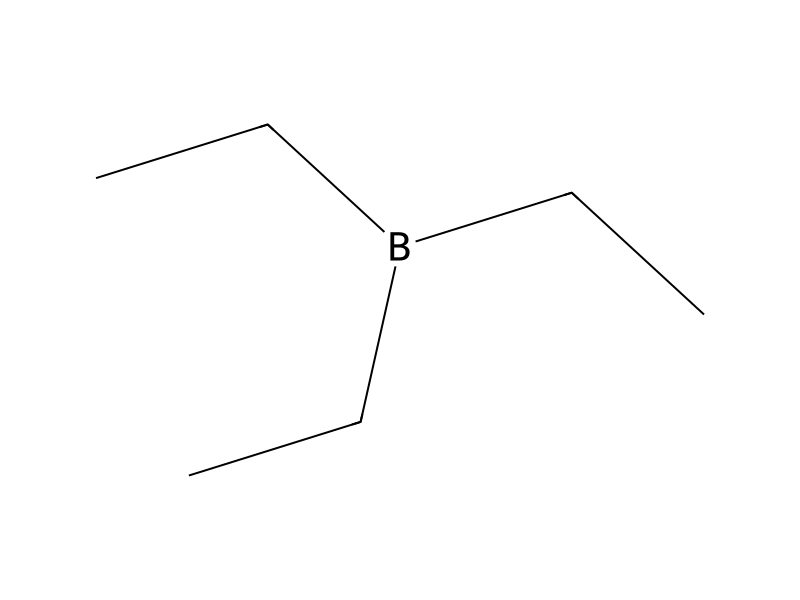
基本情報
- CAS
97-94-9- 標準SMILES
CCB(CC)CC- InChIKey
LALRXNPLTWZJIJ-UHFFFAOYSA-N- 分子式
- C6H15B
- 平均分子量
- 98 g/mol
- 単同位体質量
- 98.12668088
概要
used in the radical deuteration reaction of ribonucleoside derivatives
名称と識別子
- 優先名称
- Triethylborane
- IUPAC
- triethylborane
- 現地名
- トリエチルボラン (約1mol/Lテトラヒドロフラン溶液)
- 英語名
- Triethylborane
- 分子式
- C6H15B
- 分子量
- 97.99
名称と別名
Triethylborane97-94-9TRIETHYLBORONBorane, triethyl-TriethylborineBoron triethylBoron ethylZ3S980Z4P3DTXSID2052653RefChem:191525DTXCID9031226202-620-9
名称をさらに表示
トリエチルボラン (約1mol/Lテトラヒドロフラン溶液)トリエチルボラントリエチルほう素トリエチルボロントリエチルボラン,N-ヘキサン溶液トリエチルボラン,テトラヒドロフラン溶液トリエチルボラン (約11%テトラヒドロフラン溶液, 約1mol/L)トリエチルボラン,N‐ヘキサン溶液トリエチルボラン, 1M SOLN. IN THFトリエチルボラン 溶液トリエチルボラン,テトラヒドロフラン溶液,AcroSealR(C2H5)3BBorethylTriethylbotriethyl-boranborane,triethyl-
HSDB 897EINECS 202-620-9UNII-Z3S980Z4P3BRN 1731462BEt3Et3BTriethylborane (1.0 M in THF)4-04-00-04359 (Beilstein Handbook Reference)
データベース識別子
- CAS
97-94-9- PubChem CID
- 7357
- DTXSID
DTXSID2052653- UNII
- Z3S980Z4P3
- EC Number
- 202-620-9
- Nikkaji
- J55.478B
物性
構造計算による物性補完中
- 極性表面積
- 0 Ų
- 水素結合供与体数
- 0
- 水素結合受容体数
- 0
- 回転可能結合数
- 3
- 重原子数
- 7
- 形式電荷
- 0
- 複雑度
- 25.7
実験および物理化学的性質
Chemical ClassesMetals -> Metalloid Compounds (Boron)
Density0.70 g/cu cm at 23 °C
Color/Form
Colorless liquid
Colorless fuming liquid
Solubility
Soluble in alcohol, ether
Miscible with most organic solvents; immiscible with water
Flash Point-33 °F (-36 dec C) (open cup) /table/
Boiling Point95 °C
DecompositionWhen heated to decomposition or upon contact with air it emits toxic acrid smoke and irritating fumes.
Melting Point-93 °C
Vapor Pressure
53.0 [mmHg]
53 mm Hg at 25 °C /est/
Refractive IndexIndex of refraction: 1.3971
Heat of Combustion20,000 BTU/LB
Physical Description
安全と法規制
安全情報は参考情報です。供給元の安全データシート(SDS)、適用法令、専門家による評価に代わるものではありません。
GHS分類
GHS Classification
Danger
H225 (16.4%): Highly Flammable liquid and vapor [Danger Flammable liquids]
P203, P210, P222, P231, P233, P240, P241, P242, P243, P260, P264, P264+P265, P270, P271, P280, P284, P301+P316, P301+P330+P331, P302+P335+P334, P302+P361+P354, P303+P361+P353, P304+P340, P305+P354+P338, P316, P317, P318, P320, P321, P330, P363, P370+P378, P403+P233, P403+P235, P405, and P501 (click each P-code to see the statement)
Aggregated GHS information provided per 256 reports by companies from 10 notifications to the ECHA C&L Inventory. Each notification may be associated with multiple companies.
Danger
H225: Highly Flammable liquid and vapor [Danger Flammable liquids]
危険有害性情報
Regulatory Information
Chemical: Borane, triethyl-
Status: Active Update: 19-08-2021 https://echa.europa.eu/registration-dossier/-/registered-dossier/19345
Borane, triethyl-: HSNO Approval: HSR001432 Approved with controls
Fire PotentialSpontaneously flammable in air
Hazards Summary
Highly irritating; Animals exposed to high inhalation dose have lung irritation and convulsions; Oral LD50 (rat) = 235 mg/kg; . . . would decompose before occupational exposure can occur. [HSDB] Spontaneously flammable; [Merck Index] Corrosive to skin and eyes; [eChemPortal: ERMA] The trialkylborons are not soluble nor reactive in water; Toxic to rats at nonpyrophoric concentrations; [Ullmann] Pyrophoric; A corrosive substance that can cause injury to the skin, eyes, and respiratory tract; [MSDSonline] See Tri-n-butylborane.
RCRA Requirements
[40 CFR 261.32; U.S. National Archives and Records Administration's Electronic Code of Federal Regulations. Available from: http://www.gpoaccess.gov/ecfr as of December 15, 2004)] D003; A solid waste containing triethylboron may become characterized as a hazardous waste when subjected to testing for reactivity as stipulated in 40 CFR 261.23, and if so characterized, must be managed as a hazardous waste.
化学と産業
用途と製造
Uses
Used as a fuel additive, fuel igniter, polymerization catalyst, and intermediate; [HSDB] Used in organic syntheses (radical initiator and blocking agent); [Merck Index]
Petroleum Production and Refining [Category: Industry]
Fuel additive; igniter or fuel for jet and rocket engines; olefin polymerization catalyst; intermediate
Triethylborane (TEB) is used by the USAF as a fuel additive to nonhypergolic propellants to increase fuel ignition speed and retard engine flameout.
Methods of ManufacturingReaction of triethylaluminum and boron halide, or diborane and ethylene
General Manufacturing Information
Borane, triethyl-: ACTIVE
Mixtures with triethylaluminum have been used as hypergolic igniters for rocket propulsion systems.
Because of the low volume of organoboranes and the expensive raw material that are required for manufacture, organoboranes are expensive /chemical products/.
応用分野
用途燃料添加剤、ジェットエンジン、ロケットエンジンの着火剤もしくは燃料、ポリオレフィン重合触媒 (HSDB (2010))
使用Triethylborane reacted with 8-hydroxyquinoline to synthesize three 8--hydroxyquinolato (q) boron compounds B(C2H5)2q (1), BPh2q (2), and B(2-naph)2q (3).
調製方法
製造方法Triethylborane is prepared by reacting triethylaluminium with boron halides or by reacting diborane with ethylene: (C₂H₅)₃Al + BCl₃ → (C₂H₅)₃B + AlCl₃B₂H₆ + CH₂=CH₂ → (C₂H₅)₃B
合成方法ジエチル亜鉛とトリエトキシボランの反応
純化方法It distils at 56-57o/220mm. It can also be purified via its ammonia addition complex which is distilled in a high vacuum, decomposed with dry HCl, and the Et3B is distilled out. It is commercially available as a 15% solution in hexane or as 1M solution in hexane. [Brown J Am Chem Soc 67 376 1945, Bamford et al. J Chem Soc 471 1946, Lin et al. J Organomet Chem 312 277 1986, Beilstein 4 III 1957, 4 IV 4359.]
関連反応
233 件






化合物ノート
読み込み中…