
テレフタロイルクロリド
Terephthaloyl chloride
データを補完しています。しばらくしてからページを更新すると最新の内容を表示できます

基本情報
- CAS
100-20-9- 標準SMILES
O=C(Cl)c1ccc(C(=O)Cl)cc1- InChIKey
LXEJRKJRKIFVNY-UHFFFAOYSA-N- 分子式
- C8H4Cl2O2
- 平均分子量
- 203.02 g/mol
- 単同位体質量
- 201.95883473
概要
cross-links albumin
名称と識別子
- 優先名称
- Terephthaloyl chloride
- IUPAC
- benzene-1,4-dicarbonyl chloride
- 現地名
- テレフタロイルクロリド
- 英語名
- Terephthaloyl chloride
- 分子式
- C8H4Cl2O2
- 分子量
- 203.02
名称と別名
Terephthaloyl chloride100-20-9Terephthaloyl dichloride1,4-BENZENEDICARBONYL DICHLORIDEp-Phthaloyl chlorideTerephthalic acid dichlorideTerephthalic dichloridep-Phthaloyl dichlorideTerephthalyl dichloridep-Phenylenedicarbonyl dichloride1,4-Benzenedicarbonyl chlorideDTXSID7026653
名称をさらに表示
テレフタロイルクロリド1,4-ベンゼンジカルボン酸ジクロリドベンゼン-1,4-ジカルボン酸1,4-ジクロリドテレフタロイルジクロリド1,4-ベンゼンジ(カルボニルクロリド)1,4-ビス(クロロホルミル)ベンゼンp-フタロイルクロリドp-フタル酸ジクロリド二塩化テレフタロイルテレフタル酸ジクロリドベンゼン1,4-ジカルボン酸ジクロリドベンゼン-1,4-ジカルボン酸ジクロリドテレフタル酸クロリドテレフタロイル=ジクロリド塩化テレフタロイルテレフタル酸クロライド塩化テレフタロイル, 99%TCLTerephtaloyl chloridebis(forMaldehyde)TEREPHTHALYL CHLORIDE1,4-dichloroformylbenzenep-PhthaL
NSC-41885G247CO9608DTXCID506653RefChem:4159231,4-phthaloyl dichloride202-829-5Terephthalic acid chloridebenzene-1,4-dicarbonyl chloride
データベース識別子
- CAS
100-20-9- PubChem CID
- 7488
- DTXSID
DTXSID7026653- ChEMBL
CHEMBL1893301- UNII
- G247CO9608
- EC Number
- 202-829-5
- Nikkaji
- J4.979D
物性
構造計算による物性補完中
- XLogP
- 4
- 極性表面積
- 34.1 Ų
- 水素結合供与体数
- 0
- 水素結合受容体数
- 2
- 回転可能結合数
- 2
- 重原子数
- 12
- 形式電荷
- 0
- 複雑度
- 173
実験および物理化学的性質
Chemical ClassesToxic Gases & Vapors -> Acid Halides
SpringerMaterials PropertiesBoiling point
LogP0.88 (calculated)
Density1.32 g/cm³
Color/FormCOLORLESS NEEDLES
Solubility
SOLUBLE IN ETHER
Solubility in water: reaction
Flash Point
356 °F
180 °C
Boiling Point
259 °C
264 °C
266 °C @760 [mm Hg]
Melting Point
82-84 °C
79.5-84 °C
Vapor PressureVapor pressure, Pa at 20 °C: 320
Food Contact Substances
FCS -> FDA Cumulative Estimated Daily Intake (CEDI)
FCS -> FDA Inventory of Food Contact Substances Listed in 21 CFR
安全と法規制
安全情報は参考情報です。供給元の安全データシート(SDS)、適用法令、専門家による評価に代わるものではありません。
GHS分類
GHS Classification
This chemical does not meet GHS hazard criteria for 88.7% (2008 of 2263) of all reports.
Danger
H314 (11.2%): Causes severe skin burns and eye damage [Danger Skin corrosion/irritation]
P260, P261, P264, P271, P280, P301+P330+P331, P302+P361+P354, P304+P340, P305+P354+P338, P316, P321, P363, P403+P233, P405, and P501 (click each P-code to see the statement)
Aggregated GHS information provided per 2263 reports by companies from 9 notifications to the ECHA C&L Inventory. Each notification may be associated with multiple companies.
Danger
危険有害性情報
Regulatory Information
Chemical: 1,4-Benzenedicarbonyl dichloride
1,4-Benzenedicarbonyl dichloride is listed on the EPA's Chemical Data Reporting (CDR) system. Manufacturers and importers of 1,4-Benzenedicarbonyl dichloride are required to report information about their production and use of this chemical to the EPA under the Toxic Substances Control Act (TSCA). (40 eCFR Part 711)
Status: Active Update: 29-04-2021 https://echa.europa.eu/registration-dossier/-/registered-dossier/13172
Terephthaloyl dichloride: Does not have an individual approval but may be used under an appropriate group standard
Fire HazardsCombustible. Gives off irritating or toxic fumes (or gases) in a fire. Finely dispersed particles form explosive mixtures in air.
Hazards Summary
A reproductive effector; Causes asphyxiation by upper airway obstruction after lethal-dose inhalation studies of mice; [RTECS] Dust/air mixture may be explosive; Reacts with water producing hydrogen chloride; A corrosive substance that can cause injury to the skin, eyes, and respiratory tract; Inhalation may cause upper airway edema and pulmonary edema; [ICSC] A skin irritant; [HSDB] Reacts with water; A corrosive substance that can cause injury to the skin, eyes, and respiratory tract; A lachrymator; Inhalation may cause chemical pneumonitis; Effects in high-dose animal studies include lacrimation, changes in renal tubules and other changes to the brain; [MSDSonline]
化学と産業
用途と製造
Uses
Used in dyes, synthetic fibers, resins, films, pharmaceuticals, rubber chemicals, and as a cross-linking agent for polyurethanes and polysulfides; [HSDB]
Textiles (Fiber & Fabric Manufacturing) [Category: Industry]
DYE MANUFACTURE; SYNTHETIC FIBERS, RESINS, FILMS; ULTRAVIOLET ABSORPTION; PHARMACEUTICALS; RUBBER CHEMICALS
CROSS-LINKING AGENT FOR POLYURETHANES AND POLYSULFIDES
U.S. Production2023: 250,000 - <400,000 lb
Consumer UsesNot Known or Reasonably Ascertainable
Industry UsesIntermediate
General Manufacturing Information
Plastics Material and Resin Manufacturing
1,4-Benzenedicarbonyl dichloride: ACTIVE
応用分野
用途芳香族ポリエステル等の耐熱ポリマ-原料アラミド繊維?合成樹脂?染料?顔料原料、紫外線吸収剤
使用Terephthaloyl chloride acts as a monomer with p-phenylenediamine used in the preparation of polymer viz. poly paraphenylene terephthalamide. It is an active component in performance polymers and aramid fibers, which gives flame resistance, chemical resistance, temperature stability, light weight, and very high strength. It is also used as an effective water scavenger, utilized to stabilize isocyanates and urethane prepolymers. Further, it is used in the preparation of liquid crystalline thermosets by thermal cyclotrimerization of dicyanate compounds of ring substituted bis(4-hydroxyphenyl) terepthalates. In addition to this, it is involved in the condensation reaction with difunctional alfa, μ-diaminopolystyrene to get chain-extended polystyrene containing amide bonds along the polymer backbone.
一般的な説明Terephthaloyl chloride undergoes condensation reaction with difunctional α,ω-diaminopolystyrene to yield chain-extended polystyrene containing amide bonds along the polymer backbone. It undergoes interfacial reaction with bovine serum albumin to form thin cross-linked films.
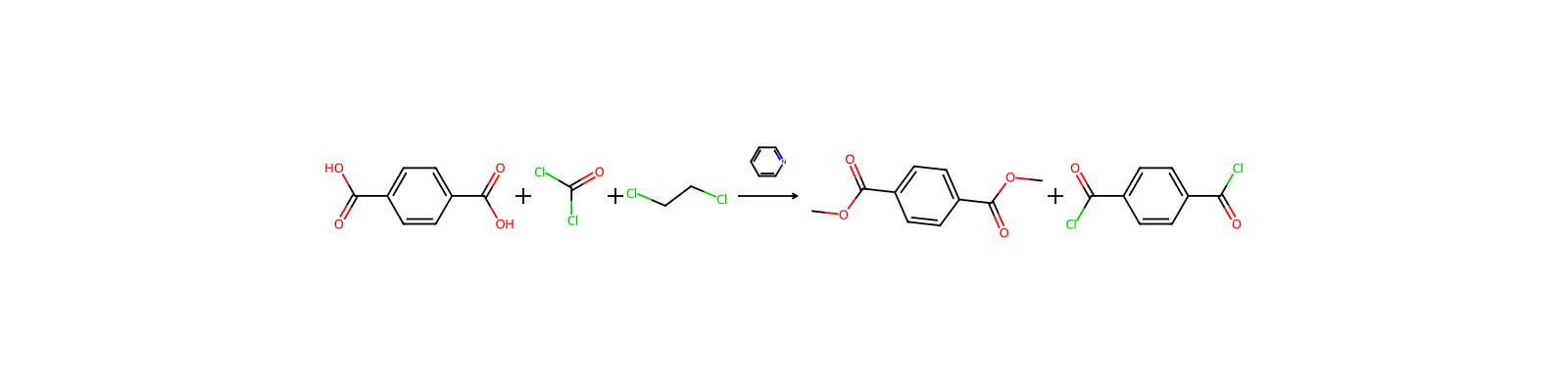
関連反応
117 件




化合物ノート
読み込み中…