ホームMCPワークベンチSkills
ホームワークベンチ通知マイページ
llms.txt · MCPガイドプライバシーポリシー · 利用規約 · サポートv1.8.0
  1. ホーム
  2. /化合物

4-エチルモルホリン

Ethylmorpholine

HCID 7525
ノートを作成反応を作成見積依頼を出す
印刷プレビュー

データを補完しています。しばらくしてからページを更新すると最新の内容を表示できます
基本情報概要名称と識別子物性安全と法規制化学と産業関連反応化合物ノート
部分構造検索類似構造を探す

基本情報

CAS
100-74-3
標準SMILES
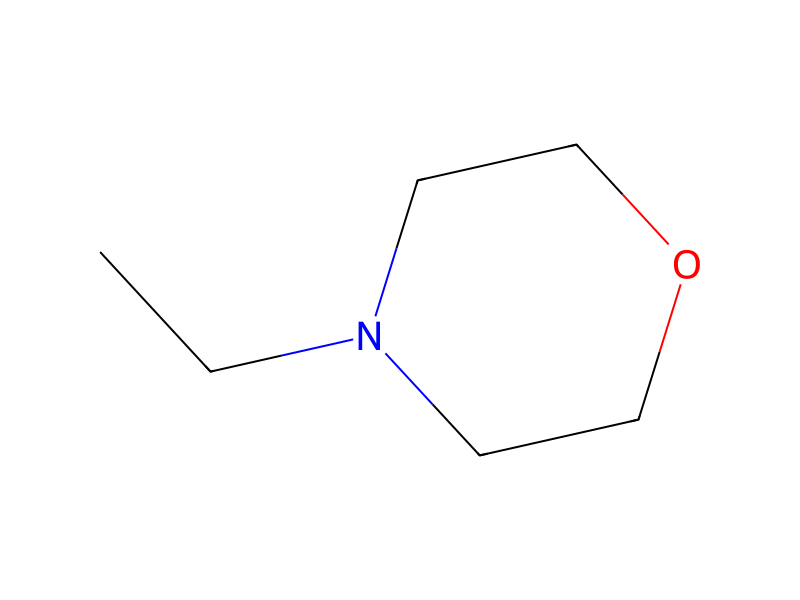
CCN1CCOCC1
InChIKey
HVCNXQOWACZAFN-UHFFFAOYSA-N
分子式
C6H13NO
平均分子量
115.17 g/mol
単同位体質量
115.09971404

概要

N-ethyl morpholine appears as a colorless liquid with a strong ammonia-like odor. Severely irritates skin, eyes, and mucous membranes. Moderately soluble in water and less dense than water. Flash point 83 °F.

名称と識別子

優先名称
Ethylmorpholine
IUPAC
4-ethylmorpholine
現地名
4-エチルモルホリン
英語名
N-Ethylmorpholine
分子式
C6H13NO
分子量
115.17

名称と別名

4-EthylmorpholineN-ETHYLMORPHOLINE100-74-3Morpholine, 4-ethyl-EthylmorpholineN-EthylmorfolinDTXSID5025312ECM0G991FQNSC-6110DTXCID205312RefChem:163360202-885-0
名称をさらに表示
4-エチルモルホリンN-エチルモルホリンNエチルモルホリン4エチルモルホリンN-エチルモリホリンエチルモルホリンN‐エチルモルホリンN - エチルモルホリンHEMTexacat NEMToyocat -NEMLUPRAGEN(R) N 1044-ethyl-morpholin4-Ethylmorhpoline
N-ethyl morpholineNSC 61104-ethyl-morpholineMFCD00006177N-Ethylmorfolin [Czech]N-ethyl-morpholineCCRIS 4818HSDB 1644

データベース識別子

CAS
100-74-3
PubChem CID
7525
DTXSID
DTXSID5025312
ChEMBL
CHEMBL3561880
UNII
ECM0G991FQ
EC Number
202-885-0
Nikkaji
J4.428H

物性

構造計算による物性補完中

XLogP
0
極性表面積
12.5 Ų
水素結合供与体数
0
水素結合受容体数
2
回転可能結合数
1
重原子数
8
形式電荷
0
複雑度
59.5

実験および物理化学的性質

Chemical Classes · 2 件

Nitrogen Compounds -> Morpholines

Flammable agents - 3rd degree

SpringerMaterials PropertiesViscosity
Odor · 2 件

AMMONIACAL ODOR

Ammonia-like odor.

Density · 4 件

0.916 at 68 °F (USCG, 1999) - Less dense than water; will float

0.8996 @ 20 °C/4 °C

Relative density (water = 1): 0.99

0.90

Viscosity1.08 mPa S @ 20 °C
Color/Form · 2 件

COLORLESS LIQUID

Colorless liquid.

Solubility · 4 件

greater than or equal to 100 mg/mL at 68 °F (NTP, 1992)

SOL IN ALL PROPORTIONS IN WATER, ETHANOL & ETHER; SOL IN ACETONE

Solubility in water: miscible

Miscible

Flash Point · 5 件

82 °F (NTP, 1992)

32 °C

90 °F (32 °C) (OPEN CUP)

32 °C

(oc) 90 °F

Boiling Point · 4 件

安全と法規制

安全情報は参考情報です。供給元の安全データシート(SDS)、適用法令、専門家による評価に代わるものではありません。

GHS分類

GHS Classification · 6 件

This chemical does not meet GHS hazard criteria for 1% (5 of 484) of reports.

Danger

H226 (99%): Flammable liquid and vapor [Warning Flammable liquids]

P210, P233, P240, P241, P242, P243, P260, P261, P262, P264, P264+P265, P270, P271, P280, P301+P317, P301+P330+P331, P302+P352, P302+P361+P354, P303+P361+P353, P304+P340, P305+P351+P338, P305+P354+P338, P316, P317, P319, P321, P330, P332+P317, P337+P317, P361+P364, P362+P364, P363, P370+P378, P403+P233, P403+P235, P405, and P501 (click each P-code to see the statement)

Aggregated GHS information provided per 484 reports by companies from 16 notifications to the ECHA C&L Inventory. Each notification may be associated with multiple companies.

Danger

危険有害性情報

Regulatory Information · 5 件

Chemical: Morpholine, 4-ethyl-

Morpholine, 4-ethyl- is listed on the EPA's Chemical Data Reporting (CDR) system. Manufacturers and importers of Morpholine, 4-ethyl- are required to report information about their production and use of this chemical to the EPA under the Toxic Substances Control Act (TSCA). (40 eCFR Part 711)

Status: Active Update: 25-01-2017 https://echa.europa.eu/registration-dossier/-/registered-dossier/17727

4-Ethylmorpholine: Does not have an individual approval but may be used under an appropriate group standard

The New Jersey Worker and Community Right to Know Act requires public and private employers to provide information about hazardous substances at their workplaces. (N.J.S.A. 34:5A-1 et. seq.)

DOT LabelFlammable Liquid
Fire Hazards · 2 件

Special Hazards of Combustion Products: Irritating vapors and toxic gases, such as ammonia, nitrogen oxides, and carbon monoxide, may be formed when involved in fire.

Flammable. Gives off irritating or toxic fumes (or gases) in a fire. Above 32 °C explosive vapour/air mixtures may be formed.

化学と産業

薬理情報

Absorption, Distribution and Excretion...ABSORBED THROUGH UNBROKEN SKIN.

用途と製造

Uses · 5 件

Used as a catalyst in the production of polyurethane foam; [ACGIH]

Plastic Composites Manufacturing [Category: Industry]

URETHANE FOAM CATALYST

INTERMEDIATE FOR DYESTUFFS, PHARMACEUTICALS, RUBBER ACCELERATORS & EMULSIFYING AGENTS; SOLVENT FOR DYES, RESINS, OILS

COMMONLY USED SUBSTRATE FOR ENZYME REACTIONS

U.S. Production2023: 50,000 - <250,000 lb
Consumer UsesCatalyst
Industry UsesCatalyst
Methods of ManufacturingREACTION OF MORPHOLINE WITH DIETHYL SULFATE
Formulations/PreparationsGRADE: TECHNICAL.
Household ProductsInformation on 1 consumer products that contain N-Ethylmorpholine in the following categories is provided:
General Manufacturing Information · 2 件

Plastics Product Manufacturing

Morpholine, 4-ethyl-: ACTIVE

応用分野 · 4 件

用途溶剤(ゴム、染料)、石鹸原料

用途香料原料、抽出剤、塗料用溶剤、印刷インキ用溶剤、なっ染用溶剤

使用N-Ethylmorpholine is a component of the buffer used in basic peptide separation through anion-exchange chromatography. Further, it acts as a catalyst in the preparation of polyurethane foam.

関連反応

660 件
反応記録を作成
HRID 2928 の反応式
HRID 2928反応物としてuspto-grants-1998_03
HRID 19511 の反応式
HRID 19511反応物としてuspto-grants-2010_06
HRID 19513 の反応式
HRID 19513反応物としてuspto-grants-2010_06
HRID 30064 の反応式
HRID 30064反応物としてuspto-grants-2008_09
HRID 36840 の反応式
HRID 36840反応物としてuspto-grants-1995_05
HRID 41805 の反応式
HRID 41805反応物としてuspto-grants-2013_09
HRID 43393 の反応式
HRID 43393反応物としてuspto-grants-2013_09
HRID 43394 の反応式
HRID 43394反応物としてuspto-grants-2013_09
1 / 83 ページ

化合物ノート

読み込み中…

このページの内容基本情報概要名称と識別子物性安全と法規制化学と産業関連反応化合物ノート
その他の操作
ノートを作成反応を作成見積依頼を出す

280 to 282 °F at 760 mmHg (NTP, 1992)

138-139 °C @ 763 MM HG

138 °C

281 °F

Melting Point · 4 件

-81 °F (NTP, 1992)

-62.78 °C

-63 °C

-81 °F

Vapor Density · 3 件

4 (NTP, 1992) - Heavier than air; will sink (Relative to Air)

4.0 (AIR= 1)

Relative vapor density (air = 1): 4.0

Odor ThresholdOdor Threshold Low: 0.08 [ppm]

物理化学的性質

融点
-63 °C · -63 °C (lit.)
沸点
139 °C · 139 °C (lit.)
比重(密度)
0.91 g/mL · 0.91 g/mL at 20 °C (lit.)
蒸気圧
8.1 hPa · 8.1 hPa (20 °C)
屈折率
20 · n20/D 1.441(lit.)
闪点
82 °F · 82 °F
貯蔵温度
30 °C · Store below +30°C.
溶解性
混和性
外見
粉
酸解離定数(Pka)
7.67 · 7.67(at 25℃)
色
クリーム~ベージュ~ブラウングレー
臭い (Odor)
悪臭
PH
11.8 · 11.8 (100g/l, H2O, 20℃)
爆発限界(explosive limit)
1.9 % · 1.9%(V)
水溶解度
混和性
凝固点
-63 ℃ · -63℃
BRN
102969 · 102969
Henry's Law Constant
4 · 4.0×102 mol/(m3Pa) at 25℃, HSDB (2015)
安定性
安定。可燃性。強力な酸化剤とは相容れない。わずかに空気に敏感。
InChI
1S/C6H13NO/c1-2-7-3-5-8-6-4-7/h2-6H2,1H3
InChIKey
HVCNXQOWACZAFN-UHFFFAOYSA-N
SMILES
CCN1CCOCC1 || CCN1CCOCC1
LogP
0.08 at · 0.08 at 24.6℃
CAS データベース
100 · 100-74-3(CAS DataBase Reference)
NISTの化学物質情報
4 · Morpholine, 4-ethyl-(100-74-3)
EPAの化学物質情報
N-Ethylmorpholine (100-74-3)
Absorption
300 nm · cut-off at 300nm
Fire Potential
...A DANGEROUS FIRE HAZARD...
Health HazardsExposure can cause irritation of eyes, nose and throat. Contact with eyes may result in foggy vision and seeing halos around lights. (USCG, 1999)
Hazards SummaryHas potential to cause corneal damage; [ACGIH]
Reactive GroupAmines, Phosphines, and Pyridines
UN ClassificationUN Hazard Class: 3; UN Pack Group: III
Reactivity AlertsHighly Flammable
OSHA Standards · 2 件

Permissible Exposure Limit: Table Z-1 8-hr Time-Weighted Avg: 20 ppm (94 mg/cu m). Skin Designation.

Vacated 1989 OSHA PEL TWA 5 ppm (23 mg/cu m), skin designation, is still enforced in some states.

Reactivity ProfileN-ETHYL MORPHOLINE can react vigorously with oxidizing materials. It dissolves LiAlH4. (NTP, 1992)
Chemical DangersDecomposes on heating. This produces toxic gases and vapours (ammonia, nitrogen oxides, carbon monoxide). Reacts violently with strong oxidants. This generates fire and explosion hazard. Attacks plastics, rubber and coatings.

安全と保護具

Fire Fighting · 2 件

Excerpt from ERG Guide 128 [Flammable Liquids (Water-Immiscible)]:

Use water spray, alcohol-resistant foam. In case of fire: keep drums, etc., cool by spraying with water.

First Aid Measures · 4 件

Fresh air, rest. Refer for medical attention.

Remove contaminated clothes. Rinse and then wash skin with water and soap. Refer for medical attention .

First rinse with plenty of water for several minutes (remove contact lenses if easily possible), then refer for medical attention.

Rinse mouth. Give one or two glasses of water to drink.

First Aid · 2 件

EYES: First check the victim for contact lenses and remove if present. Flush victim's eyes with water or normal saline solution for 20 to 30 minutes while simultaneously calling a hospital or poison control center. Do not put any ointments, oils, or medication in the victim's eyes without specific instructions from a physician. IMMEDIATELY transport the victim after flushing eyes to a hospital even if no symptoms (such as redness or irritation) develop.

(General first aid procedures)

Safe StorageFireproof. Separated from strong oxidants.
Fire Fighting Procedures · 2 件

ALCOHOL FOAM, FOAM, CARBON DIOXIDE, DRY CHEMICAL.

WATER MAY BE INEFFECTIVE.

Storage ConditionsStore in a detached storehouse without any ignition source.
Cleanup Methods · 2 件

1) REMOVE ALL IGNITION SOURCES. 2) VENTILATE AREA OF SPILL OR LEAK. 3) FOR SMALL QUANTITIES, ABSORB ON PAPER TOWELS. EVAPORATE IN SAFE PLACE (SUCH AS A FUME HOOD). ALLOW SUFFICIENT TIME FOR EVAPORATING VAPORS TO COMPLETELY CLEAR HOOD DUCTWORK. BURN PAPER IN SUITABLE LOCATION AWAY FROM COMBUSTIBLE MATERIALS.

Cover with the 9:1 mixture of sand and soda ash. After mixing, transfer into a paper carton, stuffed with ruffled paper. Burn in an open furnace with the utmost care or in the furnace with afterburner and scrubber.

Nonfire Spill ResponseExcerpt from ERG Guide 128 [Flammable Liquids (Water-Immiscible)]:
Disposal Methods · 2 件

SRP: At the time of review, criteria for land treatment or burial (sanitary landfill) disposal practices are subject to significant revision. Prior to implementing land disposal of waste residue (including waste sludge), consult with environmental regulatory agencies for guidance on acceptable disposal practices.

LARGE QUANTITIES CAN BE COLLECTED & ATOMIZED IN A SUITABLE COMBUSTION CHAMBER EQUIPPED WITH AN APPROPRIATE EFFLUENT GAS CLEANING DEVICE.

Spillage Disposal · 1 件

Personal protection: filter respirator for organic gases and vapours adapted to the airborne concentration of the substance. Ventilation. Remove all ignition sources. Collect leaking and spilled liquid in sealable containers as far as possible. Absorb remaining liquid in sand or inert absorbent. Then store and dispose of according to local regulations.

Preventive Measures · 5 件

...GOOD VENTILATION IS VERY IMPORTANT. /MORPHOLINE/

SRP: The scientific literature for the use of contact lenses in industry is conflicting. The benefit or detrimental effects of wearing contact lenses depend not only upon the substance, but also on factors including the form of the substance, characteristics and duration of the exposure, the uses of other eye protection equipment, and the hygiene of the lenses. However, there may be individual substances whose irritating or corrosive properties are such that the wearing of contact lenses would be harmful to the eye. In those specific cases, contact lenses should not be worn. In any event, the usual eye protection equipment should be worn even when contact lenses are in place.

The worker should immediately wash the skin when it becomes contaminated.

Work clothing that becomes wet should be immediately removed due to its flammability hazard.

Take off the clothing followed by drying and washing or disposing. Dispose shoes by incineration.

Isolation and EvacuationExcerpt from ERG Guide 128 [Flammable Liquids (Water-Immiscible)]:

毒性情報

Target OrgansEyes, respiratory system
Environmental Fate · 3 件

TERRESTRIAL FATE: Using a structure estimation method based on molecular connectivity indexes(1), the Koc for N-ethylmorpholine can be estimated to be about 12(SRC). According to a suggested classification scheme(2), this estimated Koc value suggests that N-ethylmorpholine has very high soil mobility(SRC). Insufficient data are available to predict the relative importance or rate of biodegradation in soil(SRC). Volatilization of N-ethylmorpholine is expected from dry soils(SRC) based on an experimental vapor pressure of 5 mm Hg(3,SRC), but not important from moist soils(SRC) based on an estimated Henry's Law constant of 2.74X10⁻⁸ atm-cu m/mole(4,SRC).

AQUATIC FATE: Based on a suggested classification scheme(2), N-Ethylmorpholine will be essentially non-volatile from water(SRC) based upon an estimated Henry's Law constant of 2.74X10⁻⁸ atm-cu m/mol(1,SRC). Insufficient data are available to predict the relative importance or rate of biodegradation in natural waters(SRC).

ATMOSPHERIC FATE: Based on an experimental vapor pressure of approximately 5 mm Hg at 25 °C(1), and a suggested classification scheme(2), N-ethylmorpholine will exist primarily in the vapor phase in the atmosphere(SRC). It will degrade in the ambient atmosphere by reaction with photochemically produced hydroxyl radicals with an estimated half-life of 2.5 hours(3,SRC). Removal of atmospheric N-ethylmorpholine may occur through wet deposition(SRC).

Exposure Routes · 2 件

The substance can be absorbed into the body by inhalation of its vapour, through the skin and by ingestion.

inhalation, skin absorption, ingestion, skin and/or eye contact

Signs and Symptoms · 4 件

Cough. Sore throat.

Redness.

Redness. Pain. Blurred vision.

irritation eyes, nose, throat; visual disturbance: corneal edema, blue-gray vision, colored haloes

Soil Adsorption/Mobility · 1 件

Using a structure estimation method based on molecular connectivity indexes(1), the Koc for N-ethylmorpholine can be estimated to be about 12(SRC). According to a suggested classification scheme(2), this estimated Koc value suggests that N-ethylmorpholine has very high soil mobility(SRC).

Human Toxicity Excerpts · 3 件

... Ten humans exposed at 100 ppm N-ethylmorpholine for 2.5 min experienced irritation to the eyes, nose, and throat and olfactory fatigue. Irritation was slight with the same duration of exposure at 50 ppm and absent at 25 ppm.

Corneal edema was observed in workers exposed at 40 ppm and more N-ethylmorpholine for several hr. The lesions appeared near the end of the work shift and cleared within 3 to 4 hr after cessation of exposure. Other investigators have also reported that corneal edema caused by amine vapors is reversible. Distortion of vision is experienced at concn below those which produce eye or respiratory irritation. Another study reported that workers exposed at concn generally in the 3 to 4 ppm N-ethylmorpholine range, and never above 11 ppm, complained of drowsiness, optical halos, and foggy vision.

... An epidemic of neurogenic urinary retention from a company, employing 141 and 75 people at 2 different plants, manufacturing polyurethane foam products ... Abnormalities in vision, upper respiratory irritation, dermatitis, and pulmonary abnormalities also occurred but appeared to be related to the presence of other chemicals including N-ethylmorpholine and toluene diisocyanate.

Artificial Pollution SourcesN-Ethylmorpholine's use as an intermediate for dyestuffs, pharmaceuticals, rubber accelerators, and emulsifying agents(1) may result in its release to the environment through various waste streams(SRC).
Environmental BioconcentrationBecause it is miscible in water(2), bioconcentration in aquatic organisms is not expected to be an important fate process for N-ethylmorpholine(1,SRC).
Volatilization from Water/Soil · 1 件

The Henry's Law constant for N-ethylmorpholine can be estimated to be 2.47X10⁻⁸ atm-cu m/mole(SRC) using a structure estimation method(1). This value of Henry's Law constant indicates that N-ethylmorpholine will be essentially non-volatile from water(2).

Non-Human Toxicity Excerpts · 4 件

ALL /N-SUBSTITUTED MORPHOLINES TESTED INCLUDING N-ETHYL MORPHOLINE/ EXHIBITED A LOW DEGREE OF ORAL TOXICITY ... N-ETHYL DERIVATIVES PRESENT THE HIGHEST POTENTIAL HAZARD FROM VAPOR EXPOSURE ... .

TESTED IN LIQUID FORM BY APPLYING A DROP FULL-STRENGTH TO RABBIT'S EYE... CAUSES THE CORNEA TO BECOME HAZY IN ABOUT FIVE MINUTES & EPITHELIUM TO SLOUGH FROM THE SURFACE. STANDARDIZED TESTING & GRADING ON RABBIT EYES GIVES A GRADE 7 INJURY ON A SCALE OF 1 TO 10. /MOST SEVERE INJURIES ARE RATED 10/

A DIRECT MUTAGENIC EFFECT WAS FOUND WITH N-ETHYLMORPHOLINE IN MUTAGENICITY TESTS WITH SALMONELLA TYPHIMURIUM STRAINS TA1535 & TA100, WITH & WITHOUT METABOLIC ACTIVATION BY LIVER PREPN FROM SPRAGUE-DAWLEY RATS. TESTS INDICATE OCCURRENCE OF AN ALKYLATING IMPURITY IN N-ETHYLMORPHOLINE.

... 1 of 6 rats died after a 4-hr inhalation exposure at 2000 ppm.

Environmental Abiotic Degradation · 1 件

The rate constant for the vapor-phase reaction of N-ethylmorpholine with photochemically produced hydroxyl radicals has been estimated to be approximately 1.49X10⁻¹⁰ cu cm/molecule-sec at 25 °C which corresponds to an atmospheric half-life of about 2.5 hours at an atmospheric concentration of 5x10+5 hydroxyl radicals per cu cm(1,SRC).

Probable Routes of Human Exposure · 2 件

...HAS PECULIARLY DISTURBING ACTION ON CORNEAL EPITHELIUM...CAUSING TRANSIENT EDEMA OF CORNEAL EPITHELIUM IN WORKERS EXPOSED TO 40 PPM OR MORE IN AIR DURING WORK DAY, CAUSING ONSET OF BLUE-GREY VISION OR COLORED HALOS AROUND LIGHTS A FEW HOURS AFTER EXPOSURE.

Occupational exposure to morpholines, such as N-ethylmorpholine, can occur through inhalation, dermal contact and ingestion(1).

安全データ

F
8-23
OEB
A
OEL
TWA: 5 ppm (23 mg/m3) [skin]
wgk
1
IDLA
100 ppm
tsca
TSCA listed
rtecs
QE4025000
ridadr
UN 2920 8/PG 2
毒性
LD50 orally in Rabbit: 1640 mg/kg LD50 dermal Rabbit 900 mg/kg
hs_code
29349990
risk_code
10-21/22-34
化審法
(5)-860
安衛法
57,57-2
消防法
危-4-2-III
hazard_code
C
safety_code
26-36/37/39-45-16
hazard_class
8
packing_group
II
自然発火温度
160 °C
Hazard Classifications
Acute Tox. 3 DermalAcute Tox. 4 OralEye Dam. 1Flam. Liq. 3Skin Corr. 1B
ストレージクラス
3 - Flammable liquids
有毒物質データの
100-74-3(Hazardous Substances Data)
危険度評価(NFPA 704基準/消防庁データ)
人的[青]=2

一般的な説明N-Ethylmorpholine appears as a colorless liquid with a strong ammonia-like odor. Severely irritates skin, eyes, and mucous membranes. Moderately soluble in water and less dense than water. Flash point 83°F.

調製方法

製造方法N-Ethylmorpholine is synthesized by the reaction of morpholine with bromoethane.

上流・下流製品情報

上流原料

モルホリンジエチレングリコールブロモエタンアンモニア4-エチルモルホリン4-オキシド4-(2-イソシアナトエチル)モルホリンα-メチル-4-モルホリンアセトニトリルN-エチルジエタノールアミンN-methyl ,ethyl-Morpholinium iodide

下流製品

Water quality stabilizerトランドラプリル