
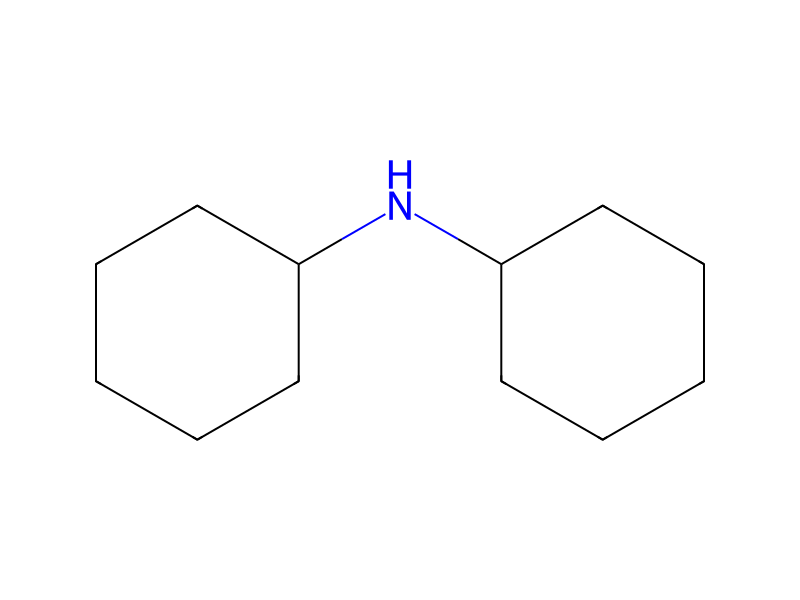
基本情報
- 標準SMILES
C1CCC(NC2CCCCC2)CC1- InChIKey
XBPCUCUWBYBCDP-UHFFFAOYSA-N- 分子式
- C12H23N
- 平均分子量
- 181.32 g/mol
- 単同位体質量
- 181.18304974
概要
Dicyclohexylamine appears as a colorless liquid with a faint fishlike odor. Less dense than water. May be toxic by ingestion. Severely irritates skin, eyes and mucous membranes. Used to make paints, varnishes and detergents.
名称と識別子
- 優先名称
- Dicyclohexylamine
- IUPAC
- N-cyclohexylcyclohexanamine
- 現地名
- ジシクロヘキシルアミン
- 英語名
- Dicyclohexylamine
- 分子式
- C12H23N
- 分子量
- 181.32
名称と別名
DICYCLOHEXYLAMINE101-83-7N-CyclohexylcyclohexanamineCyclohexanamine, N-cyclohexyl-DCHAN,N-DicyclohexylamineDodecahydrodiphenylamineDicyklohexylaminN-Cyclohexyl-cyclohexylamineDTXSID60250181A93RJW924NSC-3399
名称をさらに表示
1,1'-イミノビス(シクロヘキサン)ビスシクロヘキシルアミンN-シクロヘキシルシクロヘキシルアミンイミノビス(シクロヘキサン)N,N-ジシクロヘキシルアミンジシクロヘキシルアミンN-シクロヘキシルシクロヘキサンアミンN-シクロヘキシルシクロヘキサミンジシクロヘキシルアミン, 98%1,1′-イミノビス(シクロヘキサン)ドデカヒドロジフェニルアミンN-cyclohexyl-CyclohexanamineDicyclohexylaminDICYCLOHEXYLAMINE (DCHA)Cyclohexylcyclohexanamine(2S,4R)-4-(tert-butoxy)-1-[(tert-butoxy)carbonyl]pyrrolidine-2-carboxylic acid
DTXCID005018RefChem:586881202-980-7DichaN,N-DiclohexylamineNSC 3399dicylcohexylamineMLS002174250
データベース識別子
- CAS
101-83-7- PubChem CID
- 7582
- DTXSID
DTXSID6025018- ChEMBL
CHEMBL1451838- ChEBI
CHEBI:34694- UNII
- 1A93RJW924
- EC Number
- 202-980-7
- Nikkaji
- J4.018E
物性
構造計算による物性
- XLogP
- 3.4
- 極性表面積
- 12 Ų
- 水素結合供与体数
- 1
- 水素結合受容体数
- 1
- 回転可能結合数
- 2
- 重原子数
- 13
- 形式電荷
- 0
- 複雑度
- 116
実験および物理化学的性質
Chemical Classes
Nitrogen Compounds -> Amines, Cyclic
Corrosives
PolymersRubber
pHSTRONG BASE
SpringerMaterials PropertiesBoiling point
LogP3.5
Odor
FAINT FISHY ODOR
Amine odor.
Density
0.913 to 0.919 at 59 °F (NTP, 1992)
0.9104 at 25 °C/25 °C
Relative density (water = 1): 0.9
Color/FormCOLORLESS LIQUID
Solubility
Slightly soluble (NTP, 1992)
SPARINGLY SOL IN WATER; SOL IN USUAL ORGANIC SOLVENTS; MISCIBLE WITH CYCLOHEXYLAMINE
Soluble in ethanol, ether, benzene.
Soluble in oxygenated solvents.
Solubility in water, g/100ml at 25 °C: 0.08
Flash Point
greater than 210 °F (NTP, 1992)
105 °C
105 °C o.c.
Boiling Point
492.4 °F at 760 mmHg (NTP, 1992)
255.8 °C @ 760 MM HG
256 °C
DecompositionWhen heated to decomposition it emits toxic fumes of /nitrogen oxide/.
物理化学的性質
- 融点
- -2 °C · -2 °C
- 沸点
- 256 °C · 256 °C
- 比重(密度)
- 0.912 g/mL · 0.912 g/mL at 20 °C(lit.)
- 蒸気密度
- 6 · 6 (vs air)
- 蒸気圧
- 12 mm · 12 mm Hg ( 37.7 °C)
- 屈折率
- 20 · n20/D 1.4842(lit.)
- 闪点
- 205 °F · 205 °F
- 貯蔵温度
- 30 °C · Store below +30°C.
- 溶解性
- 有機溶剤:可溶
- 酸解離定数(Pka)
- 10.4 · 10.4(at 25℃)
- 外見
- 無色の液体
- 色
- 無色
- PH
- 11 · 11 (1g/l, H2O, 20℃)
- 臭い (Odor)
- アミン臭
- 爆発限界(explosive limit)
- 0.8 · 0.8-4.6%(V)
- 水溶解度
- 0.08 g/100mL · 0.08 g/100mL (25 ºC)
- 凝固点
- -2 ℃ · -2℃
- Merck
- 14 · 14,3095
- BRN
- 605923 · 605923
- Henry's Law Constant
- 1.8 · 1.8×10-1 mol/(m3Pa) at 25℃, HSDB (2015)
- 安定性
- 安定。強酸、強酸化剤とは相容れない。
- InChI
- 1S/C12H23N/c1-3-7-11(8-4-1)13-12-9-5-2-6-10-12/h11-13H,1-10H2
- InChIKey
- XBPCUCUWBYBCDP-UHFFFAOYSA-N
- SMILES
- C1CCC(CC1)NC2CCCCC2
- LogP
- 2.724 at · 2.724 at 25℃
- CAS データベース
- 101 · 101-83-7(CAS DataBase Reference)
- NISTの化学物質情報
- Cyclohexanamine, N-cyclohexyl-(101-83-7)
- EPAの化学物質情報
- Dicyclohexylamine (101-83-7)
安全と法規制
GHS分類
GHS Classification
Danger
H302: Harmful if swallowed [Warning Acute toxicity, oral]
P260, P264, P270, P273, P280, P301+P317, P301+P330+P331, P302+P361+P354, P304+P340, P305+P354+P338, P316, P321, P330, P363, P391, P405, and P501 (click each P-code to see the statement)
Danger
H302 (91.3%): Harmful if swallowed [Warning Acute toxicity, oral]
P260, P264, P264+P265, P270, P273, P280, P301+P317, P301+P330+P331, P302+P361+P354, P304+P340, P305+P354+P338, P316, P317, P321, P330, P363, P391, P405, and P501 (click each P-code to see the statement)
危険有害性情報
Regulatory Information
Chemical: Cyclohexanamine, N-cyclohexyl-
Cyclohexanamine, N-cyclohexyl- is listed on the EPA's Chemical Data Reporting (CDR) system. Manufacturers and importers of Cyclohexanamine, N-cyclohexyl- are required to report information about their production and use of this chemical to the EPA under the Toxic Substances Control Act (TSCA). (40 eCFR Part 711)
Status: Active Update: 06-03-2023 https://echa.europa.eu/registration-dossier/-/registered-dossier/13263
Dicyclohexylamine: Does not have an individual approval but may be used under an appropriate group standard
The New Jersey Worker and Community Right to Know Act requires public and private employers to provide information about hazardous substances at their workplaces. (N.J.S.A. 34:5A-1 et. seq.)
DOT LabelCorrosive
Fire Hazards
Excerpt from ERG Guide 153 [Substances - Toxic and/or Corrosive (Combustible)]:
· Combustible material: may burn but does not ignite readily.
Combustible. Gives off irritating or toxic fumes (or gases) in a fire.
Fire PotentialCOMBUSTIBLE WHEN EXPOSED TO HEAT OR FLAME; CAN REACT WITH OXIDIZING MATERIALS.
Health Hazards
Excerpt from ERG Guide 153 [Substances - Toxic and/or Corrosive (Combustible)]:
· TOXIC and/or CORROSIVE; inhalation, ingestion or skin contact with material may cause severe injury or death.
Hazards Summary
A corrosive substance that can cause injury to the skin, eyes, and respiratory tract; May cause pulmonary edema; [ICSC] Possible skin sensitizer; [Merck Index] Toxic by ingestion, inhalation, and skin contact; [CAMEO] A corrosive substance that can cause injury to the skin, eyes, and respiratory tract; Inhalation may cause chemical pneumonitis; No sensitizing effects known; [MSDSonline] Danger of cutaneous absorption; [MAK]
DOT ID and Guide2565 153
Reactive GroupAmines, Phosphines, and Pyridines
EC ClassificationSymbol: C, N; R: 22-34-50/53; S: (1/2)-26-36/37/39-45-60-61
UN ClassificationUN Hazard Class: 8; UN Pack Group: III
Reactivity Profile
DICYCLOHEXYLAMINE reacts with oxidizing agents. Forms crystalline salts with many N-protected amino acids (NTP, 1992). Neutralizes acids in exothermic reactions to form salts plus water. May be incompatible with isocyanates, halogenated organics, peroxides, phenols (acidic), epoxides, anhydrides, and acid halides. Flammable gaseous hydrogen may be generated in combination with strong reducing agents, such as hydrides.
Chemical DangersDecomposes on burning. This produces toxic fumes including nitrogen oxides. The substance is a strong base. It reacts violently with acid and is corrosive. Reacts with strong oxidants.
安全と保護具
Fire Fighting
Excerpt from ERG Guide 153 [Substances - Toxic and/or Corrosive (Combustible)]:
Use water spray, powder, alcohol-resistant foam, carbon dioxide. In case of fire: keep drums, etc., cool by spraying with water.
First Aid Measures
Fresh air, rest. Half-upright position. Artificial respiration may be needed. Refer for medical attention.
Remove contaminated clothes. Rinse skin with plenty of water or shower. Refer for medical attention .
First rinse with plenty of water for several minutes (remove contact lenses if easily possible), then refer for medical attention.
Rinse mouth. Do NOT induce vomiting. Refer for medical attention .
Accidental Release Measures
· CALL 911. Then call emergency response telephone number on shipping paper. If shipping paper not available or no answer, refer to appropriate telephone number listed on the inside back cover.
· ELIMINATE all ignition sources (no smoking, flares, sparks or flames) from immediate area.
First Aid
EYES: First check the victim for contact lenses and remove if present. Flush victim's eyes with water or normal saline solution for 20 to 30 minutes while simultaneously calling a hospital or poison control center. Do not put any ointments, oils, or medication in the victim's eyes without specific instructions from a physician. IMMEDIATELY transport the victim after flushing eyes to a hospital even if no symptoms (such as redness or irritation) develop.
General First Aid:
Safe StorageSeparated from strong oxidants, strong acids and food and feedstuffs.
Exposure Control and Personal Protection· Wear positive pressure self-contained breathing apparatus (SCBA).
Fire Fighting ProceduresTO FIGHT FIRE, USE ALCOHOL FOAM, CO2, AND DRY CHEMICAL.
Nonfire Spill ResponseExcerpt from ERG Guide 153 [Substances - Toxic and/or Corrosive (Combustible)]:
Disposal Methods
SRP: At the time of review, criteria for land treatment or burial (sanitary landfill) disposal practices are subject to significant revision. Prior to implementing land disposal of waste residue (including waste sludge), consult with environmental regulatory agencies for guidance on acceptable disposal practices.
Spillage Disposal
Personal protection: complete protective clothing including self-contained breathing apparatus. Do NOT let this chemical enter the environment. Collect leaking and spilled liquid in sealable containers as far as possible. Cautiously neutralize remainder. Then wash away with plenty of water.
Preventive MeasuresPROPHYLACTIC HEALTH MEASURES INCL MECHANIZATION & AUTOMATION OF TECHNOLOGICAL PROCESSES IN MFR & USE OF INHIBITORS.
Isolation and Evacuation
Excerpt from ERG Guide 153 [Substances - Toxic and/or Corrosive (Combustible)]:
Immediate precautionary measure
毒性情報
Environmental Fate
TERRESTRIAL FATE: Based on a recommended classification scheme(1), an estimated Koc value of 260(SRC), determined from a structure estimation method(2), indicates that dicyclohexylamine is expected to have moderate mobility in soil(SRC). Volatilization of dicyclohexylamine from moist soil surfaces is expected given an estimated Henry's Law constant of 5.5X10⁻⁵ atm-cu m/mole(SRC), using a fragment constant estimation method(3). Dicyclohexylamine is not expected to volatilize from dry soil surfaces based on an estimated vapor pressure of 3.4X10⁻² mm Hg(4).
AQUATIC FATE: Based on a recommended classification scheme(1), an estimated Koc value of 260(SRC), determined from a structure estimation method(2), indicates that dicyclohexylamine is expected to adsorb to suspended solids and sediment in water(SRC). Dicyclohexylamine is expected to volatilize from water surfaces(3,SRC) based on an estimated Henry's Law constant of 5.5X10⁻⁵ atm-cu m/mole(SRC), developed using a fragment constant estimation method(4). Estimated volatilization half-lives for a model river and model lake are 1.1 and 12 days, respectively(3,SRC). According to a classification scheme(5), an estimated BCF value of 1200(3,SRC), from an estimated log Kow of 4.37(6,SRC), suggests that bioconcentration in aquatic organisms is very high(SRC). A biodegradation study based on BOD measurements, using an activated sludge seed, and an initial concentration of 100 mg/l, indicated 76.9% degradation of dicyclohexylamine after 2 weeks(7).
ATMOSPHERIC FATE: According to a model of gas/particle partitioning of semivolatile organic compounds in the atmosphere(1), dicyclohexylamine, which has an experimental vapor pressure of 3.4X10⁻² mm Hg at 25 °C(2), is expected to exist solely as a vapor in the ambient atmosphere. Vapor-phase dicyclohexylamine is degraded in the atmosphere by reaction with photochemically-produced hydroxyl radicals(SRC); the half-life for this reaction in air is estimated to be about 2.9 hours(3,SRC).
Adverse EffectsDermatotoxin - Skin burns.
Exposure RoutesThe substance can be absorbed into the body by inhalation of its vapour and by ingestion.
Signs and Symptoms
Sore throat. Cough. Burning sensation. Shortness of breath. Laboured breathing. Symptoms may be delayed.
Pain. Redness. Blisters. Skin burns.
Pain. Redness. Severe deep burns.
Burning sensation. Abdominal pain. Shock or collapse.
Effluent Concentrations
Dicyclohexylamine was detected in 2 of 9 biologically treated effluent samples from a bleached Kraft mill, at a mean concentration of 60 ug/l(1). Trench leachates from Maxey Flats, Kentucky and West Valley, NY low-level radioactive waste disposal sites, contained unspecified levels of dicyclohexylamine(2).
ICSC Environmental DataThe substance is harmful to aquatic organisms.
Soil Adsorption/Mobility
Using a structure estimation method based on molecular connectivity indices(1), the Koc for dicyclohexylamine can be estimated to be about 260(SRC). According to a recommended classification scheme(2), this estimated Koc value suggests that dicyclohexylamine is expected to have moderate mobility in soil(SRC).
TSCA Test Submissions
Dicyclohexylamine (CAS # 101-83-7) was evaluated for acute oral toxicity in male and female Sprague-Dawley albino rats (alternately 2 and 3/sex/treatment level) administered single undiluted doses of 158, 200, 251 and 316 mg/kg. Treatment-related mortality was consistent with an Oral LD50 (with 95% confidence limits) of 240 (205-285) mg/kg as follows: 158 mg/kg (0/2M; 0/3F), 200 mg/kg (0/3M; 1/2F), 251 mg/kg (1/2M; 2/3F), and 316 mg/kg (3/3M; 1/2F). Death occurred from several hours to 24 hours after dosing. Pharmacotoxic signs included reduction in food consumption and activity (1 day in survivors), progressive weakness, prostration and death. Upon gross necropsy of the study lethalities, treatment-related changes of visceral organs included focal hemorrhaging of the lungs, discolored liver and acute inflammation of the gastrointestinal tract. Study survivors of 14-day post-treatment observation were free of any gross treatment-related pathology at terminal sacrifice. This study was briefly summarized. No further information was reported.
Dicyclohexylamine (CAS # 101-83-7) was evaluated for acute dermal toxicity in solitary male or female New Zealand albino rabbits administered single undiluted dermal applications of 126, 316 and 501 mg/kg for 24 hours. Two male and 3 female rabbits each were administered doses of 200 mg/kg. Treatment-related mortality was consistent with a Dermal LD50 in rabbits of 200-316 mg/kg as follows: 200 mg/kg (1/2M; 0/3F), 316 mg/kg (1/1F), and 501 mg/kg (1/1M). Death occurred prior to 16th hour post-treatment observation in all cases. A solitary male of the 126 mg/kg dose and a male and 3 females of 200 mg/kg doses survived to the 14th day end of post-treatment observation and terminal sacrifice. Pharmacotoxic signs associated with treatment included reduced appetite and activity (2-3 days in survivors), progressive weakness, prostration and death. Upon terminal necropsy of study lethalities, focal hemorrhage of the lungs, discoloration of liver, enlarged gall bladder and inflammation of the gastrointestinal tract were identified. Terminal sacrifice of the study survivors found them with normal-appearing viscera and no gross treatment-related pathology. This study was briefly summarized. No further information was reported.
Dicyclohexylamine (CAS # 101-83-7) was evaluated for acute inhalation toxicity in 6 male New Zealand albino rabbits administered whole-body exposures to 1.4 mg/L for 6 hours. A 2.1 g sample was vaporized and supplied to the 35L exposure chamber via an air flow rate of 4.0 L/min. There was no mortality associated with treatment. Treated rabbits exhibited slight lethargy only, which resolved immediately after termination of the exposure and no further untoward effects of toxicity were noted throughout 14-day post-exposure observation. Upon terminal necropsy, all viscera appeared normal. This study was briefly summarized. No further information was reported.
Dicyclohexylamine (CAS # 101-83-7) was evaluated for primary dermal irritation in 6 New Zealand albino rabbits each administered 0.5 ml undiluted dermal applications to both intact and abraded skin for 24 hours. The unanimous response and a 24-72 hour average primary irritation score was assigned a classification of corrosive. Continued observation found loosening at the edges of the resultant scab showing injury in depth within 17 to 21 days after treatment. This study was briefly summarized. No further information was reported.
Dicyclohexylamine (CAS # 101-83-7) was evaluated for acute eye irritation in 6 New Zealand albino rabbits administered single 0.1 ml undiluted ocular instillations for 24 hours. A 24-72 hour average irritation score of 32.6/110 reflected an overall response assigned a classification of moderately irritating. Treatment initially caused severe discomfort and rabbits pawed and tightly closed the treated eyes. At 1 hour post-treatment, severe erythema was apparent that was unresolved at 24th hour examination. The 24th hour post-instillation examination also found treated rabbits with slight corneal cloudiness and a sluggish iridic reaction to light. Gradual improvement was seen over the ensuing 48-168 hours and, at 14th day examination, all treated eyes were clear of any signs of irritation. This study was briefly summarized. No further information was reported.
Natural Pollution SourcesDicyclohexylamine is not known to occur as a natural product; it occurs as metabolites of cyclamates
Atmospheric ConcentrationsURBAN/SUBURBAN: Dicyclohexylamine was identified in ambient air samples from Lake Charles, LA(1).
Human Toxicity Excerpts
SKIN IRRITANT & POSSIBLE SENSITIZER.
SYSTEMIC EFFECTS IN MAN INCL NAUSEA & VOMITING, ANXIETY, RESTLESSNESS & DROWSINESS. /CYCLOHEXYLAMINE/
HUMAN LYMPHOCYTE CULTURES EXPOSED TO 4 COMPD @ 3 CONCN (10-3, 10-4 & 10-5 MOLAR) DURING FINAL 5 & 25 HR OF CULTURE. RESULTS CONFIRM THAT CYCLAMATE & CYCLOHEXYLAMINE @ HIGH CONCN CAN INDUCE CHROMOSOME ABERRATIONS. N-HYDROXYCYCLOHEXYLAMINE & DICYCLOHEXYLAMINE HAVE SIMILAR EFFECTS.
ENHANCED FREQUENCIES OF GAPS & BREAKS FOLLOWING TREATMENT OF HUMAN LEUKOCYTE CULTURES WITH DICYCLOHEXYLAMINE SULFATE. ABERRATION FREQUENCIES IN CONTROLS ABOUT 6% & 2-FOLD & 3-FOLD INCR IN CHROMATID DAMAGE WITH INT & HIGHER DOSES OF ALL TEST COMPD. EXPOSURE TIMES AS SHORT AS 5 HR.
STRONG IRRITANT TO SKIN & MUCOUS MEMBRANES.
Artificial Pollution Sources
Dicyclohexylamine's production and use as a chemical intermediate; in insecticides and plasticizers; as a corrosion inhibitor; as an antioxidant in rubber, lubricating oils, and fuels; as a catalyst for paint, varnishes, and inks; as a detergent and as an extractant(1) will result in its release to the environment(SRC).
安全データ
- F
- 8-9-23
- wgk
- 2
- tsca
- TSCA listed
- rtecs
- HY4025000
- ridadr
- UN 2565
- PRTR法
- 第一種指定化学物質
- hs_code
- 29213000
- risk_code
- 22-34-50/53-24/25
- 化審法
- (3)-2259, (3)-2686
- 消防法
- 危険物第4類第三石油類(非水溶性)
- hazard_code
- C,N
- safety_code
- 26-36/37/39-45-60-61
- hazard_class
- 8
- packing_group
- III
- 自然発火温度
- 240 °C
- 環境リスク評価
- N,N-ジシクロヘキシルアミン(101-83-7)
- Hazard Classifications
- Acute Tox. 3 DermalAcute Tox. 3 OralAquatic Acute 1Aquatic Chronic 1Skin Corr. 1B
- ストレージクラス
- 6.1C - Combustible acute toxic Cat.3toxic compounds or compounds which causing chronic effects
- 有毒物質データの
- 101-83-7(Hazardous Substances Data)
化学と産業
薬理情報
Metabolism/MetabolitesUP TO 40% IS CHANGED INTO CYCLOHEXAMINE IN HUMANS & TO LESSER EXTENT INTO DICYCLOHEXAMINE.
MeSH Pharmacological ClassificationCompounds or agents that combine with an enzyme in such a manner as to prevent the normal substrate-enzyme combination and the catalytic reaction.
Absorption, Distribution and ExcretionTHIRTY-FIVE TO FORTY PER CENT OF SODIUM SALT OF CYCLOHEXAMIC ACID IS ELIMINATED THROUGH KIDNEYS.
用途と製造
Uses
Used to make drugs, soaps, detergents, vapor-phase corrosion inhibitors , dyestuffs, emulsifying agents, and acid gas absorbents; Also used in insecticides and as a plasticizer, antioxidant (rubber, lubricating oils, and fuels), catalyst (paints, varnishes, and inks), and extractant (natural products); [HSDB]
Painting (Pigments, Binders, and Biocides) [Category: Paint]
INTERMEDIATE; INSECTICIDES; PLASTICIZER; CORROSION INHIBITORS; ANTIOXIDANTS IN RUBBER, LUBRICATING OILS, FUELS; CATALYSTS FOR PAINT, VARNISHES & INKS; DETERGENTS; EXTRACTANT
CHEM INT FOR MEDICINALS, SOAPS AND DETERGENTS, CATALYSTS IN PAINT, VARNISH, & INK MFR; EXTRACTANT FOR NATURAL PRODUCTS; CHEM INT FOR VAPOR-PHASE CORROSION INHIBITORS, RUBBER PROCESSING CHEMICALS
Manuf dyestuff, emulsifying agents, dry-cleaning soaps, acid gas absorbents
Dicyclohexylamine can be commercially important in manufacturing sulfenamides
U.S. Imports
(1976) 3.84X10+5 GRAMS (PRINCPL CUSTMS DISTS)
(1977) 4.32X10+7 GRAMS (PRINCPL CUSTMS DISTS)
U.S. Production
2023: 1,000,000 - <2,500,000 lb
(1975) PROBABLY GREATER THAN 1.36X10+6 GRAMS
(1977) PROBABLY GREATER THAN 4.54X10+6 GRAMS
Consumer UsesOther
Industry UsesCorrosion inhibitor
Methods of Manufacturing
MFR PROCESS BY HYDROGENATION OF EQUIMOLAR AMT OF CYCLOHEXANONE & CYCLOHEXYLAMINE.
Cyclohexanone + ammonia (reductive ammoniation; coproduced with cyclohexylamine)
Aniline is hydrogenated in the vapor phase over a nickel-on-pumice catalyst.
General Manufacturing Information
All Other Chemical Product and Preparation Manufacturing
Cyclohexanamine, N-cyclohexyl-: ACTIVE
PREPD BY CATALYTIC HYDROGENATION OF ANILINE @ ELEVATED TEMP & PRESSURES. FRACTIONATION OF CRUDE REACTION PRODUCT YIELDS CYCLOHEXYLAMINE, UNCHANGED ANILINE, & HIGH-BOILING RESIDUE CONTAINING N-PHENYLCYCLOHEXYLAMINE...& DICYCLOHEXYLAMINE. /CYCLOHEXYLAMINE/
INTEREST IN THIS COMPD DERIVES FROM INTEREST IN CYCLAMATES AND ARTIFICIAL SWEETENERS.
DICYCLOHEXYLAMINE WAS NOT DETECTED IN SODIUM N-CYCLOHEXYSULFAMATE POWD & FOUND IN ONLY ONE MFR PRODUCT IN AMT OF 1.6 MG/KG.
応用分野
解説弱い魚臭をもつ液体。融点約 20℃,沸点 256℃ (一部分解) 。ジシクロヘキシルアミンは,水に溶けて強い塩基性を示す。エチルアルコール,ベンゼン,エーテルにも溶ける。アニリンの高圧還元によってシクロヘキシルアミンとともに生じる。ブリタニカ国際大百科事典 小項目事典 ブリタニカ
用途有機合成原料。
用途ゴム薬品、染料
用途防錆剤?ゴム薬品?界面活性剤?染料原料
使用Dicyclohexylamine (DCHA) is an aliphatic amine. As an intermediate, it can be used in a broad range of applications in different industries. Dicyclohexylamine is used as a vulcanization accelerator. In lubricants and cutting fluids it does function as a corrosion inhibitor. Here it should be mentioned that Dicyclohexylamine does not form Nitrosamines when being used. Reagent for preparation of crystalline amino acid derivative salts. Dicyclohexylamine was used to constitute ionic liquid matrices for bacterial analysis in matrix assisted laser desorption/ionisation mass spectrometry. It was used to develop a new palladium catalyst for Suzuki coupling reaction of aryl bromides with boronic acids. It was used as extractant in determination of gold(III) by dispersive liquid-liquid microextraction and electrothermal atomic absorption spectrometry.
使用用途ジシクロヘキシルアミンの主な用途は、、ゴム薬品、エマルジョン系加工油等の原料、界面活性剤、染料原料、農薬などです。各種産業において幅広く用いられています。軟質ウレタンフォーム合成の際の触媒にも利用されます。 また、ジシクロヘキシルアミンは各種有機合成化学の中間原料としても有用な化合物です。具体的には、スルフェンアミド系加硫促進剤や、粘液溶解薬、鎮痛剤、気管支拡張薬などの医薬品などに使用されています。
調製方法
Several methods are employed for the manufacture of dicyclohexylamine. It can be manufactured by hydrogenation of equimolar amounts of cyclohexanone and cyclohexylamine. Alternatively, dicyclohexylamine can be prepared by vapor phase catalytic hydrogenation of aniline at elevated temperature and pressure. Fractionation of the crude reaction product yields cyclohexylamine, unreacted aniline, and a high boiling residue comprised of N-phenylcyclohexylamine and dicyclohexylamine (Windholz et al 1983).
上流・下流製品情報
上流原料
下流製品
関連反応
494 件





関連ノート
読み込み中…