
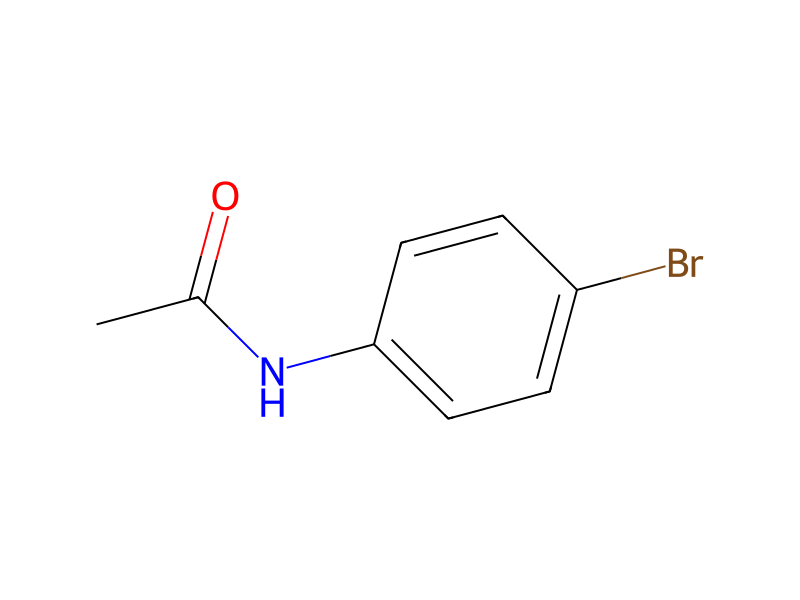
基本情報
- 標準SMILES
CC(=O)Nc1ccc(Br)cc1- InChIKey
MSLICLMCQYQNPK-UHFFFAOYSA-N- 分子式
- C8H8BrNO
- 平均分子量
- 214.06 g/mol
- 単同位体質量
- 212.97892598
名称と識別子
- 優先名称
- 4'-Bromoacetanilide
- IUPAC
- N-(4-bromophenyl)acetamide
- 現地名
- 4'-ブロモアセトアニリド
- 英語名
- 4'-Bromoacetanilide
- 分子式
- C8H8BrNO
- 分子量
- 214.06
名称と別名
4'-Bromoacetanilide103-88-84-BROMOACETANILIDEN-(4-Bromophenyl)acetamidep-BromoacetanilideBromoanilideAcetamide, N-(4-bromophenyl)-BromoantifebrinAntisepsinAsepsinN-Acetyl-4-bromoanilinep-Bromo-N-acetanilide
名称をさらに表示
4'-ブロモアセトアニリドアンチセプシンブロモアニリドN-(4-ブロモフェニル)アセトアミドブロモアンチフェブリンN-アセチル-4-ブロモアニリンN-(p-ブロモフェニル)アセトアミド4-ブロモ-1-アセチルアミノベンゼンアセプシン1-ブロモ-4-(アセチルアミノ)ベンゼンp-ブロモアセトアニリド4′-ブロモアセトアニリド4′‐ブロモアセトアニリド4-ブロモアセトアニリド4'-ブロモアセトアニリド, 98%Bromoacetanilide4-BROMOACETOANILIDE4-Bromoacetanilide, 98% PSusafdo-40Bromanilide
1-Bromo-4-acetamidobenzeneAcetanilide, p-bromo-USAF DO-40Acetanilide, 4'-bromo-N-(4-Bromo-phenyl)-acetamideN-Acetyl-p-bromoanilineNSC 105442N-(p-Bromophenyl)acetamide
データベース識別子
- CAS
103-88-8- PubChem CID
- 7683
- DTXSID
DTXSID6059283- ChEMBL
CHEMBL59019- UNII
- 4KB44F25A3
- EC Number
- 203-154-9
- Nikkaji
- J37.694I
物性
構造計算による物性
- XLogP
- 2.3
- 極性表面積
- 29.1 Ų
- 水素結合供与体数
- 1
- 水素結合受容体数
- 1
- 回転可能結合数
- 1
- 重原子数
- 11
- 形式電荷
- 0
- 複雑度
- 141
実験および物理化学的性質
SpringerMaterials Properties13C nuclear magnetic resonance spectrum
LogP2.14
物理化学的性質
- 融点
- 165 · 165-169 °C(lit.)
- 沸点
- 353.4 °C · 353.4°C (estimate)
- 比重(密度)
- 1.72 · 1.72
- 屈折率
- 1.612 · 1.6120 (estimate)
- 貯蔵温度
- 30 °C · Store below +30°C.
- 溶解性
- アルコール:適度に溶ける
- 外見
- 結晶性粉末または結晶
- 酸解離定数(Pka)
- 14.25 · 14.25±0.70(Predicted)
- 色
- ホワイトからベージュまたはライトグレー
- 水溶解度
- 不溶性
- Merck
- 14 · 14,1399
- BRN
- 2208091 · 2208091
- 安定性
- 安定。強力な酸化剤とは相容れない。
- InChI
- 1S/C8H8BrNO/c1-6(11)10-8-4-2-7(9)3-5-8/h2-5H,1H3,(H,10,11)
- InChIKey
- MSLICLMCQYQNPK-UHFFFAOYSA-N
- SMILES
- CC(=O)Nc1ccc(Br)cc1
- CAS データベース
- 103 · 103-88-8(CAS DataBase Reference)
- NISTの化学物質情報
- Acetamide, N-(4-bromophenyl)-(103-88-8)
- EPAの化学物質情報
- Acetamide, N-(4-bromophenyl)- (103-88-8)
化学的性質
化学的特性4'-Bromoacetanilide is a white to light beige crystalline solid with a melting point of 168°C and a relative density of 1.717. It is soluble in benzene, chloroform, and ethyl acetate, slightly soluble in alcohol and hot water, and insoluble in cold water. This compound can be prepared by brominating acetanilide and is commonly used as an intermediate in organic synthesis.
安全と法規制
GHS分類
GHS Classification
Warning
H315 (97.9%): Causes skin irritation [Warning Skin corrosion/irritation]
P261, P264, P264+P265, P271, P280, P302+P352, P304+P340, P305+P351+P338, P319, P321, P332+P317, P337+P317, P362+P364, P403+P233, P405, and P501 (click each P-code to see the statement)
Aggregated GHS information provided per 48 reports by companies from 6 notifications to the ECHA C&L Inventory. Each notification may be associated with multiple companies.
危険有害性情報
Regulatory Information
Chemical: Acetamide, N-(4-bromophenyl)-
Acetamide, N-(4-bromophenyl)-: Does not have an individual approval but may be used under an appropriate group standard
Hazard Classes and CategoriesSkin Irrit. 2 (97.9%)
安全データ
- wgk
- 3
- tsca
- TSCA listed
- rtecs
- AD9625000
- ridadr
- 2811
- 毒性
- mouse,LD50,intraperitoneal,250mg/kg (250mg/kg),National Technical Information Service. Vol. AD277-689,
- hs_code
- 29242998
- risk_code
- 36/37/38
- 化審法
- (3)-196
- hazard_code
- Xi
- hazard_note
- Irritant
- safety_code
- 26-36
- hazard_class
- 6.1(b)
- packing_group
- III
- ストレージクラス
- 11 - Combustible Solids
化学と産業
用途と製造
General Manufacturing InformationAcetamide, N-(4-bromophenyl)-: ACTIVE
応用分野
使用4'-Bromoacetanilide is used as an internal standard for phenylurea and the respective metabolic products in oysters. It has also been used as a reagent in the production of a new ligand to form a coordination compex between gadolinium(III) and T=titanium(IV) oxide. It was used in the synthesis of new ligand for anchoring Gd(III) chelates onto TiO2 surface.
調製方法
製造方法Preparation of 4'-Bromoacetanilide from Acetanilide. Principle: Aromatic compounds can be conveniently brominated by the use of brominating agent, which is normally a solution of bromine in acetic acid. Bromination of activated aromatic compounds usually give 2, 4, 6-tribromo derivatives while moderately activating group like anilide give preferably the para bromo product. Reaction: Procedure: Dissolve 0.5 g acetanilide in 0.6 ml glacial acetic acid and add 2.5 ml bromine solution in acetic acid (25% w/v). Shake the mixture for 1 h. After 1 h, pour the mixture on to crushed ice (20 g) with stirring. Filter the separated product and wash with cold water. Dry the product, record the practical yield and re-crystallize it. Re-crystallization: Dissolve the crude product in minimum amount of ethyl alcohol in a beaker by heating on a water bath. Filter the hot solution and cool the filtrate. The crystals of the product separate out. Filter, dry and record the melting point and TLC (using toluene as a solvent).
純化方法Crystallise the anilide from aqueous MeOH or EtOH. Purify it by zone refining. [Beilstein 12 IV 1504.]
上流・下流製品情報
上流原料
下流製品
サプライヤー50 社
梯希爱(上海)化成工业发展有限公司021-67121386 · [email protected]
上海阿拉丁生化科技股份有限公司400-6206333 13167063860 · [email protected]
上海凌富药物研究有限公司+86(21)5895 0110 19945755304 · [email protected]
北京福源坊科技有限公司010-57903446 15869909019 · [email protected]
毕佳索(上海毕得医药科技股份有限公司)400-6005915 · [email protected]
上海麦克林生化科技股份有限公司021-50706066 15221275939 · [email protected]
武汉欣扬瑞和化学科技有限公司13720274133 · [email protected]
泰州葛林美克医药科技有限公司15366892466
河南赢创生物科技有限公司16650615803 · [email protected]
武汉欣扬瑞和化学科技有限公司153-07155313 15307155313 · [email protected]
温州共赢化学有限公司+86-0086-577-64498589 +86-15355981851 · [email protected]
普善实业(陕西)有限公司029-81310890 18165209495 · [email protected]
宁波季诺化学品有限公司0574-87314919 057487319282 · [email protected]
爱斯特(成都)生物制药股份有限公司+86-28-85122536 85324413 · [email protected]
Dayang Chem (Hangzhou) Co.,Ltd.+86-0571-88938639 17705817739 · [email protected]
淮安嘉目生物科技有限公司0517-83187139 18205232085 · [email protected]
Syntechem Co.,Ltd[email protected]
南通萧畅医药贸易有限公司0513-82104991 18862997351 · [email protected]
上海迈瑞尔生化科技有限公司4006356688 18621169109 · [email protected]
北京索莱宝科技有限公司010-50973130 17801761073 · [email protected]
南部县诚信科技有限公司0838-5675166 15883665058 · [email protected]
阿法埃莎(中国)化学有限公司400-6106006 · [email protected]
安耐吉化学&3A(安徽泽升科技股份有限公司)400-0056266 · [email protected]
吴江市稣科医药发展有限公司+86-512-6320-2019
常州安轩化工有限公司13912302692 · [email protected]
上海瀚鸿科技股份有限公司021-54306202 13764082696 · [email protected]
广东方信生物科技有限公司0751-2838688 13376594225 · [email protected]
烟台盛凯伦生物制品有限公司13356901049 · [email protected]
苏州新瑞生物科技有限公司13401437572 · [email protected]
南京代盟化工有限公司02566880956 · [email protected]
上海景颜化工科技有限公司13817811078 · [email protected]
郑州药领医药科技有限公司13526569071 · [email protected]
北京伊诺凯科技有限公司15652467323 · [email protected]
北京泰亚杰科技有限公司021-33690831-8001 13552411790;18616022633 · [email protected]
赛默飞世尔科技(中国)有限公司800-810-5118 · [email protected]
南京精瑞久安生物技术有限公司025-58196018 800028039 · [email protected]
TCI AMERICA800-4238616 · [email protected]
TOKYO CHEMICAL INDUSTRY CO., LTD.03-36680489 · [email protected]
TCI Europe320-37350700 · [email protected]
越林试剂021-62960152 · [email protected]
上海灏云化工科技有限公司021-68367562 · [email protected]
安徽科迪达化工有限公司0554-2106669 · [email protected]
成都零六生物科技有限公司400-1166-196 13458535857 · [email protected]
雷丁试剂0510-85629785 18013409632 · [email protected]
湖南华腾制药有限公司400-8592883 · [email protected]
上海肯恩化学科技有限公司13120367189;18621755571 · [email protected]
上海御略医药科技有限公司021-60345187 13671753212 · [email protected]
南京多隆生物科技有限公司18905173768 · [email protected]
江苏艾康生物医药研发有限公司025-66028182 17714375163 · [email protected]
常州市水草新材料科技有限公司0519-86609972; 13861152845 · [email protected]
関連反応
56 件


関連ノート
読み込み中…