ホームMCPワークベンチSkills
ホームワークベンチ通知マイページ
llms.txt · MCPガイドプライバシーポリシー · 利用規約 · サポートv1.8.0
  1. ホーム
  2. /化合物

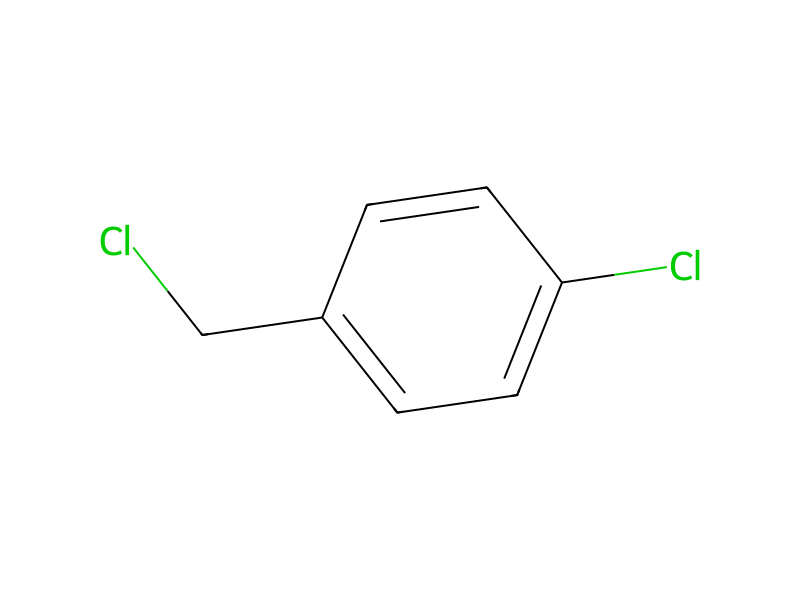
4-クロロベンジルクロリド

1-Chloro-4-(chloromethyl)benzene

HCID 7723
ノートを作成反応を作成見積依頼を出す
印刷プレビュー

データを補完しています。しばらくしてからページを更新すると最新の内容を表示できます
基本情報概要名称と識別子物性安全と法規制化学と産業関連反応化合物ノート
部分構造検索類似構造を探す

基本情報

CAS
104-83-6
標準SMILES
ClCc1ccc(Cl)cc1
InChIKey
JQZAEUFPPSRDOP-UHFFFAOYSA-N
分子式
C7H6Cl2
平均分子量
161.03 g/mol
単同位体質量
159.98465555

概要

structure in first source

名称と識別子

優先名称
1-Chloro-4-(chloromethyl)benzene
IUPAC
1-chloro-4-(chloromethyl)benzene
現地名
4-クロロベンジルクロリド
英語名
4-Chlorobenzyl chloride
分子式
C7H6Cl2
分子量
161.03

名称と別名

1-Chloro-4-(chloromethyl)benzene1-CHLORO-4-CHLOROMETHYLBENZENEp,alpha-DichlorotolueneRefChem:4313934-Chlorobenzyl chloride104-83-6p-Chlorobenzyl chloridealpha,4-DichlorotolueneBenzene, 1-chloro-4-(chloromethyl)-4-chlorobenzylchloride(4-Chlorophenyl)methyl chloride1-Chloro-4-chloromethyl-benzene
名称をさらに表示
4-クロロベンジルクロリドp-クロロベンジルクロライドp-クロロベンジルクロリドpクロロベンジルクロライド塩化4-クロロベンジル クロライド 塩化物pクロロベンジルクロリド塩化4-クロロベンジルα,4-ジクロロトルエン1-クロロ-4-(クロロメチル)ベンゼンアルファ,4‐ジクロロトルエン4‐クロロベンジルクロリドCHLOROBENZYL CHLORIDEPCBCPARA-CHLOROBENZYLCHLORIDEa13-14884p-chlorobenzylAKOS BBS-00003957,4-DichlorotolueneA,P-DICHLOROTOLUENE
alpha,p-Dichlorotoluenep-chlorobenzylchloridep-Chlorophenylmethyl chlorideMFCD00000914NSC 34032.alpha.,p-Dichlorotoluene.alpha.,4-DichlorotolueneQ9HS4N7D3M

データベース識別子

CAS
104-83-6
PubChem CID
7723
DTXSID
DTXSID4051530
UNII
Q9HS4N7D3M
EC Number
203-242-7
Nikkaji
J5.035K

物性

構造計算による物性補完中

XLogP
3.2
極性表面積
0 Ų
水素結合供与体数
0
水素結合受容体数
0
回転可能結合数
1
重原子数
9
形式電荷
0
複雑度
75

実験および物理化学的性質

SpringerMaterials PropertiesDensity
LogP · 2 件

Log Kow = 3.18

3.18

Density1.270-1.280 AT 25 DEG/15 °C
Color/Form · 2 件

COLORLESS LIQUID

Colorless needles

Solubility · 5 件

SOL IN CARBON DISULFIDE; SLIGHTLY SOL IN ALCOHOL

>10% in benzene

>10% in ethyl ether

>10% in acetic acid

For more Solubility (Complete) data for 1-CHLORO-4-CHLOROMETHYLBENZENE (7 total), please visit the HSDB record page.

Boiling Point223 °C
DecompositionWhen heated to decomposition it emits toxic vapors of /hydrogen chloride/.
Melting Point31 °C
Refractive IndexIndex of refraction: 1.5554 @ 20 °C
Other Experimental PropertiesUV: 206 (Sadtler Research Laboratories Spectral Collection) /Benzyl chloride, 2-chloro/

安全と法規制

安全情報は参考情報です。供給元の安全データシート(SDS)、適用法令、専門家による評価に代わるものではありません。

GHS分類

GHS Classification · 6 件

Danger

H302+H312+H332 (87.5%): Harmful if swallowed, in contact with skin or if inhaled [Warning Acute toxicity, oral; acute toxicity, dermal; acute toxicity, inhalation]

P260, P261, P264, P264+P265, P270, P271, P272, P273, P280, P301+P317, P301+P330+P331, P302+P352, P302+P361+P354, P304+P340, P305+P351+P338, P305+P354+P338, P316, P317, P321, P330, P333+P317, P337+P317, P362+P364, P363, P391, P405, and P501 (click each P-code to see the statement)

Aggregated GHS information provided per 96 reports by companies from 9 notifications to the ECHA C&L Inventory. Each notification may be associated with multiple companies.

Warning

H302: Harmful if swallowed [Warning Acute toxicity, oral]

危険有害性情報

Regulatory Information · 4 件

Chemical: Benzene, 1-chloro-4-(chloromethyl)-

Status: Active Update: 04-05-2021 https://echa.europa.eu/registration-dossier/-/registered-dossier/5414

4-Chlorobenzyl chloride: Does not have an individual approval but may be used under an appropriate group standard

The New Jersey Worker and Community Right to Know Act requires public and private employers to provide information about hazardous substances at their workplaces. (N.J.S.A. 34:5A-1 et. seq.)

Fire PotentialSLIGHT, WHEN EXPOSED TO HEAT OR FLAME /4-CHLOROTOLUENE/
Hazards Summary · 1 件

The major hazards encountered in the use and handling of 1-chloro-4-chloromethylbenzene stem from its toxicologic properties. Exposure to this colorless liquid occurs primarily in the occupational setting from its use as an intermediate in the synthesis of organic chemicals, pharmaceuticals, and dyes. Because this material is capable of causing irritation to the skin and eyes, persons involved with 1-chloro-4-chloromethylbenzene should wear boots, protective gloves, and goggles, at a minimum. When entering a contaminated area, also wear a full-face mask self-contained breathing apparatus which provides eye protection. Broken packages containing this substance should not be handled without protective equipment. Washing away any material which may have contacted the body with copious amounts of water, or soap and water is also recommended. This substance is normally stable, even under fire exposure conditions; requiring moderate heating for ignition to occur. Normal procedures may be used to fight a 1-chloro-4-chloromethylbenzene fire; extinguishing with "alcohol" foam, CO2, or dry chemical agents. Water also may be used in flooding quantities as a fog or spray (solid streams may be ineffective) to extinguish the fire and cool containers. The latter should be done from as far a distance as possible. This substance should be stored away from sparks, flames, and other sources of ignition. Containers of 1-chloro-4-chloromethylbenzene may be shipped by air, rail, road, or water, and should be affixed with labels stating, "Keep Away From Food". Regulatory requirements of the DOT should be consulted before transport. For large 1-chloro-4-chloromethylbenzene spills, use water spray to knock down vapor; keeping material out of water sources and sewers by diking, if necessary. Prior to implementing land diposal of waste residue (including waste sludge), consult with environmental regulatory agencies for guidance.

化学と産業

薬理情報

Mechanism of Action · 1 件

Twenty dichloromethyl compounds have been tested as potential mechanism based inactivators of the major phenobarbital inducible isozyme of rat liver cytochrome p450 in a reconstituted system. With the exception of dichloromethane and dichloroacetamide, all the compounds decreased the ethoxycoumarin deethylase activity of the enzyme in a time and NADPH dependent manner.

Metabolism/MetabolitesYIELDS P-CHLOROBENZOIC ACID & PROBABLY S-(P-CHLOROBENZYL)-L-CYSTEINE IN RABBIT. /FROM TABLE/

用途と製造

UsesINTERMEDIATE FOR ORGANIC CHEMICALS, PHARMACEUTICALS & DYES
General Manufacturing Information · 2 件

Benzene, 1-chloro-4-(chloromethyl)-: ACTIVE

THE ALGICIDE, 1-(4-CHLOROBENZYL)-2-METHYLAZIRIDINE, IS PREPARED BY REACTION OF 4-CHLOROBENZYL CHLORIDE WITH 2-METHYLAZIRIDINE IN METHANOL AT ROOM TEMP IN PRESENCE OF POTASSIUM CARBONATE.

応用分野 · 3 件

用途有機化学品、医薬、染料の中間体

使用4-Chlorobenzyl Chloride is a benzylchloride derivative used in the preparation of various biologically active compounds such as bronchodilators and antibacterial agents.

一般的な説明4-Chlorobenzyl chloride is generally used in the preparation of quaternary ammonium salts. It acts as an intermediate in the production of rice herbicide, pharmaceuticals and pesticides.

調製方法

純化方法Dry it over CaSO4, then fractionally distil it under reduced pressure. Crystallise it from heptane or dry diethyl ether at low temperature. [Beilstein 5 IV 816.] LACHRYMATORY.

関連反応

573 件
反応記録を作成
HRID 5593 の反応式
HRID 5593反応物としてuspto-grants-1993_09
HRID 5611 の反応式
HRID 5611反応物としてuspto-grants-1993_09
HRID 8023 の反応式
HRID 8023反応物としてuspto-grants-2006_08
HRID 15546 の反応式
HRID 15546反応物としてuspto-grants-2010_06
HRID 18752 の反応式
HRID 18752反応物としてuspto-grants-2010_06
HRID 27667 の反応式
HRID 27667反応物としてuspto-grants-1980_09
HRID 28651 の反応式
HRID 28651反応物としてuspto-grants-2008_09
HRID 30358 の反応式
HRID 30358反応物としてuspto-grants-2008_09
1 / 72 ページ

化合物ノート

読み込み中…

このページの内容基本情報概要名称と識別子物性安全と法規制化学と産業関連反応化合物ノート
その他の操作
ノートを作成反応を作成見積依頼を出す

物理化学的性質

融点
27 · 27-29 °C (lit.)
沸点
216 · 216-222 °C (lit.)
比重(密度)
1.26 · 1.26
闪点
208 °F · 208 °F
屈折率
1.5575 · 1.5575
貯蔵温度
Store at RT.
溶解性
不溶性
外見
結晶性低融点固体
比重
1.26 · 1.26
色
無色~白色
水溶解度
不溶性
BRN
471558 · 471558
Henry's Law Constant
2.9 · 2.9×10-2 mol/(m3Pa) at 25℃, HSDB (2015)
安定性
Moisture Sensitive
主な用途
環境医薬品
InChI
1S/C7H6Cl2/c8-5-6-1-3-7(9)4-2-6/h1-4H,5H2
InChIKey
JQZAEUFPPSRDOP-UHFFFAOYSA-N
SMILES
ClCc1ccc(Cl)cc1
CAS データベース
104 · 104-83-6(CAS DataBase Reference)
NISTの化学物質情報
1 · Benzene, 1-chloro-4-(chloromethyl)-(104-83-6)
EPAの化学物質情報
4 · 4-Chlorobenzyl chloride (104-83-6)

化学的性質

化学的特性Colorless to light yellow liqui

DOT Emergency Guidelines · 5 件

/GUIDE 153: SUBSTANCES - TOXIC AND/OR CORROSIVE (COMBUSTIBLE)/ Health: TOXIC; inhalation, ingestion, or skin contact with material may cause severe injury or death. Contact with molten substance may cause severe burns to skin and eyes. Avoid any skin contact. Effects of contact or inhalation may be delayed. Fire may produce irritating, corrosive and/or toxic gases. Runoff from fire control or dilution water may be corrosive and/or toxic and cause pollution. /Chlorobenzyl chlorides; Chlorobenzyl chlorides, liquid; Chlorobenzyl chlorides, solid/

/GUIDE 153: SUBSTANCES - TOXIC AND/OR CORROSIVE (COMBUSTIBLE)/ Fire or Explosion: Combustible material: may burn but does not ignite readily. When heated, vapors may form explosive mixtures with air: indoors, outdoors, and sewers explosion hazards. Those substances designated with a "P" may polymerize explosively when heated or involved in a fire. Contact with metals may evolve flammable hydrogen gas. Containers may explode when heated. Runoff may pollute waterways. Substance may be transported in a molten form. /Chlorobenzyl chlorides; Chlorobenzyl chlorides, liquid; Chlorobenzyl chlorides, solid/

/GUIDE 153: SUBSTANCES - TOXIC AND/OR CORROSIVE (COMBUSTIBLE)/ Public Safety: CALL Emergency Response Telephone Number ... . As an immediate precautionary measure, isolate spill or leak area in all directions for at least 50 meters (150 feet) for liquids and at least 25 meters (75 feet) for solids. Keep unauthorized personnel away. Stay upwind. Keep out of low areas. Ventilate enclosed areas. /Chlorobenzyl chlorides; Chlorobenzyl chlorides, liquid; Chlorobenzyl chlorides, solid/

/GUIDE 153: SUBSTANCES - TOXIC AND/OR CORROSIVE (COMBUSTIBLE)/ Protective Clothing: Wear positive pressure self-contained breathing apparatus (SCBA). Wear chemical protective clothing that is specifically recommended by the manufacturer. It may provide little or no thermal protection. Structural firefighters' protective clothing provides limited protection in fire situations ONLY; it is not effective in spill situations where direct contact with the substance is possible. /Chlorobenzyl chlorides; Chlorobenzyl chlorides, liquid; Chlorobenzyl chlorides, solid/

For more DOT Emergency Guidelines (Complete) data for 1-CHLORO-4-CHLOROMETHYLBENZENE (8 total), please visit the HSDB record page.

DOT Hazard Classification · 2 件

para-Chlorobenzyl chloride, liquid or solid

Marine pollutant

Hazard Classes and Categories · 2 件

Acute Tox. 4 (96.9%)

Acute toxicity (Oral) - Category 4

Shipment Methods and Regulations · 3 件

No person may /transport,/ offer or accept a hazardous material for transportation in commerce unless that person is registered in conformance ... and the hazardous material is properly classed, described, packaged, marked, labeled, and in condition for shipment as required or authorized by ... /the hazardous materials regulations (49 CFR 171-177)./

The International Air Transport Association (IATA) Dangerous Goods Regulations are published by the IATA Dangerous Goods Board pursuant to IATA Resolutions 618 and 619 and constitute a manual of industry carrier regulations to be followed by all IATA Member airlines when transporting hazardous materials.

The International Maritime Dangerous Goods Code lays down basic principles for transporting hazardous chemicals. Detailed recommendations for individual substances and a number of recommendations for good practice are included in the classes dealing with such substances. A general index of technical names has also been compiled. This index should always be consulted when attempting to locate the appropriate procedures to be used when shipping any substance or article.

Shipping Name/ Number DOT/UN/NA/IMO · 2 件

UN 2235; Chlorobenzyl chlorides

IMO 6.1; Chlorobenzyl chlorides

Skin, Eye, and Respiratory IrritationsIRRITATING TO SKIN & EYES.

安全と保護具

Fire Fighting Procedures · 1 件

Do not extinguish fire unless flow can be stopped. Use water in flooding quantities as fog. Solid streams of water may be ineffective. Cool all affected containers with flooding quantities of water. Apply water from as far a distance as possible. Use "alcohol" foam, carbon dioxide, or dry chemical. /4-Chlorotoluene/

Disposal Methods · 1 件

SRP: At the time of review, criteria for land treatment or burial (sanitary landfill) disposal practices are subject to significant revision. Prior to implementing land disposal of waste residue (including waste sludge), consult with environmental regulatory agencies for guidance on acceptable disposal practices.

Preventive Measures · 4 件

AVOID PROLONGED BREATHING OF VAPOR. USE WITH ADEQUATE VENTILATION. /4-CHLOROTOLUENE/

If material not on fire and not involved in fire: Keep sparks, flames, and other sources of ignition away. Keep material out of water sources and sewers. Build dikes to contain flow as necessary. /4-Chlorotoluene/

Personnel protection: Avoid breathing vapors. Keep upwind. Wear boots, protective gloves, and goggles. Do not handle broken packages without protective equipment. Wash away any material which may have contacted the body with copious amounts of water or soap and water. /4-Chlorotoluene/

SRP: The scientific literature for the use of contact lenses in industry is conflicting. The benefit or detrimental effects of wearing contact lenses depend not only upon the substance, but also on factors including the form of the substance, characteristics and duration of the exposure, the uses of other eye protection equipment, and the hygiene of the lenses. However, there may be individual substances whose irritating or corrosive properties are such that the wearing of contact lenses would be harmful to the eye. In those specific cases, contact lenses should not be worn. In any event, the usual eye protection equipment should be worn even when contact lenses are in place.

毒性情報

Environmental Fate · 3 件

TERRESTRIAL FATE: Based on a classification scheme(1), an estimated Koc value of 1,300(SRC), determined from a log Kow of 3.18(2) and a regression-derived equation(3), indicates that 1-chloro-4-chloromethylbenzene is expected to have low mobility in soil(SRC). Volatilization of 1-chloro-4-chloromethylbenzene from moist soil surfaces may be an important fate process(SRC) given an estimated Henry's Law constant of 3.4X10⁻⁴ atm-cu m/mole(SRC), using a fragment constant estimation method(4). Hydrolysis may occur in moist soils based upon an estimated hydrolysis half-life of 25.5 hours at 25 °C(SRC) from this compound's experimental activation energy(5). The potential for volatilization of 1-chloro-4-chloromethylbenzene from dry soil surfaces may exist(SRC) based upon an estimated vapor pressure of 1.9 mm Hg(SRC), determined from a fragment constant method(6). Volatilization from soil surfaces may be attenuated by adsorption(SRC).

AQUATIC FATE: Based on a classification scheme(1), an estimated Koc value of 1,300(SRC), determined from a log Kow of 3.18(2) and a regression-derived equation(3), indicates that 1-chloro-4-chloromethylbenzene is expected to adsorb to suspended solids and sediment in water(SRC). 1-Chloro-4-chloromethylbenzene may volatilize from water surfaces(3,SRC) based upon an estimated Henry's Law constant of 3.4X10⁻⁴ atm-cu m/mole(SRC), developed using a fragment constant estimation method(4). Estimated volatilization half-lives for a model river and model lake(3) are 7.0 hours and 6.0 days, respectively(SRC). The volatilization half-life from a model pond 2 m deep is estimated to be about 3.3 days ignoring adsorption(5); when considering maximum adsorption the volatilization half-life increases to 9.9 days(5). According to a classification scheme(6), an estimated BCF of 150(3,SRC), from a log Kow(2), suggests the potential for bioconcentration in aquatic organisms is high(SRC). Hydrolysis is expected to be an important process in aquatic systems based upon an estimated hydrolysis half-life of 25.5 hours at 25 °C(SRC) from this compound's experimental activation energy(7).

ATMOSPHERIC FATE: According to a model of gas/particle partitioning of semivolatile organic compounds in the atmosphere(1), 1-chloro-4-chloromethylbenzene, which has an estimated vapor pressure of 1.9 mm Hg at 25 °C(2,SRC), is expected to exist solely as a vapor in the ambient atmosphere. Vapor-phase 1-chloro-4-chloromethylbenzene is degraded in the atmosphere by reaction with photochemically-produced hydroxyl radicals(SRC); the half-life for this reaction in air is estimated to be 13 days(3,SRC). 1-Chloro-4-chloromethylbenzene has an adsorption band at 275 nm that extends to about 295 nm(4), suggesting 1-chloro-4-chloromethylbenzene may undergo direct photolysis(SRC).

Soil Adsorption/Mobility · 1 件

The Koc of 1-chloro-4-chloromethylbenzene is estimated as approximately 1,300(SRC), using a log Kow of 3.18(1) and a regression-derived equation(2). According to a classification scheme(3), this estimated Koc value suggests that 1-chloro-4-chloromethylbenzene is expected to have low mobility in soil.

Artificial Pollution Sources1-Chloro-4-chloromethylbenzene's use as an intermediate for organic chemicals, pharmaceuticals, and dyes(1) may result in its release to the environment through various waste streams(SRC).
Environmental Biodegradation · 1 件

1-Chloro-4-chloromethylbenzene was dehalogenated by a resting cell suspension of a soil bacterium, a Pseudomonas, that was isolated because of its ability to grow on 1,9-dichlorononane, although the bacterium was not able to grow on 1-chloro-4-chloromethylbenzene(1). Products formed after 24 hr of incubation were p-chlorobenzyl alcohol and p-chlorobenzoic acid(1). The p-chlorobenzyl alcohol was also formed in controls and therefore was produced, at least partially, by chemical hydrolysis(1). 1-Chloro-4-chloromethylbenzene is reported to degrade in a biodegradability screening test utilizing an activated sludge inoculum after 5 to 10 days incubation(2).

Environmental Bioconcentration · 1 件

An estimated BCF of 150 was calculated for 1-chloro-4-chloromethylbenzene(SRC), using a log Kow of 3.18(1) and a regression-derived equation(2). According to a classification scheme(3), this BCF suggests the potential for bioconcentration in aquatic organisms is high. However, bioconcentration may be attenuated by hydrolysis based upon a hydrolysis half-life of 25.5 hours at 25 °C(SRC), estimated from this compound's experimental activation energy(4).

Volatilization from Water/Soil · 1 件

The Henry's Law constant for 1-chloro-4-chloromethylbenzene is estimated as 3.4X10⁻⁴ atm-cu m/mole(SRC) using a fragment constant estimation method(1). This Henry's Law constant indicates that 1-chloro-4-chloromethylbenzene is expected to volatilize from water surfaces(2,SRC). Based on this Henry's Law constant, the estimated volatilization half-life from a model river (1 m deep, flowing 1 m/sec, wind velocity of 3 m/sec) is approximately 7.0 hours(2,SRC). The estimated volatilization half-life from a model lake (1 m deep, flowing 0.05 m/sec, wind velocity of 0.5 m/sec) is approximately 6.0 days(2,SRC). The volatilization half-life from a model pond 2 m deep is estimated to be about 3.3 days ignoring adsorption(3); when considering maximum adsorption the volatilization half-life increases to 9.9 days(3). 1-Chloro-4-chloromethylbenzene's Henry's Law constant(1,SRC) indicates that volatilization from moist soil surfaces may occur(SRC). The potential for volatilization of 1-chloro-4-chloromethylbenzene from dry soil surfaces may exist(SRC) based upon an estimated vapor pressure of 1.9 mm Hg(SRC), determined from a fragment constant method(4).

Populations at Special Risk/Individuals who suffer from/ skin, liver, kidney, or chronic respiratory disease, will be at an increased risk if they are exposed to chlorobenzenes. /Chlorobenzenes/
Environmental Abiotic Degradation · 1 件

The rate constant for the vapor-phase reaction of 1-chloro-4-chloromethylbenzene with photochemically-produced hydroxyl radicals has been estimated as 1.2X10⁻¹² cu cm/molecule-sec at 25 °C(SRC) using a structure estimation method(1). This corresponds to an atmospheric half-life of about 13 days at an atmospheric concentration of 5X10+5 hydroxyl radicals per cu cm(SRC). 1-Chloro-4-chloromethylbenzene has an adsorption band at 275 nm that extends to about 295 nm(2), suggesting 1-chloro-4-chloromethylbenzene may potentially undergo direct photolysis(SRC). Hydrolysis rate constants of 5.69X10⁻⁵/sec and 3.35X10⁻⁴/sec were measured at 42.86 °C and 60.44 °C, respectively(3); these rate constants correspond to hydrolysis half-lives of 3.4 hours and 0.57 hours at 42.86 °C and 60.44 °C, respectively(SRC). A hydrolysis half-life of 25.5 hr(SRC) at 25 °C was extrapolated using the experimental activation energy(3).

Probable Routes of Human Exposure · 1 件

NIOSH (NOES Survey 1981-1983) has statistically estimated that 5,961 workers (763 of these are female) are potentially exposed to 1-chloro-4-chloromethylbenzene in the US(1). Occupational exposure to 1-chloro-4-chloromethylbenzene may occur through inhalation and dermal contact with this compound at workplaces where 1-chloro-4-chloromethylbenzene is used(SRC).

Environmental Fate/Exposure Summary · 1 件

1-Chloro-4-chloromethylbenzene's use as an intermediate for organic chemicals, pharmaceuticals, and dyes may result in its release to the environment through various waste streams. If released to air, an estimated vapor pressure of 1.9 mm Hg at 25 °C indicates 1-chloro-4-chloromethylbenzene will exist solely as a vapor in the ambient atmosphere. Vapor-phase 1-chloro-4-chloromethylbenzene will be degraded in the atmosphere by reaction with photochemically-produced hydroxyl radicals; the half-life for this reaction in air is estimated to be 13 days. 1-Chloro-4-chloromethylbenzene has an adsorption band at 275 nm that extends to about 295 nm, suggesting 1-chloro-4-chloromethylbenzene may potentially undergo direct photolysis. If released to soil, 1-chloro-4-chloromethylbenzene is expected to have low mobility based upon an estimated Koc of 1,300. Volatilization from moist soil surfaces may be an important fate process based upon an estimated Henry's Law constant of 3.4X10⁻⁴ atm-cu m/mole. However, hydrolysis may attenuate volatilization from moist soil surfaces. 1-Chloro-4-chloromethylbenzene may potentially volatilize from dry soil surfaces based upon its vapor pressure. However, volatilization from soil surfaces is expected to be attenuated by adsorption to soil. If released into water, 1-chloro-4-chloromethylbenzene is expected to adsorb to suspended solids and sediment in water based upon the estimated Koc. Volatilization from water surfaces may be an important fate process based upon this compound's estimated Henry's Law constant. Estimated volatilization half-lives for a model river and model lake are 7.0 hours and 6.0 days, respectively. Adsorption to suspended solids and sediment in the water column is expected to attenuate volatilization. Hydrolysis is expected to be an important process in aquatic systems and moist soils, based upon an estimated hydrolysis half-life of 25.5 hours at 25 °C. An estimated BCF of 150 suggests the potential for bioconcentration in aquatic organisms is high. However, bioconcentration in aquatic organisms may be attenuated by hydrolysis. Occupational exposure to 1-chloro-4-chloromethylbenzene may occur through inhalation and dermal contact with this compound at workplaces where 1-chloro-4-chloromethylbenzene is used. (SRC)

安全データ

F
19-21
wgk
2
tsca
TSCA listed
rtecs
XT0720000
ridadr
UN 3427 6.1/PG III (CHLOROBENZYL CHLORIDES, SOLID)
hs_code
29049090
risk_code
34-51/53-20/21/22-52/53-43-22
化審法
(3)-78, (3)-91
安衛法
変異原性物質
hazard_code
C,N,Xn
hazard_note
Corrosive/Lachrymatory
safety_code
26-36/37/39-45-29-61-36/37
hazard_class
6.1
packing_group
III
Hazard Classifications
Acute Tox. 4 DermalAcute Tox. 4 InhalationAcute Tox. 4 OralAquatic Chronic 2Skin Sens. 1
ストレージクラス
6.1C - Combustible acute toxic Cat.3toxic compounds or compounds which causing chronic effects
有毒物質データの
104-83-6(Hazardous Substances Data)

上流・下流製品情報

上流原料

過酸化ベンゾイル2,2'-アゾビス(イソブチロニトリル)塩素塩化亜鉛パラホルムアルデヒド塩化スルフリル4-クロロトルエン (1mg/mlメタノール溶液) [水質分析用]

下流製品

1-(4-クロロベンジル)ピペラジン 塩化物2-(4-Chloro-phenyl)-acetamidine4-クロロ-α-(1-オキソプロピル)ベンゼンアセトニトリルスルコナゾールPaclobutrazol W.P.4-クロロジフェニルメタン4-クロロベンジルアミンジエチルチオカルバミン酸S-(4-クロロベンジル)4-クロロベンズアルデヒドブトコナゾール4-クロロベンゼンプロピオン酸4-クロロベンジルシアニド2-(4-クロロフェニル)イソ吉草酸1-(4-chlorobenzyl)-(1H-1,2,4-triazol-yl)-pinacolone4-クロロベンジルメルカプタン(4-クロロフェニル)メタンスルホニルクロリド4-(4-Chloro-benzyloxy)-phenylamineパクロブトラゾールbrofenvalerateエコナゾール