ホームMCPワークベンチSkills
ホームワークベンチ通知マイページ
llms.txt · MCPガイドプライバシーポリシー · 利用規約 · サポートv1.8.0
  1. ホーム
  2. /化合物

クロロぎ酸イソプロピル

Isopropyl chloroformate

HCID 7917
ノートを作成反応を作成見積依頼を出す
印刷プレビュー

データを補完しています。しばらくしてからページを更新すると最新の内容を表示できます

基本情報概要名称と識別子物性安全と法規制化学と産業関連反応化合物ノート
部分構造検索類似構造を探す

基本情報

CAS
108-23-6
標準SMILES
CC(C)OC(=O)Cl
InChIKey
IVRIRQXJSNCSPQ-UHFFFAOYSA-N
分子式
C4H7ClO2
平均分子量
122.55 g/mol
単同位体質量
122.01345714

概要

Isopropyl chloroformate appears as a clear colorless volatile liquid with a pungent irritating odor. About the same density as water and insoluble in water. Floats on water Very irritating to skin and eyes and very toxic by inhalation, ingestion and skin absorption. Used to make other chemicals.

名称と識別子

優先名称
Isopropyl chloroformate
IUPAC
propan-2-yl carbonochloridate
現地名
クロロぎ酸イソプロピル
英語名
Isopropyl chloroformate
分子式
C4H7ClO2
分子量
122.55

名称と別名

Isopropyl chloroformate108-23-6ISOPROPYL CHLOROCARBONATEChloroformic acid isopropyl esterCarbonochloridic acid, 1-methylethyl esterIsopropyl chloromethanoateFormic acid, chloro-, isopropyl ester1-methylethyl chloroformate2-propyl chloroformateUN2407HSDB 2848Carbonochloride acid, 1-methylethyl ester
名称をさらに表示
クロロぎ酸イソプロピルクロリド炭酸イソプロピルクロロ炭酸イソプロピル含塩素炭酸イソプロピルイソプロピルクロロフォ-メ-トクロロギ酸イソプロピル 塩化物含素炭酸イソプロピルクロロぎ酸イソプロピル (約30%トルエン溶液, 約2mol/L)クロロ蟻酸イソプロピルクロロ蟻酸イソプロピル (約30%トルエン溶液, 約2mol/L)イソプロピル=クロロホルマートクロロギ酸イソプロピル 溶液isopropyl carbonochloridateIPCFpropan-2-yl carbonochloridateISOPROPYL CHLOROMATEIsopropyl chloroform1-PROPYLCHLOROFORMATE2-MethylchloroformateTenofovir Impurity 95Isopropylchlorcarbonat
Isopropylester kyseliny chlormravenciEINECS 203-563-28LG1G18VXRBRN 0506416AI3-26269Isopropylester kyseliny chlormravenci [Czech]isopropoxycarbonyl chlorideUN-2407

データベース識別子

CAS
108-23-6
PubChem CID
7917
DTXSID
DTXSID7026786
UNII
8LG1G18VXR
EC Number
203-563-2
Nikkaji
J34.720E

物性

構造計算による物性補完中

XLogP
2
極性表面積
26.3 Ų
水素結合供与体数
0
水素結合受容体数
2
回転可能結合数
2
重原子数
7
形式電荷
0
複雑度
70.1

実験および物理化学的性質

Chemical Classes · 2 件

Toxic Gases & Vapors -> Acid Halides

Corrosives

SpringerMaterials PropertiesBoiling point
OdorPungent
Density · 4 件

1.08 (EPA, 1998) - Denser than water; will sink

1.078 (20 °C/4 °C)

Relative density (water = 1): 1.08

1.078 @25 °C

Viscosity0.65 cP @ 20 °C
Color/FormCOLORLESS LIQ
Solubility · 2 件

VERY SOL IN ETHER

Solubility in water: slow reaction

Flash Point · 3 件

60.1 °F (EPA, 1998)

15.6 °C

20 °C c.c.

Boiling Point · 4 件

220 °F at 761 mmHg (EPA, 1998)

104.6 °C @ 761 MM HG

104.6 °C

105 °C @760 [mm Hg]

Melting Point-80 °C

安全と法規制

安全情報は参考情報です。供給元の安全データシート(SDS)、適用法令、専門家による評価に代わるものではありません。

GHS分類

GHS Classification · 6 件

Danger

H225 (100%): Highly Flammable liquid and vapor [Danger Flammable liquids]

P210, P233, P240, P241, P242, P243, P260, P261, P264, P264+P265, P270, P271, P272, P280, P284, P301+P317, P301+P330+P331, P302+P352, P302+P361+P354, P303+P361+P353, P304+P340, P305+P354+P338, P316, P317, P320, P321, P330, P332+P317, P333+P317, P362+P364, P363, P370+P378, P403+P233, P403+P235, P405, and P501 (click each P-code to see the statement)

Aggregated GHS information provided per 208 reports by companies from 9 notifications to the ECHA C&L Inventory. Each notification may be associated with multiple companies.

Danger

H225: Highly Flammable liquid and vapor [Danger Flammable liquids]

危険有害性情報

Hazards IdentificationToxic/poison by inhalation (TIH/PIH)
Regulatory Information · 3 件

Chemical: Carbonochloridic acid, 1-methylethyl ester

Status: Active Update: 01-04-2019 https://echa.europa.eu/registration-dossier/-/registered-dossier/13188

The New Jersey Worker and Community Right to Know Act requires public and private employers to provide information about hazardous substances at their workplaces. (N.J.S.A. 34:5A-1 et. seq.)

Other Safety InformationEvaluation - Chemicals that are unlikely to require further regulation to manage risks to human health
DOT LabelPoison Inhalation Hazard Flammable Liquid Corrosive
Fire Hazards · 3 件

Extremely dangerous; this chemical has exploded while stored in refrigerator. Vapor explosion hazard indoors, outdoors or in sewers. Runoff to sewer may create fire or explosion hazard. Like other chlorides, when heated to decomposition or on contact with acids or acrid fumes, they evolve highly toxic chloride fumes. Reacts violently with phosgene. Unstable, avoid phosgene (EPA, 1998)

化学と産業

用途と製造

Uses · 5 件

Used in organic synthesis; [CAMEO]

CHEMICAL INTERMEDIATE FOR FREE-RADICAL POLYMERIZATION INITIATORS; ORGANIC SYNTHESIS.

Reactive intermediate to pesticides, veterinary medicines, polymerization initiators and other chemicals.

Intermediate in the manufacture of diisopropyl azidoformate, a blowing agent.

Intermediate in production of the herbicide IPC and in preparation of dialkyl peroxycarbonates used as catalysts in the sodium peroxide production of PVC.

ImpuritiesCarbon dioxide, hydrogen chloride, phosgene, and alkyl chlorides; main impurities are corresponding carbonates
Methods of ManufacturingPrepared by the reaction of liquid anhydrous alcohol /isopropyl/ with molar excess of dry, chlorine-free phosgene at low temperature /low molecular weight alkyl chlorofomates/
Formulations/Preparations · 2 件

Typical specifications of commercial chloroformates: purity, 98%; phosgene, <0.1%, iron, <10 ppm; acidity as HCl, <0.1%; alcohol or phenol, <2%

Commercial products have concentrations of 97-99 wt% /Chloroformic esters/

General Manufacturing Information · 3 件

Carbonochloridic acid, 1-methylethyl ester: ACTIVE

... PHOSGENE DERIVATIVE.

Most chloroformate production is used captively and production figures are not available.

応用分野 · 3 件

用途殺虫剤の反応中間体、動物用医薬品、重合開始剤

使用Chemical intermediate for free-radical polymerization initiators, organic synthesis.

一般的な説明A clear colorless volatile liquid with a pungent irritating odor. About the same density as water and insoluble in water. Floats on water Flash point 75°F. Very irritating to skin and eyes and very toxic by inhalation, ingestion and skin absorption. Used to make other chemicals.

関連反応

673 件
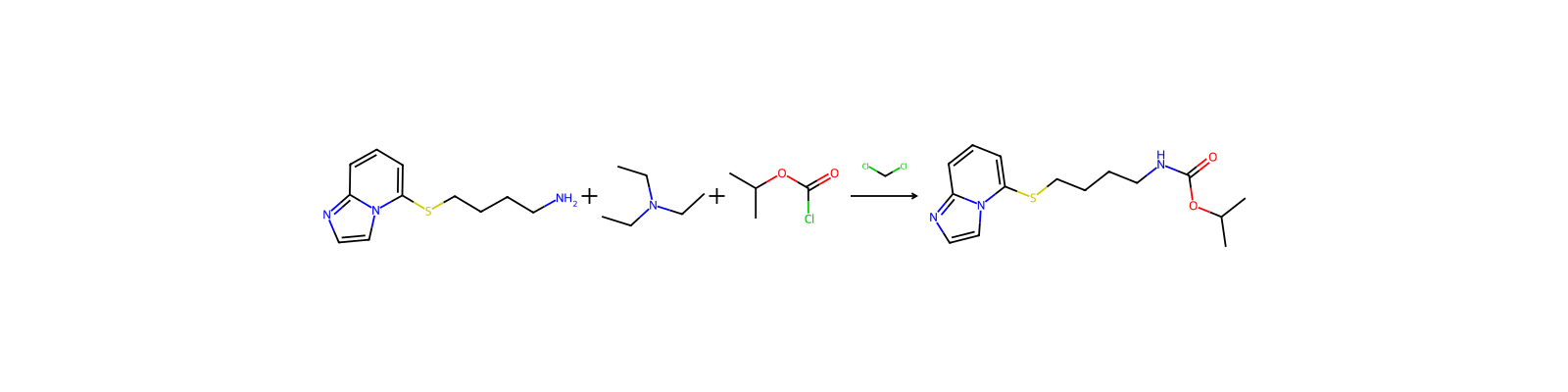
反応記録を作成
HRID 5459 の反応式
HRID 5459反応物としてuspto-grants-1993_09
HRID 5486 の反応式
HRID 5486反応物としてuspto-grants-1993_09
HRID 31827 の反応式
HRID 31827反応物としてuspto-grants-2008_09
HRID 43279 の反応式
HRID 43279溶媒としてuspto-grants-2013_09
HRID 45611 の反応式
HRID 45611反応物としてuspto-grants-2013_09
HRID 45615 の反応式
HRID 45615反応物としてuspto-grants-2013_09
HRID 45625 の反応式
HRID 45625反応物としてuspto-grants-2013_09
HRID 46921 の反応式
HRID 46921反応物としてuspto-grants-1979_11
1 / 85 ページ

化合物ノート

読み込み中…

このページの内容基本情報概要名称と識別子物性安全と法規制化学と産業関連反応化合物ノート
その他の操作
ノートを作成反応を作成見積依頼を出す
Vapor Density · 3 件

4.2 (EPA, 1998) - Heavier than air; will sink (Relative to Air)

4.2 (AIR= 1)

Relative vapor density (air = 1): 4.2

Vapor Pressure · 3 件

100 mm Hg @ 47 °C

Vapor pressure, kPa at 20 °C: 3

72 [mm Hg] @21 °C

物理化学的性質

沸点
105 °C · 105 °C
比重(密度)
0.892 g/mL · 0.892 g/mL at 25 °C
蒸気圧
27.998 hPa · 27.998hPa at 20℃
屈折率
20 · n20/D 1.485(lit.)
闪点
43 °F · 43 °F
貯蔵温度
2 · 2-8°C
溶解性
Chloroform (Sparingly), Dichloromethane (Soluble), Ethyl Acetate (Slightly), Tol
外見
liquid
BRN
506416 · 506416
Henry's Law Constant
2.4 · 2.4×10-3 mol/(m3Pa) at 25℃, HSDB (2015)
安定性
Moisture Sensitive
InChI
InChI=1S/C4H7ClO2/c1-3(2)7-4(5)6/h3H,1-2H3
InChIKey
IVRIRQXJSNCSPQ-UHFFFAOYSA-N
SMILES
C(Cl)(OC(C)C)=O
CAS データベース
108 · 108-23-6(CAS DataBase Reference)
EPAの化学物質情報
Isopropyl chloroformate (108-23-6)
化学的性質 · 1 件

化学的特性Isopropyl chloroformate is a colorless liquid with corrosive properties and a pungent odor. generally present as 1.0 mol/L toluene solution of isopropyl chloroformate. It is a highly flammable chemical. Isopropyl chloroformate decomposes when heated, producing toxic and corrosive fumes, including hydrogen chloride and phosgene. The chemical reacts with water to produce alcohol and hydrogen chloride. Hydrolysis would yield chloroformic acid, which is considered a strong acid.

· HIGHLY FLAMMABLE: Will be easily ignited by heat, sparks or flames.

Highly flammable. Gives off irritating or toxic fumes (or gases) in a fire. Vapour/air mixtures are explosive.

Health Hazards · 2 件

Acute: highly toxic by inhalation, ingestion and skin absorption. Delayed: can produce delayed pulmonary edema (2-24 hours after exposure) similar to that produced by phosgene. Inhalation of material may cause death or permanent injury. (EPA, 1998)

· TOXIC and/or CORROSIVE; inhalation, ingestion or contact (skin, eyes) with vapors, dusts or substance may cause severe injury, burns or death.

Hazards Summary · 1 件

A corrosive substance that can cause injury to the skin, eyes, and respiratory tract; Inhalation can cause pulmonary edema; Causes watering of the eyes. [ICSC] A skin, eye, and respiratory tract irritant; May cause pulmonary edema; [HSDB] See CHLOROFORMATES.

DOT ID and Guide2407 155
Reactive GroupAcyl Halides, Sulfonyl Halides, and Chloroformates
UN ClassificationUN Hazard Class: 6.1; UN Subsidiary Risks: 3 and 8; UN Pack Group: I
Reactivity AlertsHighly Flammable
Reactivity Profile · 1 件

ISOPROPYL CHLOROFORMATE is water reactive. A sample stored in a refrigerator exploded [Wischmeyer 1973]. Attacks many metals especially in humid atmosphere [Handling Chemicals Safely, 1980. p. 476]. May react vigorously or explosively if mixed with diisopropyl ether or other ethers in the presence of trace amounts of metal salts [J. Haz. Mat., 1981, 4, 291].

安全と保護具

Fire Fighting · 2 件

Isolate for 1/2 mile in all directions if tank car or truck is involved in fire.

Use carbon dioxide, dry powder, alcohol-resistant foam, dry sand. In case of fire: keep drums, etc., cool by spraying with water. NO direct contact with water.

First Aid Measures · 4 件

Fresh air, rest. Half-upright position. Artificial respiration may be needed. Refer for medical attention.

Remove contaminated clothes. Rinse skin with plenty of water or shower. Refer for medical attention .

First rinse with plenty of water for several minutes (remove contact lenses if easily possible), then refer for medical attention.

Rinse mouth. Do NOT induce vomiting. Refer for medical attention .

Accidental Release Measures · 2 件

· CALL 911. Then call emergency response telephone number on shipping paper. If shipping paper not available or no answer, refer to appropriate telephone number listed on the inside back cover.

· ELIMINATE all ignition sources (no smoking, flares, sparks or flames) from immediate area.

First Aid · 2 件

Warning: Isopropyl chloroformate is an irritant and is corrosive to the eyes, skin, and respiratory tract. Some effects of exposure may be delayed up to 24 hours. Caution is advised.

General First Aid:

Safe StorageFireproof. Separated from strong oxidants and food and feedstuffs. Dry. Well closed.
Exposure Control and Personal Protection · 2 件

· Wear positive pressure self-contained breathing apparatus (SCBA).

TIH (Toxic Inhalation Hazard) - Term used to describe gases and volatile liquids that are toxic when inhaled. Some are TIH materials themselves, e.g., chlorine, and some release TIH gases when spilled in water, e.g., chlorosilanes. [ERG 2016].

Fire Fighting Procedures · 1 件

If material on fire or involved in fire: Do not extinguish fire unless flow can be stopped. Use water in flooding quantities as fog. Solid streams of water may be ineffective. Cool all affected containers with flooding quantities of water. Use "alcohol" foam, dry chemical or carbon dioxide. Keep run-off water out of sewers and water sources.

Nonfire Spill ResponseExcerpt from ERG Guide 155 [Substances - Toxic and/or Corrosive (Flammable / Water-Sensitive)]:
Spillage Disposal · 1 件

Personal protection: chemical protection suit including self-contained breathing apparatus. Ventilation. Remove all ignition sources. Do NOT wash away into sewer. Collect leaking and spilled liquid in sealable containers as far as possible. Absorb remaining liquid in sand or inert absorbent. Then store and dispose of according to local regulations.

Preventive Measures · 4 件

If material not on fire and not involved in fire: Keep sparks, flames, and other sources of ignition away. Keep material out of water sources and sewers. Build dikes to contain flow as necessary. Attempt to stop leak if without undue personnel hazard. Use water spray to knock-down vapors.

Personnel protection: Avoid breathing vapors. Keep upwind. Wear positive pressure self-contained breathing apparatus. Wear appropriate chemical protective clothing. Do not handle broken packages unless wearing appropriate personal protective equipment. If contact with the material anticipated, wear appropriate chemical protective clothing.

Evacuation: If material leaking (not on fire) consider evacuation from downwind area based on amount of material spilled, location and weather conditions.

SRP: The scientific literature for the use of contact lenses in industry is conflicting. The benefit or detrimental effects of wearing contact lenses depend not only upon the substance, but also on factors including the form of the substance, characteristics and duration of the exposure, the uses of other eye protection equipment, and the hygiene of the lenses. However, there may be individual substances whose irritating or corrosive properties are such that the wearing of contact lenses would be harmful to the eye. In those specific cases, contact lenses should not be worn. In any event, the usual eye protectionequipment should be worn even when contact lenses are in place.

Isolation and Evacuation · 4 件

Excerpt from ERG Guide 155 [Substances - Toxic and/or Corrosive (Flammable / Water-Sensitive)]:

Immediate precautionary measure

Small spill:

Small spill:

Eye PreventionWear safety goggles, face shield or eye protection in combination with breathing protection.

毒性情報

Environmental Fate · 3 件

TERRESTRIAL FATE: Isopropyl chlorocarbonate hydrolyzes readily in water (half-life of 5.6 min at 24.5 °C)(1); therefore, aqueous hydrolysis will be the dominate fate process in moist soils(SRC). The low-boiling chloroformic esters, such as isopropyl chlorocarbonate, are highly volatile(2); therefore, evaporation from dry surfaces to the atmosphere will occur(SRC). Results of a single biodegradation study (using the Japanese MITI protocol) have classified ethyl chloroformate (a compound similar in structure to isopropyl chlorocarbonate) as biodegradable(3) but this probably refers to the hydrolysis product(SRC).

AQUATIC FATE: Isopropyl chlorocarbonate hydrolyzes readily in water (half-life of 5.6 min at 24.5 °C)(1); therefore, aqueous hydrolysis will be the dominant fate process in the aquatic environment(SRC). Aqueous volatilization, bioconcentration, biodegradation, and adsorption to sediment are not expected to be important fate processes due to isopropyl chlorocarbonate's rapid hydrolysis(SRC).

ATMOSPHERIC FATE: Based upon a vapor pressure of 100 mm Hg at 47 °C(1), isopropyl chlorocarbonate is expected to exist primarily in the vapor-phase in the ambient atmosphere(2,SRC). It will degrade in the ambient atmosphere by reaction with photochemically produced hydroxyl radicals with an estimated half-life of about 5 days(3,SRC). Since isopropyl chlorocarbonate hydrolyzes readily in water, atmospheric degradation may occur through dissolution into clouds or through contact with rain or other atmospheric water(SRC).

Adverse EffectsDermatotoxin - Skin burns.
Exposure RoutesThe substance can be absorbed into the body by inhalation of its vapour and by ingestion.
Signs and Symptoms · 4 件

Burning sensation. Cough. Laboured breathing. Shortness of breath. Sore throat. Symptoms may be delayed.

Redness. Skin burns. Pain. Blisters.

Watering of the eyes. Redness. Pain. Severe burns.

Abdominal pain. Burning sensation. Shock or collapse.

Medical Surveillance... SPECIAL ATTENTION SHOULD BE GIVEN EYES & RESP TRACT MEDICAL EXAMINATIONS. /CHLOROFORMATES/
Soil Adsorption/Mobility · 1 件

Using a structure estimation method based on molecular connectivity indexes(1), the Koc for isopropyl chlorocarbonate can be estimated to be approximately 12(SRC). According to a suggested classification scheme(2), this estimated Koc value suggests that isopropyl chlorocarbonate has high mobility in soil(SRC). However, isopropyl chlorocarbonate hydrolyzes readily in water (half-life of 5.6 min at 24.5 °C)(3); therefore, leaching in soil is not expected to be an important fate process(SRC).

Human Toxicity Excerpts · 5 件

... CAN PRODUCE DELAYED PULMONARY EDEMA SIMILAR TO THAT PRODUCED BY PHOSGENE.

EYE IRRITATION, IRRITATION OF UPPER RESP TRACT, & SURFACE BURNS HAVE BEEN PRINCIPAL FINDINGS IN EXPOSED HUMANS. ... EYE IRRITATION MAY PERSIST SOME TIME AFTER EXPOSURE CEASES. SKIN SENSITIZATION MAY OCCUR. /CHLOROFORMATES/

TOXIC BY INHALATION.

SUMMARY TOXICITY STATEMENT: HIGH IRRITANT VIA INHALATION. HIGH= CAPABLE OF CAUSING DEATH OR PERMANENT INJURY DUE TO EXPOSURES OF NORMAL USE; INCAPACITATING & POISONOUS; REQUIRES SPECIAL HANDLING.

SUMMARY TOXICITY STATEMENT: MODERATE VIA ORAL ROUTES. MODERATE= MAY CAUSE REVERSIBLE OR IRREVERSIBLE CHANGES TO EXPOSED TISSUE, NOT PERMANENT INJURY OR DEATH; CAN CAUSE CONSIDERABLE DISCOMFORT.

Artificial Pollution SourcesIsopropyl chlorocarbonate's use as a chemical intermediate in the production of herbicides and other chemicals(1) could release the compound to the environment through various waste streams generated at sites of production and use(SRC).
Environmental Biodegradation · 1 件

Using the Japanese MITI protocol (4 week incubation period with activated sludge inoculum), ethyl chloroformate (a compound similar in structure to isopropyl chlorocarbonate) was classified as biodegradable with a theoretical BOD of 81-86%(1) but this probably refers to the hydrolysis product(SRC).

Environmental BioconcentrationIsopropyl chlorocarbonate hydrolyzes readily in water (half-life of 5.6 min at 24.5 °C)(1); therefore, bioconcentration in aquatic organisms will not be an important process(SRC).
Volatilization from Water/Soil · 1 件

The Henry's Law constant for isopropyl chlorocarbonate can be estimated to be 4.15X10⁻³ atm-cu m/mole using a structure estimation method(1,SRC); this value of Henry's Law constant indicates that volatilization from water is potentially an important fate process(2). However, isopropyl chlorocarbonate hydrolyzes readily in water (half-life of 5.6 min at 24.5 °C)(3); therefore, volatilization from water is not expected to be important(SRC). The low-boiling chloroformic esters, such as isopropyl chlorocarbonate, are highly volatile(4); therefore, evaporation from dry surfaces will occur(SRC).

Non-Human Toxicity Excerpts · 2 件

INHALATION OF 122,000 PPM...BY RATS CAUSED IMMEDIATE FATALITIES WITH PULMONARY EDEMA. INHALATION OF 6450 PPM CAUSED DEATH OF ALL RATS IN ABOUT 50 MIN, WITH RESP DISTRESS, PROSTRATION, & CONVULSIONS.

Direct dropwise application to the guinea pig skin causes deep necrosis and eschar formation, and direct contact with the rabbit eye causes permanent corneal opacity.

法規制情報

CERCLA Reportable Quantities · 1 件

Releases of CERCLA hazardous substances are subject to the release reporting requirement of CERCLA section 103, codified at 40 CFR part 302, in addition to the requirements of 40 CFR part 355. Isopropyl chloroformate is an extremely hazardous substance (EHS) subject to reporting requirements when stored in amounts in excess of its threshold planning quantity (TPQ) of 1,000 lbs.

DHS Chemicals of Interest (COI) · 4 件

Isopropyl chloroformate

1.00

15,000

Toxic chemical that can be released at a facility.

安全データ

F
10-19
wgk
2
tsca
TSCA listed
rtecs
LQ6475000
ridadr
UN 2407
hs_code
29159000
risk_code
11-34-48/20-63-65-67-43-26
化審法
(2)-1144, (2)-1704
安衛法
有機則 第二種有機溶剤等
消防法
危-4-1-II
hazard_code
F,C,T+
safety_code
26-36/37/39-45-62-28-16
hazard_class
6.1
packing_group
I
Hazard Classifications
Acute Tox. 1 InhalationAquatic Chronic 3Asp. Tox. 1Eye Dam. 1Flam. Liq. 2Repr. 2Skin Corr. 1BSkin Sens. 1STOT RE 2STOT SE 3
ストレージクラス
3 - Flammable liquids
有毒物質データの
108-23-6(Hazardous Substances Data)

調製方法

Prepared by the reaction of liquid anhydrous isopropyl alcohol with molar excess of dry, chlorine-free phosgene at low temperature.

上流・下流製品情報

上流原料

Flow Cell

下流製品

イソプロピル-N-(3-クロロフェニル)カーバメート(3,4-ジエトキシフェニル)カルバミド酸プロピル1-(tert-ブトキシカルボニル)アゼチジン-3-カルボキシアルデヒドイソプロピルシクロペンタン(3-Hydroxy-phenyl)-carbamic acid isopropyl esterCarbaMic acid, [2-iodo-4-Methyl-5-(trifluoroMethyl)phenyl]-, 1-Methylethyl ester (9CI)(S)-(7-Cyano-1,2,3,4-tetrahydrocyclopenta[b]indol-2-yl)carbamic Acid Isopropyl EsterBenzoic acid, 5-Methyl-2-[[(1-Methylethoxy)carbonyl]aMino]-4-(trifluoroMethyl)-, Methyl ester