1-ブロモブタン
1-ブロモブタン · 臭化n-ブチル · ブチルブロミド · 臭化ブチル · 1-ブチルブロマイド · n-臭化ブチル · ブチルブロマイド · n臭化ブチル
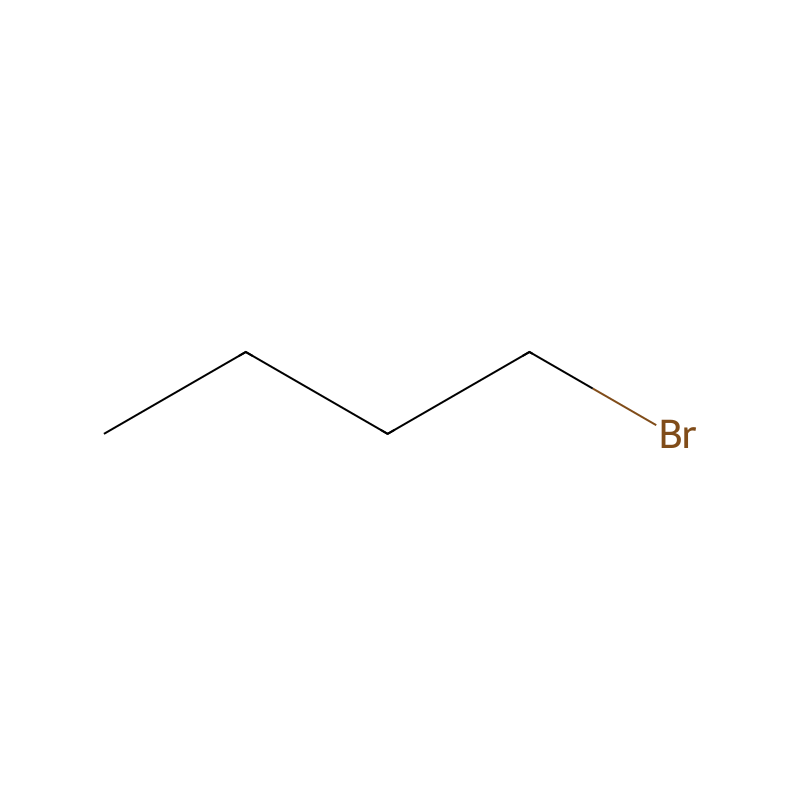
識別子と物理属性
| CAS No. | 109-65-9 |
|---|---|
| 分子式 | C4H9Br |
| 平均分子量 | 137.02 g/mol |
| 単同位体質量 | 135.98876 g/mol |
| SMILES | CCCCBr |
| InChIKey | MPPPKRYCTPRNTB-UHFFFAOYSA-N |
| PubChem CID | 8002 |
| ChEMBL | CHEMBL160949 |
| EC No. | 203-691-9 |
| DTXSID | DTXSID6021903 |
| 現地名 | 1-ブロモブタン |
化学・物理的性質
| XLogP | 2.8 |
|---|---|
| 極性表面積 | 0 |
| 水素結合供与体数 | 0 |
| 水素結合受容体数 | 0 |
| 回転可能結合数 | 2 |
| 重原子数 | 5 |
| 形式電荷 | 0 |
| 複雑度 | 13 |
| LogP(分配係数) | log Kow = 2.75 |
| 密度 | 1.276 at 68 °F (USCG, 1999) - Denser than waterwill sink1.2686 at 25 °C/4 °C1.2586 @25 °C1.276 g/mL at 25 °C(lit.) |
| Viscosity | 0.606 mPa-sec at 25 °C |
| Color/Form | Colorless to pale straw-colored liquid |
| 溶解度 | Slightly soluble in carbon tetrachloridesoluble in chloroformmiscible with ethanol, ether, acetoneIn water, 8.69X10+2 mg/L at 25 °C0.6g/リットル0.608g/L (30℃) |
| 引火点 | 65 °F (USCG, 1999)18 °C65 °F (18 °C) (Open cup)23 °C |
| 沸点 | 214 °F at 760 mmHg (USCG, 1999)101.3 °C at 760 mm Hg101.3 °C @760 [mm Hg]100-104 °C(lit.) |
| 融点 | -170 °F (USCG, 1999)-112 °CHeat fusion at melting point = 6.6944X10+6 J/kmol-112.3 °C |
| 蒸気密度 | 4.72 (Air= 1)4.7 (vs air) |
| 蒸気圧 | 77.55 mmHg (USCG, 1999)42.0 [mmHg]41.97 mm Hg at 25 °C41.97 [mm Hg] @25 °C150 mm Hg ( 50 °C) |
| Surface Tension | 25.90 mN/m at 25 °C |
| 屈折率 | Index of refraction = 1.4398 at 20 °C/Dn20/D 1.439(lit.) |
| 貯蔵条件 | Store below +30°C. |
| 外観・状態 | 液体 |
| 色 | 無色透明~薄黄色 |
| 臭い | 特有の臭い |
| 爆発限界 | 2.8-6.6%, 100°F |
| Merck | 14,1553 |
| BRN | 1098260 |
| ヘンリー定数 | 7.4×10⁻⁴ mol/(m3Pa) at 25℃, Brockbank (2013) |
| 誘電率 | 7.1600000000000001 |
| 安定性 | 安定。可燃性 - 引火点が低いことに注意してください。強酸化剤および強塩基とは相容れない。 |
| 主な用途 | 環境 |
| InChI | 1S/C4H9Br/c1-2-3-4-5/h2-4H2,1H3 |
| InChIKey | MPPPKRYCTPRNTB-UHFFFAOYSA-N |
| SMILES | CCCCBr |
| LogP(分配係数) | 2.75 |
| CAS データベース | 109-65-9(CAS DataBase Reference) |
| NISTの化学物質情報 | Butane, 1-bromo-(109-65-9) |
| EPAの化学物質情報 | 1-Bromobutane (109-65-9) |
化学的特性
1-bromobutane appears as a clear colorless to slightly yellow liquid with aroma. Flash point 65°F. Denser than water and insoluble in water, soluble in organic solvents such as alcohol, ether and chloroform.Vapors heavier than air.
安全性と法規制
| GHS 分類 | DangerH225 (69.7%): Highly Flammable liquid and vapor [Danger Flammable liquids]H226 (26.4%): Flammable liquid and vapor [Warning Flammable liquids]H315 (96.7%): Causes skin irritation [Warning Skin corrosion/irritation]H319 (78.3%): Causes serious eye irritation [Warning Serious eye damage/eye irritation]H335 (90.8%): May cause respiratory irritation [Warning Specific target organ toxicity, single exposureRespiratory tract irritation]H351 (48.4%): Suspected of causing cancer [Warning Carcinogenicity]H360FD (45.7%): May damage fertilityMay damage the unborn child [Danger Reproductive toxicity]H373 (44.5%): May causes damage to organs through prolonged or repeated exposure [Warning Specific target organ toxicity, repeated exposure]H411 (62.9%): Toxic to aquatic life with long lasting effects [Hazardous to the aquatic environment, long-term hazard]P203, P210, P233, P240, P241, P242, P243, P260, P261, P264, P264+P265, P271, P273, P280, P302+P352, P303+P361+P353, P304+P340, P305+P351+P338, P318, P319, P321, P332+P317, P337+P317, P362+P364, P370+P378, P391, P403+P233, P403+P235, P405, and P501 (click each P-code to see the statement)Aggregated GHS information provided per 337 reports by companies from 22 notifications to the ECHA C&L Inventory. Each notification may be associated with multiple companies.Information may vary between notifications depending on impurities, additives, and other factors. The percentage value in parenthesis indicates the notified classification ratio from companies that provide hazard codes. Only hazard codes with percentage values above 10% are shown. For more detailed information, please visit ECHA C&L website. |
|---|---|
| 規制情報 | Chemical: Butane, 1-bromo-Butane, 1-bromo- is listed on the EPA's Chemical Data Reporting (CDR) system. Manufacturers and importers of Butane, 1-bromo- are required to report information about their production and use of this chemical to the EPA under the Toxic Substances Control Act (TSCA). (40 eCFR Part 711)Status: Active Update: 20-11-2018 https://echa.europa.eu/registration-dossier/-/registered-dossier/12474Butane, 1-bromo-: HSNO Approval: HSR001087 Approved with controlsThe New Jersey Worker and Community Right to Know Act requires public and private employers to provide information about hazardous substances at their workplaces. (N.J.S.A. 34:5A-1 et. seq.) |
| 輸送ラベル(DOT) | Flammable Liquid |
| 火災危険 | Special Hazards of Combustion Products: Toxic fumes of hydrogen bromide.Behavior in Fire: May form explosive mixtures with air in fire. (USCG, 1999)· HIGHLY FLAMMABLE: Will be easily ignited by heat, sparks or flames.· Vapors may form explosive mixtures with air.· Vapors may travel to source of ignition and flash back.· Most vapors are heavier than air. They will spread along the ground and collect in low or confined areas (sewers, basements, tanks, etc.).· Vapor explosion hazard indoors, outdoors or in sewers.· Those substances designated with a (P) may polymerize explosively when heated or involved in a fire.· Runoff to sewer may create fire or explosion hazard.· Containers may explode when heated.· Many liquids will float on water. |
| 火災の可能性 | Dangerous fire hazard when exposed to heat, flame or oxidizers. |
| 健康有害性 | Irritating to the eyes, nose, throat, and upper respiratory tract. Symptoms of exposure include burning sensation, coughing, wheezing, laryngitis, shortness of breath, headache, nausea, and vomiting. Irritating to the skin. (USCG, 1999)· May cause toxic effects if inhaled or absorbed through skin.· Inhalation or contact with material may irritate or burn skin and eyes.· Fire will produce irritating, corrosive and/or toxic gases.· Vapors may cause dizziness or asphyxiation, especially when in closed or confined areas.· Runoff from fire control or dilution water may cause environmental contamination. |
| 有害性の概要 | Flammable liquid[Hawley] Irritating to the skin of mice and the eyes of rabbitsDid not induce sensitization by application to the ear of mice and determined by local lymph node assayDegeneration of vacuolar liver cells was observed in 28 day feeding study with ratsEvidence of mutagenicity in Salmonella typhimurium and Chinese hamster cells[HSDB] A skin, eye, nose, throat, and respiratory tract irritant[CAMEO] Causes somnolence and ataxia in lethal-dose feeding studies of rats[RTECS] |
| 輸送番号・ガイド(DOT) | 1126 130 |
| 反応性グループ | Halogenated Organic Compounds |
| Reactivity Alerts | Highly Flammable |
| Reactivity Profile | 1-BROMOBUTANE is incompatible with strong bases and oxidizers (USCG, 1999). |
| Flammable Limits | Lower (2.6%), Upper (6.6%) |
| DOT Emergency Guidelines | /GUIDE 130: FLAMMABLE LIQUIDS (Non-Polar/Water-Immiscible/Noxious)/ Fire or Explosion: HIGHLY FLAMMABLE: Will be easily ignited by heat, sparks or flames. Vapors may form explosive mixtures with air. Vapors may travel to source of ignition and flash back. Most vapors are heavier than air. They will spread along ground and collect in low or confined areas (sewers, basements, tanks). Vapor explosion hazard indoors, outdoors or in sewers. Those substances designated with a (P) may polymerize explosively when heated or involved in a fire. Runoff to sewer may create fire or explosion hazard. Containers may explode when heated. Many liquids are lighter than water./GUIDE 130: FLAMMABLE LIQUIDS (Non-Polar/Water-Immiscible/Noxious)/ Health: May cause toxic effects if inhaled or absorbed through skin. Inhalation or contact with material may irritate or burn skin and eyes. Fire will produce irritating, corrosive and/or toxic gases. Vapors may cause dizziness or suffocation. Runoff from fire control or dilution water may cause pollution./GUIDE 130: FLAMMABLE LIQUIDS (Non-Polar/Water-Immiscible/Noxious)/ Public Safety: CALL Emergency Response Telephone Number on Shipping Paper first. If Shipping Paper not available or no answer, refer to appropriate telephone number listed on the inside back cover. As an immediate precautionary measure, isolate spill or leak area for at least 50 meters (150 feet) in all directions. Keep unauthorized personnel away. Stay upwind. Keep out of low areas. Ventilate closed spaces before entering./GUIDE 130: FLAMMABLE LIQUIDS (Non-Polar/Water-Immiscible/Noxious)/ Protective Clothing: Wear positive pressure self-contained breathing apparatus (SCBA). Structural firefighters' protective clothing will only provide limited protection.For more DOT Emergency Guidelines (Complete) data for 1-BROMOBUTANE (8 total), please visit the HSDB record page. |
| 消火 | Excerpt from ERG Guide 130 [Flammable Liquids (Water-Immiscible / Noxious)]:CAUTION: The majority of these products have a very low flash point. Use of water spray when fighting fire may be inefficient.SMALL FIRE: Dry chemical, CO2, water spray or regular foam. If regular foam is ineffective or unavailable, use alcohol-resistant foam.LARGE FIRE: Water spray, fog or regular foam. If regular foam is ineffective or unavailable, use alcohol-resistant foam. Avoid aiming straight or solid streams directly onto the product. If it can be done safely, move undamaged containers away from the area around the fire.FIRE INVOLVING TANKS, RAIL TANK CARS OR HIGHWAY TANKS: Fight fire from maximum distance or use unmanned master stream devices or monitor nozzles. Cool containers with flooding quantities of water until well after fire is out. Withdraw immediately in case of rising sound from venting safety devices or discoloration of tank. ALWAYS stay away from tanks in direct contact with flames. For massive fire, use unmanned master stream devices or monitor nozzlesif this is impossible, withdraw from area and let fire burn. (ERG, 2024) |
| 漏出応急措置 | · CALL 911. Then call emergency response telephone number on shipping paper. If shipping paper not available or no answer, refer to appropriate telephone number listed on the inside back cover.· Keep unauthorized personnel away.· Stay upwind, uphill and/or upstream.· Ventilate closed spaces before entering, but only if properly trained and equipped.· ELIMINATE all ignition sources (no smoking, flares, sparks or flames) from immediate area.· All equipment used when handling the product must be grounded.· Do not touch or walk through spilled material.· Stop leak if you can do it without risk.· Prevent entry into waterways, sewers, basements or confined areas.· A vapor-suppressing foam may be used to reduce vapors.· Absorb or cover with dry earth, sand or other non-combustible material and transfer to containers.· Use clean, non-sparking tools to collect absorbed material.Large Spill· Dike far ahead of liquid spill for later disposal.· Water spray may reduce vapor, but may not prevent ignition in closed spaces. |
| 応急処置 | INHALATION: Move victim to fresh air. If breathing has stopped, give artificial respiration. If breathing is difficult, give oxygen.EYES OR SKIN: Flush with water for at least 15 minutes.INGESTION: If conscious, have victim drink water and induce vomiting. If unconscious, do nothing except keep victim warm. Call a physician. (USCG, 1999)General First Aid:· Call 911 or emergency medical service.· Ensure that medical personnel are aware of the material(s) involved, take precautions to protect themselves and avoid contamination.· Move victim to fresh air if it can be done safely.· Administer oxygen if breathing is difficult.· If victim is not breathing:-- DO NOT perform mouth-to-mouth resuscitationthe victim may have ingested or inhaled the substance.-- If equipped and pulse detected, wash face and mouth, then give artificial respiration using a proper respiratory medical device (bag-valve mask, pocket mask equipped with a one-way valve or other device).-- If no pulse detected or no respiratory medical device available, provide continuous compressions. Conduct a pulse check every two minutes or monitor for any signs of spontaneous respirations.· Remove and isolate contaminated clothing and shoes.· For minor skin contact, avoid spreading material on unaffected skin.· In case of contact with substance, remove immediately by flushing skin or eyes with running water for at least 20 minutes.· For severe burns, immediate medical attention is required.· Effects of exposure (inhalation, ingestion, or skin contact) to substance may be delayed.· Keep victim calm and warm.· Keep victim under observation.· For further assistance, contact your local Poison Control Center.· Note: Basic Life Support (BLS) and Advanced Life Support (ALS) should be done by trained professionals.Specific First Aid:· Wash skin with soap and water. |
| 暴露管理・個人防護 | · Wear positive pressure self-contained breathing apparatus (SCBA).· Structural firefighters' protective clothing provides thermal protection but only limited chemical protection. |
| 消火手順 | To fight fire use carbon dioxide, dry chemical, mist or spray.If material on fire or involved in fire: Do not extinguish fire unless flow can be stopped. Use water in flooding quantities as fog. Solid streams of water may be ineffective. Cool all affected containers with flooding quantities of water. Use alcohol foam, dry chemical or carbon dioxide. Keep run-off water out of sewers and water sources. |
| 保管条件 | Materials which are toxic as stored or which can decomp into toxic components... should be stored in a cool well ventilated place, out of the direct rays of the sun, away from areas of high fire hazard, and should be periodically inspected. Incompatible materials should be isolated... |
| 非火災時の漏出対応 | Excerpt from ERG Guide 130 [Flammable Liquids (Water-Immiscible / Noxious)]:ELIMINATE all ignition sources (no smoking, flares, sparks or flames) from immediate area. All equipment used when handling the product must be grounded. Do not touch or walk through spilled material. Stop leak if you can do it without risk. Prevent entry into waterways, sewers, basements or confined areas. A vapor-suppressing foam may be used to reduce vapors. Absorb or cover with dry earth, sand or other non-combustible material and transfer to containers. Use clean, non-sparking tools to collect absorbed material.LARGE SPILL: Dike far ahead of liquid spill for later disposal. Water spray may reduce vapor, but may not prevent ignition in closed spaces. (ERG, 2024) |
| 処分方法 | SRP: At the time of review, criteria for land treatment or burial (sanitary landfill) disposal practices are subject to significant revision. Prior to implementing land disposal of waste residue (including waste sludge), consult with environmental regulatory agencies for guidance on acceptable disposal practices. |
| Preventive Measures | If material on fire or involved in fire: Do not extinguish fire unless flow can be stopped. Use water in flooding quantities as fog. Solid streams of water may be ineffective. Cool all affected containers with flooding quantities of water. Use alcohol foam, dry chemical or carbon dioxide. Keep run-off water out of sewers and water sources. |
| Isolation and Evacuation | Excerpt from ERG Guide 130 [Flammable Liquids (Water-Immiscible / Noxious)]:IMMEDIATE PRECAUTIONARY MEASURE: Isolate spill or leak area for at least 50 meters (150 feet) in all directions.LARGE SPILL: Consider initial downwind evacuation for at least 300 meters (1000 feet).FIRE: If tank, rail tank car or highway tank is involved in a fire, ISOLATE for 800 meters (1/2 mile) in all directionsalso, consider initial evacuation for 800 meters (1/2 mile) in all directions. (ERG, 2024)Immediate precautionary measure· Isolate spill or leak area for at least 50 meters (150 feet) in all directions.· Consider initial downwind evacuation for at least 300 meters (1000 feet).· If tank, rail tank car or highway tank is involved in a fire, ISOLATE for 800 meters (1/2 mile) in all directionsalso, consider initial evacuation for 800 meters (1/2 mile) in all directions. |
| Protective Action Criteria (PAC) | 0.16 [ppm]51 [ppm]310 [ppm] |
| Personal Protective Equipment (PPE) | Approved respirator, chemical safety goggles, rubber gloves. (USCG, 1999)Personnel Protection: ... Wear appropriate chemical protective gloves, boots and goggles. |
| Treatment | EYES: irrigate opened eyes for several minutes under running water. INGESTION: do not induce vomiting. Rinse mouth with water (never give anything by mouth to an unconscious person). Seek immediate medical advice. SKIN: should be treated immediately by rinsing the affected parts in cold running water for at least 15 minutes, followed by thorough washing with soap and water. If necessary, the person should shower and change contaminated clothing and shoes, and then must seek medical attention. INHALATION: supply fresh air. If required provide artificial respiration. |
| 健康影響 | Hepatoxic, immunotoxic when ingested orally. Can cause lung damage and mucous membranes over extended periods/chronic exposures. Can cause skin and eye irritation. Not a carcinogen nor a mutagen nor a teratogen. |
| 生態毒性値 | LC50 Pimephales promelas (Fathead minnow) 36.7 mg/L/4 day /Conditions of bioassay not specified in source examined/ |
| 環境中動態 | TERRESTRIAL FATE: Based on a classification scheme(1), an estimated Koc value of 80(SRC), determined from a structure estimation method(2), indicates that 1-bromobutane is expected to have high mobility in soil(SRC). Volatilization of 1-bromobutane from moist soil surfaces is expected to be an important fate process(SRC) given an estimated Henry's Law constant of 8.7X10⁻³ atm-cu m/mole(SRC), derived from its vapor pressure, 42.0 mm Hg(3), and water solubility, 8.69X10+2 mg/L(4). 1-Bromobutane is expected to volatilize from dry soil surfaces(SRC) based upon a vapor pressure of 42.0 mm Hg(3). Limited data on the biodegradation of 1-bromobutane showed bacterial degradation has been observed(5,6).AQUATIC FATE: Based on a classification scheme(1), an estimated Koc value of 80(SRC), determined from a structure estimation method(2), indicates that 1-bromobutane is not expected to adsorb to suspended solids and sediment(SRC). Volatilization from water surfaces is expected(3) based upon an estimated Henry's Law constant of 8.7X10⁻³ atm-cu m/mole(SRC), derived from its vapor pressure, 42.0 mm Hg(4), and water solubility, 8.69X10+2 mg/L(5). Using this Henry's Law constant and an estimation method(3), volatilization half-lives for a model river and model lake are 3.5 hours and 4.7 days, respectively(SRC). According to a classification scheme(6), an estimated BCF of 26(SRC), from its log Kow of 2.75(7) and a regression-derived equation(8), suggests the potential for bioconcentration in aquatic organisms is low(SRC). 1-Bromobutane was found to degrade in sediment slurry under anaerobic conditions(9).ATMOSPHERIC FATE: According to a model of gas/particle partitioning of semivolatile organic compounds in the atmosphere(1), 1-bromobutane, which has a vapor pressure of 42.0 mm Hg at 25 °C(2), is expected to exist solely as a vapor in the ambient atmosphere. Vapor-phase 1-bromobutane is degraded in the atmosphere by reaction with photochemically-produced hydroxyl radicals(SRC)the half-life for this reaction in air is estimated to be 6.4 days(SRC), calculated from its rate constant of 2.50X10⁻¹² cu cm/molecule-sec at 25 °C(3). 1-Bromobutane does not contain chromophores that absorb at wavelengths >290 nm and therefore is not expected to be susceptible to direct photolysis by sunlight(SRC). |
| 有害作用 | Neurotoxin - Acute solvent syndromeOccupational hepatotoxin - Secondary hepatotoxins: the potential for toxic effect in the occupational setting is based on cases of poisoning by human ingestion or animal experimentation. |
| 暴露経路 | Oral (L626)inhalation (L626)dermal (L626) |
| 毒性の概要 | 1-bromobutane reacts quickly with hepatic glutathione (GSH) leading to its rapid depletion. This can cause liver damage and has been shown to increase serum levels of alanine aminotransferase and aspartate aminotransferase. Hepatic contents of thiobarbituric acid reactive substances can also be significantly increased. Splenic GSH levels can also be significantly reduced by single treatment with 1-bromobutane. S-Butyl GSH conjugates were detected in spleen from 6 hr after treatment. Oral 1-bromobutane significantly suppressed the antibody response to a T-dependent antigen and the production of splenic intracellular interlukin-2. |
| Signs and Symptoms | Skin irritation if contacts skin, redness and itching of skin and eyes. Acute exposure may lead to coughing, shortness of breath, headache, nausea, vomiting |
| Effluent Concentrations | 1-Bromobutane may be formed by the chlorination of sewage effluents, but not during the biological phase of sewage treatment, biological degradation of solid wastes, or incineration of municipal refuse or industrial sludges and slurries(1). |
| Soil Adsorption/Mobility | Using a structure estimation method based on molecular connectivity indices(1), the Koc of 1-bromobutane can be estimated to be 80(SRC). According to a classification scheme(2), this estimated Koc value suggests that 1-bromobutane is expected to have high mobility in soil. |
| TSCA Test Submissions | 1-Bromobutane (CAS # 109-65-9) was evaluated for acute oral toxicity. The test substance was administered once orally by gavage to fasted male and female Sprague-Dawley rats. Dosage and mortality data are as follows: 1000 mg/kg (0/5 M, 0/5 F)1967.9 mg/kg (0/5 M, 0/5 F)3872.6 mg/kg (5/5 M, 4/5 F)7620.8 mg/kg (5/5 M, 5/5 F)and 15,000 mg/kg (5/5 M, 5/5 F). The LD50 of male rats was determined to be 2761 mg/kg body weight, and the LD50 of females was 3161 mg/kg body weight. Clinical signs at all dose levels, included slight depression, rough coat, tremors, and red stain on eyes and/or nose. At 1967.9 mg/kg and above, soft feces, ataxia, labored respiration, and urine stains were noted. At 3872.6 mg/kg and 7620.8 mg/kg, salvation, lacrimation, prostration, and hunching were noted. Gross pathology at 3872.6 mg/kg and above, revealed bright red discoloration of the lungs, fluid in the thoracic cavity, dark-black urinary bladder, and material in the stomach and intestine (dark red, greenish, oily black, compound-like). |
| Artificial Pollution Sources | 1-Bromobutane's production and use as an alkylating agent and in synthesis(1,2) may result in its release to the environment through various waste streams(SRC). |
| 水環境危害等級(WGK) | 2 |
| TSCA 収載状態 | TSCA listed |
| RTECS 番号 | EJ6225000 |
| 輸送番号(UN) | UN 1126 |
| 毒性 | LD50 orally in Rabbit: 2761 mg/kg |
| 税関コード | 29033036 |
| 危険文句(R) | 11-36/37/38-51/53-10 |
| 化審法 | (2)-74 |
| 安衛法 | 変異原性物質 |
| 消防法 | 危-4-1-II |
| 危険表示 | F,Xi,N |
| 安全措置(S) | 16-26-60-37/39 |
| 危険等級 | 3Aquatic Chronic 2Carc. 2Flam. Liq. 2Repr. 1BSkin Irrit. 2STOT RE 2 InhalationSTOT SE 3 |
| 包装等級 | II |
| 自然発火温度 | 509 °F |
| 貯蔵分類 | 3 - Flammable liquids |
| 有害物質データ | 109-65-9(Hazardous Substances Data) |
用途
用途
有機合成原料、医薬原料、塩ビ安定剤
使用
1-Bromobutane is used as an intermediate in organic synthesis and as a solvent for cleaning and degreasing. It acts as an alkylating agent as well as to prepare organometallic compounds such as n-butyllithium. It is also involved in the synthesis of procaine and tetracaine. It reacts with magnesium metal to prepare the Grignard reagent, which is used to form carbon-carbon bonds.
一般的な説明
1-Bromobutane, an alkyl halide, is an alkylating agent. Its rotational constants, nuclear quadrupole constants and centrifugal distortion constants have been stated based on microwave spectral data. The rate coefficient for the reaction of 1-bromobutane with hydrogen atoms has been reported to be 2.4±1.2x1010cm3mol-1s-1.
製法・合成法
合成方法
1-ブタノールに赤リンを加え,これに臭素を作用させたあと,蒸留する
純化方法
Wash the bromide with conc H2SO4, water, 10% Na2CO3 and again with H2O. Dry it over CaCl2, CaSO4 or K2CO3, and distil it. Redistil it after drying with P2O5, or pass it through two columns containing 5:1 silica gel/Celite mixture and store it with freshly activated alumina. [Beilstein 1 IV 258.]