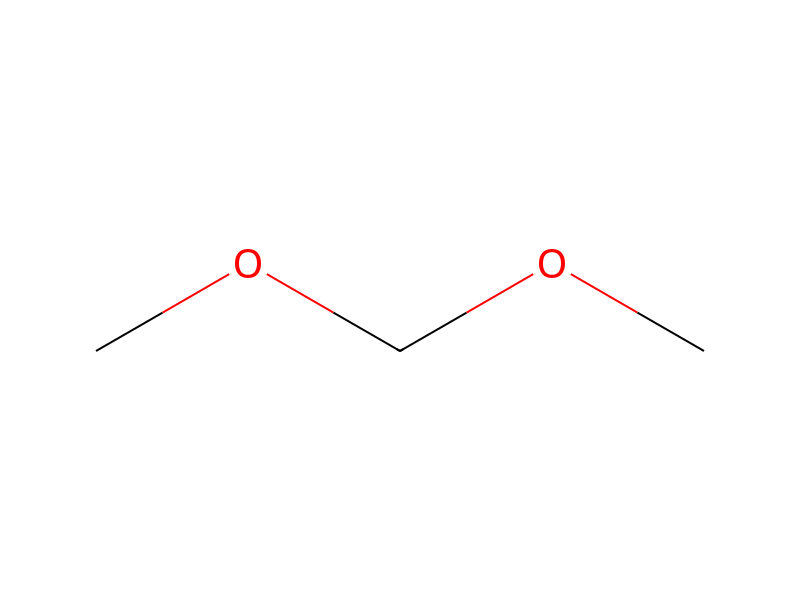
基本情報
- 標準SMILES
COCOC- InChIKey
NKDDWNXOKDWJAK-UHFFFAOYSA-N- 分子式
- C3H8O2
- 平均分子量
- 76.09 g/mol
- 単同位体質量
- 76.0524295
概要
Methylal appears as a clear colorless liquid with a chloroform-like odor. Flash point 0 °F. Boiling point 42.3 °C. Density 0.864 g / cm3 at 68 °F (20 °C). Vapors heavier than air.
名称と識別子
- 優先名称
- Dimethoxymethane
- IUPAC
- dimethoxymethane
- 現地名
- ホルムアルデヒドジメチルアセタール
- 英語名
- Dimethoxymethane
- 分子式
- C3H8O2
- 分子量
- 76.09
名称と別名
Dimethoxymethane109-87-5METHYLALFormalMethane, dimethoxy-Formaldehyde dimethyl acetalDimethyl formalAnesthenyl2,4-DioxapentaneMethylene dimethyl etherBis(methoxy)methaneMethoxymethyl methyl ether
名称をさらに表示
ジメトキシメタンホルムアルデヒドメチルケタールジメチルホルマールアネステニルメチレングリコールジメチルエーテルメトキシメチルメチルエーテルメチラールメチレンジメチルエーテル2,4-ジオキサペンタンホルマールメチラルメチラ-ルメチラ?ルホルムアルデヒド=ジメチルアセタ-ルホルムアルデヒドジメチルアセタール1,1-DIMETHOXYMETHANEMethylaMethyl formalDIMETHYLFORMALFORMALDEHYDE DIMETHYLmethanal,dimethylacetal
Formaldehyde methyl ketalMetylalFormaldehyde dimethylacetal7H1M4G2NUEDTXSID1025564CHEBI:48341RefChem:134194DTXCID905564
データベース識別子
- CAS
109-87-5- PubChem CID
- 8020
- DTXSID
DTXSID1025564- ChEMBL
CHEMBL15537- ChEBI
CHEBI:48341- UNII
- 7H1M4G2NUE
- EC Number
- 203-714-2
- Nikkaji
- J3.250F
物性
構造計算による物性
- XLogP
- 0.2
- 極性表面積
- 18.5 Ų
- 水素結合供与体数
- 0
- 水素結合受容体数
- 2
- 回転可能結合数
- 2
- 重原子数
- 5
- 形式電荷
- 0
- 複雑度
- 12.4
実験および物理化学的性質
Chemical Classes
Other Classes -> Acetals
Flammable agents - 3rd degree
Volatile Organic Compound (VOC)
CosmeticsSolvent
SpringerMaterials PropertiesSchoenflies notation
LogP
log Kow= 0.0
0.18
Odor
CHLOROFORM ODOR
Chloroform-like odor.
TastePUNGENT TASTE
Density
0.861 at 68 °F (USCG, 1999) - Less dense than water; will float
0.8593 @ 20 °C/4 °C
0.86 g/cm³
Relative density of the vapour/air-mixture at 20 °C (air = 1): 1.7
0.86
0.8593 @ 20°C
Flavoring AgentsEU Flavoring substances
Color/Form
COLORLESS, CLEAR LIQUID
Colorless solid.
Solubility
33 % (NIOSH, 2024)
MISCIBLE WITH ALCOHOL, ETHER, OILS; SOL IN 3 PARTS WATER
SOL IN ALL ACETONE, AND BENZENE
Water solubility: 330,000 mg/l
Solubility in water, g/100ml at 20 °C: 28.5 (good)
33%
Flash Point
0 °F (USCG, 1999)
-32 °C
-26 °F (-32 °C) (OPEN CUP)
-31 °C c.c.
-26 °F (open cup)
(oc) -26 °F
Boiling Point
108 °F at 760 mmHg (USCG, 1999)
41.6 °C @ 760 MM HG
42 °C
111 °F
42 °C @760 [mm Hg]
111 °F
物理化学的性質
- 融点
- -105 °C · -105 °C
- 沸点
- 41 · 41-43 °C
- 比重(密度)
- 0.86 g/mL · 0.860 g/mL at 20 °C(lit.)
- 蒸気密度
- 2.6 · 2.6 (vs air)
- 蒸気圧
- 6.38 psi · 6.38 psi ( 20 °C)
- 屈折率
- 20 · n20/D 1.354
- 闪点
- -18 °C · -18 °C
- 貯蔵温度
- 20 °C · Store at <= 20°C.
- 溶解性
- 32.3 g/100mL · 32.3g/100mL(16℃)
- 外見
- 液体
- 酸解離定数(Pka)
- 3.1 · 3.1[at 20 ℃]
- 色
- 無色透明
- 臭い (Odor)
- マイルドで優美。クロロホルム様。
- PH
- pH (12.5vol % , 25℃) : 4.5~6.6
- 爆発限界(explosive limit)
- 1.6 · 1.6-17.6%(V)
- 水溶解度
- 32.3 g/100mL · 32.3g/100mL(16℃)
- 比熱容量
- 2.13 J/ · Cp(liquid): 2.13 J/(g·K), at 25℃
- Merck
- 14 · 14,6012
- BRN
- 1697025 · 1697025
- Henry's Law Constant
- (x 10-4 atmm3/mol): 1.73 at 25 °C (Hine and Mookerjee, 1975)
- Dielectric constant
- 2.7 · 2.7(20℃)
- 安定性
- 安定。非常に可燃性。空気と爆発性混合物を容易に形成します。引火点が低く、爆発限界が広いことに注意してください。強力な酸化剤、強酸とは相容れない。空気にさらされると、爆発性の過酸化物が生成されることがあります。
- 化粧品成分の機能
- 溶媒
- InChI
- 1S/C3H8O2/c1-4-3-5-2/h3H2,1-2H3
- InChIKey
- NKDDWNXOKDWJAK-UHFFFAOYSA-N
- SMILES
- COCOC
- LogP
- 0 · 0
- CAS データベース
- 109 · 109-87-5(CAS DataBase Reference)
- NISTの化学物質情報
- Methane, dimethoxy-(109-87-5)
- EPAの化学物質情報
- Dimethoxymethane (109-87-5)
化学的性質
化学的特性Dimethoxymethane, also called methylal, is a colorless flammable liquid with a low boiling point, low viscosity and excellent dissolving power. It is stable in the presence of alkalis and mild acids, and to high temperatures and pressures. It differs from other ethers in that it forms only minute omounts of peroxides. It will dissolve such synthetic resins as nitrocellulose, cellulose acetate and propionate, ethyl cellulose, vinyl, "Epons" and polystyrene, and also many of the natural gums and waxes. Methylal as a latent solvent is activated by the addition of esters, ketones or alcohols. Its evaporation rate, twice that of acetone, places this ether in a class with such solvents as acetone, methyl acetate and ethyl acetate in resin formulations.
安全と法規制
GHS分類
GHS Classification
This chemical does not meet GHS hazard criteria for 1.2% (5 of 433) of reports.
Danger
H225 (98.8%): Highly Flammable liquid and vapor [Danger Flammable liquids]
P210, P233, P240, P241, P242, P243, P261, P264, P264+P265, P271, P280, P302+P352, P303+P361+P353, P304+P340, P305+P351+P338, P319, P321, P332+P317, P337+P317, P362+P364, P370+P378, P403+P233, P403+P235, P405, and P501 (click each P-code to see the statement)
Aggregated GHS information provided per 433 reports by companies from 19 notifications to the ECHA C&L Inventory. Each notification may be associated with multiple companies.
Danger
危険有害性情報
Regulatory Information
Chemical: Methane, dimethoxy-
Commission Regulation (EC) No 1565/2000 (Repealed by Com. Implementing Reg. (EU) No 872/2012)
Methane, dimethoxy- is listed on the EPA's Chemical Data Reporting (CDR) system. Manufacturers and importers of Methane, dimethoxy- are required to report information about their production and use of this chemical to the EPA under the Toxic Substances Control Act (TSCA). (40 eCFR Part 711)
Status: Active Update: 27-10-2021 https://echa.europa.eu/registration-dossier/-/registered-dossier/5159
Methane, dimethoxy-: HSNO Approval: HSR001047 Approved with controls
The New Jersey Worker and Community Right to Know Act requires public and private employers to provide information about hazardous substances at their workplaces. (N.J.S.A. 34:5A-1 et. seq.)
DOT LabelFlammable Liquid
Fire Hazards
FLAMMABLE. Irritating gases may be produced when heated. Containers may explode in fire. Flashback along vapor trail may occur. Vapor may explode if ignited in an enclosed area. Irritating formaldehyde gas may be present in smoke. (USCG, 1999)
· HIGHLY FLAMMABLE: Will be easily ignited by heat, sparks or flames.
Highly flammable. Heating will cause rise in pressure with risk of bursting. Vapour/air mixtures are explosive. Risk of fire and explosion on contact with strong oxidizing agents or strong bases.
Fire PotentialDANGEROUS, WHEN EXPOSED TO HEAT, FLAME, OXIDIZERS
Health Hazards
VAPOR: Irritating to eyes, nose and throat. Harmful if inhaled. LIQUID: Irritating to skin and eyes. Harmful if swallowed. (USCG, 1999)
· Inhalation or contact with material may irritate or burn skin and eyes.
Hazards SummaryAnimal inhalation studies: anesthesia and damage to the liver and other organs; [ACGIH] A skin, eye, and respiratory tract irritant; Inhalation of high concentrations can cause CNS depression; [ICSC]
DOT ID and Guide
1234 127
1234 127
Reactive GroupAcetals, Ketals, Hemiacetals, and Hemiketals
UN ClassificationUN Hazard Class: 3; UN Pack Group: II
TSCA Requirements
Pursuant to section 8(d) of TSCA, EPA promulgated a model Health and Safety Data Reporting Rule. The section 8(d) model rule requires manufacturers, importers, and processors of listed chemical substances and mixtures to submit to EPA copies and lists of unpublished health and safety studies. Methane, dimethoxy- is included on this list.
Reactivity AlertsHighly Flammable
OSHA Standards8 hr Time-Weighted avg: 1,000 ppm (3,100 mg/cu m)
安全と保護具
Fire Fighting
Excerpt from ERG Guide 127 [Flammable Liquids (Water-Miscible)]:
Use water spray, dry powder, carbon dioxide, alcohol-resistant foam. In case of fire: keep drums, etc., cool by spraying with water.
First Aid Measures
Fresh air, rest. Refer for medical attention.
First rinse with plenty of water for at least 15 minutes, then remove contaminated clothes and rinse again.
First rinse with plenty of water for several minutes (remove contact lenses if easily possible), then refer for medical attention.
Rinse mouth. Do NOT induce vomiting. Refer for medical attention .
Accidental Release Measures
· CALL 911. Then call emergency response telephone number on shipping paper. If shipping paper not available or no answer, refer to appropriate telephone number listed on the inside back cover.
· ELIMINATE all ignition sources (no smoking, flares, sparks or flames) from immediate area.
First Aid
Excerpt from NIOSH Pocket Guide for Methylal:
General First Aid:
(General first aid procedures)
Safe StorageFireproof. Separated from strong oxidants and strong bases. Cool. Keep in the dark. Well closed. Store only if stabilized. Store in an area without drain or sewer access.
Exposure Control and Personal Protection
· Wear positive pressure self-contained breathing apparatus (SCBA).
500.0 [ppm]
Fire Fighting Procedures
TO FIGHT FIRE: FOAM, CARBON DIOXIDE, DRY CHEMICAL ...
Water may be ineffective. Alcohol foam.
Cleanup Methods
1. REMOVE ALL IGNITION SOURCES. 2. VENTILATE AREA OF SPILL OR LEAK. 3. FOR SMALL QUANTITIES, ABSORB ON PAPER TOWELS. EVAPORATE IN SAFE PLACE (SUCH AS FUME HOOD). ALLOW SUFFICIENT TIME TO COMPLETELY CLEAR HOOD DUCTWORK. BURN PAPER IN SUITABLE LOCATION AWAY FROM COMBUSTIBLE MATERIALS. 3. LARGE QUANTITIES CAN BE COLLECTED, DISSOLVED IN ALC OF GREATER MOLECULAR WT THAN BUTYL ALC, & ATOMIZED IN SUITABLE COMBUSTION CHAMBER. METHYLAL SHOULD NOT BE ALLOWED TO ENTER CONFINED SPACE, SUCH AS SEWER, BECAUSE OF THE POSSIBILITY OF AN EXPLOSION.
Nonfire Spill ResponseExcerpt from ERG Guide 127 [Flammable Liquids (Water-Miscible)]:
Disposal Methods... MAY BE DISPOSED OF BY DISSOLVING IN ALCOHOL OF GREATER MOLECULAR WEIGHT THAN BUTYL ALCOHOL & ATOMIZING IN SUITABLE COMBUSTION CHAMBER.
Spillage Disposal
Consult an expert! Personal protection: filter respirator for organic vapours of low boiling point adapted to the airborne concentration of the substance. Remove all ignition sources. Cover the spilled material with sand or other non-combustible material. Collect leaking liquid in covered containers. Absorb remaining liquid in sand or inert absorbent. Then store and dispose of according to local regulations.
Preventive Measures
SRP: The scientific literature supports the wearing of contact lenses in industrial environments, as part of a program to protect the eye against chemical compounds and minerals causing eye irritation. However, there may be individual substances whose irritating or corrosive properties are such that the wearing of contact lenses would be harmful to the eye. In those specific cases contact lenses should not be worn.
SAFE-HANDLING PRECAUTIONS SHOULD INCL USE OF ADEQUATE VENTILATION TO BE CERTAIN THAT AVG CONCN ARE WELL BELOW 1000 PPM, & AVOIDANCE OF EXCESSIVE OR PROLONGED SKIN CONTACT. METHYLAL SHOULD BE HANDLED WITH DUE REGARD FOR ITS FLAMMABLE PROPERTIES.
To prevent injury from occurring as a result of contact with an aldehyde in the form of liquid or vapor, the process in which the substance is present should, if possible be conducted in enclosed plant. If openings are necessary for the purposes of manipulation, vapor should be prevented from escaping into the workroom by the application of exhaust ventilation to the plant or enclosure. When the process cannot be enclosed, exhaust ventilation hoods should be fitted to trap and extract escaping vapor before it can diffuse into the workroom atmosphere. /Aldehydes and ketals/
The worker should immediately wash the skin when it becomes contaminated.
Work clothing that becomes wet should be immediately removed due to its flammability hazard.
毒性情報
Body Burden
In the EPA National Human Adipose Survey for fiscal year 1982, 46 composite samples categorized broadly by region and age group were analyzed for pollutants(1). Methylal was identified in one sample from the northeast US in the >45 age group.
Target OrgansEyes, skin, respiratory system, central nervous system
Environmental Fate
TERRESTRIAL FATE: If released on land, methylal would volatilize rapidly due to its high vapor pressure and Henry's Law constant and low adsorptivity to soil. It would also exhibit high mobility in soil. The importance of biodegradation in soil is unknown. (SRC)
AQUATIC FATE: If released to water, methylal will be primarily lost through volatilization. Its half-life in a model river is estimated from a calculated Henry's Law constant to be 7.2 hr(1-3). Adsorption to sediment and particulate matter in the water column, and bioconcentration should not be important. The importance of biodegradation in water is unknown. Hydrolysis is fairly slow(SRC).
ATMOSPHERIC FATE: The atmosphere is the sink for methylal. In the atmosphere, methylal will degrade by reaction with photochemically-produced hydroxyl radicals. The half-life for this reaction is estimated to be 2.3 days(1). Methylal is highly soluble in water, 2.44X10+5 ppm(2), and would be washed out by rain. However, methylal thus remove would be recycled back into the atmosphere. (SRC)
Adverse EffectsNeurotoxin - Acute solvent syndrome
Exposure Routes
The substance can be absorbed into the body by inhalation of its vapour.
inhalation, ingestion, skin and/or eye contact
Signs and Symptoms
Cough. Dizziness. Drowsiness. Headache. Sore throat. Unconsciousness.
Dry skin.
Redness. Pain.
Abdominal pain. Nausea. Vomiting. Further see Inhalation.
irritation eyes, skin, upper respiratory system; anesthesia
Effluent Concentrations
In a comprehensive survey of wastewater from 4000 industrial and publicly owned treatment works (POTWs) sponsored by the Effluent Guidelines Division of the U.S. EPA, methylal was identified in discharges of the following industrial category (positive occurrences; median concn in ppb): leather tanning (1; 1637.5), plastics and synthetics (3; 30.8), organic chemicals (6; 45.6), publicly owned treatment works (3; 5.0)(1). The highest effluent concn was 1637 ppb in the leather tanning industry(1). Detected in effluent concentrates from the advanced treatment plant in Orange County, CA, but not in that of five other communities(2).
ICSC Environmental DataEnvironmental effects of the substance have been adequately investigated, but no significant effects have been found.
Soil Adsorption/MobilityThe Koc for methylal estimated from its water solubility, 2.44X10+5 ppm(1), by a recommended regression equation is 5(2). Therefore methylal would be very mobile in soil(3).
Human Toxicity Excerpts
... PROPERTIES OF SIMPLE UNSUBSTITUTED ACETALS ARE CHARACTERIZED BY ETHER-LIKE ANESTHETIC ACTION, & BY RELATIVELY LOW DEGREE OF PRIMARY IRRITATION COMPARED TO PARENT ALDEHYDE. /ACETALS/
INHALATION CAUSES IRRITATION OF RESP SYSTEM & DEPRESSION OF CNS. LIQ CAUSES IRRITATION OF EYES & WILL IRRITATE SKIN IF ALLOWED TO REMAIN.
Artificial Pollution Sources
Methylal used as a solvent and reagent in organic synthesis(2) may be released to the environment in waste water and as fugitive emissions relating to its manufacture and use. Mean vapor emission rates of methylal measured at two locations at an industrial waste water treatment facility in December were 28.6 and 14.7 mg/min sq-m, at which time the ambient and liquid surface temperatures were 6 and 15 °C, respectively(1).
METHYLAL WAS ONE OF THE COMPONENTS IN WASTE WATER FROM A UREA-FORMALDEHYDE GLUE PLANT.
Environmental Biodegradation
A reduction in BOD in 8 hr was obtained in one study in which well acclimated sewage seed was incubated with 333 ppm of methylal(1). However this reduction was small compared with the theoretical oxygen demand and toxicity resulted in an initial increase in BOD.
法規制情報
TSCA Requirements
Pursuant to section 8(d) of TSCA, EPA promulgated a model Health and Safety Data Reporting Rule. The section 8(d) model rule requires manufacturers, importers, and processors of listed chemical substances and mixtures to submit to EPA copies and lists of unpublished health and safety studies. Methane, dimethoxy- is included on this list.
安全データ
- F
- 21
- OEB
- A
- OEL
- TWA: 1000 ppm (3100 mg/m3)
- wgk
- 1
- IDLA
- 2,200 ppm [10% LEL]
- tsca
- TSCA listed
- rtecs
- PA8750000
- ridadr
- UN 1234
- 毒性
- LD50 orally in Rabbit: 6653 mg/kg
- hs_code
- 2911 00 00
- risk_code
- 11-19-36-36/37/38
- 化審法
- (2)-498
- 安衛法
- 57,57-2
- 消防法
- 危-4-1-II
- hazard_code
- F,Xi
- safety_code
- 16-26-33-7/9-37/39
- hazard_class
- 3
- packing_group
- II
- 自然発火温度
- 459 °F
- Hazard Classifications
- Flam. Liq. 2
- ストレージクラス
- 3 - Flammable liquids
- 有毒物質データの
- 109-87-5(Hazardous Substances Data)
化学と産業
薬理情報
Metabolism/Metabolites
Methylal (dimethoxymethane) ... was metabolised by rats to methanol and dimethyl ether in equimolar ratio, regardless of the route of administration. Symptoms of methylal poisoning and the typical damage to the retina and optic nerve are the same as those seen in methanol poisoning. Inhalation experiments showed that the blood methanol concentration is proportional to the concentration of methylal in the air.
用途と製造
Uses
Used as a solvent for adhesives and coatings, a fuel, and an intermediate for other organic compounds; [ACGIH] Has been used as an anesthetic; [HSDB]
Painting (Solvents) [Category: Paint]
IN PERFUMERY; MFR ARTIFICIAL RESINS; REACTION MEDIUM FOR GRIGNARD & REPPE REACTIONS
EXTERNALLY AS OINTMENT AND INTERNALLY AS AN ANAESTHETIC AND HYPNOTIC
SPECIAL PURPOSES FUEL; SOLVENT FOR ADHESIVES & COATINGS; IN ORG SYNTHESES
In methacrylate mfg
U.S. Production2023: 1,000,000 - <2,500,000 lb
Consumer UsesSolvent
Industry UsesIntermediate
Methods of Manufacturing... BY CATALYTIC VAPOR-PHASE OXIDN OF METHANOL IN PRESENCE OF SMALL AMT OF HYDROCHLORIC ACID; FROM METHANOL & FORMALDEHYDE. FROM PARAFORMALDEHYDE + METHANOL IN PRESENCE OF CALCIUM CHLORIDE + HYDROCHLORIC ACID.
Household ProductsInformation on 10 consumer products that contain Dimethoxymethane in the following categories is provided:
Use ClassificationCosmetics -> Solvent
General Manufacturing Information
Plastics Material and Resin Manufacturing
Methane, dimethoxy-: ACTIVE
応用分野
解説ホルムアルデヒドジメチルアセタール,無色の液体.融点-105 ℃,沸点41~42 ℃.d420"0.8593.nD18"1.3589.揮発性.ほとんどの有機溶媒に可溶.クロロホルムに似た臭気を有する.ヨウ化水素と反応してヨウ化メチルとホルムアルデヒドになる.溶剤,香料,有機合成などに用いられる.肝臓や腎臓障害の原因になるほか,高濃度では催眠性がある.森北出版「化学辞典(第2版)
用途有機合成原料、溶剤
使用Dimethoxymethane (Methylal) is a valuable extraction solvent for pharmaceutical products and a stable, inexpensive solvent for Grignard reactions. Methylal is stable under alkaline and mild acidic conditions. Its dissolving ability is stronger than ether, acetone, and methanol and azeotrope can dissolve nitrocellulose with high nitrogen content. Dimethoxymethane is mainly used in the production of anion-exchange resins, and also as solvents and special fuels.
一般的な説明Dimethoxymethane (DMM, methylal) is a biodegradable dimethyl acetal. It can be synthesized by acid catalyzed condensation of formaldehyde with methanol. It is amphiphilic in nature with low viscosity, surface tension and boiling point. It is a flammable, highly volatile solvent with good dissolving power. DMM is considered as a potential alternative fuel and fuel additive due to its high oxygen content and its ability to enhance the combustion characteristics of diesel and petrol. Its thermal diffusivity has been determined by photoacoustic method. Analysis of the molecular structure of DMM by electron diffraction technique shows that it has C2 symmetry with a gauche-gauche conformation.
調製方法
純化方法It is a volatile flammable liquid which is soluble in three parts of H2O, and is readily hydrolysed by acids. Purify it by shaking with an equal volume of 20% aqueous NaOH, stand for 20minutes, dry over fused CaCl2, filter and fractionally distil it through an efficient column. Store it over molecular sieves. [Buchler et al. Org Synth Coll Vol III 469 1955, Rambaud & Besserre Bull Soc Chim Fr 45 1955, IR: Wilmshurst Can J Chem 36 285 1958, Beilstein 1 IV 3026.]
上流・下流製品情報
上流原料
下流製品
サプライヤー50 社
国药集团化学试剂有限公司86-21-63210123 · [email protected]
梯希爱(上海)化成工业发展有限公司021-67121386 · [email protected]
上海犇特化工有限公司13761726461 · [email protected]
上海阿拉丁生化科技股份有限公司400-6206333 13167063860 · [email protected]
聊城作之杭化工有限公司19163518031; 19163518031
上海比阳实业有限公司+86-21-52699951; +8613917686115 · [email protected]
武汉欣扬瑞和化学科技有限公司153-07155313 15307155313 · [email protected]
宁波化工原料有限公司13306607903;13306607903 · [email protected]
山东益聚化工有限公司18806441525 · [email protected]
河北创海生物科技有限公司+86-86-13131129325 · [email protected]
爱斯特(成都)生物制药股份有限公司+86-28-85122536 85324413 · [email protected]
Dayang Chem (Hangzhou) Co.,Ltd.+86-0571-88938639 17705817739 · [email protected]
Syntechem Co.,Ltd[email protected]
上海迈瑞尔生化科技有限公司4006356688 18621169109 · [email protected]
阿法埃莎(中国)化学有限公司400-6106006 · [email protected]
安耐吉化学&3A(安徽泽升科技股份有限公司)400-0056266 · [email protected]
石家庄斯迪亚诺精细化工有限公司0311-89250318 13582355795 · [email protected]
上海瀚鸿科技股份有限公司021-54306202 13764082696 · [email protected]
上海景颜化工科技有限公司13817811078 · [email protected]
嘉兴市艾森化工有限公司0573-85285100 18627885956 · [email protected]
上海比阳实业有限公司+86-15021878111 · [email protected]
山东西亚化学有限公司13355009207 13355009207 · [email protected]
玛雅试剂+86 (573) 82222445 (0)18006601000 452520369 · [email protected]
四川库利南科技有限公司400-1166-196 18981987031 · [email protected]
Xiamen AmoyChem Co., Ltd+86-86-5926051114 · [email protected]
南京维奥化工有限公司Please Send Email 18652950785 · [email protected]
南京化学试剂股份有限公司025-58369808 17895012682 · [email protected]
武汉吉业升化工有限公司027-13545242311 13545242311 · [email protected]
斯百全化学(上海)有限公司021-021-021-67601398-809-809-809 15221380277 · [email protected]
艾科试剂4008-755-333 18080918076 · [email protected]
上海思域化工科技有限公司86-21-34053660 · [email protected]
赛默飞世尔科技(中国)有限公司800-810-5118 · [email protected]
北京伊诺凯科技有限公司400-810-7969 010-59572699 · [email protected]
上海遐瑞医药科技有限公司+86 21 61551611
TCI AMERICA800-4238616 · [email protected]
TOKYO CHEMICAL INDUSTRY CO., LTD.03-36680489 · [email protected]
TCI Europe320-37350700 · [email protected]
上海贤鼎生物科技有限公司4009209199 · [email protected]
上海将来实业股份有限公司400-0066400 13621662912 · [email protected]
HBCChem, Inc.+1-510-219-6317 · [email protected]
日照力德士化工有限公司010-51268198 · [email protected]
美岚实业(上海)有限公司021-58958189 · [email protected]
上海爱蝶实业有限公司021-58957966 18930537195 · [email protected]
成都零六生物科技有限公司400-1166-196 13458535857 · [email protected]
雷丁试剂0510-85629785 18013409632 · [email protected]
上海御略医药科技有限公司021-60345187 13671753212 · [email protected]
上海麦克林生化科技股份有限公司15221275939 15221275939 · [email protected]
上海有朋化工有限公司021-69005955 13701776567 · [email protected]
上海凯赛化工有限公司021-33516722 13701817765 · [email protected]
上海彤源化工有限公司021-021-69182866 13701855675 · [email protected]
補足説明
定義本品は、次の化学式で表されるエーテルである。
定義ChEBI: Dimethoxymethane is an acetal that is the dimethyl acetal derivative of formaldehyde. It is an acetal and a diether. It derives from a methanediol.
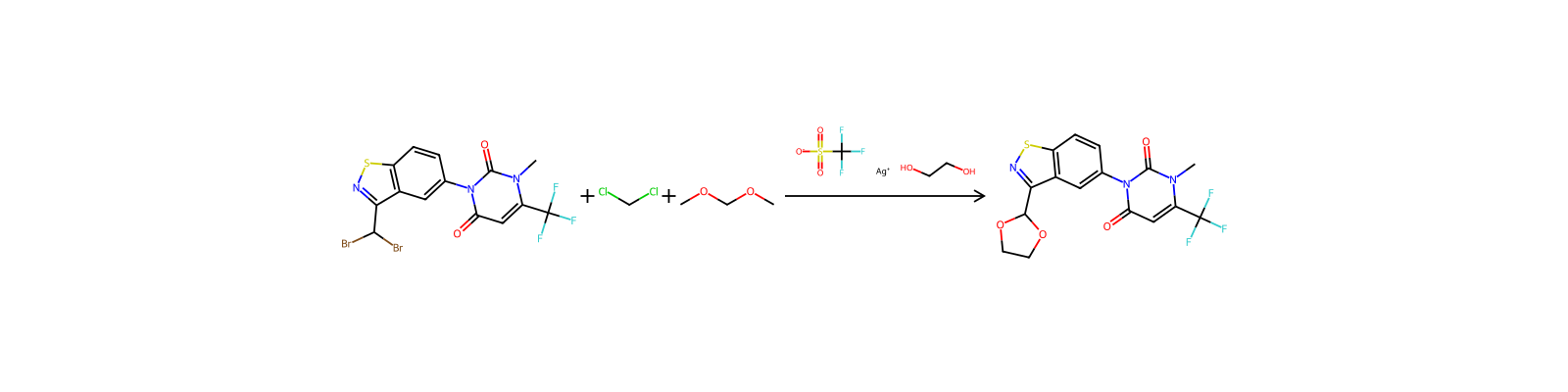
関連反応
182 件




関連ノート
読み込み中…