ホームMCPワークベンチSkills
ホームワークベンチ通知マイページ
化工社オープンプロジェクト:[email protected]AIアクセス:llms.txt · MCPガイドプライバシーポリシー · 利用規約 · サポートv1.7.8
  1. ホーム
  2. /化合物

トリエチレングリコールジアセタート

1,8-Diacetoxy-3,6-dioxaoctane

HCID 8098
ノート反応
基本情報名称と識別子物性安全と法規制化学と産業関連反応化合物ノート
部分構造検索類似構造を探す

基本情報

CAS
111-21-7
標準SMILES
CC(=O)OCCOCCOCCOC(C)=O
InChIKey
OVOUKWFJRHALDD-UHFFFAOYSA-N
分子式
C10H18O6
平均分子量
234.25 g/mol
単同位体質量
234.11033829

名称と識別子

優先名称
1,8-Diacetoxy-3,6-dioxaoctane
IUPAC
2-[2-(2-acetyloxyethoxy)ethoxy]ethyl acetate
現地名
トリエチレングリコールジアセタート
英語名
Triethylene glycol diacetate
分子式
C10H18O6
分子量
234.25

名称と別名

Triethylene glycol diacetate111-21-7TDACTRIGLYCOL DIACETATETriglycol, diacetateTriethylene glycol, diacetate2,2'-(Ethylenedioxy)di(ethyl acetate)Acetic acid, triethylene glycol diesterEthanol, 2,2'-ethylenedioxydi-, diacetateDTXSID3026223NSC-2591A559792B4Q
名称をさらに表示
トリエチレングリコールジアセタートビス酢酸3,6-ジオキサオクタン-1,8-ジイルトリグリコールジアセタートトリエチレングリコール二酢酸エステルトリエチレングリコールジアセテート二酢酸3,6-ジオキサオクタン-1,8-ジイル二酢酸トリグリコール2,2'-エチレンビスオキシジエタノールジアセタート二酢酸トリエチレングリコールトリエチレングリコ-ルジアセテ-トAC-PEG3-ACトリエチレングリコールジアセタート, 98%二酢酸エチレンビス(オキシエチレン)2,2′-エチレンビスオキシジエタノールジアセタート2-{2-[2-(アセチルオキシ)エトキシ]エトキシ}エチル アセタート2,2’-ethylenedioxydi-ethanodiacetateAc-PEG3-AcTEGdiacetatetriglycoldiacetatetriglycol,diacetateTriethylamine Glycol DiacetateETHYLENEBIS-(2-OXYETHYL ACETATE)
DTXCID8062232,2'-(1,2-Ethanediylbis(oxy))bisethanol, diacetateEthanol, 2,2'-(1,2-ethanediylbis(oxy))bis-, diacetateEthanol, 2,2'-[1,2-ethanediylbis(oxy)]bis-, diacetateRefChem:8996281,8-Diacetoxy-3,6-dioxaoctane203-846-02-[2-(2-acetyloxyethoxy)ethoxy]ethyl acetate

データベース識別子

CAS
111-21-7
PubChem CID
8098
DTXSID
DTXSID3026223
ChEMBL
CHEMBL3186191
UNII
A559792B4Q
EC Number
203-846-0
Nikkaji
J58.261A

物性

構造計算による物性

XLogP
-0.3
極性表面積
71.1 Ų
水素結合供与体数
0
水素結合受容体数
6
回転可能結合数
11
重原子数
16
形式電荷
0
複雑度
181

実験および物理化学的性質

Density · 2 件

1.1173 at 68 °F (NTP, 1992) - Denser than water; will sink

1.112 AT 25 °C

Color/FormCOLORLESS LIQUID
Solubility · 3 件

greater than or equal to 100 mg/mL at 68 °F (NTP, 1992)

MISCIBLE WITH ALCOHOL, ETHER

Very soluble in water, ethyl ether, and ethanol.

Flash Point · 2 件

345 °F (NTP, 1992)

345 °F (174 °C) (OPEN CUP)

Boiling Point · 2 件

572 °F at 760 mmHg (NTP, 1992)

286 °C

DecompositionWhen heated to decomposition it emits acrid smoke and irritating fumes.
Melting Point · 2 件

-58 °F (NTP, 1992)

-50 °C

Vapor Density8.1 (NTP, 1992) - Heavier than air; will sink (Relative to Air)
Vapor Pressure · 2 件

19 mmHg at 77 °F (NTP, 1992)

0.00409 [mmHg]

Refractive Index

安全と法規制

安全情報は参考情報です。供給元の安全データシート(SDS)、適用法令、専門家による評価に代わるものではありません。

GHS分類

GHS Classification · 3 件

This chemical does not meet GHS hazard criteria for 100% (41 of 41) of all reports.

Not Classified;Reported as not meeting GHS hazard criteria by 41 of 41 companies. For more detailed information, please visit ECHA C&L website.

Aggregated GHS information provided per 41 reports by companies from 1 notifications to the ECHA C&L Inventory.;Reported as not meeting GHS hazard criteria per 41 of 41 reports by companies.;There are 0 notifications provided by 0 of 41 reports by companies with hazard statement code(s).;Information may vary between notifications depending on impurities, additives, and other factors. The percentage value in parenthesis indicates the notified classification ratio from companies that provide hazard codes. Only hazard codes with percentage values above 10% are shown. For more detailed information, please visit ECHA C&L website.

危険有害性情報

Regulatory Information · 3 件

Chemical: Ethanol, 2,2'-[1,2-ethanediylbis(oxy)]bis-, diacetate

Status: Active Update: 29-03-2021 https://echa.europa.eu/registration-dossier/-/registered-dossier/13731

Ethanol, 2,2'-[1,2-ethanediylbis(oxy)]bis-, diacetate: Does not have an individual approval but may be used as a component in a product covered by a group standard. It is not approved for use as a chemical in its own right.

Fire HazardsThis chemical is combustible. (NTP, 1992)
Health Hazards · 1 件

SYMPTOMS: Symptoms of exposure to this compound via skin contact include irritation, itching, burning, redness and blisters. Eye contact may cause irritation, burning, tearing and redness.;ACUTE/CHRONIC HAZARDS: This compound is an irritant of the skin and eyes. It may be toxic if ingested in large quantities. When heated to decomposition it emits acrid smoke, irritating fumes and toxic fumes of carbon monoxide. (NTP, 1992)

Hazards SummaryA reproductive effector and mild skin irritant; [RTECS] May polymerize; A skin and eye irritant; [CAMEO] A skin irritant; [MSDSonline]

化学と産業

用途と製造

Uses · 6 件

Used as plasticizer for cellulose acetate, cellulose nitrate, cellulose acetate butyrate, ethyl cellulose, and polymethyl methacrylate resins; [HSDB]

Plastic Composites Manufacturing [Category: Industry]

PLASTICIZER

PLASTICIZER FOR CELLULOSE ACETATE & NITRATE RESINS

PLASTICIZER FOR CELLULOSE ACETATE BUTYRATE RESINS

PLASTICIZER FOR ETHYL CELLULOSE RESINS

U.S. Production · 2 件

(1980) PROBABLY GREATER THAN 2.27X10+6 GRAMS

(1982) PROBABLY GREATER THAN 2.27X10+6 GRAMS

Methods of ManufacturingTriethylene glycol + acetic anhydride (acetylation).
General Manufacturing Information · 2 件

Ethanol, 2,2'-[1,2-ethanediylbis(oxy)]bis-, 1,1'-diacetate: ACTIVE

Though the toxicity data available /from animal studies/ ... suggest that this material should pose no significant health hazard, it would seem prudent to follow generally accepted good industrial hygiene practices in the handling of triethylene glycol diacetate.

応用分野

使用Triethylene Glycol Diacetate is used in preparation method of solar cell grid line slurry, and solar cell.

一般的な説明Triethylene glycol diacetate is an odorless clear colorless liquid. (NTP, 1992)

サプライヤー100 社

梯希爱(上海)化成工业发展有限公司021-67121386 · [email protected]
郑州阿尔法化工有限公司+86-18530059196 · [email protected]
湖北永阔科技有限公司027-59223108 15972152991 · [email protected]

関連反応

2 件
反応記録を作成
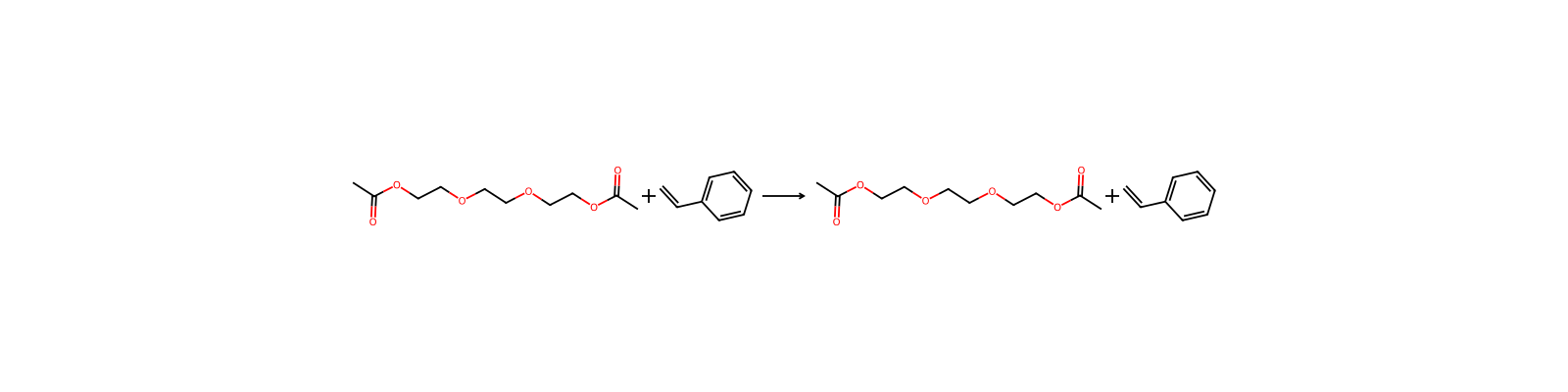
HRID 257545 の反応式
HRID 257545反応物としてuspto-grants-1993_11
HRID 1464347 の反応式
HRID 1464347反応物としてuspto-grants-1994_04

化合物ノート

読み込み中…

このページの内容基本情報名称と識別子物性安全と法規制化学と産業関連反応化合物ノート
INDEX OF REFRACTION: 1.437 AT 25 °C
Physical Description · 2 件

Triethylene glycol diacetate is an odorless clear colorless liquid. (NTP, 1992)

Colorless liquid; [HSDB] Odorless; [CAMEO]

Stability/Shelf LifeLOW DEGREE OF VOLATILITY

物理化学的性質

融点
-50 °C · -50°C
沸点
286 °C · 286°C
比重(密度)
1 · 1,12 g/cm3
蒸気圧
0.039 Pa · 0.039Pa at 20℃
屈折率
1.44 · 1.4400
闪点
174 °C · 174°C
貯蔵温度
Sealed in dry,Room Temperature
溶解性
Completely soluble in water
外見
clear liquid
色
Colorless to Almost colorless
水溶解度
1000 g/L · 1000g/L at 20℃
BRN
1789453 · 1789453
Henry's Law Constant
3.7 · 3.7×107 mol/(m3Pa) at 25℃, HSDB (2015)
LogP
0.03 at · 0.03 at 40℃
CAS データベース
111 · 111-21-7(CAS DataBase Reference)
EPAの化学物質情報
Triethylene glycol diacetate (111-21-7)
Reactive GroupEsters, Sulfate Esters, Phosphate Esters, Thiophosphate Esters, and Borate Esters;Ethers;Polymerizable Compounds
Special ReportsReel JR et al; Report (NTP 86-039): 190 (1985). Triethylene glycol diacetate: Reproduction and fertility assessment in CD-1 mice when administered in the drinking water.
TSCA Requirements · 1 件

Pursuant to section 8(d) of TSCA, EPA promulgated a model Health and Safety Data Reporting Rule. The section 8(d) model rule requires manufacturers, importers, and processors of listed chemical substances and mixtures to submit to EPA copies and lists of unpublished health and safety studies. Triethylene glycol diacetate is included on this list.

FIFRA Requirements · 1 件

Triethylene glcol diacetate is exempted from the requirement of a tolerance when used as a solvent (limit: for use on beef cattle only) in accordance with good agricultural practice as inert (or occasionally active) ingredients in pesticide formulations applied to animals.

Reactivity AlertsPolymerizable
Reactivity Profile · 1 件

TRIETHYLENE GLYCOL DIACETATE can undergo polymerization upon exposure to extreme heat or light. This chemical is incompatible with acetic acid. It is also incompatible with peroxides, strong oxidants, oxygen scavengers and heavy metal compounds. (NTP, 1992).

Air and Water ReactionsWater soluble. Ca(C12H23C6H4SO3)2 dissolved in C4H9OH
NFPA Hazard Classification · 4 件

0 - Materials that, under emergency conditions, would offer no hazard beyond that of ordinary combustible materials.

1 - Materials that must be preheated before ignition can occur. Materials require considerable preheating, under all ambient temperature conditions, before ignition and combustion can occur.

0 - Materials that in themselves are normally stable, even under fire conditions.

安全と保護具

Fire FightingFires involving this material can be controlled with a dry chemical, carbon dioxide or Halon extinguisher. A water spray may also be used. (NTP, 1992)
First Aid · 1 件

EYES: First check the victim for contact lenses and remove if present. Flush victim's eyes with water or normal saline solution for 20 to 30 minutes while simultaneously calling a hospital or poison control center. Do not put any ointments, oils, or medication in the victim's eyes without specific instructions from a physician. IMMEDIATELY transport the victim after flushing eyes to a hospital even if no symptoms (such as redness or irritation) develop.;SKIN: IMMEDIATELY flood affected skin with water while removing and isolating all contaminated clothing. Gently wash all affected skin areas thoroughly with soap and water. If symptoms such as redness or irritation develop, IMMEDIATELY call a physician and be prepared to transport the victim to a hospital for treatment.;INHALATION: IMMEDIATELY leave the contaminated area; take deep breaths of fresh air. If symptoms (such as wheezing, coughing, shortness of breath, or burning in the mouth, throat, or chest) develop, call a physician and be prepared to transport the victim to a hospital. Provide proper respiratory protection to rescuers entering an unknown atmosphere. Whenever possible, Self-Contained Breathing Apparatus (SCBA) should be used; if not available, use a level of protection greater than or equal to that advised under Protective Clothing.;INGESTION: DO NOT INDUCE VOMITING. If the victim is conscious and not convulsing, give 1 or 2 glasses of water to dilute the chemical and IMMEDIATELY call a hospital or poison control center. Be prepared to transport the victim to a hospital if advised by a physician. If the victim is convulsing or unconscious, do not give anything by mouth, ensure that the victim's airway is open and lay the victim on his/her side with the head lower than the body. DO NOT INDUCE VOMITING. IMMEDIATELY transport the victim to a hospital. (NTP, 1992)

Fire Fighting Procedures"ALCOHOL" FOAM. WATER OR FOAM MAY CAUSE FROTHING.
Nonfire Spill Response · 1 件

SMALL SPILLS AND LEAKAGE: If you should spill this chemical, use absorbent paper to pick up all liquid spill material. Seal the absorbent paper, as well as any of your clothing which may be contaminated, in a vapor-tight plastic bag for eventual disposal. Wash any surfaces you may have contaminated with a soap and water solution. Do not reenter the contaminated area until the Safety Officer (or other responsible person) has verified that the area has been properly cleaned.;STORAGE PRECAUTIONS: You should protect this material from exposure to light, and store it in a refrigerator. (NTP, 1992)

Disposal Methods · 1 件

SRP: At the time of review, criteria for land treatment or burial (sanitary landfill) disposal practices are subject to significant revision. Prior to implementing land disposal of waste residue (including waste sludge), consult with environmental regulatory agencies for guidance on acceptable disposal practices.

Allowable Tolerances · 1 件

Triethylene glcol diacetate is exempted from the requirement of a tolerance when used as a solvent (limit: for use on beef cattle only) in accordance with good agricultural practice as inert (or occasionally active) ingredients in pesticide formulations applied to animals.

Personal Protective Equipment (PPE) · 1 件

RECOMMENDED RESPIRATOR: Where the neat test chemical is weighed and diluted, wear a NIOSH-approved half face respirator equipped with an organic vapor/acid gas cartridge (specific for organic vapors, HCl, acid gas and SO2) with a dust/mist filter. (NTP, 1992)

毒性情報

Environmental Fate · 3 件

TERRESTRIAL FATE: Based on a classification scheme(1), an estimated Koc value of 20(SRC), determined from an estimated log Kow of -0.14(2,SRC) and a regression-derived equation(3), indicates that triethylene glycol, diacetate is expected to have very high mobility in soil(SRC). Volatilization of triethylene glycol, diacetate from moist soil surfaces is not expected to be an important fate process(SRC) given an estimated Henry's Law constant of 2.7X10⁻¹³ atm-cu m/mole(SRC), using a fragment constant estimation method(4). Triethylene glycol, diacetate is not expected to volatilize from dry soil surfaces based on an estimated vapor pressure of 4.1X10⁻³ mm Hg(SRC), determined from a fragment constant method(5). Biodegradation of triethylene glycol, diacetate may be important(SRC), based upon 100% biodegradation of 2-(2-butoxyethoxy)ethyl acetate(6), a structurally similar compound.

AQUATIC FATE: Based on a classification scheme(1), an estimated Koc value of 20(SRC), determined from an estimated log Kow of -0.14(2,SRC) and a regression-derived equation(3), indicates that triethylene glycol, diacetate is not expected to adsorb to suspended solids and sediment in water(SRC). Triethylene glycol, diacetate is not expected to volatilize from water surfaces(3,SRC) based on an estimated Henry's Law constant of 2.7X10⁻¹³ atm-cu m/mole(SRC), developed using a fragment constant estimation method(4). According to a classification scheme(5), an estimated BCF of 0.46(3,SRC), from an estimated log Kow(2,SRC), suggests that bioconcentration in aquatic organisms is low(SRC). Estimated hydrolysis half-lives of 150 and 15 days at pHs 7 and 8, respectively(6), suggest that hydrolysis is expected to be a slow process(SRC). Biodegradation of triethylene glycol, diacetate may be important(SRC), based upon 100% biodegradation of 2-(2-butoxyethoxy)ethyl acetate(7), a structurally similar compound.

ATMOSPHERIC FATE: According to a model of gas/particle partitioning of semivolatile organic compounds in the atmosphere(1), triethylene glycol, diacetate, which has an estimated vapor pressure of 4.1X10⁻³ mm Hg at 25 °C(2,SRC), is expected to exist solely as a vapor in the ambient atmosphere. Vapor-phase triethylene glycol, diacetate is degraded in the atmosphere by reaction with photochemically-produced hydroxyl radicals(SRC); the half-life for this reaction in air is estimated to be about 12 hours(3,SRC).

Soil Adsorption/Mobility · 1 件

The Koc of triethylene glycol, diacetate is estimated as approximately 20(SRC), using a measured log Kow of -0.14(1) and a regression-derived equation(2,SRC). According to a classification scheme(3), this estimated Koc value suggests that triethylene glycol, diacetate is expected to have very high mobility in soil(SRC).

Artificial Pollution SourcesTriethylene glycol, diacetate's production and use as a plasticizer(1) may result in its release to the environment through various waste streams(SRC).
Environmental BiodegradationBiodegradation data were not available for triethylene glycol, diacetate(SRC). However 2-(2-butoxyethoxy)ethyl acetate degraded 100% in an unspecified biodegradability test(1).
Environmental Bioconcentration · 1 件

An estimated BCF of 0.46 was calculated for triethylene glycol, diacetate(SRC), using an estimated log Kow of -0.14(1,SRC) and a regression-derived equation(2). According to a classification scheme(3), this BCF suggests that bioconcentration in aquatic organisms is low(SRC).

Volatilization from Water/Soil · 1 件

The Henry's Law constant for triethylene glycol, diacetate is estimated as 2.7X10⁻¹³ atm-cu m/mole(SRC) using a fragment constant estimation method(1). This value indicates that triethylene glycol, diacetate is expected to be essentially nonvolatile from water surfaces(2,SRC). Triethylene glycol, diacetate's Henry's Law constant(1,SRC) indicates that volatilization from moist soil surfaces is not expected to occur(SRC). Triethylene glycol, diacetate is not expected to volatilize from dry soil surfaces based on an estimated vapor pressure of 4.1X10⁻³ mm Hg(SRC), determined from a fragment constant method(3).

Non-Human Toxicity Excerpts · 3 件

IT IS...LOW IN SINGLE-DOSE TOXICITY WHEN INJECTED IP, SINCE THE LD50 FOR RATS IS 1.41 ML/KG. ...EYE CONTACT SHOULD GIVE RISE TO NO SIGNIFICANT IRRITATION NOR IS IT LIKELY TO BE ABSORBED THROUGH THE SKIN IN TOXIC AMOUNTS...

A SINGLE 8-HR EXPOSURE OF RATS TO ESSENTIALLY SATURATED VAPORS GENERATED AT APPROX 20 °C RESULTED IN NO SIGNIFICANT ADVERSE EFFECTS.

Triethylene glycol and two of its derivatives were evaluated for reproductive toxicity in a continuous breeding protocol with Swiss CD-1 mice. Triethylene glycol (TEG: 0, 0.3, 1.5, and 3%), triethylene glycol diacetate (TGD: 0, 0.75, 1.5, and 3%), and triethylene glycol dimethyl ether (triethylene glycol dimethyl ether: 0, 0.25, 0.5, and 1%) were administered in drinking water to breeding pairs (20 pairs per treatment groups, 40 control pairs) during a 98-day cohabitation period. Reproductive function was assessed by the number of litters per pair, live pups per litter, proportion of pups born alive, and pup weight. There were no apparent effects on reproductive function in the animals receiving triethylene glycol or triethylene glycol diacetate at doses up to 3% in the drinking water (representing 6.78 or 5.45 g/kg, respectively). However, some developmental toxicity was demonstrated for both triethylene glycol and triethylene glycol diacetate. Continuous exposure of dams to 1.5 or 3% triethylene glycol significantly reduced live pup weight at birth compared to control and 0.3% triethylene glycol significantly reduced live pup weight at birth compared to control and 0.3% triethylene glycol. while exposure to 3% triethylene glycol diacetate during lactation significantly (but reversibly) reduced pup body weights on Postnatal Days 14 and 21. In contrast, triethylene glycol dimethyl ether was toxic to the reproductive system as evidenced by decreases at the highest does (1% triethylene glycol dimethyl ether; 1.47 g/kg) in the proportion of pairs that produced at least one litter, live pups per litter, and proportion of pups born alive, with dose-related trends seen in the latter two parameters. A crossover mating trial showed that triethylene glycol dimethyl ether was more toxic to the female than the male reproductive system. These data indicate that triethylene glycol dimethyl ether (1.47 g/kg) is a reproductive toxicant in Swiss mice while reproductive toxicity was

Environmental Abiotic Degradation · 1 件

The rate constant for the vapor-phase reaction of triethylene glycol, diacetate with photochemically-produced hydroxyl radicals has been estimated as 3.2X10⁻¹¹ cu cm/molecule-sec at 25 °C(SRC) using a structure estimation method(1,SRC). This corresponds to an atmospheric half-life of about 12 hours at an atmospheric concentration of 5X10+5 hydroxyl radicals per cu cm(1,SRC). A base-catalyzed second-order hydrolysis rate constant of 0.53 L/mol-sec (SRC) was estimated using a structure estimation method(2); this corresponds to half-lives of 150 and 15 days at pH values of 7 and 8, respectively(2,SRC).

Probable Routes of Human Exposure · 1 件

NIOSH (NOES Survey 1981-1983) has statistically estimated that 4,322 workers (356 of these are female) are potentially exposed to triethylene glycol, diacetate in the US(1). Occupational exposure to triethylene glycol, diacetate may occur through dermal contact with this compound at workplaces where triethylene glycol, diacetate is produced or used(SRC).

Environmental Fate/Exposure Summary · 1 件

Triethylene glycol, diacetate's production and use as a plasticizer may result in its release to the environment through various waste streams. If released to air, triethylene glycol, diacetate is expected to exist solely as a vapor in the ambient atmosphere based upon an estimated vapor pressure of 4.1X10⁻³ mm Hg at 25 °C. Vapor-phase triethylene glycol, diacetate will be readily degraded in the atmosphere by reaction with photochemically-produced hydroxyl radicals with an estimated half-life of 12 hours. If released to soil, an estimated Koc of 20 suggests that triethylene glycol, diacetate is expected to have very high mobility. Volatilization from wet and dry soil surfaces is not expected to be an important fate process based upon an estimated Henry's Law constant of 2.7X10⁻¹³ atm-cu m/mol and this compound's estimated vapor pressure, respectively. If released into water, this compound is not expected to adsorb to suspended solids and sediment in the water column based upon its estimated Koc. Triethylene glycol, diacetate is not expected to volatilize from water surfaces based on the estimated Henry's Law constant. An estimated BCF of 0.46 suggests the potential for bioconcentration in aquatic organisms is low. Estimated hydrolysis half-lives of 150 and 15 days at pHs 7 and 8, respectively, indicate that hydrolysis is expected to be a slow process. Biodegradation of triethylene glycol, diacetate may be important, based upon 100% biodegradation of 2-(2-butoxyethoxy)ethyl acetate, a structurally similar compound. Occupational exposure to triethylene glycol, diacetate may occur through dermal contact with this compound at workplaces where triethylene glycol, diacetate is produced or used. (SRC)

National Toxicology Program Studies · 1 件

Triethylene glycol diacetate (TGDA) was tested in the Reproductive Assessment by Continuous Breedng (RACB) protocol using Swiss CD-1 mice, ... Data gathered on body weights, clinical signs, & food & water consumption during the Task 1 dose-range-finding study were used to select concns for the continuous breeding phase (Task 2) of 0.0, 0.75%, 1.5%, & 3% /weight/volume/ in drinking water. These concns produced calculated consumption estimates of nearly equal to 1.31, 2.62, & 5.25 g/kg/day. Continuous exposure of adult F0 mice to these concns of TGD had no effect on the number of litters/pair, or the number or weight of live pups/litter. The proportion of pups born alive was not affected by these concns of TGDA. Since no effects were observed in Task 2, Task 3, which determines the effected sex, was not conducted. The last litter from Task 2 was nursed until weaning, & then given water containing TGDA at the same concn as their parents. Only the control & 3% TGDA groups were assessed in a second generation. Although viability was not adversely affected, pups nursed by dams receiving 3% TGDA weighed between 15 & 25% less than their controls at /postnatal day/ 14 & 21. These differences in body weight had disappeared by the time of Task 4 mating at nearly equal to /postnatal day/ 74. In the second generation mating trial, there were no treatment-related effects on mating or fertility indices, or on the number of F2 pups, their viability, or weight adjusted for litter size. After the F2 litters were delivered & evaluated, the F1 adults were killed & necropsied. There were no TGDA-related differences in body weight for either sex. In males & females, relative kidney weight was increased by nearly equal to 6-8%. No other treatment-related effects were found. Epididymal sperm concn, motility, & morphology were unaffected by 3% TGDA consumption. These data show that triethylene glycol diacetate had no detectable reproductive toxicity in Swiss mice at exposure levels that alt

法規制情報

Regulatory Information · 3 件

Chemical: Ethanol, 2,2'-[1,2-ethanediylbis(oxy)]bis-, diacetate

Status: Active Update: 29-03-2021 https://echa.europa.eu/registration-dossier/-/registered-dossier/13731

Ethanol, 2,2'-[1,2-ethanediylbis(oxy)]bis-, diacetate: Does not have an individual approval but may be used as a component in a product covered by a group standard. It is not approved for use as a chemical in its own right.

TSCA Requirements · 1 件

Pursuant to section 8(d) of TSCA, EPA promulgated a model Health and Safety Data Reporting Rule. The section 8(d) model rule requires manufacturers, importers, and processors of listed chemical substances and mixtures to submit to EPA copies and lists of unpublished health and safety studies. Triethylene glycol diacetate is included on this list.

FIFRA Requirements · 1 件

Triethylene glcol diacetate is exempted from the requirement of a tolerance when used as a solvent (limit: for use on beef cattle only) in accordance with good agricultural practice as inert (or occasionally active) ingredients in pesticide formulations applied to animals.

安全データ

tsca
TSCA listed
rtecs
YE4950000
毒性
LD50 oral in rat: 22600uL/kg
hs_code
29153900
化審法
(2)-2540
消防法
危-4-3-III
safety_code
24/25
有毒物質データの
111-21-7(Hazardous Substances Data)
上海阿拉丁生化科技股份有限公司400-6206333 13167063860 · [email protected]
湖北万得化工有限公司15377098680 15377098680 · [email protected]
广州纳珑化工有限公司13192879270; 13192879270 · [email protected]
毕佳索(上海毕得医药科技股份有限公司)400-6005915 · [email protected]
上海麦克林生化科技股份有限公司021-50706066 15221275939 · [email protected]
杭州品高化工有限公司0571-87658025 · [email protected]
上海腾准生物科技有限公司19821570922 · [email protected]
普善实业(陕西)有限公司029-81310890 18165209495 · [email protected]
湖北云镁科技有限公司027-59206672 18327059871 · [email protected]
爱斯特(成都)生物制药股份有限公司+86-28-85122536 85324413 · [email protected]
Dayang Chem (Hangzhou) Co.,Ltd.+86-0571-88938639 17705817739 · [email protected]
Hebei Yanxi Chemical Co., Ltd.+86-17531190177 · [email protected]
上海迈瑞尔生化科技有限公司4006356688 18621169109 · [email protected]
北京索莱宝科技有限公司010-50973130 17801761073 · [email protected]
江苏普乐司生物科技有限公司0513-66017706 18551496367 · [email protected]
武汉市聚舜化工有限公司027-02783261126 18971318572 · [email protected]
阿法埃莎(中国)化学有限公司400-6106006 · [email protected]
安耐吉化学&3A(安徽泽升科技股份有限公司)400-0056266 · [email protected]
武汉卡诺斯科技有限公司027-83238443 15327105076 · [email protected]
广东云星生物技术有限公司0751-18902340975/189023400307 18902340307 · [email protected]
United Life Science020-82099279 18988968278 · [email protected]
湖北广奥生物科技有限公司027-02702759223056 18162699093 · [email protected]
吉林中科研伸科技有限公司18143011203 · [email protected]
湖北成海化工有限公司027-59220433 18327245847 · [email protected]
湖北微斯汀科技有限公司027-61182895 13367240285 · [email protected]
山东西亚化学有限公司13355009207 13355009207 · [email protected]
玛雅试剂+86 (573) 82222445 (0)18006601000 452520369 · [email protected]
四川库利南科技有限公司400-1166-196 18981987031 · [email protected]
天津希恩思生化科技有限公司400 638 7771 · [email protected]
上海德铼钶医药科技有限公司17351445187
ZHEJIANG JIUZHOU CHEM CO., LTD+86-0576225566889 +86-13454675544 · [email protected];[email protected];[email protected]
TargetMol 中国(陶术生物)400-821-0310 15002144251 · [email protected]
TOKYO CHEMICAL INDUSTRY CO., LTD.03-36680489 · [email protected]
上海贤鼎生物科技有限公司4009209199 · [email protected]
武汉卡诺斯科技有限公司153-37111468 15337111468 · [email protected]
上海湄水化工科技有限公司021-60549325 18616193163
上海石洋化工有限公司021-56795766 · [email protected]
杭州杰恒化工有限公司0571-87396432 · [email protected]
康迪斯化工(湖北)有限公司13125172151 · [email protected]
陕西缔都医药化工有限公司029-81024372 17792795018 · [email protected]
青岛海智微元生物科技有限公司18317699790 18317699790 · [email protected]
湖北巨胜科技有限公司027-59599241 18871490274 · [email protected]
湖北川合化工有限公司187-7130-7593 18672969259 · [email protected]
启源(广东)医药化工有限公司18026564465 · [email protected]
安那莱(齐河)新材料科技有限公司18600642180(微信同) 13391601435 · [email protected]
上海源叶生物科技有限公司18916372613 · [email protected]
武汉市承天精细化工有限公司18164098996 · [email protected]