
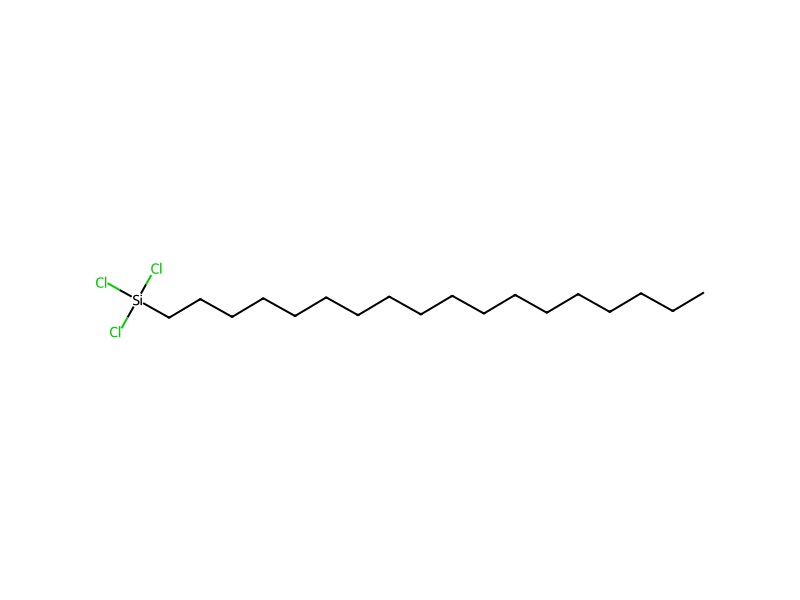
基本情報
- 標準SMILES
CCCCCCCCCCCCCCCCCC[Si](Cl)(Cl)Cl- InChIKey
PYJJCSYBSYXGQQ-UHFFFAOYSA-N- 分子式
- C18H37Cl3Si
- 平均分子量
- 387.9 g/mol
- 単同位体質量
- 386.17301075
概要
Octadecyltrichlorosilane appears as a colorless liquid with a pungent odor. Decomposed by water to hydrochloric acid with the evolution of heat. Corrosive to metals and tissue. Used to make various silicon containing compounds.
名称と識別子
- 優先名称
- Trichlorooctadecylsilane
- IUPAC
- trichloro(octadecyl)silane
- 現地名
- トリクロロオクタデシルシラン
- 英語名
- n-Octadecyltrichlorosilane
- 分子式
- C18H37Cl3Si
- 分子量
- 387.93
名称と別名
OCTADECYLTRICHLOROSILANE112-04-9n-OctadecyltrichlorosilaneTrichlorooctadecylsilaneSilane, trichlorooctadecyl-Stearyltrichlorosilaneoctadecyl trichlorosilane1QLE771PKENSC-96644DTXSID50868051n-OTSRefChem:167715
名称をさらに表示
トリクロロオクタデシルシラン1-(トリクロロシリル)オクタデカンオクタデシルトリクロロシラントリクロロ(オクタデシル)シラントリクロロステアリルシランn-オクタデシルトリクロロシラントリクロロ(ステアリル)シラントリクロロ(オクタデカン-1-イル)シラントリクロロオクタデシルシラン (>99.0%)ODTSTrichlorosilyloctadecaneDK041CO9750trichlorooctadecyl-silan
DTXCID90816192203-930-7Trichloro(octadecyl)silaneTrichlorostearylsilaneSilane, octadecyltrichloro-Trichloro octadecyl silaneTrichloroctadecylsilaneMFCD00000484
データベース識別子
- CAS
112-04-9- PubChem CID
- 8157
- DTXSID
DTXSID50868051- UNII
- 1QLE771PKE
- EC Number
- 203-930-7
- Nikkaji
- J36.483E
物性
構造計算による物性
- 極性表面積
- 0 Ų
- 水素結合供与体数
- 0
- 水素結合受容体数
- 0
- 回転可能結合数
- 16
- 重原子数
- 22
- 形式電荷
- 0
- 複雑度
- 217
実験および物理化学的性質
Chemical Classes
Toxic Gases & Vapors -> Chlorosilanes
Corrosives
Density
0.984 g/cu cm at 25 °C
0.984 @25 °C
Color/FormWater-white liquid
SolubilitySoluble in benzene, ethyl ether, heptane, and perchloroethylene
CorrosivityCorrosive
Flash Point
193 °F (NFPA, 2010)
193 °F (89 °C) (closed cup)
Boiling Point
380 °C
BP: 223 °C at 10 mm Hg
Decomposition
The silanes decomp at elevated temp to liberate hydrogen and deposit a high purity silicon, which leads to some of the principal uses of silanes. /Silanes/
Hydrogen chloride and phosgene gases may form; both are toxic and irritating.
When heated to decomposition it emits toxic fumes of /chlorine/.
Melting Pointabout 20 °C
Vapor Pressure0.00000992 [mmHg]
Refractive IndexIndex of refraction = 1.4602 at 20 °C/D
Physical Description
Octadecyltrichlorosilane appears as a colorless liquid with a pungent odor. Decomposed by water to hydrochloric acid with the evolution of heat. Corrosive to metals and tissue. Used to make various silicon containing compounds.
Colorless liquid with a pungent odor; [CAMEO]
物理化学的性質
- 融点
- 22 °C · 22°C
- 沸点
- 223 °C10 · 223 °C10 mm Hg(lit.)
- 比重(密度)
- 0.984 g/mL · 0.984 g/mL at 25 °C(lit.)
- 蒸気密度
- 1 · >1 (vs air)
- 蒸気圧
- 5 mm · <5 mm Hg ( 20 °C)
- 屈折率
- 20 · n20/D 1.459(lit.)
- 闪点
- 193 °F · 193 °F
- 貯蔵温度
- 30 °C · Store below +30°C.
- 溶解性
- Chloroform (Sparingly), Dichloromethane (Slightly)
- 外見
- 液体
- 比重
- 0.984 · 0.984
- 色
- White or Colorless to Light yellow
- 水溶解度
- 水で分解します。
- BRN
- 1778847 · 1778847
- 安定性
- 安定。水と激しく反応する。強酸、強塩基、強酸化剤とは相容れない。空気に敏感。可燃性。
- InChI
- 1S/C18H37Cl3Si/c1-2-3-4-5-6-7-8-9-10-11-12-13-14-15-16-17-18-22(19,20)21/h2-18H2,1H3
- InChIKey
- PYJJCSYBSYXGQQ-UHFFFAOYSA-N
- SMILES
- CCCCCCCCCCCCCCCCCC[Si](Cl)(Cl)Cl
- LogP
- 6 · 6
- CAS データベース
- 112 · 112-04-9(CAS DataBase Reference)
- NISTの化学物質情報
- Silane, trichlorooctadecyl-(112-04-9)
- EPAの化学物質情報
- Silane, trichlorooctadecyl- (112-04-9)
化学的性質
化学的特性Colorless clear liquid
安全と法規制
GHS分類
GHS Classification
This chemical does not meet GHS hazard criteria for 1.2% (1 of 81) of reports.
Danger
H314 (98.8%): Causes severe skin burns and eye damage [Danger Skin corrosion/irritation]
P260, P261, P264, P271, P280, P301+P330+P331, P302+P361+P354, P304+P340, P305+P354+P338, P316, P319, P321, P363, P403+P233, P405, and P501 (click each P-code to see the statement)
Aggregated GHS information provided per 81 reports by companies from 13 notifications to the ECHA C&L Inventory. Each notification may be associated with multiple companies.
危険有害性情報
Hazards IdentificationWater-reactive material (WR)
Regulatory Information
Chemical: Silane, trichlorooctadecyl-
REACH registered substance: Trichloro(octadecyl)silane (EC: 203-930-7)
Trichlorooctadecylsilane: Does not have an individual approval but may be used under an appropriate group standard
The New Jersey Worker and Community Right to Know Act requires public and private employers to provide information about hazardous substances at their workplaces. (N.J.S.A. 34:5A-1 et. seq.)
DOT LabelCorrosive
Fire Hazards
Excerpt from ERG Guide 156 [Substances - Toxic and/or Corrosive (Combustible / Water-Sensitive)]:
· Combustible material: may burn but does not ignite readily.
Fire Potential
Octadecyltrichlorosilane is a combustible liquid.
Self-ignites in air. /Chlorosilanes/
With a little ammonia, it forms a self-igniting product.
Health Hazards
Excerpt from ERG Guide 156 [Substances - Toxic and/or Corrosive (Combustible / Water-Sensitive)]:
· TOXIC and/or CORROSIVE; inhalation, ingestion or contact (skin, eyes) with vapors, dusts or substance may cause severe injury, burns or death.
Hazards Summary
Reacts violently with water, steam, or moisture evolving heat, hydrogen gas (combustible), and hydrogen chloride gas (corrosive); Produces hydrogen chloride gas on contact with air; Corrosive to tissue; [CAMEO] Can cause second- and third-degree burns from brief contact; Vapors are severely irritating to eyes and throat and may cause injury to eyes and lungs; [HSDB] Reacts violently with water; Causes burns; Inhalation may cause corrosive injuries to upper respiratory tract and lungs; [Sigma-Aldrich MSDS]
DOT ID and Guide1800 156
Reactive GroupChlorosilanes
RCRA RequirementsD003; A solid waste containing octadecyltrichlorosilane may become characterized as a hazardous waste when subjected to testing for reactivity as stipulated in 40 CFR 261.23, and if so characterized, must be managed as a hazardous waste.
Reactivity AlertsWater-Reactive
Reactivity Profile
Chlorosilanes, such as OCTADECYLTRICHLOROSILANE, are compounds in which silicon is bonded to from one to four chlorine atoms with other bonds to hydrogen and/or alkyl groups. Chlorosilanes react with water, moist air, or steam to produce heat and toxic, corrosive fumes of hydrogen chloride. They may also produce flammable gaseous H2. They can serve as chlorination agents. Chlorosilanes react vigorously with both organic and inorganic acids and with bases to generate toxic or flammable gases.
安全と保護具
Fire FightingExcerpt from ERG Guide 156 [Substances - Toxic and/or Corrosive (Combustible / Water-Sensitive)]:
Accidental Release Measures
· CALL 911. Then call emergency response telephone number on shipping paper. If shipping paper not available or no answer, refer to appropriate telephone number listed on the inside back cover.
· ELIMINATE all ignition sources (no smoking, flares, sparks or flames) from immediate area.
First Aid
Excerpt from ERG Guide 156 [Substances - Toxic and/or Corrosive (Combustible / Water-Sensitive)]:
General First Aid:
Firefighting Hazards
Do not use water.
Containers may explode in fire or if contaminated by water.
Use water spray only to keep fire-exposed containers cool. Do not get water inside containers.
Vapors may travel to a source of ignition and flash back. Vapor is heavier than air and may travel a distance to cause a fire or explosion far from the source.
Exposure Control and Personal Protection
· Wear positive pressure self-contained breathing apparatus (SCBA).
TIH (Toxic Inhalation Hazard) - Term used to describe gases and volatile liquids that are toxic when inhaled. Some are TIH materials themselves, e.g., chlorine, and some release TIH gases when spilled in water, e.g., chlorosilanes. [ERG 2016].
Fire Fighting Procedures
If material on fire or involved in fire: use dry chemical, dry sand, or carbon dioxide; do not use water on material itself; if large quantities of combustibles are involved, use water in flooding quantities as spray and fog; use water spray to knock down vapors; cool all affected containers with flooding quantities of water; apply water from as far a distance as possible.
Wear positive pressure self-contained breathing apparatus ... Wear appropriate chemical protective gloves, boots, and goggles.
Storage Conditions
SRP: Operations involving entry into tanks or closed vessels, and emergency situations, require consideration of potentially oxygen deficient, or "immediately dangerous to life and health" IDLH environments. This may necessitate use of a self-contained breathing apparatus (SCBA), or a positive pressure supplied air respirator.
Octadecyltrichlorosilane must be stored to avoid contact with water since violent reactions occur ... Store in tightly closed containers in a cool, well-ventilated area away from moist air. Sources of ignition, such as smoking and open flame, are prohibited where octadecyltrichlorosilane is used, handled, or stored in a manner that could create a potential fire or explosion hazard. Wherever octadecyltrichlorosilane is used, handled, manufactured, or stored, use explosion-proof electrical equipment and fittings.
Cleanup Methods
SRP: Wastewater from contaminant suppression, cleaning of protective clothing/equipment, or contaminated sites should be contained and evaluated for subject chemical or decomposition product concentrations. Concentrations shall be lower than applicable environmental discharge or disposal criteria. Alternatively, pretreatment and/or discharge to a permitted wastewater treatment facility is acceptable only after review by the governing authority and assurance that "pass through" violations will not occur. Due consideration shall be given to remediation worker exposure (inhalation, dermal and ingestion) as well as fate during treatment, transfer and disposal. If it is not practicable to manage the chemical in this fashion, it must be evaluated in accordance with EPA 40 CFR Part 261, specifically Subpart B, in order to determine the appropriate local, state and federal requirements for disposal.
If octadecyltrichlorosilane is spilled or leaked, take the following steps: evacuate persons not wearing protective equipment from area of spill or leak until clean-up is complete; remove all igntion sources; absorb liquids in vermiculite, dry sand, earth, or a similar material and deposit in sealed containers. Do not use water or wet method. Ventilate and wash area after clean-up is complete. It may be necessary to contain and dispose of octadceyltrichlorosilane as a hazardous waste. Contact your state Department of Environmental Protection (DEP) or your regional office of the federal Environmental Protection Agency (EPA) for specific recommendations.
Nonfire Spill ResponseExcerpt from ERG Guide 156 [Substances - Toxic and/or Corrosive (Combustible / Water-Sensitive)]:
Disposal Methods
SRP: The most favorable course of action is to use an alternative chemical product with less inherent propensity for occupational harm/injury/toxicity or environmental contamination. Recycle any unused portion of the material for its approved use or return it to the manufacturer or supplier. Ultimate disposal of the chemical must consider: the material's impact on air quality; potential migration in soil or water; effects on animal and plant life; and conformance with environmental and public health regulations.
Preventive Measures
SRP: The scientific literature for the use of contact lenses by industrial workers is inconsistent. The benefits or detrimental effects of wearing contact lenses depend not only upon the substance, but also on factors including the form of the substance, characteristics and duration of the exposure, the uses of other eye protection equipment, and the hygiene of the lenses. However, there may be individual substances whose irritating or corrosive properties are such that the wearing of contact lenses would be harmful to the eye. In those specific cases, contact lenses should not be worn. In any event, the usual eye protection equipment should be worn even when contact lenses are in place.
SRP: Contaminated protective clothing should be segregated in a manner that results in no direct personal contact by personnel who handle, dispose of, or clean the clothing. Quality assurance procedures to confirm the efficacy of the cleaning procedures should be implemented prior to the decontaminated protective clothing being returned for reuse by the workers. Contaminated clothing (including shoes/socks) should not be taken home at end of shift, but should remain at employee's place of work for cleaning.
SRP: Local exhaust ventilation should be applied wherever there is an incidence of point source emissions or dispersion of regulated contaminants in the work area. Ventilation control of the contaminant as close to its point of generation is both the most economical and safest method to minimize personnel exposure to airborne contaminants. Ensure that the local ventilation moves the contaminant away from the worker.
If material not on fire and not involved in fire: keep sparks, flames, and other sources of ignition away; keep material out of water sources and sewers; build dikes to contain flow as necessary; use water spray to knock down vapors; do not use water on material itself; neutralize spilled material with crushed limestone, soda ash, or lime.
For more Preventive Measures (Complete) data for Octadecyltrichlorosilane (8 total), please visit the HSDB record page.
Isolation and Evacuation
Excerpt from ERG Guide 156 [Substances - Toxic and/or Corrosive (Combustible / Water-Sensitive)]:
Immediate precautionary measure
When spilled in water
When spilled in water
毒性情報
Adverse EffectsDermatotoxin - Skin burns.
Human Toxicity Excerpts
/SIGNS AND SYMPTOMS/ Acute inhalation exposure may result in sneezing, choking, laryngitis, dyspnea (shortness of breath), respiratory tract irritation, and chest pain. Higher exposure can cause pulmonary edema, a medical emergency that can be delayed for several hours. This can cause death. Bleeding of nose and gums, ulceration of the nasal and oral mucosa, pulmonary edema, chronic bronchitis, and pneumonia may also occur. If the eyes have come in contact with dimethyldichlorosilane, irritation, pain, swelling, corneal erosion, and blindness may result. Dermatitis (red, inflamed skin), severe burns, pain, and shock generally follow dermal exposure. Inhalation irritates mucous membranes. Severe gastrointestinal damage may occur. Vapors cause severe eye and lung injury. Upon short contact, second and third degree burns may occur. Signs and symptoms of acute ingestion of dimethyldichlorosilane may be severe and include increased salivation, intense thirst, difficulty swallowing, chills, pain, and shock. Oral, esophageal, and stomach burns are common. /Dimethyldichlorosilane/
/SIGNS AND SYMPTOMS/ Inhalation irritates mucous membranes. Contact with liq causes severe burns of eyes and skin ... Vapors cause severe irritation of eyes and throat and can cause eye and lung injury. They cannot be tolerated even at low concn. Causes second- and third-degree burns on short contact ...
/SIGNS AND SYMPTOMS/ Causes severe eye and skin burns. Serious health hazard. May be harmful if inhaled. Irritating to eye, skin, and respiratory system. /Dimethylchlorosilane/
/SIGNS AND SYMPTOMS/ Octadecyltrichlorosilane is a highly corrosive chemical and contact can severely irritate and burn the skin and eyes with possible eye damage. Breathing octadecyltrichlorosilane can irritate the nose, throat, and lungs causing coughing, wheezing, and/or shortness of breath.
For more Human Toxicity Excerpts (Complete) data for Octadecyltrichlorosilane (6 total), please visit the HSDB record page.
Non-Human Toxicity Excerpts
/OTHER TOXICITY INFORMATION/ Hydrogen chloride AEGL values were adopted as AEGL values for monochlorosilanes, AEGL values for dichlorosilanes were derived by dividing the hydrogen chloride AEGL values by a molar adjustment factor of two, AEGL values for the title trichlorosilanes were derived by dividing the hydrogen chloride AEGL values by a molar adjustment factor of three, and AEGL values for tetrachlorosilane were derived by dividing the hydrogen chloride AEGL values by a molar adjustment factor of four.
/OTHER TOXICITY INFORMATION/ All these compounds, even in very low doses ... caused severe burns of cornea and eyelids ... /After/ application to the skin of the rabbit the region attacked by chlorosilanes blanches and then blisters appear ... /Chlorosilanes/
/OTHER TOXICITY INFORMATION/ Although chemical-specific data are not available for many of the ... chlorosilanes, acute inhalation data from rat studies are available for structurally-similar chlorosilanes (n-propyltrichlorosilane, methyltrichlorosilane, vinyltrichlorosilane, ethyltrichlorosilane, methylvinyldichlorosilane, methyldichlorosilane, dimethyldichlorosilane, dimethylchlorosilane, trimethylchlorosilane, and tetrachlorosilane). These data suggest that the acute toxicity of chlorosilanes is due to the hydrogen chloride hydrolysis product; acute toxicity of the chlorosilanes is both qualitatively (based on clinical signs) and quantitatively (based on molar equivalents of hydrogen chloride) similar to that of HCl. Complete hydrolysis of one mole of a monochlorosilane would yield a maximum of one mole of hydrogen chloride. Complete hydrolysis of a dichlorosilane would yield a maximum of two moles of hydrogen chloride, complete hydrolysis of a trichlorosilane would yield a maximum of three moles of hydrogen chloride, and complete hydrolysis of tetrachlorosilane would yield a maximum of four moles of hydrogen chloride. /Chorosilanes/
Environmental Abiotic Degradation
Silane compounds decompose upon contact with water or steam to produce heat and toxic and corrosive fumes of hydrogen chloride. Silane ignites spontaneously in air(1,2). With a little ammonia, it forms a self-igniting product(1). /Chlorosilanes/
Probable Routes of Human Exposure
According to the 2006 TSCA Inventory Update Report, the number of workers reasonably likely to be exposed in the industrial manufacturing, processing, and use for octadecyltrichlorosilane is 1-99 persons; the data may be greatly underestimated(1).
Environmental Fate/Exposure Summary
Chlorosilane compounds' production and use as intermediates for silicone products may result in their release to the environment through various waste streams. However, these compounds decompose to release hydrogen chloride upon contact with water or steam. Therefore, volatilization, biodegradation, and bioconcentration are not expected to be important environmental fate processes. /Chlorosilanes/ (SRC)
Antidote and Emergency Treatment
Immediate first aid: Ensure that adequate decontamination has been carried out. If patient is not breathing, start artificial respiration, preferably with a demand-valve resuscitator, bag-valve-mask device, or pocket mask, as trained. Perform CPR as necessary. Immediately flush contaminated eyes with gently flowing water. Do not induce vomiting. If vomiting occurs, lean patient forward or place on left side (head-down position, if possible) to maintain an open airway and prevent aspiration. Keep patient quiet and maintain normal body temperature. Obtain medical attention. /Silane, Chlorosilane, and Related Compounds/
Basic treatment: Establish a patent airway (oropharyngeal or nasopharyngeal airway, if needed). Suction if necessary. Watch for signs of respiratory insufficiency and assist ventilations if necessary. Administer oxygen by nonrebreather mask at 10 to 15 L/min. Monitor for pulmonary edema and treat if necessary ... . Anticipate seizures and treat if necessary ... . Monitor for shock and treat if necessary ... . For eye contamination, flush eyes immediately with water. Irrigate each eye continuously with 0.9% saline (NS) during transport ... . Do not use emetics. For ingestion, rinse mouth and administer 5 ml/kg up to 200 ml of water for dilution if the patient can swallow, has a strong gag reflex, and does not drool. Administer activated charcoal (refer to ingestion protocol in Section Three ... . Cover skin burns with sterile dressings after decontamination ... . /Silane, Chlorosilane, and Related Compounds/
Advanced treatment: Consider orotracheal or nasotracheal intubation for airway control in the patient who is unconscious, has severe pulmonary edema, or is in severe respiratory distress. Early intubation at the first sign of upper airway obstruction may be necessary. Positive-pressure ventilation techniques with a bag-valve-mask device may be beneficial. Consider drug therapy for pulmonary edema ... . Monitor cardiac rhythm and treat arrhythmias if necessary ... . Start IV administration of D5W /SRP: "To keep open", minimal flow rate/. Use 0.9% saline (NS) or lactated Ringer's (LR) if signs of hypovolemia are present. For hypotension with signs of hypovolemia, administer fluid cautiously. Consider vasopressors if patient is hypotensive with a normal fluid volume. Watch for signs of fluid overload ... . Treat seizures with diazepam or lorazepam ... . Use proparacaine hydrochloride to assist eye irrigation ... . /Silane, Chlorosilane, and related compounds/
法規制情報
RCRA RequirementsD003; A solid waste containing octadecyltrichlorosilane may become characterized as a hazardous waste when subjected to testing for reactivity as stipulated in 40 CFR 261.23, and if so characterized, must be managed as a hazardous waste.
DHS Chemicals of Interest (COI)
Octadecyltrichlorosilane
A Commercial Grade
A Placarded Amount
Chemical or material that can be mixed with readily available materials.
安全データ
- F
- 10-21
- wgk
- 1
- tsca
- TSCA listed
- rtecs
- VV4680000
- ridadr
- UN 1800
- hs_code
- 29319090
- risk_code
- 14-34-29
- 化審法
- (2)-2041
- 消防法
- 危-4-3-III
- hazard_code
- C
- safety_code
- 26-36/37/39-43-45-8
- hazard_class
- 8
- packing_group
- II
- Hazard Classifications
- Eye Dam. 1Skin Corr. 1B
- ストレージクラス
- 8A - Combustible corrosive hazardous materials
- 有毒物質データの
- 112-04-9(Hazardous Substances Data)
化学と産業
薬理情報
Metabolism/Metabolites... Chlorosilanes will be rapidly hydrolyzed upon contact with tissue fluids to release hydrochloric acid. /Chlorosilanes/
用途と製造
Uses
Used as an intermediate for silicones; [HSDB]
Toxic Gas from Spilling Chemical in Water [Category: Other]
Intermediate for silicones
U.S. ProductionProduction volumes for non-confidential chemicals reported under the Inventory Update Rule. [Table#7457]
General Manufacturing InformationSilane, trichlorooctadecyl-: ACTIVE
応用分野
使用n-Octadecyltrichlorosilane is used in semiconductor industry to form self-assembled monolayer thin films on silicon dioxide substrates. Used in molecular electronics, as thin insulating gates in Metal-Insulator-Semiconductor Field-Effect Transistors. It is also used in platinum catalyzed synthesis.
一般的な説明A colorless liquid with a pungent odor. Flash point of 193°F. Decomposed by water to hydrochloric acid with the evolution of heat. Corrosive to metals and tissue. Used to make various silicon containing compounds.
調製方法
純化方法Purify it by fractional distillation at high vacuum. [Winstein & Seubold J Am Chem Soc 69 2916 1947, Beilstein 4 IV 4256.]
上流・下流製品情報
上流原料
サプライヤー50 社
国药集团化学试剂有限公司86-21-63210123 · [email protected]
梯希爱(上海)化成工业发展有限公司021-67121386 · [email protected]
湖北科孚乐材料科技有限公司027-84459282 13720265353 · [email protected]
上海比阳实业有限公司+86-21-52699951; +8613917686115 · [email protected]
温州共赢化学有限公司+86-0086-577-64498589 +86-15355981851 · [email protected]
上海遐瑞医药科技有限公司+86-021-61551413 · [email protected]
河北创海生物科技有限公司+86-86-13131129325 · [email protected]
T&W GROUP021-61551611 13296011611 · [email protected]
武汉绿景丰华生物科技有限公司19972070065 · [email protected]
Syntechem Co.,Ltd[email protected]
上海迈瑞尔生化科技有限公司4006356688 18621169109 · [email protected]
江苏普乐司生物科技有限公司0513-66017706 18551496367 · [email protected]
阿法埃莎(中国)化学有限公司400-6106006 · [email protected]
安耐吉化学&3A(安徽泽升科技股份有限公司)400-0056266 · [email protected]
武汉凯威斯科技有限公司86-027-67849912 · [email protected]
武汉卡诺斯科技有限公司027-83238443 15327105076 · [email protected]
上海瀚鸿科技股份有限公司021-54306202 13764082696 · [email protected]
山东洛克化工有限公司17653113209 13065062079 · [email protected]
上海比阳实业有限公司+86-15021878111 · [email protected]
山东西亚化学有限公司13355009207 13355009207 · [email protected]
玛雅试剂+86 (573) 82222445 (0)18006601000 452520369 · [email protected]
四川库利南科技有限公司400-1166-196 18981987031 · [email protected]
天津希恩思生化科技有限公司400 638 7771 · [email protected]
Xiamen AmoyChem Co., Ltd+86-86-5926051114 · [email protected]
Novel Chemical+86-21-64855560, 4008207808 · [email protected]
南京化学试剂股份有限公司025-58369808 17895012682 · [email protected]
斯百全化学(上海)有限公司021-021-021-67601398-809-809-809 15221380277 · [email protected]
艾科试剂4008-755-333 18080918076 · [email protected]
赛默飞世尔科技(中国)有限公司800-810-5118 · [email protected]
北京伊诺凯科技有限公司400-810-7969 010-59572699 · [email protected]
张家港保税区凯利特化工有限公司18606289633 15862625988 · [email protected]
QINGDAO KAIENSI INTERNATIONAL TRADE CO.,LTD.+86-0532-8699-9256 +86-18518128472 · [email protected]
TCI AMERICA800-4238616 · [email protected]
TOKYO CHEMICAL INDUSTRY CO., LTD.03-36680489 · [email protected]
TCI Europe320-37350700 · [email protected]
Shanghai MOF Chemical Tech Limited13661494087 18964793018 · [email protected]
安徽科迪达化工有限公司0554-2106669 · [email protected]
上海探圭新材料科技有限公司18516111942 · [email protected]
上海石洋化工有限公司021-56795766 · [email protected]
成都零六生物科技有限公司400-1166-196 13458535857 · [email protected]
上海麦克林生化科技股份有限公司15221275939 15221275939 · [email protected]
陕西缔都医药化工有限公司029-81024372 17792795018 · [email protected]
上海兴鲁化工科技有限公司02120970332 · [email protected]
池州凯隆进出口贸易有限公司[email protected]
Sigma-Aldrich西格玛奥德里奇(上海)贸易有限公司021-61415566 800-8193336 · [email protected]
铜陵恒优生物科技有限公司021-50426030 13856289449;13124863828 · [email protected]
Shanghai Enchem Industry Co., Ltd.15021317485
康迪斯化工(湖北)有限公司13343438265 · [email protected]
壮铭新材料科技江苏有限公司17312398916 051386936896 15216715905 · [email protected]
九鼎化学(上海)科技有限公司4009209199 · [email protected]
関連反応
1 件
関連ノート
読み込み中…