
基本情報
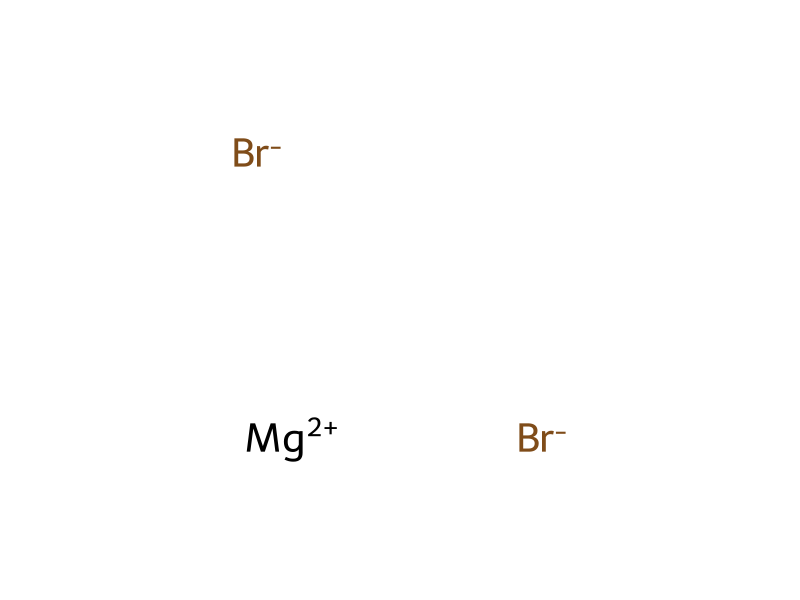
- 標準SMILES
[Br-].[Br-].[Mg+2]- InChIKey
OTCKOJUMXQWKQG-UHFFFAOYSA-L- 分子式
- Br2Mg
- 平均分子量
- 184.11 g/mol
概要
Magnesium bromide is a chemical compound of magnesium and bromine. It is often used as a mild sedative and as an anticonvulsant for treatment of nervous disorders. Bromine is a halogen element with the symbol Br and atomic number 35. Diatomic bromine does not occur naturally, but bromine salts can be found in crustal rock. (L625, L657)
名称と識別子
- 優先名称
- Magnesium Bromide
- IUPAC
- magnesium dibromide
- 現地名
- 臭化マグネシウム, 無水
- 英語名
- Magnesium bromide
- 分子式
- Br2Mg
- 分子量
- 184.11
名称と別名
Magnesium bromide7789-48-2MgBr2RefChem:155178DTXCID9048069232-170-92VC6P60SLNDTXSID7064865Magnesium bromide (MgBr2)Magnesium bromide, anhydrousmagnesiumbromideMagnesium Dibromide;
名称をさらに表示
臭化マグネシウム, 無水臭化マグネシウム無水臭化マグネシウム臭化マグネシウム,無水和物finechemicalMagnesium dibromideMagnesium bromide 98 %magnesiumbromide(mgbr2)Magnesium bromide 7789-48-2Magnesiumbromide,anhydrous,98%
Br2MgMagnesiumbromidmagnesium-bromidemagnesium bromide saltmagnesium(II) bromidestarbld0009615magnesium bromide 6-hydrateSCHEMBL19000
データベース識別子
- CAS
7789-48-2- PubChem CID
- 82241
- UNII
- 2VC6P60SLN
- EC Number
- 232-170-9
- Nikkaji
- J43.879K
物性
構造計算による物性
- 極性表面積
- 0 Ų
- 水素結合供与体数
- 0
- 水素結合受容体数
- 2
- 回転可能結合数
- 0
- 重原子数
- 3
- 形式電荷
- 0
- 複雑度
- 0
実験および物理化学的性質
Chemical ClassesMetals -> Metals, Inorganic Compounds
CosmeticsViscosity controlling
Physical DescriptionHexahydrate: Colorless or white solid; Highly deliquescent; [Merck Index] Hygroscopic solid; [Sigma-Aldrich MSDS]
物理化学的性質
- 融点
- 711 °C · 711 °C (lit.)
- 沸点
- 1248.47 °C · 1248.47°C (estimate)
- 比重(密度)
- 3.72 g/mL · 3.72 g/mL at 25 °C (lit.)
- 溶解性
- DMSO (Slightly, Heated), Methanol (Slightly), Water (Slightly)
- 外見
- 粉
- 色
- オフホワイト
- 比重
- 3.72 · 3.72
- 水溶解度
- 2 O · H2O (g/100g): 100.6 (25°C), 125.4 (100°C); 固相, MgBr2 6H2O [KRU93]
- Merck
- 13 · 13,5681
- 安定性
- 吸湿性
- 化粧品成分の機能
- 粘度制御
- InChI
- InChI=1S/2BrH.Mg/h2*1H;/q;;+2/p-2
- InChIKey
- OTCKOJUMXQWKQG-UHFFFAOYSA-L
- SMILES
- [Mg+2].[Br-].[Br-]
- CAS データベース
- 7789 · 7789-48-2(CAS DataBase Reference)
- NISTの化学物質情報
- Magnesium dibromide(7789-48-2)
- EPAの化学物質情報
- Magnesium bromide (MgBr2) (7789-48-2)
化学的性質
化学的特性マグネシウムブロマイドは化学式がMgBr2で表される無機化合物ですこの白色または無色の固体は水に非常に溶けやすい特性を持ち多湿環境では吸湿性を示しますマグネシウムブロマイドは主に工業的な用途や化学研究において利用されています
化学的特性Magnesium Bromide is a colorless, very deliquescent crystals or white solid; bitter taste. Soluble in water; slightly soluble in alcohol. It formed by reaction of magnesium carbonate and hydrobromic acid.
安全と法規制
GHS分類
GHS Classification
This chemical does not meet GHS hazard criteria for 8.2% (4 of 49) of reports.
Warning
H315 (91.8%): Causes skin irritation [Warning Skin corrosion/irritation]
P261, P264, P264+P265, P271, P280, P302+P352, P304+P340, P305+P351+P338, P319, P321, P332+P317, P337+P317, P362+P364, P403+P233, P405, and P501 (click each P-code to see the statement)
Aggregated GHS information provided per 49 reports by companies from 9 notifications to the ECHA C&L Inventory. Each notification may be associated with multiple companies.
Warning
危険有害性情報
Regulatory Information
Chemical: Magnesium bromide (MgBr2)
Magnesium bromide (MgBr2): Does not have an individual approval but may be used as a component in a product covered by a group standard. It is not approved for use as a chemical in its own right.
Hazards SummaryA moderate irritant; Targets the CNS and kidney; [Sigma-Aldrich MSDS] See Magnesium chloride. See Bromine.
Hazard Classes and Categories
Skin Irrit. 2 (100%)
Skin Irrit. 2 (91.8%)
毒性情報
Treatment
EYES: irrigate opened eyes for several minutes under running water. INGESTION: do not induce vomiting. Rinse mouth with water (never give anything by mouth to an unconscious person). Seek immediate medical advice. SKIN: should be treated immediately by rinsing the affected parts in cold running water for at least 15 minutes, followed by thorough washing with soap and water. If necessary, the person should shower and change contaminated clothing and shoes, and then must seek medical attention. INHALATION: supply fresh air. If required provide artificial respiration.
Health Effects
Bromine vapour causes irritation and direct damage to the mucous membranes. Elemental bromine also burns the skin. The bromide ion is a central nervous system depressant and chronic exposure produces neuronal effects. This is called bromism and can result in central reactions reaching from somnolence to coma, cachexia, exicosis, loss of reflexes or pathologic reflexes, clonic seizures, tremor, ataxia, loss of neural sensitivity, paresis, papillar edema of the eyes, abnormal speech, cerebral edema, delirium, aggressiveness, and psychoses. (L625, L626, L627)
Adverse EffectsNeurotoxin - Other CNS neurotoxin
Exposure RoutesOral (L626) ; inhalation (L626) ; dermal (L626)
Toxicity Summary
Bromine is a powerful oxidizing agent and is able to release oxygen free radicals from the water in mucous membranes. These free radicals are also potent oxidizers and produce tissue damage. In additon, the formation of hydrobromic and bromic acids will result in secondary irritation. The bromide ion is also known to affect the central nervous system, causing bromism. This is believed to be a result of bromide ions substituting for chloride ions in the in actions of neurotransmitters and transport systems, thus affecting numerous synaptic processes. (L626, L627, A543)
Signs and Symptoms
Bromine vapour causes irritation and direct damage to the mucous membranes. Symptoms include lacrimation, rhinorrhoea, eye irritation with mucous secretions from the oropharyngeal and upper airways, coughing, dyspnoea, choking, wheezing, epistaxis, and headache. The bromide ion is a central nervous system depressant producing ataxia, slurred speech, tremor, nausea, vomiting, lethargy, dizziness, visual disturbances, unsteadiness, headaches, impaired memory and concentration, disorientation and hallucinations. This is called bromism. (L626, L627)
Carcinogen ClassificationNo indication of carcinogenicity to humans (not listed by IARC).
安全データ
- wgk
- 1
- tsca
- TSCA listed
- hs_code
- 28275900
- risk_code
- 36/37/38
- hazard_code
- Xi
- safety_code
- 26-36
- ストレージクラス
- 11 - Combustible Solids
化学と産業
薬理情報
Metabolism/Metabolites
Bromine is mainly absorbed via inhalation, but may also enter the body through dermal contact. Bromine salts can be ingested. Due to its reactivity, bromine quickly forms bromide and may be deposited in the tissues, displacing other halogens. (L626)
用途と製造
UsesUsed in organic syntheses; Has been used as a therapeutic sedative and anticonvulsant; [Merck Index]
Use ClassificationCosmetics -> Viscosity controlling
General Manufacturing InformationMagnesium bromide (MgBr2): ACTIVE
応用分野
解説MgBr2(184.11).水酸化マグネシウムを臭化水素酸で中和して濃縮すると六水和物が得られる.六水和物は無色の六方晶系針状晶.密度2.00 g cm-3.融点172.4 ℃.臭化マグネシウムは,臭化水素気流中で脱水し,乾燥窒素気流中で熱すると無水物となる.無水物は無色の三方晶系結晶.密度3.72 g cm-3.融点711 ℃,沸点1230 ℃.いずれも潮解性で,水に易溶.エタノール,アンモニアには付加物をつくって溶ける.有機合成,医薬品などに用いられる.[CAS 7789-48-2:MgBr2][CAS 13446-53-2:MgBr2・6H2O]森北出版「化学辞典(第2版)
用途マグネシウムブロマイドはその高い溶解度と化学的安定性のため多くの工業的応用に利用されています例えば有機合成における触媒や反応媒介としてまたは火炎抑制剤としての使用が知られていますさらに高等教育機関や研究所における化学実験において重要な試薬としても用いられます
天然物の起源Magnesium bromide occurs in seawater, some mineral springs, natural brines, inland seas and lakes such as the Dead Sea and the Great Salt Lake, and salt deposits such as the Stassfurt deposits. In seawater, it is the primary source of bromine. By the action of chlorine gas upon seawater or seawater bitterns, bromine is formed. It is an electrolyte component in certain dry cells. In medicine, it is a sedative and anticonvulsant for treatment of nervous disorder. It also is used in organic synthesis forming several addition compounds.
調製方法
製造方法Magnesium bromide is prepared by treating MgO with hydrobromic acid and then crystallization above 0.0°C in solution. The product is the hexahydrate salt: MgO+2HBr→MgBr2+H2O→MgBr2·6H2O The anhydrous form may also be prepared by heating the hexahydrate with dry HBr gas. This compound can also be formed directly from the elements: Mg+Br2→MgBr2
純化方法Crystallise it from EtOH or H2O (3.3g/mL). Dry it in a vacuum at ~150o, or heat the hydrate in a stream of HCl. It is very deliquescent. [Ehrlich in Handbook of Preparative Inorganic Chemistry (Ed. Brauer) Academic Press Vol I p 909 1963.]
上流・下流製品情報
上流原料
下流製品
サプライヤー50 社
北京华美互利生物化工010-56205725 · [email protected]
上海阿拉丁生化科技股份有限公司400-6206333 13167063860 · [email protected]
湖南韵邦生物科技股份有限公司85561037 15386497078 · [email protected]
Career Henan Chemica Co+86-0371-86658258 +86-13203830695 · [email protected]
毕佳索(上海毕得医药科技股份有限公司)400-6005915 · [email protected]
武汉欣扬瑞和化学科技有限公司13720274133 · [email protected]
上海炎泽化工有限公司15345144255 19975051755 · [email protected]
廊坊乾耀科技有限公司0316-2617888 17301291189 · [email protected]
武汉欣扬瑞和化学科技有限公司153-07155313 15307155313 · [email protected]
河南多贝化工有限公司0370-6999054 17550096163 · [email protected]
上海毕得医药科技股份有限公司400-1647117 13681763483 · [email protected]
江苏星科元信息科技有限公司400-605-7200 15335295587
河北展药生物科技有限公司15369953316 +8615369953316 · [email protected]
Baoji Guokang Healthchem co.,ltd+8615604608665 15604608665 · [email protected]
Dayang Chem (Hangzhou) Co.,Ltd.+86-0571-88938639 17705817739 · [email protected]
Hebei Yanxi Chemical Co., Ltd.+86-17531190177 · [email protected]
郑州鸿晟医药科技有限公司0371-55695890 15637198702 · [email protected]
武汉绿景丰华生物科技有限公司19972070065 · [email protected]
上海迈瑞尔生化科技有限公司4006356688 18621169109 · [email protected]
北京索莱宝科技有限公司010-50973130 17801761073 · [email protected]
上海晶抗生物工程有限公司021-54721350 13524668266 · [email protected]
上海颖心实验室设备有限公司021-59178156 17002132182 · [email protected]
安耐吉化学&3A(安徽泽升科技股份有限公司)400-0056266 · [email protected]
上海瀚鸿科技股份有限公司021-54306202 13764082696 · [email protected]
广东方信生物科技有限公司0751-2838688 13376594225 · [email protected]
山东洛克化工有限公司17653113209 13065062079 · [email protected]
湖北广奥生物科技有限公司027-02702759223056 18162699093 · [email protected]
武汉丰泰威远科技有限公司+86-27-8746-5837 +86-18627785180 · [email protected]
武汉丰泰威远科技有限公司027-87465837 19945049750 · [email protected]
山东西亚化学有限公司13355009207 13355009207 · [email protected]
四川库利南科技有限公司400-1166-196 18981987031 · [email protected]
赛默飞世尔科技(中国)有限公司800-810-5118 · [email protected]
上海特伯化学科技有限公司+86-21-60341587 · [email protected]
上海遐瑞医药科技有限公司+86 21 61551611
上海将来实业股份有限公司400-0066400 13621662912 · [email protected]
上海将来实业股份有限公司021-61552785 · [email protected]
雷丁试剂0510-85629785 18013409632 · [email protected]
天津普西唐生物医药科技有限公司010-60605840 · [email protected]
上海麦克林生化科技股份有限公司15221275939 15221275939 · [email protected]
杭州杰恒化工有限公司0571-87396432 · [email protected]
长沙晶康新材料科技有限公司0733-0731-85118349 18229890050 · [email protected]
Sigma-Aldrich西格玛奥德里奇(上海)贸易有限公司021-61415566 800-8193336 · [email protected]
九鼎化学(上海)科技有限公司4009209199 · [email protected]
西安美川生物科技有限公司029-89275612 +8618991951683 · [email protected]
山东智尚新材料有限公司+8617653113209 · [email protected]
Alfa Chemistry+1-5166625404 · [email protected]
上海珈得尔化学技术有限公司021-4007787-550 400-7787-550 · [email protected]
武汉裕清嘉衡药业有限公司027-83850122 13343472658 · [email protected]
廊坊乾耀科技有限公司0316-2132008 19932680339 · [email protected]
Qiuxian Baitai New Material Co., LTD+86-19932103556 · [email protected]
関連反応
208 件


関連ノート
読み込み中…